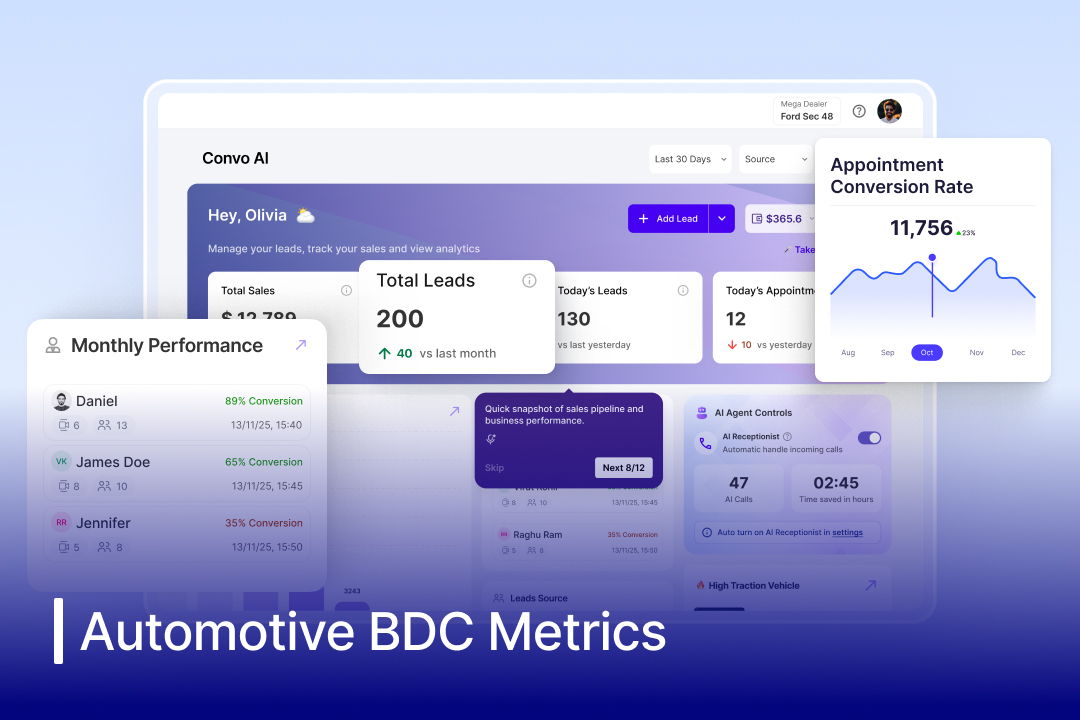

Want to grow your car dealership’s revenue in 2025? Start by tracking the right automotive BDC metrics. Today, over 60% of dealership leads come through digital or phone channels, making your Business Development Center (BDC) a key driver of sales. In fact, dealerships that actively track and optimize BDC performance metrics see up to 30% more appointments booked and 25% higher close rates. But without the right data, it’s impossible to know what’s working.
This guide breaks down the top automotive BDC metrics to track, along with practical tips to act on each number. You’ll see how to read performance signals correctly, fix weak spots in your process, and turn insights into daily execution, so teams can spot what drives sales and course-correct before opportunities go cold.
12 Key Automotive BDC Metrics That Drive Real Dealership Revenue
Your BDC controls the first real sales conversation, and that’s where momentum is either built or lost. The right automotive BDC metrics expose how quickly leads are worked, how effectively appointments are set, and where revenue slips away. Below are the 12 metrics that turn daily BDC activity into predictable dealership sales.
1. Lead Response Time
Lead Response Time measures how quickly your BDC contacts a new lead after it enters the system, via website forms, third-party marketplaces, chat, or inbound calls.
What to track:
- Average first response time (by source)
- Percentage of leads contacted within 5 and 10 minutes
- Missed or delayed responses during peak hours
How to improve it:
- Route digital leads instantly to available agents
- Use call and SMS automation during off-hours
- Flag slow-response lead sources inside the CRM
2. Appointment Set Rate/Inbound Appointment Conversion Rate
Appointment Set Rate tracks the percentage of contacted leads that result in a scheduled showroom or virtual appointment. It shows how effectively your BDC turns conversations into committed next steps.
What to track:
- Appointments set ÷ leads contacted
- Set rate by lead source (OEM, third-party, website, phone)
- Set rate by agent and shift
- Digital vs phone appointment conversion
How to improve it:
- Lead with availability and value, not price
- Use structured call automotive BDC phone scriptswith flexibility for buyer intent
- Review recorded calls where contact was made but no appointment was set
3. Appointment Show Rate
Appointment Show Rate measures how many scheduled appointments actually arrive. Using tools like an auto attendant phone systemcan help route calls efficiently and ensure customers receive reminders and confirmations without delay.
What to track:
- Show rate by agent and lead source
- Same-day vs future appointment show rate
- No-show patterns by day and time
How to improve it:
- Send confirmations via SMS and email immediately after booking
- Add reminder touchpoints 24 hours and 2 hours before the visit
- Train agents to set clear expectations on timing and duration
4. Outbound Contact Rate
Outbound Contact Rate measures how often your BDC successfully connects with leads during follow-up attempts. It reflects dialing strategy, timing, and message relevance.
What to track:
- Contacts made ÷ outbound attempts
- Contact rate by lead source and time of day
- Attempts made before first contact
- Contact rate by agent
How to improve it:
- Call within minutes of lead submission
- Rotate call times across mornings, afternoons, and evenings
- Pair calls with SMS and voicemail drops
- Prioritize high-intent leads in early attempts
5. Close Rate (BDC-Influenced)
Close Rate tracks the percentage of BDC-handled leads that result in a vehicle sale. This metric connects BDC activity directly to revenue.
What to track:
- Close rate by appointment type (walk-in, scheduled, virtual)
- Close rate by lead source
- Sold rate for shown vs no-show appointments
How to improve it:
- Focus on appointment quality, not volume
- Align BDC messaging with sales floor expectations
- Pass clean notes and customer context through the CRM
- Review sold vs unsold appointment patterns weekly
6. Call Answer Rate
Call Answer Rate measures how many inbound calls to your dealership are actually answered by the BDC. Missed calls often equal missed sales, making this a core operational metric.
What to track:
- Answered calls ÷ total inbound calls
- Missed calls by hour and day
- Average queue or hold time
- Overflow or abandoned calls
How to improve it:
- Staff BDC shifts based on call volume trends
- Use call routing and overflow rules during peak hours
- Reduce IVR friction and long hold times
- Track missed calls in real time, not after the fact
7. Average Talk Time
Average Talk Time reflects how long BDC agents spend on live conversations. The goal isn’t shorter calls, it’s productive ones that move buyers forward.
What to track:
- Average talk time by agent
- Talk time on connected vs unqualified leads
- Correlation between talk time and appointment set rate
- Calls under 60 seconds vs high-conversion calls
How to improve it:
- Coach agents on discovery, not scripts
- Identify ideal call-length ranges tied to appointments
- Review long calls that fail to convert
- Use call recordings for targeted coaching

8. CRM Usage & Data Quality
CRM usage and data quality measures how consistently BDC agents log activities, update lead statuses, and capture accurate customer information within the automotive CRM.
What to track:
- Percentage of leads with complete contact details
- Logged calls, texts, and emails per lead
- Timely status updates after each interaction
- Notes quality and handoff clarity to sales
How to improve it
- Make CRM updates part of the call workflow
- Standardize required fields for lead closure
- Audit CRM activity by agent weekly
9. Lead-to-Contact Ratio
Lead-to-Contact Ratio tracks how many incoming leads result in an actual conversation. It highlights lead quality and follow-up effectiveness.
What to track:
- Contacts made ÷ total leads received
- Contact rate by lead source
- Attempts required before first contact
- Contact ratio by response time tier
How to improve it:
- Score and prioritize high-intent leads
- Adjust follow-up cadence by source performance
- Refresh scripts for low-contact channels
- Eliminate low-quality lead providers
10. Appointment Confirmation Rate
Appointment Confirmation Rate measures how many scheduled appointments are actively confirmed before the visit. It sits between set rate and show rate and often predicts no-shows early.
What to track:
- Confirmed appointments ÷ total appointments set
- Confirmation success by channel (SMS, call, email)
- Time between booking and confirmation
- Unconfirmed appointments that result in no-shows
How to improve it:
- Trigger same-day confirmation messages automatically
- Use two-way SMS for quick replies
- Assign ownership for next-day confirmations
- Escalate unconfirmed appointments to priority follow-up
11. Outbound Attempts per Lead
Outbound Attempts per Lead tracks how persistently the BDC follows up before a lead goes cold. An automated lead follow-up system ensures the right balance between persistence and efficiency, without overloading reps or missing critical touchpoints.
What to track:
- Average attempts made before contact or closure
- Attempts by lead source and intent level
- Drop-off point where contact likelihood declines
- Attempts per agent per day
How to improve it:
- Set attempt benchmarks by source performance
- Use AI lead scoring for car dealerships to prioritize high-intent leads
- Front-load attempts within the first 72 hours
- Automate low-impact follow-ups to free agent time
12. Agent Productivity Rate
Agent Productivity Rate measures how effectively BDC agents convert their working time into meaningful outcomes, contacts, appointments, and shown visits. It separates busy activity from real output.
What to track:
- Contacts or appointments per agent per day
- Productive time vs idle or admin time
- Appointments set per hour worked
- Productivity by shift and tenure
How to improve it:
- Align schedules with peak lead and call volume
- Remove manual tasks through automation
- Coach based on outcome metrics, not activity volume
- Share top-performer workflows across the team
Old vs New Automotive BDC Metrics: What Dealers Should Be Tracking in 2026
Today, automation, real-time dashboards, and virtual BDC automotive models have reshaped how dealers track efficiency, accountability, and revenue impact, at speed and at scale. Below is a comparison of how automotive BDC metrics shifted from a fragmented, manual approach to a unified, performance-driven model.
| BDC Metric | Old Approach | 2026 Approach |
| Call Tracking | Calls logged manually with no insight into quality or outcome | Every inbound and outbound call tracked with source, duration, outcome, and agent impact in real time |
| Lead Response Time | Rarely measured or reviewed after delays | Measured in minutes, tracked live, and tied directly to conversion performance |
| Appointment Creation | Manually entered into spreadsheets or CRMs | Auto-created and synced across CRM and DMS without manual intervention |
| Appointment Show Rate | Confirmed through floor checks or assumptions | System-verified show data updated automatically in the DMS |
| Agent Productivity | Evaluated by call counts and availability | Assessed through contact rates, talk-time quality, follow-ups, and missed opportunities |
| Conversion Tracking | Limited visibility beyond lead-to-appointment | Tracked from first contact through appointment, sale, or service completion |
| Channel Performance | All leads treated equally regardless of source | ROI measured by channel, campaign, and lead source |
| Reporting Speed | Weekly or monthly reports pulled manually | Real-time dashboards supporting immediate action |
| Operational Scalability | Growth required additional headcount | Automation and virtual BDC models scale output without linear staffing increases |
8 Automotive BDC Tips for High-Impact Dealership Performance
To run a BDC that doesn’t just handle leads but accelerates sales and service appointments, dealerships need more than basic phone answer skills. These automotive BDC tips draw on proven strategies used by top dealership BDC teams to consistently improve conversion rates and customer satisfaction.
1. Master the Basics of Communication
Every effective BDC for car dealerships is built on how well conversations are handled, not how many calls are made. Before focusing on scripts or automation, BDC reps need a solid grip on communication fundamentals. Train your team to:
- Speak with clarity and intent, avoiding filler or over-explaining
- Ask the right questions and listen for buying signals or service urgency
- Keep a steady, professional tone that reflects the dealership’s brand
2. Create a Consistent, Time-Bound Follow-Up Process
Most leads don’t convert on the first touch, but many are lost due to inconsistent follow-up, this is where an AI receptionist for car dealerships helps enforce disciplined response windows and structured outreach sequences, while BDC reps stay focused on high-value conversations and conversion.
- Make first contact quickly and within dealership-set SLAs
- Follow a structured cadence across calls, texts, and emails
- Adjust messaging based on customer behavior and engagement
3.U se CRM as a Daily Operating System
In a modern virtual BDC automotive setup, the CRM should guide every action, not serve as a passive database. Reps need to be trained to work inside the system with discipline and intent. Ensure they know how to:
- Log every interaction with clear context and follow-up notes
- Schedule tasks based on lead source, intent level, and response timing
- Track appointment outcomes to improve future conversations
4. Build Strong Product and Dealership Knowledge
A BDC rep who sounds unsure creates friction before the customer ever reaches the showroom or service lane. For a high-performing BDC car dealership, agents must clearly understand what the dealership sells and how it operates. Train your team to:
- Stay current on inventory, trims, pricing ranges, and lead times
- Communicate OEM offers, dealership incentives, and service packages accurately
- Explain next steps without transferring calls unnecessarily
5. Track the Right BDC Metrics That Influence Revenue
Volume alone doesn’t reflect BDC performance. High-performing dealership BDC teams focus on metrics that directly impact sales and service outcomes. Train managers and reps to monitor:
- Response time by lead source
- Appointment set, show, and sold rates
- Contact-to-conversion trends across sales and automotive service BDC leads
6. Train Reps to Handle Objections Without Losing Control
Objections are part of every BDC conversation, but untrained responses often derail momentum. Using good virtual receptionist services, concerns can be acknowledged better without conceding the appointment. Coach your team to:
- Recognize common objections around price, timing, and availability
- Respond with reassurance and clarity instead of defensiveness
- Redirect the conversation back to the value of the next step
7. Focus on Setting Appointments, Not Closing Deals
The BDC’s job isn’t to sell vehicles over the phone, it’s to earn the next step. An AI sales assistant supports high-performing BDC car dealership teams by handling early qualification and consistency, while reps keep conversations centered on scheduling, not negotiating. Reps should be trained to:
- Identify intent and transition smoothly toward an appointment ask
- Avoid price debates that belong on the showroom floor
- Reinforce the value of visiting the dealership or booking service
8. Coach Continuously Using Real Call and Lead Data
One-time training doesn’t move the needle for a BDC car dealership. Ongoing coaching, grounded in real performance data, does. The strongest dealership BDC teams build feedback loops that are frequent, specific, and tied to outcomes. Managers should focus on:
- Reviewing recorded calls to identify patterns, not just mistakes
- Coaching based on lead quality, response timing, and appointment results
- Using individual metrics to tailor training for each rep
How to Start Tracking Automotive BDC Metrics in 30 Days?
Knowing the right automotive BDC metrics doesn’t help until someone actually puts a baseline number on the board. Most dealerships try to fix everything in the same week and end up with a dashboard nobody trusts a month later. This plan runs four weeks: measure honestly, fix the single worst leak, build a scorecard the team actually looks at, then lock in targets management can defend. None of it requires new software before day one.
- Week 1: Set the baseline. Pull 90 days of CRM and phone data and calculate current numbers for lead response time, set rate, show rate, and call answer rate before changing anything. Automotive BDC metrics are only useful once there’s an honest starting point to measure against.
- Week 2: Fix the single biggest leak. Most stores find it in one of two places, leads sitting unworked for the first twenty minutes, or appointments going unconfirmed until the day of the visit.
- Week 3: Build the scorecard. Put lead response time, set rate, show rate, and cost per appointment on a dashboard every agent can see, updated daily rather than reviewed once a month.
- Week 4: Lock in targets and coach to them. Set 90-day targets based on your own baseline rather than an industry average, and run weekly one-on-ones built around the scorecard.
Which Automotive BDC Metrics Change When AI Handles Part of the Call Volume?
Dealerships layering AI into the BDC need four additional numbers, because “calls handled” alone can’t say whether the automation is working or just failing faster.
- Automation rate: the share of interactions resolved completely, scheduled, answered, or completed, without a human joining the call
- Response latency: how fast the system picks up, with top platforms answering in under 5 seconds
- Escalation accuracy: whether a handoff to a human arrives with real context and reaches the right department
- Booking integrity: whether the appointment lands correctly in the DMS and CRM, with no double-bookings or mismatched service codes
Dealerships evaluating an AI BDC handling both sales and service calls should measure these four separately for each department, since a platform that books sales appointments well can still mishandle a service scheduling request built on different rules.
What Compliance Metrics Belong Next to Your BDC Dashboard?
Compliance tracking belongs on the same dashboard as automotive BDC metrics, not filed away separately. If the BDC texts leads or runs an AI voice system, track consent documentation, opt-out rate, and time-to-honor opt-outs alongside performance numbers. The FCC has clarified that AI-generated voices used in outbound calls fall under the same TCPA rules as prerecorded calls, and consent requirements have shifted more than once in recent years. This isn’t legal advice, so confirm current requirements with dealership counsel before scaling any outbound AI voice program.
How Vini AI Improves These Automotive BDC Metrics?
BDC performance often dips due to delayed responses, missed calls, and inconsistent follow-ups. When these gaps add up, even efficient and well-staffed teams find it hard to sustain strong automotive BDC metrics. With Vini, its conversational AI built for dealership BDC workflows, inbound calls and leads are handled instantly, consistently, and without downtime. Below is how it helps:
- Cuts response time to seconds: Vini answers every call immediately, eliminating missed calls that inflate response-time metrics and kill appointment potential.
- Improves call-to-appointment ratios: Structured, goal-driven conversations guide callers toward bookings instead of open-ended chats.
- Acts as a scalable automotive answering service: After-hours, weekends, and overflow calls are handled without hiring additional staff.
- Increases lead qualification accuracy: Intent, budget signals, and vehicle interest are captured upfront, helping BDC reps prioritize faster.
- Reinforces consistent phone handling: Vini applies best-practice automotive phone training logic on every call, no script drift, no fatigue.
- Boosts show rates through follow-ups: Automated confirmations and reminders reduce no-shows tied to poor post-call engagement.
- Creates cleaner BDC reporting: Every interaction syncs into the CRM, making metrics like response time, appointment set rate, and close rate easier to track and optimize.

Closing Thoughts
Strong BDC performance comes down to visibility. When automotive BDC metrics like response time, lead-to-appointment ratios, and close rates are tracked consistently, gaps surface quickly and follow-ups are quicker.
Whether the operation is internal or supported externally, consistent KPI tracking keeps the system accountable. Spyne steps in as a strategic partner, with Vini, its AI call agent, bringing structure, speed, and reliability to every customer interaction. If you want a clearer view of performance and faster conversions, book a demo and see how Spyne helps drive sales and engagement.