
| Executive Summary: The best conversational AI platform for a car dealership depends on the operational problem the store needs to solve. Vini AI by Spyne is designed for omnichannel sales, service, and BDC conversations, while Numa specializes heavily in fixed ops, Podium combines AI with dealership communications, Fullpath connects lead handling with customer data, and Mia focuses on dealership phone and text automation. Dealers should compare platforms by automotive specialization, system actions, integration depth, sales and service coverage, human handoff, and measurable dealership outcomes rather than judging conversation quality alone. |
Conversational AI has become an operational dealership category rather than another website-chat feature. CDK reported in 2026 that AI adoption among dealerships increased from 28% to 39% in one year, while Pied Piper found 51% of auto dealers now deliver a “perfect” web-lead response through faster, multichannel communication. The harder question is now which AI actually fits the dealership. This guide compares leading automotive conversational AI platforms across channels, dealership integrations, system actions, sales and service workflows, handoffs, and published automotive evidence so dealers can build a practical shortlist.
What Makes a Conversational AI Platform ‘Dealership-Ready’?
Before comparing individual platforms, it helps to understand what separates automotive-grade conversational AI from generic chatbot tools.
A dealership-ready platform should cover five non-negotiable areas:
- First, it needs automotive-specific NLP, the AI must understand terms like RO, CSI, VDP, trade-in, and be able to discuss inventory details like trim, mileage, and pricing from live data.
- Second, it needs deep integration with your DMS (CDK, Reynolds, Tekion) and CRM (VinSolutions, DealerSocket, Salesforce) so that every interaction updates your systems in real time.
- Third, it should offer true omnichannel support across phone, SMS, web chat, and email, not just one channel.
- Fourth, it should handle both sales and service workflows, since dealerships that automate only one department leave major revenue on the table.
- And fifth, it should provide 24/7 coverage without relying on after-hours answering services or overflow BDC providers.
Generic chatbot builders (Tidio, HubSpot chat, Drift) can handle basic website queries but fall short on inventory-aware conversations, appointment booking into DMS schedulers, and voice AI for phone calls. That distinction matters when the goal is recovering lost revenue, not just deflecting FAQs.
What Are the Best Conversational AI Platforms for Car Dealerships in 2026?
The leading conversational AI platforms dealers should evaluate in 2026 include Vini AI by Spyne, Mia, Podium, Numa, Fullpath, STELLA Automotive AI, Conversica, Gubagoo, and ActivEngage. They compete in the same broad category, but each approaches dealership conversations differently.
| Platform | Best For | Core Channels | Sales | Service | Operational Strength |
| Vini AI by Spyne | Omnichannel sales, service, and BDC automation | Voice, SMS, chat, email | Yes | Yes | Qualification, appointments, follow-up, routing, dealership-system workflows |
| Mia | Automotive voice AI across dealership departments | Voice, text | Yes | Yes | Reception, appointment booking, inbound and outbound conversations |
| Podium / Jerry | Consolidating dealership communications and AI BDC workflows | Phone, SMS, web chat, email, social | Yes | Yes | Lead response, test drives, scheduling, follow-up |
| Numa | High-volume fixed ops and customer communication | Voice, text and AI inbox workflows | Yes | Strong | Service scheduling, DMS context, CSI and follow-up |
| Fullpath | Data-driven lead handling and customer activation | SMS, email, voice | Strong | Yes | CDP-powered lead handling, CRM workflows, appointments |
| STELLA Automotive AI | Voice-first sales and service automation | Voice and omnichannel outreach | Yes | Strong | Call handling, service appointments, routing and outreach |
| Conversica | Persistent lead, service, and F&I nurturing | Digital conversations and follow-up | Yes | Yes | Lead qualification, nurture, re-engagement |
| Gubagoo | Automotive website conversations with AI-human flexibility | Website chat and messaging | Yes | Yes | Inventory conversations, chat engagement and handoff |
| ActivEngage | Human-led customer engagement enhanced by AI | Chat, messaging and AI-assisted communication | Yes | Limited | Managed conversations, summaries, reception and human engagement |
This is a shortlist rather than a numerical ranking. A Fixed Ops Director struggling with unanswered service calls should weight capabilities differently from a BDC Director managing internet leads across several rooftops.
Dealers comparing the wider category can also use Spyne’s AI for dealerships buyer’s guide to evaluate costs, implementation, ROI, and broader dealership AI requirements.
Dealer takeaway: Conversational AI should be evaluated by what happens after the customer asks a question. The strongest systems connect conversation, dealership data, system actions, appointment workflows, employee handoff, and reporting instead of stopping once the AI generates a response.
How Did We Compare Conversational AI Platforms for Dealerships?
Dealership conversational AI should be compared by operational capability, not by the number of AI features listed on a product page. For this article, platforms were reviewed using publicly available automotive product documentation, integration information, dealership use cases, and published vendor evidence available in August 2026.
1. Automotive Specialization
The AI should understand dealership workflows rather than operate like a generic contact-center agent. Inventory availability, VINs, sales appointments, service scheduling, trade-ins, recall requests, ROs, CRM records, and department routing all create automotive-specific context.
2. Channel Coverage and Continuity
Phone, SMS, website chat, and email coverage matter, but channel count is only the starting point. Dealers should ask whether customer context survives when someone starts on the website, continues by text, and later calls the store.
Dealerships specifically evaluating phone automation can compare the requirements in Spyne’s AI call bot for car dealerships feature guide.
3. Sales and Service Workflow Coverage
A platform saying it supports automotive does not prove equivalent depth across departments. Dealers should separately test lead qualification, test-drive appointments, service scheduling, rescheduling, recall outreach, missed-call recovery, status requests, and long-term follow-up.
4. CRM, DMS, Inventory, and Scheduler Integration
The number of integration logos matters less than what the integration enables. Buyers should determine which records the AI can retrieve, which fields it can update, whether inventory is current, and whether scheduling occurs inside the dealership’s system of record.
5. Ability to Take Dealership System Actions
Operational conversational AI should be able to do more than answer a question. Depending on the use case, dealers should test whether the platform can:
- create or modify appointments;
- retrieve live inventory or customer context;
- update CRM notes and lead records;
- route customers to the correct employee or rooftop;
- initiate follow-up;
- preserve conversation transcripts and outcomes;
- cancel or reschedule appointments without creating duplicates.
The useful question during procurement is therefore not “Do you integrate with our CRM?” It is “Exactly what can your AI read, write, create, and change inside our CRM?”
For a deeper procurement framework, use Spyne’s AI vendor evaluation checklist for car dealerships.
6. Human Handoff and Escalation
An automotive AI needs clear boundaries. The system should identify when a salesperson, service advisor, BDC agent, or manager must take over and transfer enough conversational context that the customer does not restart the interaction.
7. Multi-Rooftop Controls
Dealer groups require separate inventories, schedules, operating hours, departments, offers, escalation rules, and staff routing across locations. Central reporting should coexist with rooftop-specific controls.
Spyne covers these requirements in more detail in How Dealer Groups Govern AI Across Multiple Rooftops.
8. Reporting and Quality Assurance
Conversation volume is not sufficient. Dealer managers need visibility into response time, contact rate, appointments set, escalation frequency, resolution, shows, service bookings, inaccurate responses, and failures after handoff.
9. Published Automotive Evidence
Named dealership deployments, product documentation, case studies, OEM programs, and quantified performance help buyers separate production products from impressive demos. Vendor-reported results are useful evidence, but dealers should still reproduce the outcome inside their own store.
10. Security, Compliance, and Governance
AI can touch calls, customer records, consent data, appointment systems, and CRM information. Dealers should examine user permissions, recording practices, audit trails, data handling, outbound communication controls, and processes for reviewing problematic AI interactions.
Best Conversational AI Platforms for Automotive Dealers
Before we break down each platform, here’s a quick look at how the top conversational AI tools compare based on real dealership use cases, integrations, and outcomes.
1. Vini AI by Spyne: Best for Omnichannel Sales, Service, and BDC Workflows
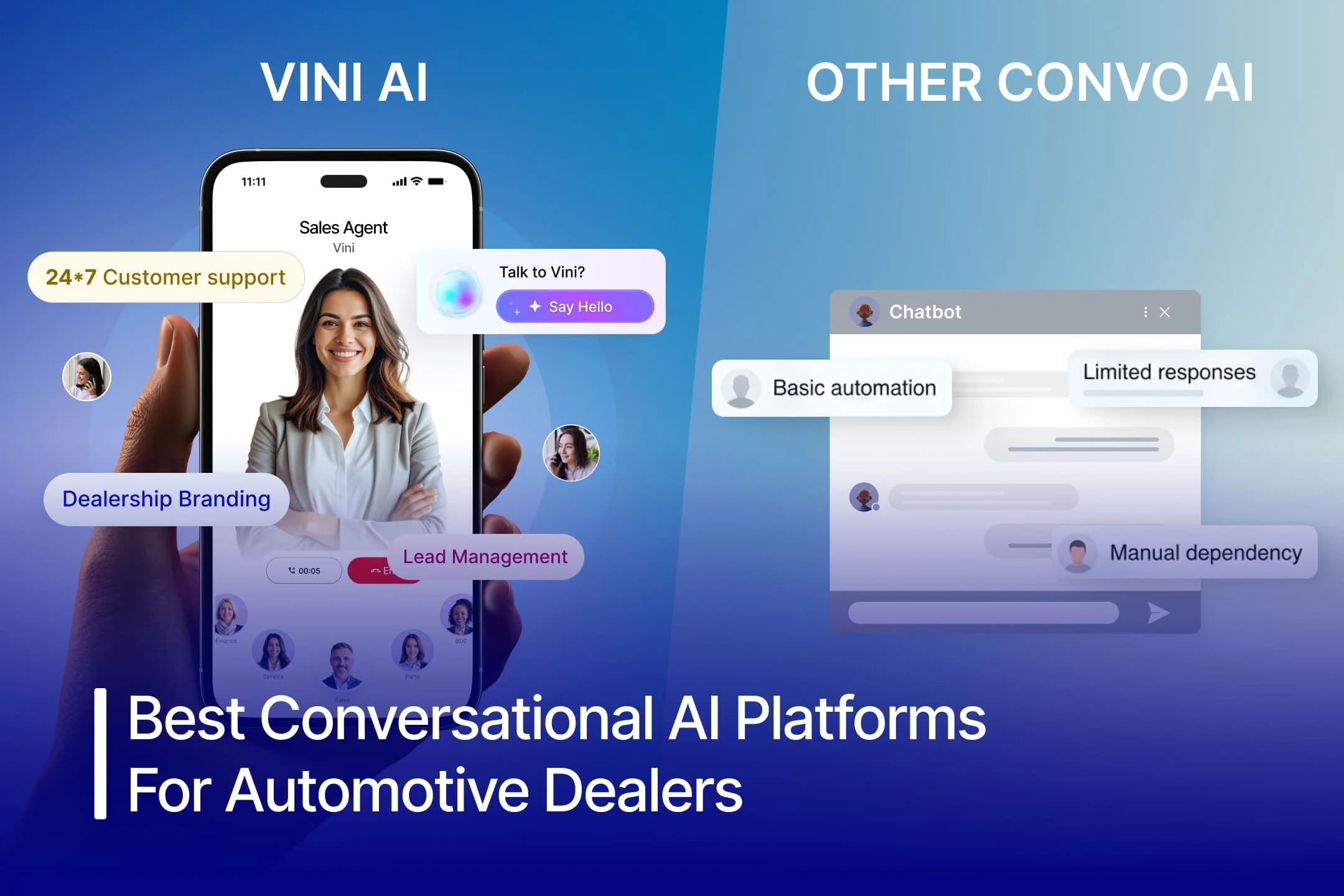
Vini AI by Spyne is automotive conversational AI designed around dealership interactions across sales, service, BDC, parts, and finance. Vini AI supports customer conversations across voice, SMS, chat, and email while connecting interactions with dealership data and workflows.
Vini AI can capture and qualify leads, use inventory and customer information to personalize conversations, handle appointment-related requests, route high-intent customers, follow up, and synchronize interaction data with CRM workflows. Spyne also positions Vini AI across both inbound and outbound use cases rather than limiting it to an AI receptionist.
That broader coverage is particularly relevant when a dealership wants to avoid creating separate automation layers for sales inquiries, BDC overflow, service calls, and outbound follow-up.
Dealers focused specifically on phone workflows can also review Spyne’s AI call bot for car dealerships, while stores evaluating broader lead-management capacity can use the 2026 BDC software guide.
Best fit: Dealerships and dealer groups seeking one conversational AI layer across customer-facing departments.
What to test: Required CRM, DMS, inventory, scheduling, routing, outbound, and human-handoff workflows using the store’s own systems.
2. Mia: Best for Automotive Voice AI Across Reception, Sales, and Service
Mia describes itself as an automotive AI platform for customer conversations across dealership departments. Its official site highlights inbound and outbound communication, reception, appointment booking, multilingual conversations, and centralized workflow management.
Mia’s reception product integrates with systems including CDK, Tekion, VinSolutions, Reynolds & Reynolds, Dealertrack, vAuto, and Xtime to retrieve information and book appointments. Its GM-specific page reports 35+ dealership system integrations, more than 300,000 GM conversations handled, and more than 46,000 GM appointments booked. These figures are vendor-reported.
Mia has also expanded into outbound voice and text campaigns for service-due customers, recalls, reminders, and inactive customers.
Best fit: Dealers prioritizing phone automation while wanting one automotive AI product across reception, sales, and service.
What to test: Cross-channel continuity, department-specific scheduling rules, outbound governance, and write-back for the dealership’s exact stack.
3. Podium / Jerry: Best for Combining AI With Dealership Communications
Podium positions Jerry as an AI employee covering dealership sales and service while connecting phones, messaging, CRM workflows, and DMS data. Jerry can respond to calls and digital leads, qualify prospects, use inventory context, schedule appointments, and support follow-up.
Its Sales AI documentation says conversations, appointments, and notes can flow into the CRM, with 24/7 test-drive booking and proactive database follow-up. These are Podium’s own product and performance claims.
The strongest fit is therefore broader than AI phone answering. Podium becomes relevant when a dealership wants conversational AI sitting inside a larger communications environment.
Best fit: Dealers looking to consolidate AI lead handling, phones, messaging, follow-up, and customer communication.
What to test: CRM/DMS actions, ownership of communication data, escalation logic, and whether the wider communications stack is necessary for the store.
4. Numa: Best for Fixed Ops Communication and Service Workflows
Numa positions itself as an AI operating system for dealerships, with particularly deep emphasis on service operations, Voice AI, Smart Inbox, DMS context, appointment scheduling, and customer experience management.
Numa says more than 1,300 rooftops use its products and reports more than 1 billion calls and texts handled. Its Voice AI can use DMS information to recognize customers, understand service context, book against live availability, and write appointments back into the DMS. These figures and results are vendor-reported.
Best fit: Franchise stores and dealer groups with heavy service-call volume, advisor communication bottlenecks, missed appointments, and CSI concerns.
What to test: DMS coverage, service scheduling rules, RO context, status-request handling, outbound follow-up, and sales-side depth if both departments need the system.
5. Fullpath: Best for AI Lead Handling Connected With Dealership Customer Data
Fullpath’s Lead Handling Agent combines dealership CRM, customer-profile, inventory, and CDP information to engage incoming leads through SMS and email, qualify shoppers, nurture them, and work toward appointments.
The product supports configurable escalation rules, conversation takeover, AI summaries, and CRM updates. Fullpath states that qualified appointments can be pushed into the CRM, while its Voice Agent handles incoming dealership phone calls and can work sales and service requests.
Best fit: Dealerships prioritizing AI lead handling connected closely with customer data, inventory, CRM workflows, and broader marketing activation.
6. STELLA Automotive AI: Best for Voice-First Dealership Automation
STELLA positions itself as automotive conversational AI designed to answer calls around the clock, personalize phone conversations, automate service interactions, and support dealership communication without adding equivalent staffing capacity.
Its current positioning emphasizes 24/7 first-ring answering, customizable messaging and transfers, omnichannel outreach, and automotive-native conversation handling. STELLA’s solution overview also describes AI-led interaction across dealership customer touchpoints.
The product is particularly relevant for dealerships where inbound phone demand and service appointment handling are central problems rather than secondary communication channels.
Best fit: Stores prioritizing voice automation, call coverage, service scheduling, reception, and outbound customer communication.
What to test: Exact DMS scheduler actions, handling of complex service questions, live transfers, department routing, and continuity after a customer leaves the voice channel.
7. Conversica: Best for Persistent Sales, Service, and F&I Follow-Up
Conversica’s automotive AI Agents focus on engaging, qualifying, and following up with dealership customers across sales, service, and F&I workflows.
Its automotive offering includes dealership-specific logic for service intervals, trade-ins, inventory questions, scheduling, and follow-up. Conversica also lists integrations with DealerSocket, CDK, VinSolutions, CRM, calendar, and DMS workflows.
Conversica says its automotive products power conversations for 1,000+ dealer teams, making it one of the more established products in persistent dealership lead engagement. This is vendor-reported scale.
Best fit: Dealerships with large lead databases, internet-lead backlogs, service retention outreach, F&I opportunities, or prospects requiring longer nurture cycles.
What to test: Inbound voice requirements, lead-source rules, CRM status management, handoff triggers, and how the platform stops outreach when dealership staff take over.
8. Gubagoo: Best for Automotive Website Conversations and AI-Human Handoff
Gubagoo’s GubaIQ remains focused heavily on dealership website conversation and automotive digital engagement. Its official product page describes detailed vehicle questions, comparisons, inventory-rich chat experiences, and support for more than 120 languages.
Gubagoo also combines AI with human conversation management. Its AI Handoff feature allows dealership teams to move an active conversation between a human agent and GubaIQ, giving staff flexibility to handle high-value or complex discussions while returning routine engagement to AI.
That model is useful for stores that still see website chat as an important digital sales channel but want AI to reduce the workload behind it.
Best fit: Dealers prioritizing website conversion, inventory conversations, digital retail engagement, and flexible human takeover.
9. ActivEngage: Best for Human-Led Engagement Enhanced by AI
ActivEngage takes a deliberately different approach to dealership conversational AI. Its AI Suite is positioned around enhancing human customer communication rather than handing the full interaction to autonomous agents.
Its 2026 offering includes an AI Receptionist, AI conversation summaries, language translation, and AI-supported messaging while keeping live engagement experts central to many customer interactions.
ActivEngage’s official messaging product also emphasizes managed customer engagement across dealership digital channels.
Best fit: Dealers that want AI assistance and automation but still prefer humans to handle important digital selling conversations.
What to test: Which stages remain human-managed, after-hours coverage, escalation speed, appointment ownership, reporting, and total cost of the managed-service component.
Which Conversational AI Platform Is Best for Different Dealership Use Cases?
The best conversational AI vendor changes when the dealership problem changes. A single-store service department, centralized dealer-group BDC, and high-volume internet sales team should not use identical procurement criteria.
| Dealership Need | Platforms to Evaluate |
| Omnichannel sales + service coverage | Vini AI, Podium, Mia |
| Sales and BDC lead response | Vini AI, Fullpath, Podium, Conversica |
| Service calls and scheduling | Vini AI, Numa, STELLA, Mia |
| Automotive voice AI | Vini AI, Mia, STELLA, Numa |
| Persistent lead nurturing | Conversica, Fullpath, Vini AI |
| Website chat | Gubagoo, Vini AI |
| Human-led digital engagement | ActivEngage, Gubagoo |
| Dealer-group operations | Vini AI, Numa, Podium, Mia |
| Outbound follow-up | Vini AI, Mia, Conversica, Podium |
| BDC overflow and after-hours | Vini AI, Podium, Numa, Mia |
The buying decision also needs to reflect how dealership responsiveness is changing. Pied Piper’s 2026 Internet Lead Effectiveness study, based on inquiries to 3,290 dealership websites, found that 51% of dealers delivered a “perfect response,” twice the rate recorded five years earlier. Texting to answer shopper questions rose from 38% to 54% in one year.
Dealers therefore are not comparing AI against the response standards of 2021. They are comparing it against competitors increasingly using multichannel automation.
For stores specifically evaluating whether AI should supplement their BDC, Spyne’s BDC software guide for dealerships explores that operating model separately.
How Should Dealers Compare Conversational AI Vendors?
Dealers should compare conversational AI vendors through standardized dealership scenarios and measurable outcomes instead of letting each vendor define its own demonstration.
Pied Piper’s 2026 research demonstrates why this matters. Although automation improved lead response overall, the study found that when automated responses required employee involvement, customer questions were twice as likely to go unanswered. Automation can therefore improve the first touch while exposing weaknesses further downstream.
A practical dealership scorecard should evaluate:
| Evaluation Area | What the Dealer Should Measure |
| Business outcomes | Qualified opportunities, appointments, shows, sales, ROs |
| Conversation quality | Accuracy, context retention, intent recognition, objection handling |
| Integration | CRM/DMS read-write, inventory, scheduler, lead status |
| System actions | Booking, rescheduling, routing, CRM update, follow-up |
| Channel coverage | Voice, SMS, chat, email, inbound and outbound |
| Human handoff | Transfer reliability, context retention, ownership |
| QA | Incorrect answers, unresolved conversations, escalation review |
| Governance | Store rules, permissions, compliance, multi-rooftop controls |
| Economics | Cost per incremental appointment, show, sale, or RO |
Dealers wanting the full procurement process can use Spyne’s dealership AI vendor evaluation checklist rather than expanding this category comparison into a second buyer’s guide.
Evaluation takeaway: The most useful conversational AI KPI is rarely “conversations handled.” Dealers should follow the entire chain from lead or call through appointment, show, sale or RO, including whether the AI correctly updated dealership systems and whether a human completed the work after escalation.
What Should a Dealership Test During an AI Demo?
A dealership should deliberately try to break the AI during a demo because scripted success scenarios reveal very little about production performance.
Give every shortlisted vendor the same tests:
- Ask about a VIN that was sold earlier that day.
- Ask for a similar vehicle at another rooftop.
- Change vehicles halfway through the conversation.
- Change an appointment time after it is confirmed.
- Move from a sales inquiry to a service request.
- Ask about a payment the AI should not invent.
- Request a manager immediately.
- Attempt to create a duplicate appointment.
- Ask the AI to continue the conversation on another channel.
- Submit an opt-out request.
- Call after hours with an urgent but non-emergency service question.
- Inspect the CRM, DMS, scheduler, transcript, and employee notification afterward.
Car Wars’ phone benchmarks shaping 2026 were based on thousands of dealerships and found that nearly one-third of dealership calls were lost before a conversation began. Better conversational AI should reduce that loss without introducing another failure downstream.
How to Choose the Right Platform for Your Dealership?
The right choice depends on your dealership’s primary pain point and operational profile.
- If your biggest problem is missed calls and after-hours coverage: Any of the top platforms will help here, but Spyne (Vini), Numa, and STELLA have the strongest inbound call coverage stories. Vini and Numa both offer 24/7 coverage across multiple channels; STELLA excels specifically at phone-based appointment booking.
- If you need full-funnel coverage (sales + service + parts + finance): Spyne (Vini) is the most comprehensive single-platform option, covering all four departments with dedicated agent types. DealerAI also covers multiple departments through its generative AI approach.
- If text/SMS is your primary engagement channel: Matador is the strongest SMS-first platform with the deepest automation library for text-based workflows.
- If you want voice AI that sounds the most natural: Numa, Mia, and Toma all emphasize voice quality and natural conversational flow. Toma’s per-dealership customization gives it an edge on personalization.
- If you also need merchandising and visual tools: Spyne is one of those platforms that combines conversational AI with vehicle photography, car tours, and listing automation. Spyne’s advantage here is that Vini and Studio AI share the same ecosystem, so inventory data flows seamlessly into conversations.
- If you’re an enterprise group or OEM: Matador, and Spyne all serve enterprise-scale operations. Matador has the deepest SMS automation for large groups whereas Spyne offers the broadest single-platform coverage.
What KPIs Should You Track After Implementing Conversational AI?
To measure real impact, dealerships should focus on metrics tied directly to revenue, responsiveness, and operational efficiency:
- Inbound Coverage Rate (%): Percentage of calls, chats, and messages answered. Top platforms aim for near 100% coverage.
- Speed-to-Lead (Response Time): Time taken to respond to new inquiries. Faster responses (within seconds) significantly improve qualification rates.
- Lead-to-Appointment Conversion Rate: How many inquiries turn into booked test drives or service visits. A key indicator of AI effectiveness.
- Appointment Show Rate (%): Tracks how many booked appointments actually show up, influenced by reminders and follow-ups.
- Conversation-to-Lead Qualification Rate: Percentage of interactions that turn into qualified leads with clear intent and next steps.
- ROI (Revenue vs Cost): Revenue generated from AI-driven appointments and conversions compared to platform cost, typically visible within 60–90 days.
Common Mistakes Dealerships Make with Conversational AI
Adopting conversational AI can unlock significant gains, but many dealerships underperform because of how the technology is implemented, not the platform itself. These are the most common mistakes seen across deployments.
- Treating AI Like a Basic Chatbot (Not a Revenue System)
Many dealerships deploy conversational AI as a website chatbot instead of integrating it into core sales and service workflows. This limits it to answering FAQs instead of qualifying leads, booking appointments, and driving revenue. High-performing stores use AI as an extension of their BDC, not a support widget. - Ignoring CRM and DMS Integration Depth
A common failure point is choosing tools with shallow or one-way integrations. If the AI cannot read and write data in real time (inventory, customer history, appointments), conversations become generic and disconnected. Research across dealership tech stacks shows that poor data sync leads to missed follow-ups and lower conversion rates. - Automating Only One Department (Sales or Service)
Some dealerships deploy AI only for sales leads or only for service calls. This creates gaps in coverage and leaves revenue on the table. Industry benchmarks show that service departments often handle a significant share of inbound calls, ignoring them reduces the total ROI potential of AI adoption. - Not Defining Clear KPIs Before Implementation
Without tracking metrics like speed-to-lead, lead-to-appointment conversion, and inbound coverage, dealerships struggle to measure impact. According to widely cited industry research (including Harvard Business Review findings on response time), faster responses significantly improve lead qualification odds, but only if tracked and optimized. - Overlooking Training and Customization
Conversational AI is not “set and forget.” Dealerships that don’t train the AI on their inventory, pricing, tone, and workflows often end up with generic or inaccurate responses. Platforms perform best when configured to reflect dealership-specific processes and real-time data. - Poor Human Handoff and Escalation Setup
AI cannot and should not handle every conversation. A critical mistake is failing to define when and how conversations are transferred to human staff. Without seamless handoff (with full context), customers repeat themselves, leading to frustration and drop-offs. Best-performing dealerships treat AI and human teams as a coordinated system, not separate channels.
Where Does Vini AI Fit Among Dealership Conversational AI Platforms?
Vini AI fits most naturally when a dealership wants one automotive conversational layer spanning customer acquisition, inbound communication, service, BDC coverage, and outbound follow-up.
Spyne’s Vini conversational AI product page shows dedicated use cases across sales, service, BDC, parts, and finance, including lead qualification, personalized responses, appointment workflows, CRM synchronization, and follow-up.
Dealers can go deeper into individual workflows through:
- AI call bot for car dealerships for inbound and outbound phone automation;
- AI voice agents for dealership sales teams for sales-call workflows;
- AI outbound calling for dealerships for CRM reactivation and proactive campaigns;
- how AI reduces service advisor overload for fixed ops;
- how dealerships prevent duplicate AI follow-up for omnichannel coordination.
The key evaluation question remains operational: can Vini AI complete the exact sales and service workflows your dealership needs against your current stack? That should be tested with real dealership scenarios during the pilot rather than inferred from a feature checklist.
Why Choose Spyne for Automotive Operations?
Spyne is particularly well-suited for independent and mid-sized dealerships that want enterprise-level visual merchandising without the enterprise-level cost or complexity. If you’re currently juggling multiple tools for photos, editing, and listing management, or if your time-to-market is measured in days rather than minutes, Spyne’s unified approach eliminates that fragmentation.
For larger groups, Spyne’s API and DMS integrations allow it to plug into existing workflows at scale, and the AI-driven consistency means every rooftop produces the same quality of output regardless of staff turnover or skill level.

Final Take
Conversational AI selection in 2026 should come down to operational fit, not which vendor produces the most impressive scripted conversation. CDK reports that AI usage has reached 39% of dealerships, while Pied Piper’s 2026 research shows multichannel response quality is improving quickly across the industry. That raises the standard for every store. Dealers should shortlist vendors around a specific problem, test them against identical sales and service scenarios, inspect system write-back and handoffs, and measure appointments, shows, sales, and ROs against a baseline. Book a demo with Spyne to see how Vini AI handles your dealership’s real customer workflows.