
An AI scheduling assistant is becoming essential in the modern business landscape, where customers demand quick answers. Today, these customers make appointments via websites, chat, text, and phone calls at any time of the day. Several studies in the industry also indicate that the speed of response is directly related to the conversion rates. The lesser the time between the inquiry and confirmation, the more the chances of getting the booking. However, in most business environments, coordination of schedules is still done manually. During the rush times, calls are not answered, and enquiries wait in inboxes. This is exactly where an AI scheduling assistant helps by eliminating the delay between intent and confirmation.
These tools help automate booking processes, optimize calendar management, and enhance your team’s overall productivity 24 hours a day, seven days a week. In this blog, we walk you through the 12 best-performing AI scheduling assistants in detail, what works best to suit your domain workflows, and why scaling businesses are choosing automated booking systems to boost productivity and drive revenue.
What is an AI Scheduling Assistant?
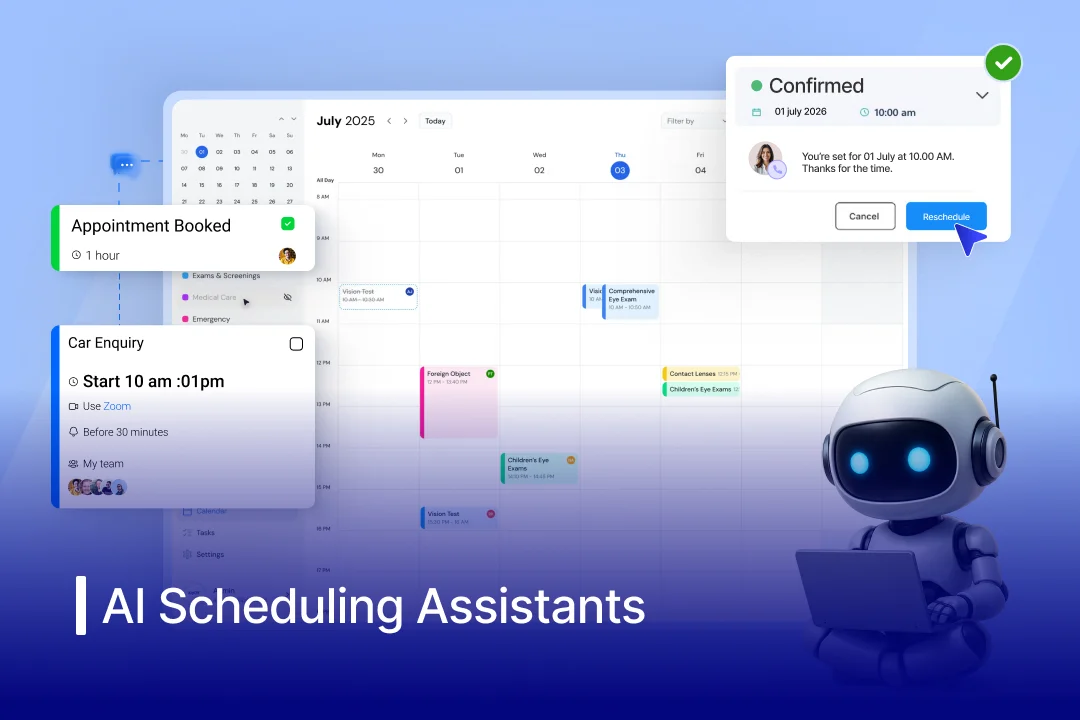
An AI scheduling assistant is a software designed to automate appointment booking, calendar coordination, and planning workflows using artificial intelligence. Acting as a virtual assistant, it uses Natural Language Processing (NLP) to understand queries, detect user preferences, and take action accordingly.
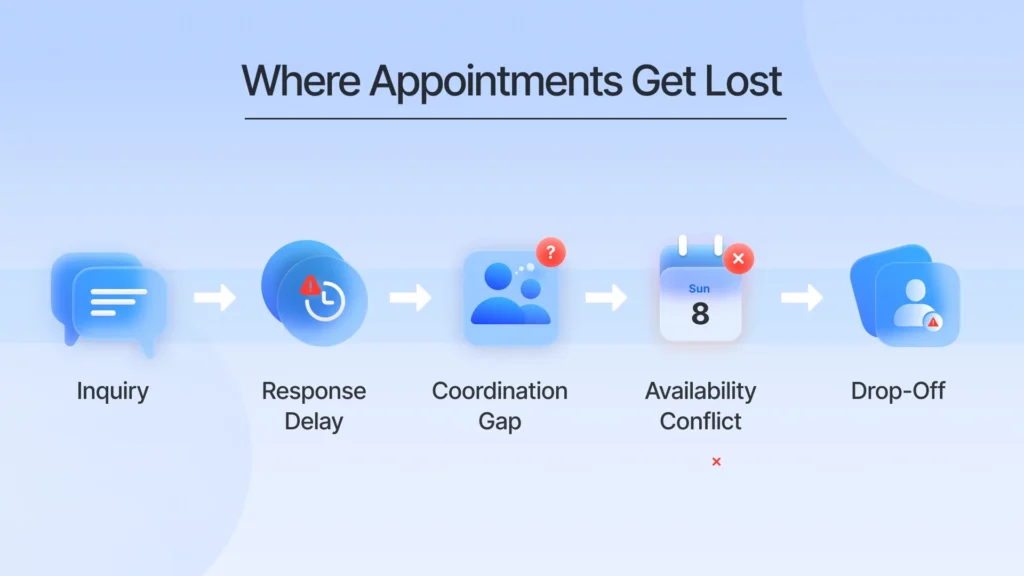
Unlike traditional calendar tools that simply display availability, an AI scheduling assistant actively manages the entire appointment process. It captures booking requests, checks real-time availability, confirms appointments, sends reminders, and updates connected systems without manual intervention.
Having an AI booking system helps businesses execute a structured, automated booking process, boosting response speed, protects opportunity, and supporting team productivity at scale.
Top 12 AI Scheduling Assistants: Based on Core Capabilities
Choosing the right AI scheduling assistant depends on what your team needs most: whether it is conversational booking, calendar automation, deep CRM integration, or sales workflow routing. Below are some of the top AI scheduling assistants out there, categorized by domain strength and use case.
1. Spyne’s Vini: Conversational AI Scheduling for Customer-Facing Workflows
Vini is built for teams that engage directly with customers rather than internal meeting coordination. Unlike generic schedulers, Vini makes conversations actionable: capturing requests via voice, chat, SMS, and web forms, and converting them into confirmed appointments without manual intervention.
Core features include:
- Conversational appointment booking times across voice, chat, and automotive text messaging
- Real-time availability checks and CRM updates
- Automated reminders and rescheduling workflows
- Intelligent routing based on business rules
- Deep integration with sales and service systems
This AI scheduling assistant is ideal for customer-centric businesses where missed calls directly affect revenue. Its scheduling logic aligns with dealership workflows rather than internal meeting management.

While many productivity-oriented schedulers focus only on internal meetings, Vini focuses on both outbound and inbound customer interactions: reducing missed appointments and increasing confirmed bookings by engaging users the moment they express intent.
2. Chili Piper: Scheduling for B2B Sales Ops
Chili Piper stands out for high-velocity inbound sales teams where leads arrive through forms, inbound inquiries, or SDR outreach. It routes leads to the right rep instantly and enables same-day booking to reduce drop-off.
Core features include:
- Intelligent lead routing and prioritization
- Calendar sync and automated reminders
- Salesforce and CRM integration
- Meeting queues for inbound requests
- Personalized booking links
This AI appointment booking agent is ideal for B2B sales organizations where inbound speed determines pipeline growth. Its scheduling logic is built around lead qualification, routing, and rep allocation rather than general calendar management.
3. OnceHub: Custom Workflow AI Scheduling
OnceHub is designed for businesses that require structured, multi-step appointment booking processes. Instead of simple time-slot selection, it allows teams to create customized booking flows with qualification logic and routing rules built in.
Core features:
- Conditional booking logic based on customer responses
- Multi-step appointment workflows
- Advanced routing and team allocation
- Real-time calendar synchronization
- Booking analytics and reporting
This AI-powered appointment booking system is ideal for businesses with layered booking requirements or extended customer qualification steps.
4. AIVA (CDK Global): Fixed Operations Scheduling Automation
AIVA is an artificial intelligence virtual assistant that is aimed at automotive fixed operations. It allows you to make an appointment at any time and book in several languages.
Core features include:
- Artificial intelligence-based booking system.
- Multilingual timetable apprehension.
- Real-time calendar synchronization.
- Integration of workflow in service departments.
- Voice-based booking
AIVA is designed to fit dealerships that are heavy service-oriented, with service lanes performance and regular scheduling coverage as the foremost consideration.
5. Reclaim AI: Automated Time Management
Reclaim AI helps in saving time across busy calendars. It introduces buffer time, scheduling in the form of priorities, and ensuring that the day is not overrun by meetings.
Core features:
- Suggestions of tasks and meetings based on AI assistance.
- Buffer and focus time scheduling.
- Notification and calendar synchronization.
This AI calendar will best serve individuals with heavy workloads and small teams and streamline internal schedules, as opposed to customer-facing bookings.
6. Motion: AI-Powered Planning Meets Scheduling
Motion is a project management tool that contains an AI scheduling assistant that will plan your day automatically. It does not just make a reservation but dynamically resets tasks when all the deadlines change or a new meeting is created.
Core features include:
- Prioritization of tasks using AI.
- Automatic daily planning
- Task consolidation and calendar consolidation.
- On-the-fly modifications of the schedule.
- Deadline-aware rescheduling
Motion is perfect when a professional or a team desires to have an AI scheduling assistant app that combines time management and a well-organized implementation. It is productivity-oriented as compared to customer-facing and thus applicable to the internal planning and not the appointment booking automation.
7. Numa: Voice AI for Automotive Service Teams
Numa concentrates on the work of voice AI agents in the automotive service and a Smart Inbox serving inbound calls and texts. It is intended to help decrease the workload of service advisors and enhance the response consistency.
Core features include:
- AI voice agent to make appointments.
- Intelligent text and call management inbox.
- Confirmation of service appointments.
- CRM integration
- After-hours coverage
Numa can be effective when used in dealerships that need to minimize missed service calls and improve efficiency in booking in the environment of fixed operations.
8. Acuity Scheduling: Service-Based Appointment Automation
Acuity Scheduling targets service-oriented businesses that require the self-scheduling of clients that have pre-configured customization and payment solutions. It allows customers to make appointments themselves and also have well-organized availability management.
Core features:
- Bespoke reservation forms and admission forms.
- Confirmations and reminders (automatic).
- In-built payment processing.
- Time zone detection
- Platform cross-platform calendar synchronization.
The scheduling assistant AI agent is suitable for consultants, coaches, and service-based small businesses in various fields such as beauty, wellness, education, etc.
9. Clockwise: Deep Work Optimization for Teams
Clockwise is an AI scheduling tool that aims at optimizing internal calendars. It proactively generates deep-work blocks and resorts to meetings to safeguard productivity time.
Core features include:
- Time scheduling of focus automatically
- Meeting time optimization
- Calendar synchronization of teams.
- Resolution of conflicts among participants.
- AI-led schedule optimization
Clockwise would be the best when a distributed team aims to ease burdensome meetings and enhance structured collaboration without automating customer-facing appointment booking.
10. Akiflow: Centralized Scheduling and Task Control
Akiflow serves as a control hub in terms of tasks and meetings. It integrates emails, Slack, and calendar in a single scheduling dashboard.
Core features include:
- Task and meeting consolidation.
- Time-blocking automation
- Calendar integration
- Priority-based scheduling
- Productivity tracking
This is an artificial intelligence scheduling tool that suits professionals dealing with several projects and communication avenues at a single location.
11. Skej: Conversational Scheduling Through Email and Messaging
Skej is a conversation-based AI scheduling assistant that can be added to email chains, Slack, and chat applications. It organizes meetings through the interpretation of the language of conversation.
Core features include:
- AI-driven scheduling of meetings by email.
- Messaging and Slack integration.
- Automatic calendar syncing
- Conflict detection
- Conversational rescheduling
Skej has a good fit in a team whose workflow is mostly done through email or chat-based platforms instead of web-based appointment scheduling systems.
12. GoToConnect AI Receptionist: Phone-Based Scheduling with Integration
GoToConnect’s AI Receptionist for car dealerships supports natural language phone-based scheduling and integrates with systems such as Xtime for real-time automotive appointment syncing.
Core features include:
- AI voice booking of appointments.
- Natural language telephony scheduling.
- Live updates on service slots.
- Integration of CRM and a scheduling system.
- After-hours booking support
The solution applies to dealerships that focus on voice-based booking of appointments and organization of the service lane.
Benefits of Using an AI Scheduling Assistant
Let’s go back to that 9:42 PM inquiry we talked about earlier. Your team is offline, and your calendar is closed. With dependency on manual scheduling, your leads get stuck in waiting, only to lose interest later, and look for other alternatives until they are won over by your competitor.
With an AI scheduling assistant, your business replies to such leads instantly, checks availability, and confirms an appointment; all in an instant. Here’s how the difference is visible across all stages:
1. 24/7 Availability with Faster Response Times
When an AI appointment booking system responds immediately, it eliminates the waiting window between inquiry and confirmation. This way, it not only saves time but takes off stress from your team by optimizing the calendar updates instantly to last-minute changes, gaining more trust for overall scheduled meetings, be it on holidays or busy days.
2. Build Higher Productivity
Imagine your business’s peak hours, where each time you get a call directed to voicemail, your already-pressured team is stretched to its limit managing scheduling manually. On the other hand, having an AI scheduling assistant absorbs that load off your team by prioritizing tasks, confirming bookings automatically, sending reminders, and auto-updating CRM systems without anyone pausing their current task. As per the study from the University of California, it can take over 23 minutes to get back into the state of ‘deep work’ after an interruption. Having a scheduling assistant AI also allocates time for your team to have focus hours, boosting overall work-life balance and productivity.
3. Higher Booking Completion Rates
For the caller who called asking for an availability next week, if instead of an hour-long wait time, they are answered instantly with the earliest time options, the likelihood of them confirming their availability and walking in for the appointment increases significantly. Here, with the help of an AI calendar assistant, automation shortened the decision cycle. Furthermore, for leads gone called in your CRM, with the help of automated reminders, follow-up nudges, rescheduling links, no-shows, and missed appointment rates can be reduced, too, with a consistent customer experience every time.
4. Intelligent Coordination Across Global Teams
For scaling businesses, scheduling involves optimizing multiple calendars as your teams can be divided across departments and time zones. Without structured coordination, availability conflicts and meeting overlaps can become difficult to manage and prone to human error. An AI scheduling assistant automatically manages time zones and auto-detects the most optimal window for all participants, be it for internal reviews, client meetings, cross-functional discussions, or more.
5. Connected CRM Workflows
Without automation, appointment scheduling details can be easily lost track of, as they can be in the form of an inbound email, missed call log, or even a handwritten note. Such fragmentation can lead to risk of operations, as such appointments may end up never being logged into the CRM, causing a chain reaction of delayed follow-ups and missed leads. With an AI scheduling assistant, every confirmed appointment gets auto-synced within your CRM instantly the moment a booking is finalized.
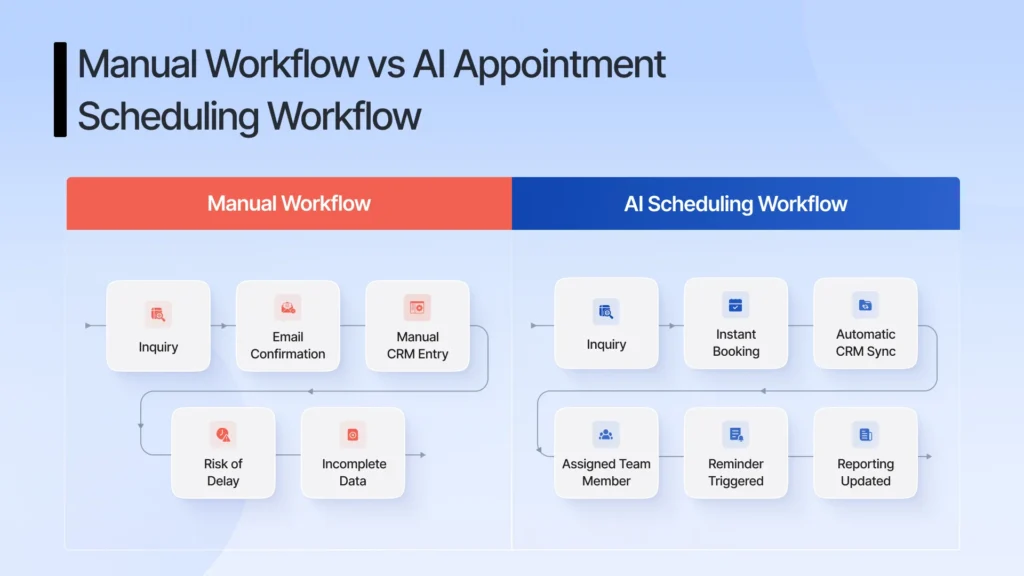
Among the many benefits of appointment scheduling software, your sales and service teams stay up to date in real time on upcoming appointments without the chaos of searching through emails. Additionally, reporting gets easier by the book as data becomes structured, forecasting becomes clearer, and pulling data directly from the CRM records.
Use Cases of AI Scheduling Assistants in Modern Business
Scheduling friction may look different based on your business/service model; however, the pattern remains consistent. When scheduling heavily relies on manual coordination, it causes revenue leakage. On the other hand, when scheduling becomes automated and connected, it removes friction, driving higher conversions and revenue boost. This is the difference between a missed opportunity and a closed deal:
Inbound Sales Teams
In case of a fast-scaling B2B sales environment, inbound interest cools off quickly, especially when a prospect fills out a demo request form. Without structured automation, the demo sits waiting in the inboxes until a rep manually checks availability and fills in the next course of action. An AI scheduling assistant removes such delays by instantly routing such high-intent inquiries to the right representative, offering available time slots in the same interaction, leading to faster purchase decisions, reduced drop-offs, and stronger pipeline momentum.
Calendar Conflict Management
It detects overlaps, manages time zone differences, and prevents double bookings automatically. This ensures smoother daily operations without manual calendar checks.
Customer Service and Support Teams
Service-based businesses are known for unpredictable spikes in call volume, especially during peak hours or just before the holidays. Manual scheduling only increases stress and pressure across human bandwidth, creating follow-up gaps. An AI appointment booking system, on the other hand, absorbs that pressure by automatically handling booking requests across different channels. It starts by confirming availability, updating records, and sending reminders without causing disruptions across frontline teams. This way, continuity is ensured, even during peak-demand seasons.
Consultants and Distributed Teams
For enterprises with a geographical footprint across multiple regions and teams scattered through different time zones, coordination becomes complicated quickly. Overlapping meetings and frequent rescheduling can create chaos. An AI calendar assistant simplifies this by auto-detecting time zones, analyzing availability across participants, and opposing meeting windows. This way, intelligent scheduling becomes the backbone of the entire workflow, tying it together into a single process for faster execution.
Automotive Sales and Service Operations
In automotive BDC environments, enquiries at 9:42 pm are quite common. And not just on a weekday, but even during holidays, when enquiries come in during late hours, often after celebrations are over. And such enquiries can be a test drive request, a service booking, a trade-in evaluation, or a finance consultation; directly tied to the revenue pipeline of the dealership. Today’s buyers often contact multiple dealerships online if they find a car that matches their preferences, much before even stepping into a dealership. For such high-intent buyers, manual scheduling will only lead to conversion loss, or even worse, your competitor’s gain.
Having an AI scheduling assistant ensures:
- Inbound calls for appointments are handled instantly.
- Service and sales appointments are confirmed in real time.
- CRM records are updated automatically.
- Reminders reduce missed showroom visits.
Launching an AI Scheduling Assistant Implementation: Checklist
Launching an AI scheduling assistant requires structure, as well as understanding its current gaps, and replacing it with automation to drive impact. Here’s how to approach the rollout strategically:
Step 1: Map Your Primary Booking Channel
Before deciding on an AI appointment booking tool, determine where most of your booking requests come from:
- Website forms using AI for appointment booking online
- Phone calls needing an AI voice agent for appointment booking
- Live chat powered by an appointment booking AI chatbot
- Messaging platforms that need conversational AI for appointment booking
Identifying your primary booking channel can help you select the right AI appointment booking system from the get-go.
Step 2: Understand Your Business Type and Scale
There’s no one-size-fits-all when it comes to appointment scheduling automation. In fact, for small businesses, having an AI appointment booking bot may not be enough, as they’d need additional systems for lead qualification, payment collection, service selection, and more. Similarly, for multi-location operations, you may require a multilingual AI appointment booking system to handle customers across distributed teams. A few domain-specific examples include:
- Roofing appointment booking AI for field services
- Multifamily AI scheduling assistant for property managers
- AI scheduling assistant for students managing academic calendars
Overall, the scale and workflow complexity of your business will predetermine the type of solution you’d need.
Step 3: Align Your Revenue Goals
After completing the previous step, when choosing between appointment booking AI tools, they should do more than just manage calendars. Even for an AI agent, appointment booking becomes strategic when it aligns directly with your revenue and productivity outcomes.
It should include:
- Increase confirmed bookings
- Reduce missed calls
- Improve operational visibility
- Strengthen customer experience
Step 4: Evaluate Core AI Scheduling Features
As you’re comparing the best AI scheduling assistant options for your business, verify that the solution includes:
- Real-time availability syncing
- Automated reminders
- Intelligent routing
- CRM integration
- Multichannel support
Look for automated appointment booking software with AI that supports both voice and automotive live chat, especially if your operations need it. For example:
- Voice AI appointment booking software
- AI chatbot for appointment booking
- Appointment booking AI agent
- AI receptionist appointment booking
The ideal AI assistant for appointment scheduling should eliminate manual coordination.
Step 5: Evaluate System Integrations
For a fully-functional appointment booking system to work seamlessly, it must easily integrate with your pre-existing systems, like CRM systems, Google Calendar, communication channels, and reporting dashboards for a complete and connected workflow. Without it, there might be gaps without manual data entry, leading to confusion and potential revenue loss.
For service-heavy industries, integration is the backbone of reliable automation. If your scheduling assistant AI does not connect to your core systems, it only shifts the workload instead of eliminating it.
- Calendar updates happen in real time
- CRM records are created automatically
- Team members are assigned instantly
- Reminder workflows trigger without intervention
- Booking analytics feed directly into dashboards
Step 6: Weighing Free vs Paid AI Scheduling Tools
While businesses tend to start with free AI scheduling assistants, it’s crucial to understand that for growing teams, advanced AI appointment booking software with voice and conversational capabilities is a must-have. Therefore, before narrowing down on the features and committing long-term, keep an eye out for scalability across:
- Multi-channel support, including AI appointment booking, voice, and chat
- Conversational AI for appointment booking
- Advanced routing and assignment logic
- CRM synchronization
- Reporting depth
- Multi-location operations
- Industry-specific use cases, such as AI platforms for car service appointment booking
As a business, your goal is to choose an AI scheduling tool that grows with your business needs, and sometimes it comes with deeper automation, delivering long-term operational clarity and measurable ROI.
Step 7: Look for Conversational Intelligence
Today’s buyers want answers to their queries right away, but also want it to feel natural and context-aware. Which translates to having an AI appointment booking bot doing more than just analyzing multiple calendars and showing available slots. It should also:
- Understand natural language
- Detect intent
- Ask clarifying questions
- Route bookings intelligently
Step 8: Evaluate Omnichannel Capabilities
Your customers don’t interact through a single channel, so having an omnichannel AI assistant scheduling workflow ensures that the tool supports:
- AI appointment booking voice
- Voice AI appointment booking system
- Appointment booking AI chatbot
- Web-based AI appointment booking app
This small addition of features can increase booking completion rates.
Step 9: Test and Track Key Performance Indicators
Before you decide on an AI scheduling assistant software, run a few tests that evaluate the scheduling workflows, especially metrics like:
- Response time improvements
- Booking completion rates
- No-show reduction
- CRM data accuracy
This way, you can compare performance against your previous manual process and have more visibility on optimization.
Step 10: Evaluate Long-Term Scalability
Finally, your AI scheduling assistant app for appointment need to adapt as operations expand, as well as handle your growing business needs like:
- Higher booking volume
- Multiple staff calendars
- Cross-department routing
- Industry-specific workflows
How to Choose the Correct AI Scheduling Assistant?
Business operations, their processes you need to automate, and how deeply the automation integrates into your workflows predetermine your selection of AI scheduling software in the long-term. In case you’ve already figured out a few core requirements, here’s a breakdown to get you started:
1. Integration Capabilities
An AI scheduling assistant does not work on its own. Also, make sure that the tool you choose will integrate with your calendar solutions, like Google Calendar or Outlook, email systems, video meeting software, such as Zoom or Microsoft Teams, and CRM systems. A disconnected scheduling assistant will need more manual work. Close integration would make sure that meetings, confirmations, reminders, and reporting information remain aligned between systems and there are no instances of duplicate entries or missed updates.
When your scheduling assistant is not able to connect with your operational stack, it will never be functional.
2. Level of Automation
Not all teams require the same level of automation. Some businesses lean towards complete automation with the AI appointment booking system automatically validating appointments, rescheduling, and arranging appointments without human intervention. Others would choose the human-in-the-loop model, whereby the AI proposes changes but requires prior approval before confirming.
When you deal with high-volume, front office bookings, full automation might be required. In cases where internal meetings need management, partial control might be more effective. The key lies in matching automation depth and operational risk tolerance.
3. Meeting and Team Complexity
As teams expand, scheduling gets layered. Find AI scheduling tools that will support assigning round-robin among team members, shared resources in limited availability, department-based routing, and smart re-scheduling without any friction. The capability of intelligent booking distribution in multi-staff settings eliminates overloading and enhances operational balancing. When the complexity of teams cannot be managed with the help of your scheduling assistant, the problems only get moved from one person to another instead of getting solved at grassroot.
4. Context Awareness
Smart AI time schedule apps do not just match time slots, but they also understand context.
For example:
- Automatic addition of buffer time between appointments.
- Protecting deep work focus slots.
- Considering the travel time between work.
- Alignment of task deadline and calendar planning.
Context-based scheduling is used to make sure that the calendars are realistic and do not represent the hypothetical availability in the real world. This difference is particularly crucial when the appointments influence the revenue stream at the time of operations.
5. User Interface and Acceptance
Without adopted teams, even the most sophisticated AI scheduling assistant will not work.
Look for:
- Clean, intuitive dashboards
- Confirmed bookings can be clearly seen.
- Single rescheduling processes.
- Easy access to reporting
Adoption determines impact. In case the interface seems complex or disruptive, they might go back to manual coordination, defeating the purpose of automation. A well-designed AI scheduling assistant must not seem like an additional burden but rather an extension of everyday work.

Why is an AI Scheduling Assistant Critical for Automotive Businesses?
Car buyers today research online, compare inventories across multiple dealerships, and reach out to multiple sellers before stepping into a showroom. This way, every enquiry that comes through via call, chat, or email can be a potential test drive request, vehicle availability enquiry, or trade-in valuation, taken via an automotive answering service. Now, given the weightage of such requests, consider what happens when such scheduling relies on manual processes:
- Calls get missed during peak showroom hours and end up in voicemail instead
- Voicemails received after-hours or on holidays wait too long to get followed up on
- Service slot confirmations remain verbal and don’t get reflected in the CRM, leading to reporting gaps and operational inconsistencies.
This way, the delay in each step increases the chances of losing the lead to another dealership.
In automotive environments, appointment scheduling directly impacts showroom traffic, service revenue, sales pipeline velocity, and overall customer engagement. And, for dealerships today, having such responsiveness right at the first touchpoint with the audience can be a game-changer.
Why Automotive Teams Choose Spyne for AI Scheduling?
When automotive appointment scheduling directly impacts traffic, revenue, and pipeline velocity, then the solution cannot be generic. Instead, they need structured, omnichannel, automotive-aware execution that evolves to meet your needs.
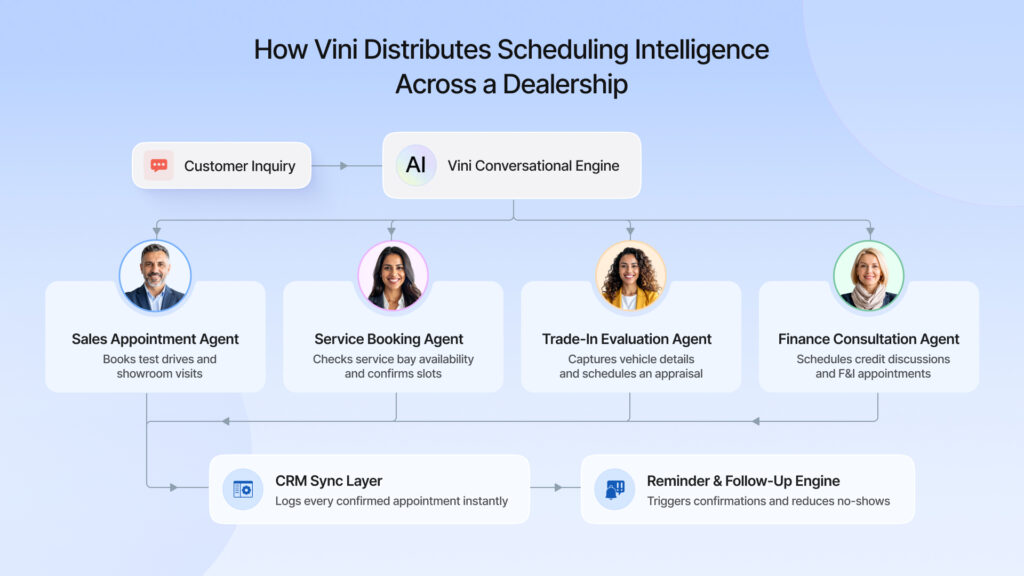
This is where Spyne’s conversational AI agent, Vini, stands apart. Vini is a conversational AI scheduling assistant purpose-built for automotive sales solutions. It does not operate like a basic calendar tool. It functions as a multi-agent system that handles dealership-specific booking logic across channels and departments.
Instead of letting high-intent enquiries depend on staff availability, Vini ensures continuous engagement. Here’s how:
Automotive-Aware Conversational Coverage
Unlike generic AI scheduling agents, Vini is trained on automotive data, which helps it to auto-detect intent right from the get-go of an enquiry received. Furthermore, given its human-like, natural-inflection-based conversational abilities, Vini blends right in to your dealership’s tonality and feels natural while talking/engaging with your customers. Across voice, chat, SMS, and web forms, Vini acts as an AI voice agent for appointment booking and an AI callbot for car dealerships simultaneously.
24×7 Dedicated AI Agents Across Dealership Verticals
Automotive scheduling softwares work across multiple dimensions. For example, a test drive request does not follow the same workflow as a service booking. Similarly, a trade-in valuation requires different information compared to a finance consultation. Vini distributes intelligence through specialized agents that handle each vertical independently while remaining connected to the same system.
Real-Time CRM Visibility
The moment an appointment is confirmed, Vini updates the CRM automatically, turning every interaction into structured data, strengthening forecasting, improving reporting accuracy, and creating accountability across teams.
Intelligent Routing and Load Distribution
Peak-hour overload is a reality in dealerships. Vini distributes appointment requests based on availability, department logic, and defined business rules. It prevents overbooking, reduces scheduling conflicts, and ensures smoother internal coordination. The AI appointment booking system works as an operational layer, not just a booking link.
24/7 Engagement, Even After Hours
Car buyers often engage late at night, on weekends, and during holidays. Manual systems create gaps. Vini keeps scheduling actively 24 hours a day, ensuring that high-intent buyers receive immediate confirmation instead of delayed callbacks. In a competitive dealership landscape, that timing difference directly influences conversion outcomes.
Automotive scheduling software provides speed, which builds trust, while structured automation protects opportunity.
Conclusion
Scheduling may look simple, but manual dependency increases friction across each step. For the 9:42 PM inquiry, if it waits too long in the CRM, it becomes a lost opportunity. Processes get more stalled in case of disconnected systems, even after having an AI for car dealerships that’s not integrated end-to-end across your existing workflow.
To put it simply, for fast-scaling environments, the best AI scheduling assistants eliminate gaps across processes, compressing the time between inquiry and a lost opportunity consistently. Because in competitive markets, speed is the differentiator.
Spyne’s Vini optimizes dealership execution. It connects conversational AI for appointment booking with CRM synchronization, vertical-specific routing, reminder workflows, and revenue visibility. If you want to move from missed appointments to closed deals, book a demo with us and see how Spyne turns it into action across dealership workflows, giving you the advantage of speed, automotive intelligence, and consistency.