
As sales and marketing functions scale, the quality of leads matters more than ever. Teams today don’t struggle with lead volume, they struggle with lead quality. Despite heavy investment in demand generation, only about 25% of marketing leads are actually deemed sales-ready, leaving the majority of inquiries unconverted. Worse still, up to 79% of marketing-generated leads never become customers, a gap that manual sorting and inconsistent qualification simply can’t close.
As inbound channels scale, marketers today see AI lead qualification as strategic levers that help teams prioritize high-intent opportunities, reduce response time, and improve conversion outcomes.
In this blog, we’ll break down how automated lead qualification works, best practices, frameworks, common challenges, best AI tools for lead qualification, and what to look for in 2026, including automotive-specific applications.
What is Automated Lead Qualification using AI?
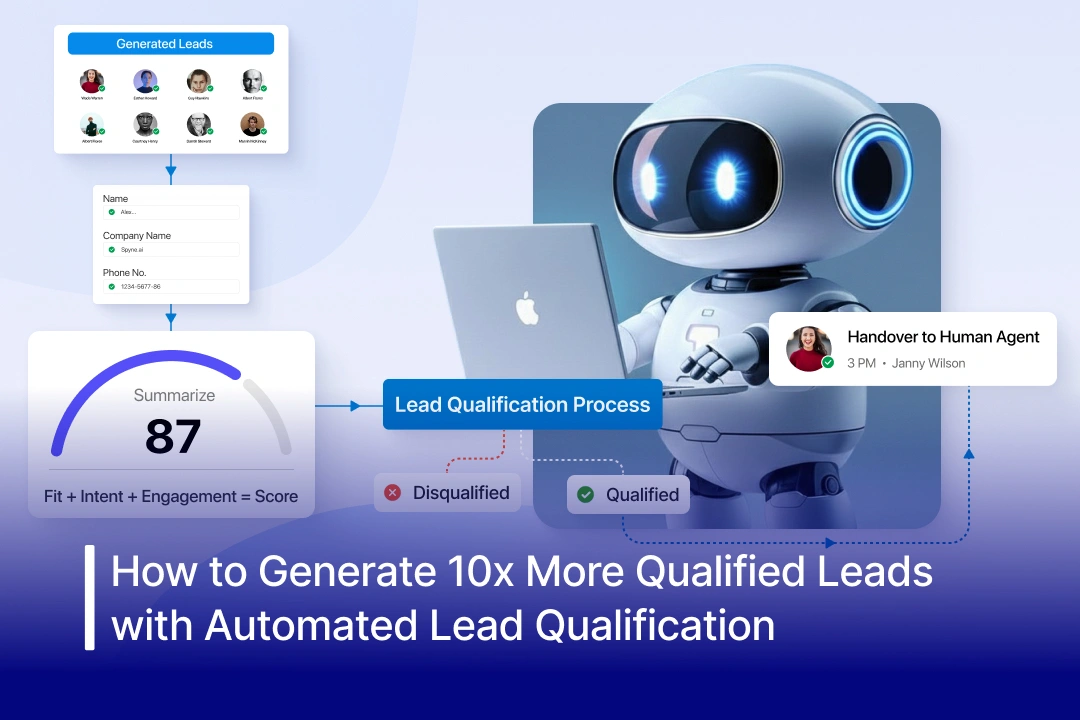
Automated lead qualification is the process of using technology, data signals, and predefined scoring rules to determine whether a prospect aligns with your Ideal Customer Profile (ICP) and is likely to convert, without manual evaluation.
It assesses both fit (industry, role, company size, budget) and intent (behavior, engagement, buying signals) to segment leads automatically.
At a high level, leads are bifurcated into:
- Qualified leads: Prospects that match your ICP and show strong purchase intent
- Unqualified leads: Prospects that don’t meet ICP criteria or lack buying signals
Qualified leads may further be categorized as MQLs, SQLs, or PQLs based on readiness.
Why Automated Lead Qualification Matters in 2026
In 2026, revenue growth depends less on generating more leads and more on qualifying the right ones, faster and more accurately. The traditional debate of demand generation vs lead generation is shifting, volume alone is no longer the bottleneck. Buying journeys are non-linear, intent signals are fragmented across channels, and sales cycles are increasingly compressed. Manual qualification simply can’t keep up.
Here’s why automated lead qualification is mission-critical:
- Higher Conversion Efficiency: Leads are scored based on ICP fit and real engagement data, ensuring sales teams focus on high-probability opportunities.
- Faster Speed-to-Lead: Automated routing reduces lag between inquiry and outreach, protecting conversion windows.
- Consistent, Data-Driven Decisions: Standardized scoring removes subjectivity and guesswork from qualification.
- Stronger Sales-Marketing Alignment: Shared criteria improve handoffs and pipeline visibility.
- Lower Acquisition Waste: Filtering low-fit leads early reduces wasted outreach and CAC.
- Scalable Growth Without Headcount Expansion: Systems handle volume increases without operational strain.
How does AI Assist in the Lead Qualification Process?
Automated lead qualification brings structure to pipeline evaluation by combining defined criteria, enriched data, and intelligent scoring. It can assess fit, intent, and readiness in real time, converting raw inquiries into prioritized revenue opportunities unlike the manual review process.
Here’s how it works in practice:
1). Define Qualification Logic
Before automation begins, teams align on what ‘qualified’ means. This includes:
- Ideal Customer Profile (ICP): Industry, company size, revenue band, geography
- Role & Authority: Decision-maker vs. influencer
- Commercial Fit: Budget range, urgency, use case
- Intent Signals: Demo requests, pricing visits, repeat high-value page sessions
2). Capture and Enrich Lead Data
Modern systems continuously enrich inbound leads with firmographic and behavioral context. This may include technographic data, CRM activity, email engagement, and third-party intent signals. Lead qualification automation ensures every record is complete enough to evaluate accurately, eliminating manual research by sales reps.
3). Apply Intelligent Scoring Models
This is where AI lead qualification adds measurable impact.
Scoring blends:
- Rule-based logic (explicit ICP match, role validation)
- Behavioral scoring (engagement depth and recency)
- Predictive modeling using historical win/loss data
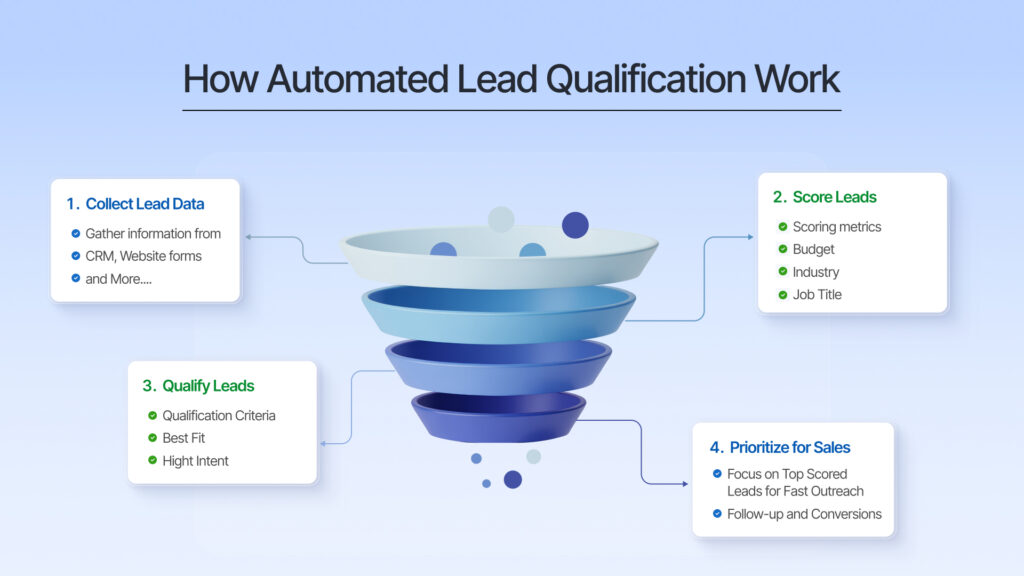
4). Segment and Route Instantly
Once scoring thresholds are met:
- Leads are categorized (MQL, SQL, PQL)
- Assigned automatically by territory, product, or deal size
- Prioritized by urgency and likelihood to convert
Advanced lead qualification AI systems can even trigger automated meeting scheduling or conversational workflows to accelerate the next step.
5). Optimize Through Feedback Loops
High-performing systems don’t stay static. Conversion outcomes feed back into the model, refining signal weights and qualification thresholds over time. This ensures the qualification engine improves as the business scales.
Implementing the Automated Lead Qualification Process: The 2026 Checklist (Baseline Operating Model)
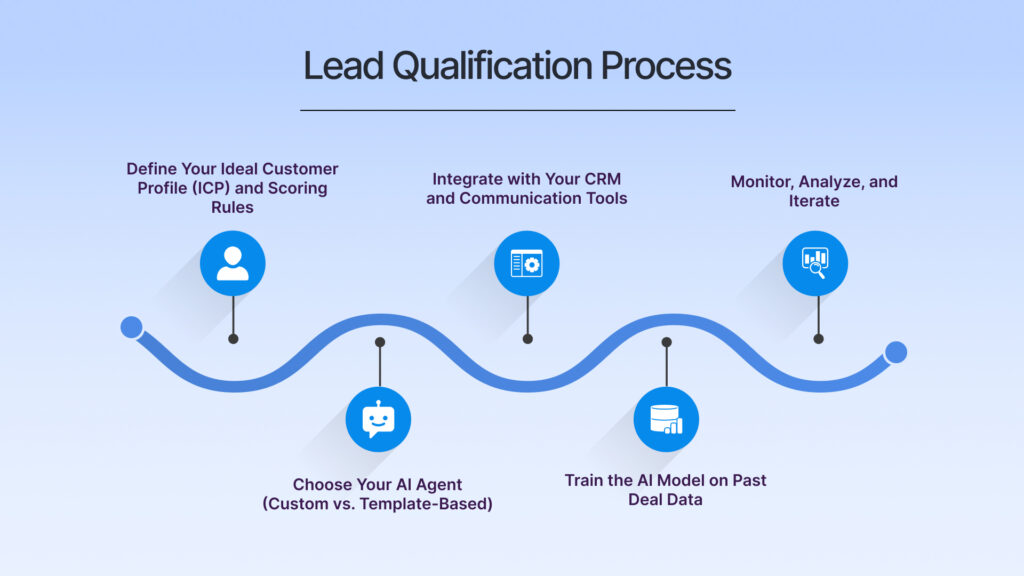
Automated lead qualification only works when it is embedded into the way your revenue team already operates. When it’s treated as a standalone ‘AI layer’, it becomes another dashboard no one checks. When it’s woven into CRM workflows, routing logic, and rep accountability, it can increase lead quality and sales velocity.
Though there’s no universal blueprint here, some teams operate with four tightly defined stages, others with a dozen nuanced checkpoints, but in practice, we’ve seen structured, multi-step qualification frameworks consistently outperform ad-hoc approaches.
Here’s how to automate lead qualification with AI in a way that actually changes outcomes:
#1. Start with a Shared Definition of ‘Qualified’
Most automation projects fail before they begin because marketing and sales are optimizing for different definitions of a qualified lead.
Before deploying any AI lead qualification workflow, align on:
- Align on what makes a lead sales-ready (clear buying intent, budget clarity, timeline, role authority, etc.).
- Identify which signals matter most in your sales cycle:
- Firmographic fit (industry, company size, geography)
- Behavioral signals (pricing page visits, demo requests, repeat engagement)
- Conversational signals (budget confirmation, urgency language, competitor mentions)
- Define hard disqualifiers (students, vendors, wrong geography, unrealistic budgets).
#2. Choose the Right Automation Layer
Not all systems labeled as lead qualification AI operate the same way. Choosing the wrong automation layer for your sales motion creates friction instead of efficiency.
Start by identifying what problem you’re solving:
- Too many low-quality inbound leads?
- Slow response times?
- SDR bandwidth constraints?
- Inconsistent qualification standards?
- Missed high-intent opportunities?
There are typically three approaches:
- Rule-Based Qualification: Predefined scoring and routing based on fixed criteria like firmographics and form inputs).
- Predictive Scoring: AI lead scoring models that prioritize leads using behavioral patterns, intent signals, and historical conversion data).
- Conversational Qualification: Automated chat, voice, or interactive flows that actively validate fit, intent, and book meetings in real time).
#3. Integrate Directly into CRM and Scheduling Workflows
Automated qualification only works when it drives immediate action. A score inside a dashboard doesn’t create revenue, routing and response do.
Once a lead qualifies, the system should automatically:
- Route it to the right rep (based on territory, segment, or deal size)
- Enrich contact and company data
- Trigger real-time alerts for high-intent activity
- Enable instant meeting booking where appropriate
- Place lower-intent leads into structured nurture flows
When teams automate lead qualification with AI, the difference between ‘automation that exists’ and automation that performs comes down to lead response time. High-intent leads should never wait for manual triage. Routing and scheduling should happen instantly, not during the next SDR check-in.
#4. Build Tiered Lead Paths (Not Just Qualified vs. Unqualified)
A binary system wastes opportunity. Not every lead is ready to buy today, but that doesn’t mean they lack potential.
Instead of classifying leads as simply “qualified” or “disqualified,” create tiered pathways:
| Lead Category | Qualification Signal Profile | Action Taken | Ownership |
| High-Intent, Sales-Ready | Strong ICP match + demo/pricing intent + urgency | Immediate routing + meeting auto-booking | Account Executive |
| Qualified, Early-Stage | Good ICP match + moderate engagement | Contextual SDR outreach | SDR / BDR |
| Good Fit, Low Intent | Strong ICP fit but low behavioral signals | Targeted nurture workflows | Marketing Automation |
| Poor Fit | Weak ICP alignment or disqualifying criteria | Removed from active sales queue | System (automated) |
This structured lead qualification AI agent process ensures no opportunity is mishandled due to oversimplified categorization.
#5. Train Your Sales Team
Beyond understanding the scoring logic, reps should be trained on how to use qualification insights in real conversations. If a lead was prioritized due to repeat pricing-page visits or a stated budget range, outreach should acknowledge that context rather than restarting discovery from scratch.
#6. Monitor and Adjust Continuously
Automated lead qualification is not a “set it and forget it” system. Buyer intent signals shift, campaign sources evolve, and conversion patterns change over time. Regularly reviewing performance metrics ensures your scoring logic and routing rules stay aligned with real revenue outcomes.
Track performance beyond lead volume:
- Conversion rate from qualified lead converting to a booked demo
- Sales acceptance rate
- Meeting show rate
- Opportunity creation rate
- Time-to-first-response
If high-scored leads consistently stall, revisit your scoring logic. If low-scored leads are closing, your weighting may be off.
3 Key Automated Lead Qualification Frameworks
When it comes to identifying high-quality prospects, BANT and CHAMP are two of the most popular AI lead qualification frameworks. However, they’re not the only ones, others like ANUM, and FAINT are also widely used across sales teams. Below we’ve explained the terms and how they evolve in an automated qualification environment.
#1. BANT: Budget, Authority, Need, and Timeline
The BANT framework has been used for decades as a structured method to evaluate prospect readiness. In manual sales environments, reps uncover this information through discovery calls. In automated systems, each BANT component is mapped to data signals and workflows.
How BANT can be automated:
- Budget is inferred from company size, funding rounds, revenue estimates, or technology stack data pulled from enrichment tools.
- Authority is evaluated using job title parsing, org chart mapping, and LinkedIn-level seniority signals.
- Need is derived from website behavior, content engagement, product page depth, and use-case alignment.
- Timeline is detected via demo requests, pricing page revisits, high-intent keywords, or buying-stage indicators.
#2. CHAMP: Challenge, Authority, Money, Prioritization
Unlike BANT, which starts with a budget, CHAMP prioritizes the prospect’s core business challenges first. In automated lead qualification systems, this framework is converted into structured signals and scoring logic that evaluate urgency, decision power, financial viability, and initiative priority in real time.
- Challenges: Automation detects problem intensity through high-intent behaviors such as repeated visits, engagement with use-case content, demo requests, and transcripts. AI models tag recurring pain themes and align them with defined ICP problem statements.
- Authority: Systems classify decision-makers using title parsing, seniority mapping, and stakeholder enrichment. Buying group completeness and economic buyer presence can be auto-flagged before routing to sales.
- Money: Budget is inferred through firmographics such as company size, revenue bands, funding stage, and historical deal benchmarks from similar accounts.
- Prioritization: Urgency is scored using recency, intent spikes, initiative-related keywords, and buying-stage behaviors such as pricing page revisits or calendar bookings.
#3. MEDDIC: Metrics, Economic Buyer, Decision Criteria, Decision Process, Identify Pain, and Champion
The MEDDIC framework is widely used in complex B2B sales environments where deal sizes are larger and buying committees are more structured. Unlike basic models, MEDDIC goes deeper into how decisions are made and who truly drives them. Because of its depth, MEDDIC integrates well into AI lead qualification systems that rely on structured discovery signals and multi-threaded account data.
Here’s how each component works:
- It begins with defining Metrics, the quantifiable business outcomes the prospect expects, such as revenue growth, cost reduction, or operational efficiency.
- Then it identifies the Economic Buyer, the individual who owns the budget and has final approval authority.
- Next, it clarifies the Decision Criteria, the technical, financial, and operational standards the solution must meet.
- It maps the Decision Process, the formal steps required for evaluation, procurement, and sign-off.
- It uncovers the core Pain driving urgency, the business problem serious enough to justify change.
- And finally, it secures a Champion, an internal advocate who pushes the deal forward within the organization.
When MEDDIC is embedded into automated lead qualification workflows, it enables structured, data-driven evaluation of deal strength. Instead of relying solely on rep discovery, organizations can operationalize these criteria within scoring models and CRM processes to prioritize accounts with clear impact, authority alignment, and internal momentum.

How to Measure the Success of Lead Qualification Processes?
The effectiveness of a lead qualification process should be measured by its impact on pipeline quality, sales efficiency, and revenue outcomes. Instead of tracking volume alone, focus on metrics that indicate whether qualified leads are truly sales-ready and progressing faster through the funnel.
Key Metrics to Track:
- MQL to SQL Conversion Rate: Percentage of marketing-qualified leads that meet sales-ready criteria, indicating scoring accuracy and intent alignment.
- Sales Acceptance Rate (SAR): Proportion of qualified leads accepted by sales, reflecting trust in the qualification model.
- Speed-to-Lead: Time taken to contact a qualified lead after inquiry, directly tied to conversion probability.
- Opportunity Creation Rate: Share of qualified leads that convert into pipeline opportunities, signaling lead quality.
- Pipeline Velocity: Speed at which qualified leads move from first contact to closed-won, measuring sales efficiency.
- Win Rate on Qualified Leads: Close rate specifically for SQLs, showing whether qualification improves deal success.
- Revenue per Qualified Lead: Average revenue generated per SQL, indicating value prioritization over volume.
- Cost per Opportunity: Sales and marketing cost required to generate one opportunity, reflecting operational efficiency.
The Best Lead Qualification Tools for 2026 (By Category) *
In 2026, the best lead qualification platforms go beyond simple rule-based scoring, integrating predictive analytics, conversational AI, CRM routing, and real-time enrichment to help sales teams focus on high-intent prospects.
Below is a categorized breakdown of the best platforms across industries, helping teams choose the right AI lead qualification solution based on use case rather than hype.
| Category | Tool | Best For | Key Strengths | Ideal Use Case |
| Automotive Retail | Spyne | AI-driven automotive sales qualification | AI digital employee for sales lead qualification, conversational follow-ups, pricing inquiry handling, showroom booking automation | Dealerships managing high volumes of vehicle inquiries and requiring automated consumer lead capture and qualification |
| Conversational AI / Website Qualification | Drift | Real-time chatbot qualification | AI chatbot flows, instant meeting booking, visitor identification | Companies needing the best AI chatbot for lead qualification on high-traffic websites |
| Inbound Speed-to-Lead Optimization | Chili Piper | Routing + instant scheduling | Automated routing, calendar sync, rep matching | Teams focused on reducing delay after high-intent form fills |
| Outbound Prospecting + Enrichment | Apollo.io | Prospect scoring + sequencing | Contact enrichment, outbound scoring logic, automation workflows | Revenue teams combining outbound prospecting with AI tools for lead qualification |
| AI Voice-Based Qualification | Bland.ai | AI voice agents | AI voice agents vs SDRs lead qualification use cases, automated discovery calls | Companies testing AI-first inbound call qualification models |
| Data Enrichment & Intent Layer | Clearbit | Real-time enrichment | Firmographic and technographic enrichment, anonymous visitor identification | Teams strengthening scoring accuracy before applying lead scoring software |
| AI Agent-Based Automation | Relevance AI | Custom AI qualification workflows | Lead qualification AI agent process automation, workflow orchestration | Organizations building fully automated lead qualification using AI pipelines |
This is not a sponsored ranking or endorsement. Capabilities, pricing, and integrations may vary by plan and evolve over time.
Challenges in Automated Lead Qualification & How to Solve Them
Automated lead qualification can significantly improve pipeline quality and sales efficiency, but only when implemented with strong data foundations, clear definitions, and cross-team alignment. Below are the most common challenges teams face, along with practical solutions to address them.
1) Misalignment Between Marketing and Sales
Challenge:
Teams often attempt to automate lead qualification with AI without defining shared acceptance criteria. Marketing may optimize for engagement while sales prioritizes deal probability, leading to rejection cycles.
Solution:
Deploy structured AI lead qualification tools that incorporate sales feedback loops. Establish clear MQL and SQL criteria based on historical conversion data, not assumptions. Adopt a Unified Revenue Operations (RevOps) framework with shared KPIs and clearly defined service level agreements (SLAs).
2) Static Scoring That Ignores Buying Context
Challenge:
Many rule-based systems lack contextual intelligence. Downloads and webinar registrations may signal interest but do not confirm timeline, authority, or defined pain. This limits the effectiveness of lead qualification AI frameworks built on rigid scoring rules.
Solution:
Adopt AI for lead qualification that evaluates behavioral sequences rather than isolated actions. Pattern recognition across visits, repeat intent signals, and CRM enrichment creates a truer representation of readiness.
3) Fragmented Data Across Systems
Challenge:
Disconnected CRMs, enrichment tools, and conversational systems undermine even the best AI tools for virtual lead qualification. When systems fail to share real-time context, scoring accuracy declines, response times slow, and teams stop losing leads only when integration and data synchronization become a priority rather than an afterthought.
Solution:
Consolidate data pipelines using unified AI tools for lead qualification that centralize engagement signals, firmographics, and call intelligence within one operational framework.
4) AI vs Human SDR Effectiveness Debate
Challenge:
The comparison of AI voice agents vs SDRs lead qualification raises concerns around personalization and objection handling, particularly when cost discussions dominate performance analysis.
Solution:
Evaluate AI lead qualification voice agent pricing against measurable output such as response speed, conversation depth, and conversion uplift. Map the lead qualification AI agent process against traditional SDR workflows to assess efficiency and scalability.
Why Automated Lead Qualification Is Essential for Modern Automotive Retail?
Buyers today expect near-immediate responses. Studies show that responding within the first five minutes of a lead inquiry can make you up to 100× more likely to connect with a prospect compared to slower follow-ups. When outreach takes longer than five minutes, qualification probability plunges by as much as 80%, and conversion rates can drop eightfold if you wait an hour.
This creates a major pain point for automotive sales teams: buyers are ready now, but processes are reactive, slow, or inconsistent. Slow lead-follow-ups don’t just reduce sales, they increase your defection rate as shoppers choose the dealership that engages them first.
Why Spyne for Automated Lead Qualification in Automotive?
In an industry where seconds matter and every lead carries potential revenue, Spyne stands out as a purpose-built solution that understands the unique demands of automotive retail. Unlike generic CRM add-ons or marketing platforms repurposed for lead scoring, Spyne is optimized specifically for dealerships and auto groups, strengthening automotive lead generation.
Here’s why Spyne is rapidly becoming the automotive lead management engine of choice for automotive businesses:
- Designed for Automotive Buyer Behavior: Spyne’s AI captures intent signals across all these channels and rapidly qualifies them, ensuring no high-intent lead is overlooked. It understands the nuances of automotive triggers like trade-in interest, desired model urgency, and test-drive intent, converting them into actionable scoring insights.
- 24/7 Engagement Captures Leads Immediately: Spyne’s conversational AI, Vini answers calls, chats, SMS and messages instantly, including outside business hours. Unanswered or slow responses are one of the biggest killers of lead quality, if no one responds, qualification never happens
- Real-Time Prioritization & Sales Routing: Not all automotive leads are equal. The AI lead qualification software automatically scores and ranks leads based on intent and readiness, then routes them to the right advisor according to SLAs and priority rules.
- Continuous Learning from Revenue Outcomes: By analyzing contact rates, appointment conversions, and deal progression, Spyne refines qualification logic over time, aligning scoring with actual revenue-driving behaviors.
Final Take
Automate lead qualification with AI is shifting from static scoring to agentic, always-on execution. With task-specific AI agents expected to appear in 40% of enterprise apps by 2026 , qualification will increasingly happen in real time across calls, chat, forms, and CRM activity.
Key Trends Shaping the Future
- Conversational AI & Voice Bots: Conversational AI is becoming central to automated lead qualification, enabling real-time voice and chat interactions that capture qualification data instantly. These AI agents engage leads within the critical response window, increasing connect rates and preserving buying intent.
- Predictive & Behavioral Scoring: Modern AI lead qualification tools will use predictive scoring engines to evaluate hundreds of live data points, such as website behavior, content engagement, and interaction depth, to forecast conversion probability.
- Autonomous Agent Workflows: Next-gen lead generation systems automate end-to-end lead qualification workflows, from initial outreach to BANT or CHAMP-based assessment and meeting scheduling, reducing manual dependency while improving speed-to-lead performance.
- Hyper-Personalization at Scale: Advanced AI-powered automated lead qualification platforms tailor follow-ups based on interaction history and intent signals, ensuring outreach remains contextual, relevant, and conversion-focused.

Conclusion
As inbound volume grows and buyer journeys become more complex, teams that rely on manual scoring and inconsistent follow-ups will continue to leak pipeline. In contrast, automated consumer lead capture & qualification brings structure, speed, and objectivity to the process, ensuring high-intent leads are prioritized, routed correctly, and engaged while interest is still active.
In 2026, the competitive advantage won’t come from generating more leads but from converting the right ones faster and more predictably.
If you’re ready to turn lead qualification into a measurable growth engine, book a demo with us and see how intelligent automation can improve pipeline quality, response time, and conversion performance in real time.