

Car buyers move faster than your responses. Buyers these days expect instant responses around the clock. Further, every missed call, unanswered question, or delayed follow-up means a lost opportunity. That’s why most dealerships are switching to AI and virtual BDC for automotive.
A virtual BDC helps dealerships stay on top of customer conversations and respond faster, manage leads more efficiently, and keep follow-ups from slipping through the cracks.
In this blog, we’ll break down what a virtual BDC is, how it works, and its key benefits. We’ve also prepared a list of the best automotive BDC companies so you can easily find the best fit for your business.
What is Virtual BDC in Automotive?
A virtual BDC in automotive is a remote team that handles customer communication, internet leads, calls, follow-ups, and appointment scheduling for a dealership. It works as an extension of the automotive dealership BDC, without requiring a fully staffed on-site team.
A virtual BDC can respond to leads, recover missed calls, re-engage inactive shoppers, and schedule sales or service appointments. With automotive virtual BDC software, dealerships can also automate routine communication while keeping their existing CRM and workflows connected.
Traditional BDC vs Virtual BDC
A traditional BDC in automotive typically operates on-site, with an in-house team handling calls, internet leads, follow-ups, and appointment setting during defined working hours. This model gives teams direct access to the dealership floor but comes with staffing, training, and overhead requirements.
A virtual BDC uses remote agents, outsourced specialists, or digital tools to manage similar tasks from outside the dealership. With automotive virtual BDC software, dealerships can extend coverage, respond to leads faster, and handle customer conversations beyond regular business hours without building a larger in-house team.
How Does Virtual BDC Automotive Fit Modern Dealership Operations?
A virtual BDC automotive solution works as an extension of your dealership team, helping manage customer conversations and follow-ups without adding more work to your in-house staff. Here’s how it fits into modern dealership operations:
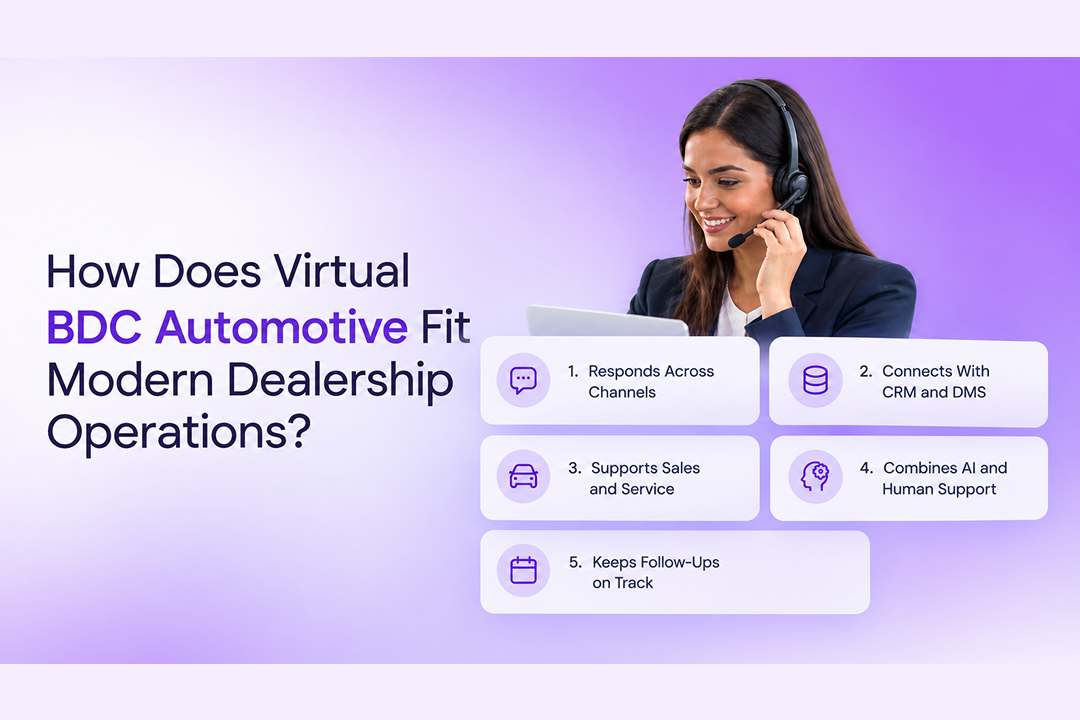
1. Responds Across Channels
Handles calls, texts, chats, and emails so customers can get timely responses even during busy periods or after dealership hours. This helps dealerships stay responsive when sales and BDC teams are unavailable.
2. Connects With CRM and DMS
Integrates with existing dealership systems to capture customer details, update records, and schedule appointments without disrupting your current workflows. Teams can maintain customer information and conversation history in one place.
3. Supports Sales and Service
Helps qualify sales leads, schedule test drives, book service appointments, and follow up on recalls or previously declined services. This allows one workflow to support customers across different stages of their dealership journey.
4. Combines AI and Human Support
AI can handle routine questions, lead capture, and initial conversations, while human teams step in when customers need more personalized assistance. This approach lets dealerships automate repetitive interactions while keeping human support available when needed.
5. Keeps Follow-Ups on Track
Automates reminders and follow-ups so leads, appointments, and service opportunities are less likely to be missed. Consistent follow-up can help teams manage more conversations without relying entirely on manual outreach.
Which One Should You Choose: AI BDC vs. Virtual BDC?
Choosing between an AI BDC vs in-house BDC or a virtual model depends on how your dealership handles leads, calls, follow-ups, and staffing. AI BDC software can automate routine conversations and provide immediate responses, while a virtual BDC typically relies on remote human agents to handle customer interactions.
AI BDC
An AI BDC is useful for dealerships that want to automate repetitive customer interactions and maintain 24/7 coverage. It can respond to inquiries, qualify leads, answer common questions, schedule appointments, and follow up without requiring additional headcount for every conversation.
Best suited for:
- Dealerships looking for 24/7 lead response
- High volumes of inbound calls, chats, or messages
- Automated lead qualification and follow-ups
- Teams looking to reduce repetitive manual work
Virtual BDC
A virtual BDC uses remote agents to manage customer conversations on behalf of the dealership. It can provide a more personalized experience for customers who need detailed answers, have specific concerns, or prefer speaking with a person.
Best suited for:
- Dealerships that need additional sales or BDC support
- Customer conversations requiring human judgment
- Follow-ups that need a personalized approach
- Stores looking to extend their team without hiring locally
For many dealerships, the choice does not have to be either-or. An AI BDC can handle the first response, routine questions, and follow-ups, while human teams take over conversations that need more context or personal attention. This hybrid approach can combine the speed of AI BDC software with the flexibility of a virtual BDC.
Top 7 Automotive BDC Companies
1. Spyne
Spyne provides AI-powered BDC solutions designed for modern automotive dealerships. Its Vini AI helps dealerships manage customer conversations across sales and service, from the first response to appointment scheduling. It can also handle follow-ups and route conversations when human support is needed.
Key features:
- AI-powered inbound and outbound conversations
- Lead qualification and appointment scheduling
- Sales and service call handling
- CRM, DMS, and scheduler integrations
2. Strolid
Strolid combines trained BDC specialists with technology to support dealership sales and service operations. Its approach focuses on managing customer conversations, lead follow-ups, and appointment opportunities. Dealerships can use its BDC support to extend their existing teams.
Key features:
- Human-led BDC support with AI capabilities
- Sales and service lead follow-up
- Multi-channel customer engagement
- CRM-based communication and reporting
3. Traver Connect
Traver Connect provides outsourced BDC services focused on customer communication and appointment setting. Its services cover both sales and service workflows, helping dealerships manage inbound and outbound interactions. The company also focuses on service retention and customer engagement.
Key features:
- Inbound and outbound BDC support
- Sales and service appointment setting
- Service retention and customer outreach
- Trained automotive BDC representatives
4. Better Car People
Better Car People offers managed BDC services for dealerships across sales and service operations. Its model combines human agents with AI-supported tools to manage customer interactions and follow-ups. The platform is designed to support ongoing engagement across multiple dealership locations.
Key features:
- Outsourced sales and service BDC
- Lead follow-up and appointment setting
- AI-supported customer engagement
- Multi-rooftop dealership support
5. BDC.AI
BDC.AI uses conversational AI agents to automate dealership communication across voice and digital channels. Its solutions support sales, service, and receptionist workflows while helping dealerships respond to customer inquiries. Human support can be used when conversations require additional assistance.
Key features:
- AI voice and text conversations
- Lead engagement and qualification
- Sales and service appointment scheduling
- CRM, DMS, and inventory integrations
6. Dealer Synergy
Dealer Synergy provides outsourced BDC services focused on sales and service lead management. Its teams handle customer interactions and follow-ups through channels such as phone, email, and text. The company works within dealership CRM workflows to help manage customer opportunities.
Key features:
- Outsourced sales and service BDC
- Phone, email, and text communication
- Lead follow-up and appointment management
- CRM-based dealership workflows
7. Podium
Podium provides conversational tools that help dealerships manage customer communication and lead engagement. Its AI capabilities can respond to inquiries, qualify leads, and assist with appointment scheduling. The platform also brings customer conversations across multiple communication channels.
Key features:
- AI-powered customer conversations
- Lead response and qualification
- Appointment and test-drive scheduling
- Multichannel messaging and communication

7 Automotive BDC Best Practices for Modern Dealerships
A well-structured automotive dealership BDC helps sales and service teams respond faster, manage customer conversations, and keep follow-ups consistent. Whether you use an in-house team, outsourced BDC automotive support, or AI-powered tools, these best practices can help improve day-to-day BDC operations.
1. Respond to Leads Quickly
Speed matters when a customer reaches out about a vehicle or service. Set clear response-time targets and use automated alerts or AI assistance to ensure new inquiries are acknowledged quickly, including after regular dealership hours.
2. Use Multiple Communication Channels
Customers may prefer calls, texts, emails, or website chat depending on the situation. Give your BDC team the tools to manage conversations across multiple channels while keeping customer information and conversation history organized.
3. Prioritize High-Intent Leads
Not every lead requires the same level of attention. Use your CRM and available customer data to identify signals such as vehicle interest, purchase timeline, or appointment requests, then prioritize leads that need immediate follow-up.
4. Separate Sales and Service Workflows
Sales leads and service customers have different needs, so their BDC processes should reflect that. Create separate scripts, follow-up sequences, appointment goals, and performance metrics for sales and fixed operations.
5. Automate Routine BDC Tasks
AI BDC software can handle repetitive tasks such as answering common questions, capturing lead information, sending reminders, and scheduling appointments. This allows human teams to spend more time on conversations that require judgment or personal attention.
6. Monitor Conversations and Performance
Regularly review calls, messages, appointments, and follow-up activity to understand what is working. Track metrics such as response time, contact rate, appointment rate, show rate, and customer feedback to identify areas for improvement.
7. Create a Smooth Handoff to the Dealership
A BDC conversation should not end when an appointment is booked. Make sure customer details, vehicle preferences, questions, and appointment information are recorded in the CRM so sales or service teams have the context they need before taking over.
How to Choose the Right AI BDC in Automotive?
Choosing the right AI BDC in automotive starts with looking beyond basic automation. Consider how well the solution fits your dealership’s existing workflows, handles customer conversations, integrates with your systems, and supports both sales and service operations.
1. Check Multi-Channel Communication
Look for an AI BDC that can handle calls, SMS, web chat, and other customer communication channels. This helps your dealership respond to customers wherever they choose to reach out, including outside regular business hours.
2. Verify CRM and DMS Integration
Your AI BDC should work smoothly with the CRM, DMS, and scheduling tools your dealership already uses. Strong integrations help keep customer information, conversation history, lead status, and appointments updated without creating separate data silos.
3. Look for Automotive-Specific Capabilities
Choose automotive virtual BDC software built around dealership workflows rather than a generic conversational AI platform. It should understand vehicle inquiries, sales leads, test drives, service appointments, recalls, and other common dealership conversations.
4. Evaluate AI and Human Handoff
AI can manage routine questions, lead qualification, appointment scheduling, and follow-ups, but some conversations still need human involvement. Check whether the platform can recognize when a conversation needs additional support and route it to the right dealership team.
5. Review Compliance and Controls
Customer communication should follow applicable regulations and dealership policies. Check how the platform manages consent, opt-outs, call recording, messaging permissions, and communication schedules before deploying it across your dealership.
6. Measure Appointment and Lead Performance
Look for reporting that goes beyond the number of conversations handled. Track response times, contact rates, qualified leads, appointments booked, show rates, and follow-up activity to understand how the AI BDC is performing.
7. Test Before You Scale
Before rolling out an AI BDC across every workflow, test it with real dealership scenarios. Review how it handles common questions, difficult conversations, appointment changes, service requests, and handoffs to make sure it fits your team’s processes.
How Spyne’s AI Calling Solutions Are the Best Choice for Your Dealership
Spyne offers an AI receptionist for car dealerships that keeps your dealership active no matter the time of day. We help you communicate with your customers better, set more appointments, sell more cars, and cut costs. Here’s how we keep your dealership ahead.
1. Never Miss a Lead with 24/7 AI Support
Spyne’s automotive answering service operates 24/7 to answer queries, qualify leads, and schedule appointments. Your dealership can capture every opportunity regardless of whether your team is online. Our AI services step in and handle all customer interactions.
2. Human-Like Conversations with Personalizations
We pay attention to little details that make a difference. Every message you send using our conversational AI is personalized using customer names, preferences, and past chats. Spyne’s AI makes digital conversations feel human, boosts trust, and increases conversion rates.
3. Instant Follow-Ups That Keep Leads Warm
We look after all follow-ups, no matter where your customers are in the sales process. Your buyers are engaged from first contact to the final booking, all without manual effort, with the help of our automated lead follow up system for car dealerships. This ensures your team can focus on more valuable activities.
4. Everything in One Place, Fully Synced
If you were considering throwing away those spreadsheets, now’s the time. Spyne’s virtual BDC automotive services sync directly with your CRM and other dealership software, giving your team full visibility into the sales process and eliminating duplicate tasks or double-checking.
5. Talk to Buyers Wherever They Contact
Spyne ensures all your interactions are connected, from calls to text and social media platforms. With the help of our omnichannel contact center, your team can respond faster to customer queries and solve issues wherever they pop up.
6. Prioritize the Right Leads with Smart Scoring
Our AI lead scoring for car dealerships shows you the important buyers first. By tagging customers who are ready to buy, our BDC solution focuses on converting leads that are more likely to bring you higher profits.

Conclusion
Virtual BDC automotive offers a smarter and more scalable way to manage leads and improve customer experiences. It provides constant customer support and automated follow-ups, so you can close deals more efficiently and keep customers happy. As digital communication becomes the new trend, having a strong BDC strategy is essential for remaining profitable in today’s automotive industry.
Spyne provides AI and automation to streamline your dealership’s BDC processes. It helps you automate interactions and turn every conversation into conversions, helping you boost profitability and growth. So, book a free demo with Spyne and explore our services!