
| Executive Summary
An AI sales assistant for car dealerships handles every step between lead arrival and qualified appointment: instant response, inventory confirmation, buyer qualification, and CRM write-back. Vini AI by Spyne responds to every inbound lead within 5 seconds across calls, SMS, and chat, 24/7 including weekends, and writes the complete qualification record to VinSolutions or DealerSocket before a rep picks up. The result: reps start conversations with context, not a cold queue of 48-hour-old leads. |
Most dealership sales reps spend 30–40% of their day on tasks that have nothing to do with closing: processing new leads, chasing non-responders, updating CRM records, and clearing the overnight voicemail queue. That is not a people problem. It is a workflow design problem.
According to Foureyes’ study of 22,500 dealerships, 43% of internet leads are mishandled, not just slow to respond, but missed, unlogged, or abandoned after a single auto-reply. Pied Piper’s PSI research puts the average dealership response time at over 90 minutes, by which point a competing store has already called the same buyer.
An AI sales assistant fixes the intake side of the equation, not by replacing the rep, but by handling everything between “lead arrives” and “qualified buyer is ready to talk.” This post covers what that looks like operationally, where stores are leaking gross without knowing it, and what to demand from any platform before signing.
What Is an AI Sales Assistant for Car Dealerships?
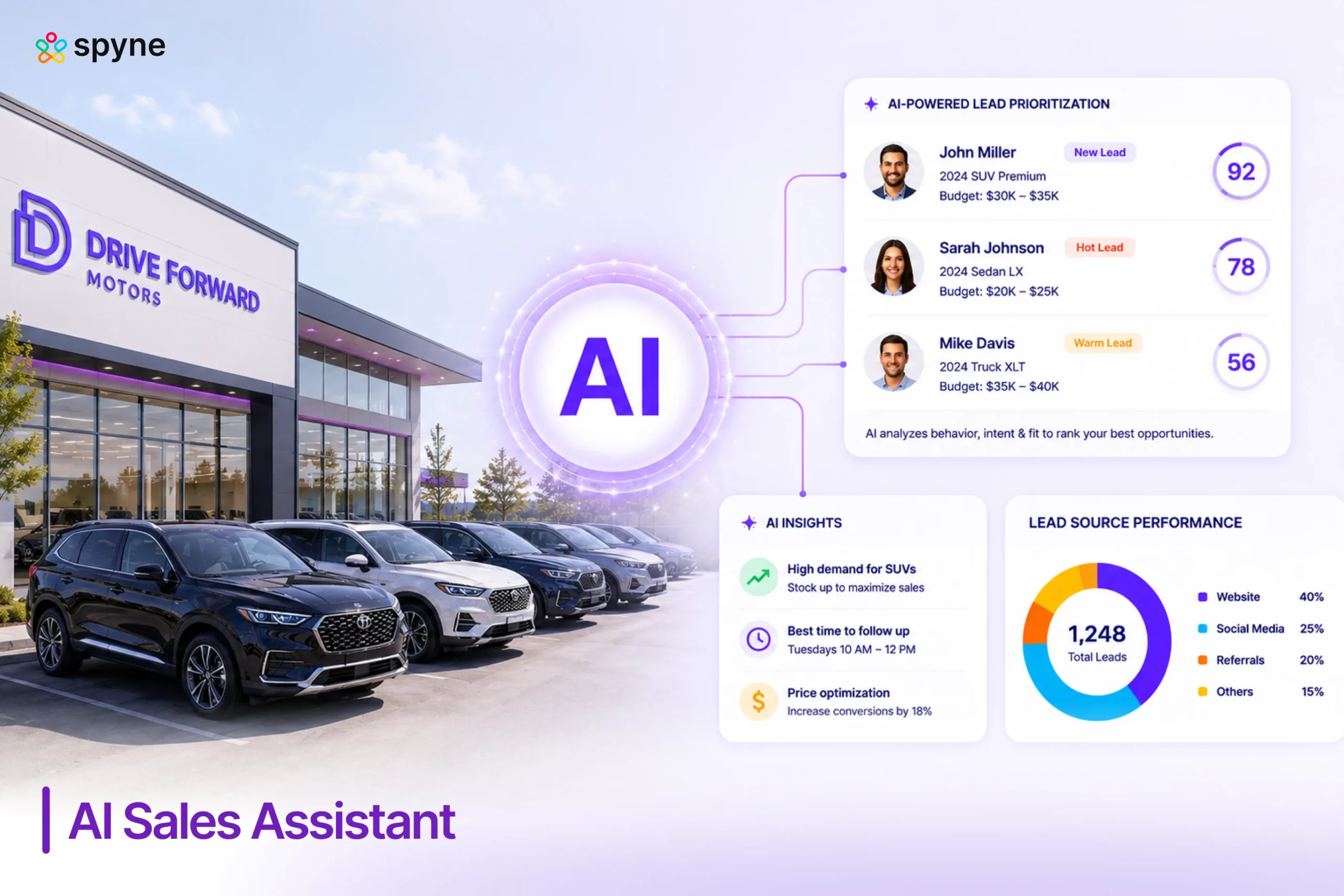
An AI sales assistant for a car dealership is a conversational AI platform that handles first-touch lead engagement, qualification, and CRM logging automatically, without human intervention on initial contact. It responds to inbound leads within seconds, confirms vehicle availability against live DMS inventory, captures buyer intent across six data points, and books appointments directly into the DMS calendar, all before a sales rep or BDC agent touches the record.
The distinction that matters: an AI sales assistant owns the intake workflow. A sales rep owns the conversion workflow. These are different jobs requiring different skills at different moments. Conflating them is where most dealerships quietly lose gross with no line item to point to.
What an AI Sales Assistant Does, and What It Leaves for the Rep?
The two roles are not interchangeable. Mixing them creates a workflow error with a direct cost on the P&L.
What the AI handles:
- Responds to every inbound lead instantly, across call, SMS, and chat, regardless of hour or day
- Confirms vehicle availability against live DMS inventory before the conversation advances
- Asks the qualifying questions: payment target, trade-in status, purchase timeline, financing intent
- Books the appointment into the DMS calendar
- Writes the full qualification record to the CRM before any human sees the lead
What the rep handles:
- Calls the warm lead with full context already logged
- Walks the buyer through the inventory match
- Handles objections that require judgment and empathy
- Builds the relationship that closes the deal
The problem at most stores is not that reps are bad at intake. It is that doing both jobs simultaneously means neither gets done well. A rep processing 40 new leads is not calling the 20 warm conversations from last week. That trade-off is where gross disappears, and it never shows up on a standard CRM report.
Why Response Speed Is the Highest-Leverage Variable in Internet Lead Conversion
Speed-to-lead is the interval between when a buyer submits a lead and when a dealership makes first meaningful contact. It is, consistently across every major industry study, the single highest-impact variable in internet lead conversion, more than price, more than inventory selection.
The data is unambiguous:
- Responding within 5 minutes makes a dealership up to 100x more likely to qualify and connect with a buyer than responding after 30 minutes (Chili Piper)
- 78% of buyers purchase from the first dealership to respond (Lead Connect)
- After 30 minutes, lead qualification probability drops by a factor of 21
- The industry median response time is over 90 minutes, meaning the average store is working leads that have already spoken to competitors (Pied Piper, 4,000+ dealerships)
The stores that improve ILE performance from below 40 to above 80 see a 50% increase in units sold from the same lead volume, according to Pied Piper’s dealer group research. That is the same ad spend, the same inventory, the same team, a better response system.
Before and After: What the CRM Queue Looks Like on Monday Morning
This is the operational gap that costs the most and is the easiest to visualize.
Without an AI sales assistant:
| Detail | |
| Leads in queue | 34 (14 Saturday, 20 Sunday) |
| Leads contacted over the weekend | 0 |
| Already received a competitor quote | 12 |
| How Monday starts | Rep calls Friday 6 PM lead, gets voicemail |
| First two hours of Monday | First-contact calls that should have happened 60 hours ago |
With an AI sales assistant:
| Detail | |
| Leads in queue | 34 (same weekend) |
| Contacted within 5 seconds of submission | 29 |
| Test drive appointments already on the calendar | 11 |
| Leads in active qualification conversation | 7 |
| CRM record contains | Vehicle confirmed in stock, payment target, trade-in status, timeline, full transcript |
| How Monday starts | Rep calls the 7 live conversations with full context |
The difference in close rate is not because the rep improved. It is because they entered the conversation at the right moment with the right information rather than starting from scratch 60 hours later.
The Leads Already in Your CRM That Have Never Been Worked Twice
The most recoverable gross in most stores is not in new ad spend. It is in leads the store already paid to acquire and never followed up on a second time.
The Foureyes 7th Annual Automotive Dealer Industry Benchmarks Report found that 43.2% of dealership sales leads were mishandled, missed calls, unlogged submissions, or abandoned after a single attempt. In a store generating 150 internet leads per month, that is roughly 65 leads going dark every 30 days. Most of those buyers did not lose interest. They heard from a competitor first.
Foureyes also found that 60% of buyers purchased within the first three days of submitting a lead. The close rate drops from 12.4% in the first three days to 2.3% between days four and seven. Follow-up effort drops at exactly the same inflection point. The correlation is not coincidental.
What the math looks like on a standard store:
| Metric | Number |
| Monthly internet leads | 150 |
| Ad spend | $45,000/month |
| Leads mishandled (43%) | ~65 leads |
| Ad spend on never-contacted leads | ~$19,350 wasted |
| Lost deals at 12% close rate | ~8 deals/month |
| Missed gross at $3,800 combined F&I | ~$30,400/month |
How AI re-engagement works:
The system identifies CRM leads with no activity in 48 or more hours and initiates outreach, a call or SMS, tied specifically to the vehicle the buyer originally inquired about. If the lead responds, it qualifies and books. If not, it retries once at a different time, then flags the record for human follow-up with the full context logged.
What the Rep Actually Receives at Handoff, and Why It Determines Adoption
The quality of the AI-to-rep handoff is what determines whether sales reps trust and use an AI sales assistant or quietly route around it.
A poor handoff, name, phone number, appointment time, leaves the rep to re-qualify from scratch. The buyer feels like the store was not paying attention. The rep stops trusting the AI’s output.
A good handoff contains six data points, logged to the CRM before the rep sees the record:
- Vehicle of interest confirmed against live DMS inventory
- Payment target
- Trade-in status (yes/no and rough condition)
- Purchase timeline
- Financing intent
- Suggested opening line based on what the buyer said during qualification
The CRM record also includes the full conversation transcript and an intent score. The rep’s first call is not a qualification call. It opens with: “I saw you were looking at the Camry XLE, we have one confirmed in stock, want to talk through it?”
That difference, context versus a cold introduction, is what converts rep skepticism into rep advocacy for the AI system. The handoff record is the proof point that matters most for internal adoption.
AI Sales Assistant vs. BDC: The Distinction That Costs Dealers When They Get It Wrong
An AI sales assistant and a BDC are not substitutes for each other. Treating them as competing budget items costs dealerships coverage, quality, or both.
Where each belongs:
| Function | AI Sales Assistant | BDC Rep |
| 11 PM inbound lead | Responds in 5 seconds | Off shift |
| Weekend form submissions | Qualifies and books | Not staffed |
| Cold CRM re-engagement (48+ hrs) | Automated, contextual outreach | Bandwidth-limited |
| Price negotiation or objection handling | Escalates to human with transcript | Handles directly |
| Appointment confirmation sequences | Automated | Human confirmation |
| Complex financing questions | Routes to F&I | Handles or routes |
| Inbound service calls (routine scheduling) | Handles directly | Routes or handles |
A BDC handles high-touch communication requiring judgment: inbound calls that need empathy, persuasion-based outbound campaigns, appointment confirmations, and escalations. AI handles high-volume, time-sensitive first touch requiring speed and consistency, the functions that require the system to be available at 11 PM on a Saturday, not a person.
The right deployment runs both in sequence. AI handles intake and first qualification. The BDC works a smaller volume of warmer, already-qualified leads. The result is a higher appointment set rate from the same headcount and payroll line.
How to Deploy AI Sales Assistants in Under a Week? Plug-and-Play Playbook
Rolling out AI sales assistants doesn’t have to feel like an IT project, and need not necessarily come with headaches.
Most teams can get one up and running in less than a week. Here’s roughly how it goes:
- Identify where your leads come from- your site, ads, WhatsApp, and referrals.
- Decide what you want help with first- follow-ups, scheduling, or qualifying.
- Upload your scripts, FAQs, and tone guidelines. Let it learn your voice.
- Integrate your CRM so the assistant logs everything automatically.
- Test, measure, and compare AI-led leads versus manually handled ones.
For instance, suppose a dealership that handles around 300 new leads per week automates nearly 80% of initial outreach. That alone can bring in 20-30 additional deals a month, without hiring anyone new.
These virtual sales assistants can replicate your team’s conversational tone, manage lead flows, and sync data directly into your CRM, all within days and not months. Platforms like Vini AI make this process quick by deploying pre-trained models, ready integrations, and no complicated setup.
How to Evaluate an AI Sales Assistant for Your Dealership: Six Questions That Separate Real Platforms from Marketing
Most vendors describe their products in nearly identical terms: “purpose-built for automotive,” “seamless CRM integration,” “24/7 coverage.” These phrases have been diluted to the point of meaninglessness. What actually differentiates platforms shows up in operational specifics, and in what happens when things go wrong.
The evaluation criteria below come from how GSMs and Internet Directors actually lose money after a bad deployment, not from vendor feature lists.
1. Does It Write Back to the DMS, or Only Read?
The AI must book appointments directly into the DMS and write the full qualification record to the CRM without human intervention. When a vendor says “we integrate with VinSolutions,” ask one specific question: does the integration write back, or does it only pull data?
Read-only integration means a human still creates the appointment manually. That is a notification system, not an AI sales assistant. Write-back determines whether the rep receives context at handoff or just an alert.
Ask: Does your integration write appointment data and qualification records back to [VinSolutions / DealerSocket / CDK / Tekion] without manual input from our team?
2. Has It Been Trained on Actual Dealership Conversations?
A general-purpose AI platform can technically be configured for automotive. The problem is that configuration takes months, requires continuous iteration, and fails at edge cases, at the worst possible moments. Purpose-built automotive AI handles the scenarios that appear in every real dealership call: confirming a specific VIN is in stock, handling a trade-in question without pricing it, distinguishing between a new-car inquiry and a service call, and routing each correctly.
Ask: How does your AI handle [trade-in questions / VIN availability / service vs. sales routing]? Can we listen to a live or recorded dealership call?
3. Who Reviews Flagged Calls, and How Fast?
Every new outreach workflow or lead source should be tested before going live with actual customers, and vendors should maintain an ongoing quality assurance process that reviews real conversations, not just at initial launch. Ask every vendor: who reviews flagged calls, how quickly, and what is the escalation path when the AI gives incorrect information?
A daily human review loop prevents a single bad interaction from becoming a pattern. It is also the most credible answer to the “what if the AI says something wrong?” objection, which will come from reps and floor managers in every store.
Ask: What is your QA process after launch? Who reviews flagged calls and what is the response SLA?
4. Is It TCPA-Compliant, and Who Owns Liability?
Auto dealers face substantial exposure under the Telephone Consumer Protection Act as they rely more on AI-enabled outbound communication. Statutory damages run $500 to $1,500 per alleged violation, and a single outbound AI campaign with improper consent management can generate class-action exposure that dwarfs the cost of the platform.
The FTC’s position has consistently been that whoever controls the communication owns the liability, not the vendor and not the platform. The FCC’s 2026 one-to-one consent rule requires explicit individual consent for each seller, eliminating the shared consent loophole that previously let lead generators distribute contact data to multiple buyers.
Vini AI is SOC2, TCPA, GDPR, and DNC compliant. Before signing any contract, confirm: how consent is captured and stored, how opt-outs are processed across channels, and whether call recordings satisfy your state’s disclosure requirements.
Ask: How does your platform manage TCPA consent, DNC scrubbing, and state-specific disclosure requirements? Who owns compliance liability if a violation occurs?
5. What Happens When the AI Cannot Handle a Call?
Pied Piper’s 2025 Service Telephone Effectiveness Study found that when dealership AI systems needed to transfer a caller to a human, those handoffs failed 56% of the time. The AI booking rate was strong. The handoff design was not. A system that books well but escalates poorly destroys exactly the trust it was meant to build.
A reliable escalation requires: the AI identifying the trigger accurately (negotiation, pricing question, upset caller), passing the full conversation transcript to the human receiving the transfer, and completing the transfer without dropping the call. All three must work.
Ask: What percentage of your escalation transfers complete successfully? Can we see data from live dealership deployments?
6. Does the Reporting Show Revenue, or Just Activity?
Many AI platforms default to reporting on activity: calls handled, messages sent, response time averages. These tell you whether the system is running. They do not tell you whether it is paying off.
The metrics that matter to a GSM are: contact rate on new leads in the first hour (benchmark: 95%+ with AI versus 30–40% without), appointment set rate per 100 internet leads at 60 days (benchmark: 18–25%), and gross recovered from AI-booked deals against platform cost. If a vendor’s reporting dashboard leads with messages sent and cannot show you gross per AI-booked appointment, the reporting is built to justify the renewal, not to inform management decisions.
Ask: What does your standard reporting show at 30, 60, and 90 days? Can you show appointment set rate and gross from AI-booked deals at a comparable-size store?

Closing Thoughts
The dealerships getting results from AI sales assistants are not the ones with the most sophisticated tech stacks. They are the ones that ran an honest audit of what was actually happening to their leads, how many went uncontacted overnight, how many got one call and nothing after, how many reps spent Monday morning on intake instead of selling.
Dealership automation does not fix a broken sales process. But it does close the gaps that a capable process cannot cover with human bandwidth alone: the 11 PM form submission, the 65 un-worked CRM leads, the Monday queue that should have been warm conversations. If you want to see what a fully qualified, CRM-logged handoff looks like before a rep’s first call, book a demo with Spyne.