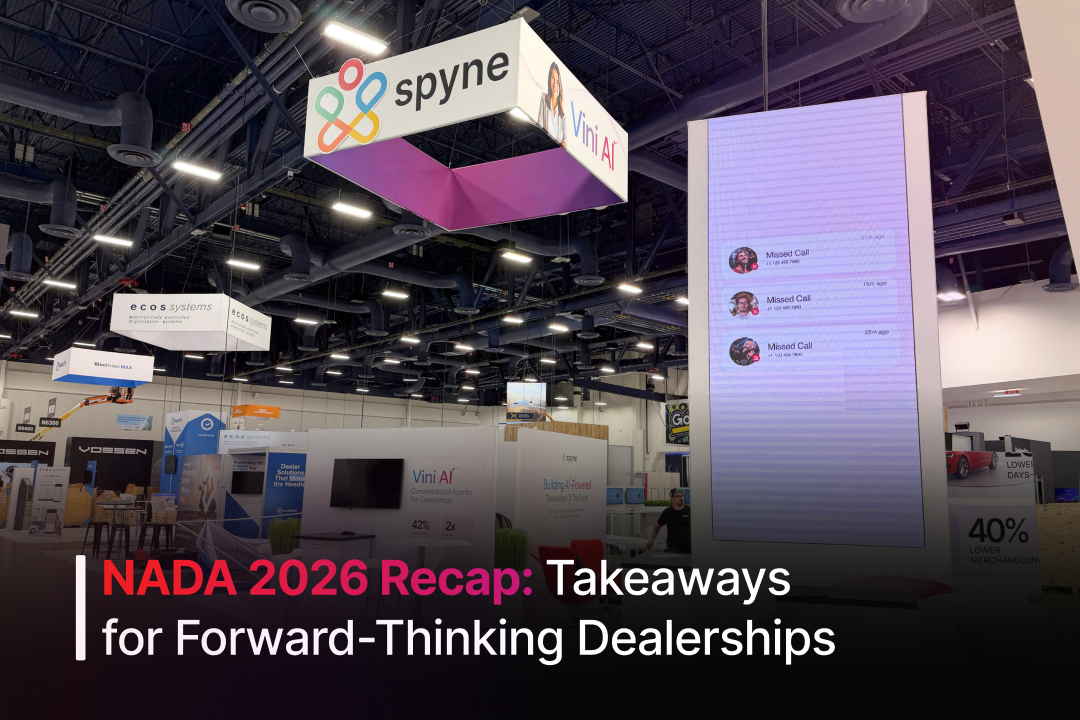

Las Vegas delivered four packed days of straight talk about where automotive retail is headed. At NADA Show 2026, the energy was electric, and the questions dealers asked were different.
This year wasn’t about features or collecting vendor brochures. Attendees showed up with an execution-first mindset. The conversations that mattered centered on measurable ROI, seamless workflow integration, and tools teams could adopt with minimal friction.
Here’s a concise breakdown of the themes that dominated the show, the challenges dealers voiced, and the priorities shaping decisions for the rest of 2026.
Main Stage Speakers & Key Takeaways from the NADA Show
NADA’s Main Stage set the tone for the week with an inspiring speaker lineup that brought leadership, resilience, and real-world strategy to the forefront:
#1. Jon Dorenbos, Former NFL Player & World-Class Magician
Jon Dorenbos took the Main Stage with a keynote centered on resilience, adversity, and perspective. Blending storytelling with humor and illusion, he shared personal experiences that underscored the power of mindset, gratitude, and teamwork in overcoming life’s challenges.
#2. Molly Fletcher, Former Sports Agent, Author & Podcaster
The lessons Molly brought into the dealership world, focused on leadership discipline and high-performance habits. She introduced her “Dynamic Drive” principles, connecting mindset and energy to business outcomes and long-term influence.
#3. Alex Rodriguez, Former Baseball Player & Chairman/CEO of A-Rod Corp
Positioned to speak on leadership, strategic thinking, and the entrepreneurial mindset, Alex Rodriguez brought insights shaped by both professional sports and business investment. His perspective connects high-performance team dynamics with modern business ecosystems, with a focus on scaling operations and driving innovation.
#4. Tom Castriota, 2025 NADA Chairman & Mike Stanton, NADA President & CEO
NADA leadership opened the general session by reinforcing dealer unity, advocacy efforts, and the industry’s deep community roots.
Tom Castriota emphasized that dealers share common values and purpose across communities. Mike Stanton pointed to legislative engagement and industry wins as proof of the impact dealers can have when unified.
Key Industry Themes from NADA Show 2026
The NADA Show 2026 in Las Vegas delivered a powerful blend of strategic insights, industry thought leadership, and actionable takeaways for automotive retailers and solution providers alike. Here’s which ones stood out:
1) ROI-First Technology Buying Replaced Feature-First Buying
Across floor conversations and session recaps at NADA Show 2026, attendees evaluated technology through a profitability lens, not a feature checklist. Buying behavior has matured. Instead of asking what a tool can do, dealers focused on what it measurably improves in terms of revenue, conversion, cost control, or turnaround time. Focusing on:
- ROI validation over feature depth, with dealers asking for outcome metrics and benchmarks.
- Faster payback expectations, with preference for tools tied directly to revenue or efficiency gains.
- Performance dashboards and attribution clarity, not just capability demos.
2) Dealers Are Streamlining Their Technology Stacks for Operational Efficiency
Conversations across booths and sessions reflected a shared fatigue with managing too many disconnected tools across CRM, marketing, inventory, service, and communications. Instead of adding more standalone software, dealers are actively looking to simplify their tech stacks, favoring integrated platforms that reduce data silos and improve cross-department visibility.
The shift showed up in how buying questions were framed:
- Preference for integrated suites instead of multiple niche vendors.
- Demand for shared data across sales, service, and marketing systems.
- Fewer dashboards, more unified reporting views.
- Reduced vendor overlap to lower operational complexity.
Operational efficiency now includes stack efficiency for technology is expected to connect processes, not multiply them.
3) Digital Retail & Speed-to-Lead Performance Are Competitive Differentiators
A major operational theme across sessions and exhibitor showcases at NADA Show 2026 was the growing importance of response speed and digital retail execution. Dealers are no longer treating lead handling and online buying steps as secondary workflows, they’re treating them as primary conversion levers.
As one industry observer from the show put it,
‘AI is everywhere, but expectations are higher: Dealers are moving past experimentation and prioritizing reliable AI that delivers practical value through improved call coverage, accurate reporting, and measurable impact on connect rates and appointments booked.’
4) Affordability Pressure Is Reshaping Dealer Strategy
Affordability dominated dealer conversations, with rising vehicle prices, higher interest rates, insurance, and ownership costs tightening buyer decision windows. Focus areas include:
- Better financing flexibility
- Payment-first merchandising instead of price-first listings
- Greater emphasis on used and certified inventory to widen affordability bands
5) Consumer Financial Strain Is Influencing Sales Conversations
Dealer sentiment reflected growing awareness of consumer stress signals, including rising delinquencies and tighter household budgets. This is changing how sales and F&I teams approach qualification, structuring, and follow-up. The shift is from volume-driven selling to deal-structure discipline and risk-aware engagement. Key implications include:
- More rigorous pre-qualification and payment sensitivity checks
- Emphasis on transparent pricing and total cost breakdowns
- Stronger F&I positioning to protect approvals and backend revenue
6) Efficiency Gains Are Preferred Over Headcount Expansion
Rather than expanding teams, most dealerships are prioritizing productivity gains from their current workforce. Budget tightening is not translating into hiring freezes alone, it’s driving demand for tools and processes that help teams handle more workload with greater consistency. Focus areas include:
- Automation across merchandising, listing, and marketing workflows
- Process standardization to reduce dependency on individual performers
- Tools that compress turnaround time without adding staff
- Technology that supports throughput, not just reporting

Inside the Dealer Conversations at the Spyne Booth
If the main-stage conversations at NADA Show 2026 emphasized discipline, profitability, and operational clarity, the discussions at our booth went one layer deeper, how that discipline actually gets built inside the dealership.
Three dealers discussion amongst hours of dealership conversations that shaped every meaningful conversation at Spyne:
#1. Dealerships Are Embedding AI Into Daily Operations, Not Standalone Tools
AI must function as the dealership’s operating layer, said Chad Staples during a fireside chat at the NADA 2026 show hosted by Spyne. Disconnected tools create lag across sales, service, and marketing, while an end-to-end operating system helps dealerships convert speed and coordination into revenue.
The Way Ahead:
- AI is being tied to measurable sales & conversion lift
- Workflow automation over standalone AI features
- Vendor partnerships focused on dealership use cases, not generic AI capability
- Efficiency and consistency gains across merchandising, marketing, and lead handling
#2. High-Performing Dealerships Are Doubling Down on Consistency
In a live Q&A with Brian Benstock of Paragon Honda, the conversation surfaced insights into what separates elite dealerships from the rest:
- Operational adoption matters: Sanjay Kumar emphasized that software only earns adoption when it actually works in daily operations
- Consistency is the competitive edge: Automation wins when it delivers reliable results every single time, something Benstock has proven on his own showroom floor
#3. The Future of Retail Is Digital Efficiency Backed by Human Judgment
Doug Horner, GM at Mercedes-Benz of North Olmsted and host of the Benzs & Bowties channel, joined us for a chat to address practical challenges in dealership AI execution. He highlighted how leadership conversations have shifted from discussing features to driving execution inside daily workflows.
The discussion wrapped with a data-backed look at the future of car buying: more digital, more human, or both? AI tools should remove operational friction while humans build trust and close deals. That’s exactly what Spyne’s conversational AI, Vini, was purpose-built for, handling lead response, qualification, appointment booking, and follow-ups automatically, so sales teams can focus on high-value conversations.
What We Brought to the Ground at NADA 2026
Every year, NADA is where real dealership execution stories surface, not just product launches. Here’s what Spyne showcased and discussed on the ground in 2026:
- Live Booth Conversations & Dealer Strategy Sessions: Live Q&A, back-to-back dealer conversations and fireside chats with industry leaders like Glen Lundy, Gerhard Lourens, Jason Moka to name a few, focused on how AI is moving from experimental use to daily operational execution.
- Industry Magazine & Insight Resources: Spyne also spotlighted ‘Dealer Pulse’, its first dealership-focused industry magazine, featuring data-backed trends, operational benchmarks, and execution playbooks for modern auto retail.

Missed Us at NADA 2026?
Let’s continue the conversation.
In 2026 and years to come, execution will be the new advantage. Dealers today are moving fast, turning AI from pilot projects into operational systems that drive real ROI.
The shift is already underway. The question is whether your dealership will lead it or catch up later.
If we didn’t connect in Las Vegas, book a demo with Spyne and see how you can put AI to work inside your daily workflows, simply, seamlessly, and at scale.