
In the competitive automotive industry, missing a call means losing a deal. Car buyers expect quick, reliable, and genuine responses 24/7. AI phone answering services meet these rising customer expectations while delivering 24/7 support. Modern automotive answering services handle every incoming call, schedule service appointments, route complex queries to human agents, and log everything to your CRM.
In this guide, we will break down how AI phone answering for car dealerships helps capture more leads around the clock and boost more showroom visits. Whether you’re a small business handling overflow calls or a high-intent automotive operation managing peak-hour demand, this guide is for you.
What is an Automotive Answering Service?
An automotive answering service is a specialized call-handling solution for car dealerships and auto repair shops. Instead of sending calls to voicemail, a live or AI agent answers immediately and resolves customer queries. Automotive answering services typically operate in three ways:
1. Traditional Live Phone Answering Service
Human agents answer incoming calls, handle basic customer queries, take messages, and route callers to the right department. They offer a personal touch but may have limited availability outside business hours.
2. AI Call Answering Service Automotive
AI voice agents answer calls instantly, understand customer requests, and handle tasks such as booking service appointments, capturing leads, and answering common questions. They can provide 24/7 call coverage without requiring staff to answer every call.
3. IVR / Automated Phone Trees
IVR systems use prerecorded messages and menu options to direct callers to the right department, such as sales, service, or parts. They help organize call traffic but often require callers to navigate menus before reaching the right destination.
Why Do Dealerships Need an AI Phone Answering Service?
Dealerships handle calls about vehicle availability, test drives, service appointments, and repair updates. When staff is busy or unavailable, these calls can go unanswered, leading to missed sales opportunities, lost service bookings, and frustrated customers.
An AI Phone answering service helps dealerships answer calls instantly, capture leads, and manage routine inquiries around the clock. From booking service appointments to routing complex requests, an automotive AI receptionist for car dealerships helps teams stay responsive without adding to their workload.
For service departments, AI automotive lead response solutions for missed calls in auto service can be especially useful during peak hours, when advisors are busy assisting customers. By handling routine questions and appointment requests, AI helps dealerships manage call volumes more efficiently while allowing staff to focus on customers who need personal assistance.

AI Phone Answering Service Vs Live Answering Service
An AI phone answering service and a live answering service help dealerships manage incoming calls, but they differ in how they handle customer interactions, call volume, and availability. Understanding these differences can help dealerships choose the right approach for reducing missed calls and improving customer service.
| Feature | AI Phone Answering Service | Live Answering Service |
| Availability | Can provide 24/7 call coverage, including weekends and holidays. | Depends on the provider’s operating hours and staffing. |
| Response Time | Answers calls instantly when available, without traditional queues. | Callers may experience hold times during busy periods. |
| Call Handling Capacity | Handles multiple calls simultaneously, depending on system capacity. | Handles calls based on the number of available agents. |
| Customer Interaction | Uses conversational AI to answer questions and manage routine requests. | Offers human interaction and more flexible judgment. |
| Routine Tasks | Can capture leads, answer FAQs, and schedule appointments when integrated with relevant systems. | Agents can take messages, answer questions, and book appointments based on their access and training. |
| Cost | Pricing typically depends on features, usage, and subscription plans. | Pricing may depend on call volume, handling time, and coverage requirements. |
| Scalability | Can manage call spikes without hiring additional agents for every increase in volume. | Higher call volumes may require additional staffing or service capacity. |
| Handling Complex Queries | May need to transfer sensitive or complex requests to a human agent. | Human agents can use judgment to handle unexpected or nuanced conversations. |
| Best Suited For | Dealerships looking to automate routine calls, extend coverage, and reduce missed opportunities. | Dealerships that prioritize human interaction for call handling and customer support. |
Use Cases of AI phone answering for car dealerships
Car dealerships receive calls about vehicle availability, test drives, service appointments, repair updates, and recalls. An AI phone answering system helps manage these conversations, capture customer information, and handle routine requests when dealership staff are busy or unavailable.
Here are some practical ways AI phone answering for car dealerships can support sales and service operations.
1. Service Appointment Booking
AI auto attendant phone system can handle calls for oil changes, tire rotations, routine maintenance, and other service requests. When connected to compatible scheduling systems, it can check availability, book appointments, and send confirmation messages.
2. Vehicle Inventory Inquiries
Potential buyers often call to check whether a specific make, model, trim, or color is available. An AI agent connected to dealership inventory systems can answer these questions and help buyers take the next step, such as scheduling a test drive.
3. After-Hours Lead Capture
Not every buyer calls during dealership business hours. An after-hours answering service can respond to after-hours inquiries, collect contact details, record vehicle preferences, and pass qualified leads to the sales team for follow-up.
4. Call Routing and Department Transfers
Dealerships receive calls for sales, service, parts, financing, and other departments. AI can identify why someone is calling and route them to the appropriate team, reducing unnecessary transfers and helping callers reach the right person.
5. Missed-Call Recovery and Follow-Ups
When sales representatives or service advisors cannot answer, AI can capture caller details and arrange follow-ups. Depending on its capabilities, it can also make outbound calls or send messages to reconnect with customers who missed appointments or need to schedule service.
6. Recall Notifications and Service Reminders
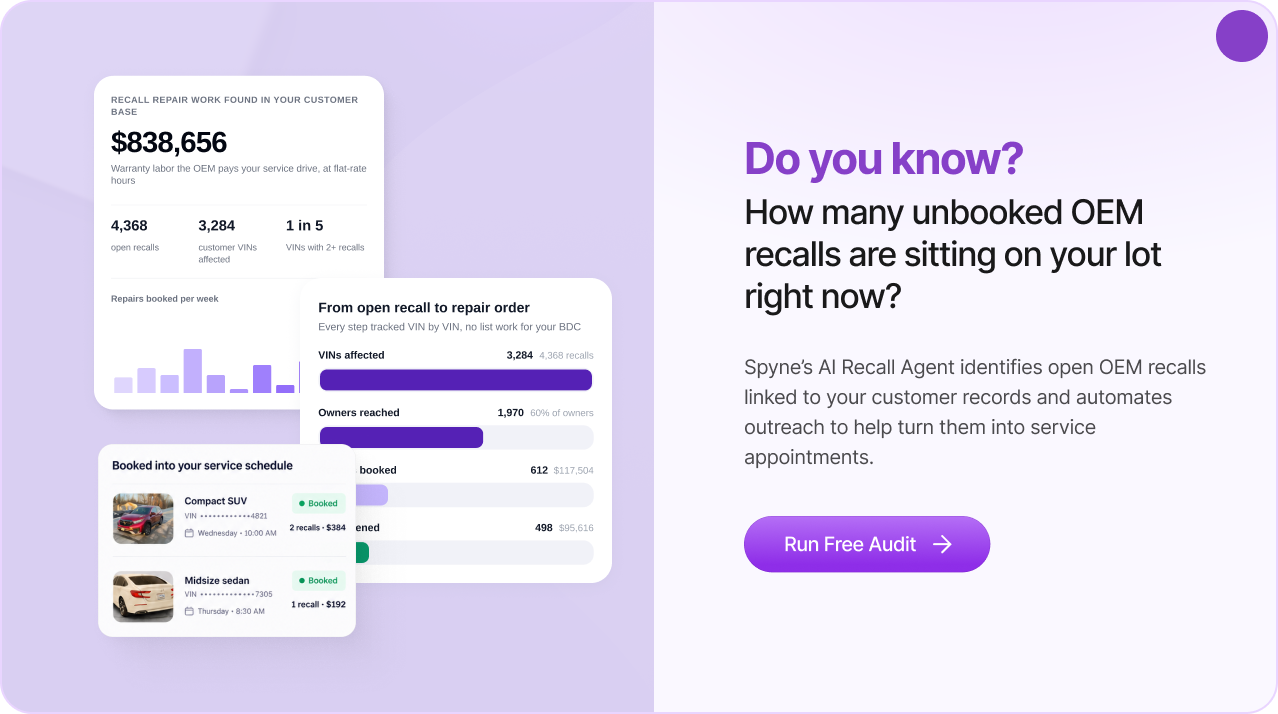
AI agents can contact eligible customers about open recalls, overdue maintenance, or upcoming service needs. With access to approved customer records and compatible systems, they can answer basic questions and help customers schedule an appointment.
7. Repair Status and Common Service Questions
Customers frequently call to ask whether their vehicle is ready, what the service department’s hours are, or what happens during a maintenance visit. AI can answer supported questions using dealership-approved information and route repair-specific requests to service advisors when needed.
8. Call Summaries and Performance Tracking
AI call handling for dealerships can record conversation details, summarize customer requests, and capture lead information for follow-up. These insights help dealership managers identify recurring questions, review missed opportunities, and understand where additional staff support may be needed.
Ultimately, the right system depends on your dealership’s call volume, workflows, and existing technology. When evaluating AI solutions for missed calls in auto service, prioritize accurate responses, reliable appointment scheduling, integrations with your existing systems, and smooth transfers to human staff.
Best AI Phone Answering Services Businesses Can Use in 2026
Businesses evaluating the best AI phone answering service or best virtual answering service should focus on solutions that deliver outcomes and not just basic call answering. Below is a list of the best phone answering services powered by AI currently available in the market.
How these tools were selected:
We evaluated on criteria like human-like voice quality, use-case fit, ease of setup, advanced call handling (lead capture, appointment booking), seamless integrations, scalability, and transparent pricing. Rather than ranking tools generically, this list highlights where each AI answering service performs best, so businesses can choose based on their specific needs.
1. Spyne AI
Spyne is a purpose-built AI phone answering service designed to reduce missed calls, manage peak-hour demand, and convert inbound conversations into qualified leads. Its automotive-first architecture understands dealership workflows, captures vehicle and service details, and intelligently routes urgent calls.
Pros:
- Customized for dealership and service workflows
- Deep CRM/DMS integration via an AI receptionist
- Multilingual support with actionable analytics
Standout Feature: Automotive-specific call logic powered by an AI call bot for car dealerships that directly drives bookings, leads, and revenue.
Best For: Automotive dealerships, service departments, and high-intent automotive businesses looking to replace legacy systems like a traditional car dealership phone system
2. Smith.ai
Smith.ai combines AI call handling with trained human agents to manage inbound calls, screen leads, and book appointments while escalating complex conversations to live receptionists.
Pros:
- A hybrid model combining AI with live virtual receptionists
- Reliable for appointment booking and call screening
- Strong integrations with CRMs and scheduling tools
- Well-suited for professional services and small teams
Standout Feature: Smooth AI-to-human escalation without disrupting the caller experience.
Best For: SMBs that want AI efficiency with live human backup
3. Allo
Allo focuses on answering inbound calls, handling FAQs, and capturing basic caller information with minimal setup, making it suitable for small teams starting with AI answering.
Pros:
- Strong conversational AI with natural voice interactions
- Flexible call flows for FAQs, transfers, and basic bookings
- Easy setup for SMBs and service-based businesses
- Supports multi-language call handling
Standout Feature: Fast deployment with low configuration overhead.
Best For: Small businesses needing quick AI call coverage
4. Goodcall
Goodcall emphasizes natural, human-like phone conversations, allowing businesses to answer questions, handle bookings, and engage callers without complex workflows.
Pros:
- Natural-sounding AI conversations for inbound calls
- Customizable scripts aligned with brand voice
- Handles FAQs, message capture, and call routing effectively
- Useful analytics and call summaries
Standout Feature: Conversational AI that feels less scripted to callers.
Best For: Local and service-based businesses prioritizing conversational AI
5. Sona AI
Sona AI is built around advanced conversational voice AI, enabling more adaptive and context-aware responses compared to rule-based answering systems.
Pros:
- Fast deployment with minimal configuration
- Handles high call volumes reliably
- Good fit for appointment-heavy businesses
- Offers real-time call insights and reporting
Standout Feature: Dialogue-first voice AI designed for fluid conversations.
Best For: Businesses focused on dynamic, intent-driven conversations
6. Rosie AI
Rosie AI acts as a virtual receptionist, answering inbound calls, transferring them, and capturing messages when teams are unavailable.
Pros:
- Designed specifically for dealership sales and service calls
- Handles overflow and after-hours automotive inquiries
- Integrates with dealership workflows and calendars
- Improves missed-call recovery during peak hours
Standout Feature: Receptionist-like call flows for inbound coverage.
Best For: Local businesses replacing front-desk call handling
7. Emitrr
Emitrr combines AI phone answering with SMS automation to manage calls, follow-ups, reminders, and missed-call texts from a single platform.
Pros:
- AI calls paired with SMS workflows
- Automated reminders and follow-ups
- CRM and scheduling integrations
Standout Feature: Strong call-to-text automation that reduces missed opportunities after calls end.
Best For: Multi-location SMBs and service businesses
8. Dialpad AI Voice
Dialpad AI Voice embeds AI call answering, transcription, and insights directly into its cloud phone system.
Pros:
- Native real-time speech recognition and AI call transcription
- Live coaching prompts and post-call summaries
- Unified voice, video, and messaging platform
- Strong fit for modern, distributed sales and support teams
Standout Feature: AI insights are tightly integrated into a business phone platform.
Best For: Businesses already using Dialpad
9. RingCentral AI Voice
RingCentral AI Voice adds AI-powered call handling to its unified communications platform, offering advanced routing, analytics, and scalability for high-volume environments.
Pros:
- Enterprise-grade scalability
- Advanced call routing and analytics
- Works within RingCentral’s UC ecosystem
Standout Feature: Built for large-scale operations already using enterprise phone systems.
Best For: Enterprises with large call volumes and complex routing needs
10. Talkdesk AI Voice
Talkdesk AI Voice delivers AI-driven automation, intent detection, and routing for high-volume contact centers.
Pros:
- Enterprise-grade conversational AI with strong intent detection
- Advanced IVR, sentiment analysis, and call routing logic
- Deep integrations with Salesforce and enterprise CRMs
- Built for high-volume contact centers with complex workflows
Standout Feature: AI call automation built for contact-center scale.
Best For: Contact centers and complex call environments
Why Spyne’s 24/7 AI Phone Answering Service?
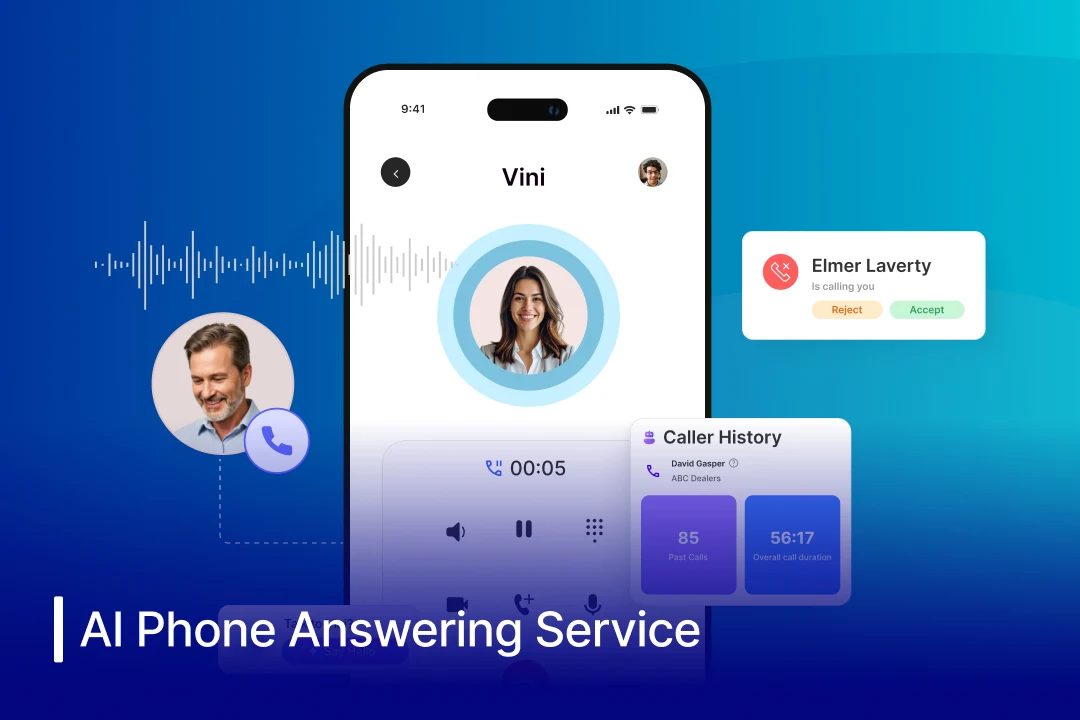
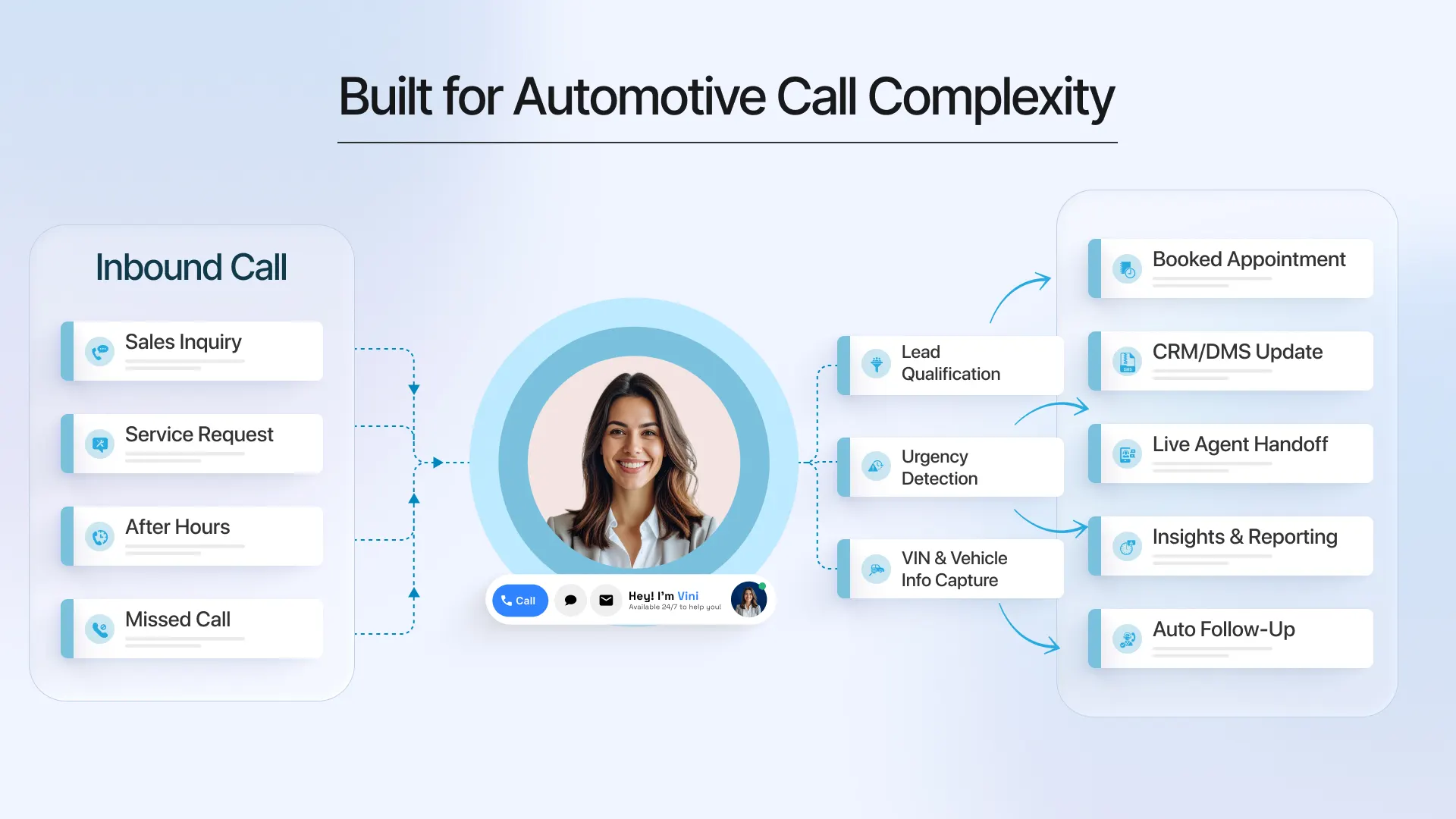
Spyne’s 24/7 AI Phone Answering Service helps dealerships respond to customer calls, capture leads, and manage routine inquiries without overloading sales or service teams. From instant responses to automated follow-ups, it keeps customer communication running smoothly, even after business hours.
1. Instant Responses
Spyne’s AI agent answers inbound calls within 5 seconds, helping customers get assistance without long hold times or voicemail. This AI phone answering service keeps your dealership accessible, even during peak hours.
2. Identifies Customer Intent
The AI agent understands why a customer is calling, whether they need vehicle information, want to book a service appointment, or have a question for your sales team. It routes each inquiry appropriately, making AI call handling for dealerships more efficient.
3. Human-Like Conversations
Instead of relying on rigid phone menus, Spyne’s AI voice agent engages callers in natural, conversational interactions. It answers common questions, gathers relevant details, and transfers complex requests to your team when human assistance is needed.
4. Appointment Scheduling and Lead Capture
From service bookings to test drive requests, the AI agent helps customers take the next step without waiting for a staff member. This AI phone answering for car dealerships helps capture inquiries and convert more calls into actionable opportunities.
5. Automatic CRM Sync and Follow-Ups
Customer details and call summaries can sync with connected CRM systems, giving your team the context needed for follow-ups. By keeping inquiries organized, Spyne’s automotive answering service helps sales and service teams manage customer conversations more consistently.
6. Call Overflow
Spyne’s call overflow solutions handle incoming calls when sales representatives and service advisors are busy or already on other calls. It helps reduce hold times, capture customer details, and ensure inquiries are not missed during peak hours. This allows your dealership to manage high call volumes more efficiently without putting additional pressure on your team.
Top 10 Core Features of AI Call Handling for Dealerships
AI call handling for dealerships helps manage incoming and outgoing calls, capture customer inquiries, and automate routine tasks across sales and service departments. Here are 10 core features to look for when choosing a solution.
1. 24/7 Availability
AI phone agent answers customer calls beyond regular business hours, including weekends and holidays. Round-the-clock coverage helps dealerships respond to inquiries even when their sales and service teams are unavailable.
2. Automated Appointment Scheduling
It allows customers to book service appointments or request test drives over the phone. When connected to compatible scheduling systems, AI can check availability, confirm bookings, and send appointment details.
3. Overflow Call Handling
Automotive AI answering services manage incoming calls when dealership phone lines become busy during peak hours. AI can answer multiple calls simultaneously, helping reduce hold times and capture inquiries that might otherwise go unanswered.
4. Bilingual Answering Service
AI phone agent with a bilingual answering service communicates with customers in supported languages to make conversations more accessible. A bilingual AI agent can answer questions, collect customer details, and assist callers in their preferred language.
5. Intelligent Call Routing
AI identifies why a customer is calling and directs them to the appropriate department, such as sales, service, or parts. This helps reduce unnecessary transfers and gets callers to the right team faster.
6. CRM Integration
AI phone answering service connects the AI system with your dealership’s CRM to record customer details, call summaries, and lead information. This gives sales and service teams useful context for managing inquiries and follow-ups.
7. After-Hour Answering Services
After-hour answering services capture sales inquiries, service requests, and callback details when the dealership is closed. Instead of leaving customers with voicemail, AI can provide immediate assistance and help the team follow up during business hours.
8. Outbound Calling
AI call handling for dealerships automates follow-up calls for service reminders, appointment confirmations, missed inquiries, and eligible recall notifications. Outbound calling helps dealerships reconnect with customers without requiring staff to make every call manually.
9. Lead Qualification and Capture
Call handling AI for car dealerships collects information about a buyer’s vehicle preferences, budget, purchase timeline, or service needs. AI can organize these details and pass qualified inquiries to the relevant team for follow-up.
10. Call Summaries and Analytics
AI call analytics generate call summaries and track conversation outcomes, customer intent, and recurring questions. These insights help dealership managers review call-handling performance, identify gaps, and improve customer communication processes.

Conclusion
An AI phone answering service is no longer just a call-handling tool, but a revenue protection and efficiency layer. For automotive businesses, Spyne’s AI phone answering service delivers measurable impact without increasing headcount.
It combines always-on coverage, industry-specific intelligence, and seamless integration, making it easier to capture every opportunity without increasing headcount. Book a demo today and optimize call handling for your dealership.
Disclaimer: These services are included for comparative purposes. Spyne is not affiliated with the other tools listed; their inclusion does not constitute endorsement.