
AI is no longer a novelty in automotive retail. Over the past few years, dealerships have rapidly adopted AI-driven tools to respond faster, automate workflows, and manage growing digital demand. Yet despite this widespread adoption, performance gains remain uneven and often fail to scale beyond isolated improvements.
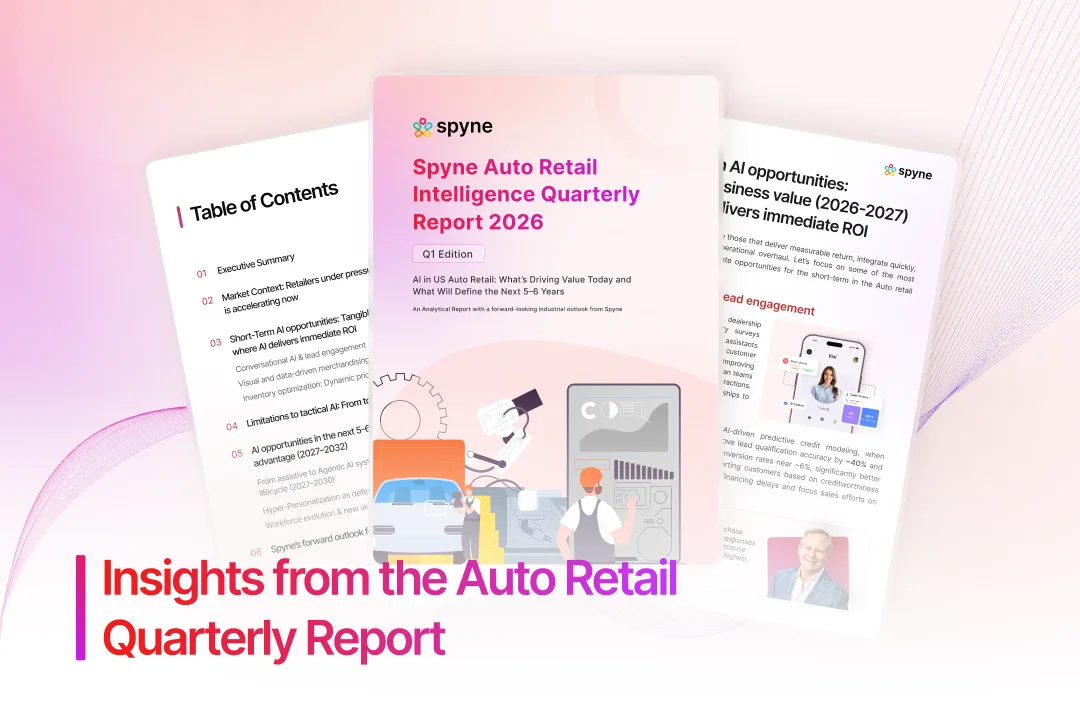
This gap between activity and outcomes is a central theme in Spyne’s Auto Retail Intelligence Quarterly Report 2026, which examines how AI is being deployed across dealerships today and why execution gaps persist despite rising adoption.
This article draws on those insights to examine why tactical AI is reaching its limits, how fragmentation impacts measurable outcomes, and what it takes to move toward an AI-controlled dealership ecosystem built for sustained performance.
AI is No Longer a Differentiator in Auto Retail
As per the Auto Retail Intelligence Report, AI adoption across automotive retail has accelerated rapidly. Most dealerships now deploy AI across lead response, customer communication, inventory merchandising, and pricing intelligence to manage rising digital demand and ongoing staffing constraints.
AI adoption in the automotive retail industry has accelerated rapidly. Today, most dealerships utilize AI across lead response, customer communication, inventory merchandising, and pricing intelligence to address rising digital demand and ongoing staffing constraints.
These tools have delivered clear gains at the task level, particularly in reducing response times and increasing operational efficiency. However, broader performance outcomes have not improved at the same pace.
In many dealerships, AI exists as a set of disconnected tools, each optimized for a specific function but unable to coordinate across the buyer journey. As a result, activity increases without consistent improvement in lead progression, qualification quality, or conversion outcomes.
The industry has moved beyond the question of adopting AI. The real challenge now is using AI in a way that drives execution across the entire funnel.
Why Tactical AI Breaks Down at Scale?
Tactical AI refers to point solutions built to optimize individual dealership tasks such as faster lead responses, automated follow-ups, or dynamic pricing. While effective in isolation, these tools lack visibility into the full buyer journey.
The most significant losses in auto retail occur between funnel stages, including:
- inquiry to qualification,
- qualification to appointment,
- and appointment to purchase.
Even 2-5% drop-offs at each funnel transition can compound into substantial revenue loss over a quarter when scaled across dealership volume. And because tactical AI operates without shared context, cumulative intent signals, or downstream awareness, it cannot coordinate progression across these transitions.
This results in faster activity but uneven outcomes, with high-intent and low-intent buyers often treated the same. When performance is evaluated across the full funnel, the cost of fragmented AI becomes increasingly clear.
What Fragmented AI Is Costing Dealerships?
Across the dealerships analyzed in the report, fragmentation across AI systems consistently leads to measurable performance gaps that often remain hidden when metrics are viewed in isolation. When tools operate without shared context or coordinated logic, inefficiencies emerge across the sales funnel rather than within individual tasks.
These gaps typically show up as:
- longer lead-to-qualification timelines,
- lower appointment show rates,
- inconsistent conversion from appointment to sale,
- uneven workload distribution across sales teams.
Individually, none of these metrics may appear alarming. However, when evaluated across the full buyer journey, they reveal a pattern of lost momentum at critical transition points. Strong performance at the task level fails to translate into stronger outcomes at the funnel level.
This disconnect explains why incremental optimization alone rarely delivers sustained gains and why structural alignment across systems is required to improve execution.
For a deeper breakdown of these execution gaps and the underlying data, you can download this auto retail quarterly report by Spyne.
Building an AI-Controlled Dealership Ecosystem
As the limitations of tactical AI become more apparent, a different approach is gaining traction across high-performing dealerships. Instead of adding more point solutions, these organizations are shifting focus toward how AI operates across the dealership as a whole.
An AI-controlled dealership ecosystem is built around coordination rather than isolated automation. Instead of tools reacting to individual triggers, AI functions as an operating layer that:
- aggregates buyer signals across channels,
- evaluates intent continuously rather than at fixed steps,
- prioritizes actions based on their impact on funnel progression,
- and orchestrates engagement across teams and touchpoints.
This shift moves AI from task execution to decision intelligence. Engagement, follow-ups, and handoffs are no longer managed independently but aligned across the buyer journey.
Platforms like Spyne increasingly reflect this ecosystem-driven approach by unifying conversational AI, intent detection, and operational intelligence to drive execution, not just efficiency.

Why Buyer Journeys Now Require AI Orchestration?
Buyer behavior in auto retail has evolved faster than dealership processes. Today’s buyers move across multiple digital touchpoints, often switching channels mid-conversation and expecting continuity throughout their interactions.
AI-led buyer journeys address this complexity by maintaining context across every engagement. Rather than treating each interaction as a standalone event, integrated AI systems recognize patterns over time and adapt responses accordingly.
In practice, this enables dealerships to:
- preserve buyer context across channels and sessions,
- adjust engagement based on real-time behavior and intent,
- maintain momentum without relying on manual intervention.
Dealerships adopting AI-led orchestration typically see faster progression from inquiry to qualification, more consistent appointment setting, and improved overall funnel efficiency. These gains are measurable and tied directly to journey-level performance rather than isolated activity metrics.
Intent Detection as a Measurable Revenue Lever
One of the most impactful capabilities within AI-led dealership systems is real-time intent detection. Intent is not revealed through a single action, but through a combination of behavioral and conversational signals accumulated over time.
These signals include:
- the language buyers use during conversations,
- how quickly and consistently they respond,
- the depth of information they seek,
- and how their engagement patterns evolve.
When intent is identified accurately and acted on early, it becomes a measurable input into dealership performance. Strong intent detection directly influences:
- qualification accuracy,
- sales team productivity,
- and overall close rates.
By aligning engagement and prioritization with buyer readiness, dealerships can focus effort where the probability of conversion is highest rather than spreading attention evenly across all leads.
This is where conversational AI platforms such as Spyne’s VINI move beyond basic automation and into decision intelligence, enabling dealerships to act on buyer readiness rather than static rules or predefined workflows.
What High-Performing Dealerships Are Doing Differently?
The report identifies real-time intent detection as one of the most impactful capabilities shaping AI-led dealership systems. High-performing dealerships are not experimenting more with AI, but they are deploying it with greater operational discipline.
These dealerships share a few clear characteristics:
- fewer disconnected tools across sales and marketing,
- centralized visibility into the buyer journey,
- AI aligned to operational workflows rather than departmental silos.
This approach also changes how success is measured. Instead of tracking surface-level activity metrics, high-performing dealerships focus on:
- how quickly buyers progress through the funnel,
- how closely engagement aligns with purchase intent,
- and how consistently buyers experience continuity across interactions.
These dealerships achieve predictable performance gains without increasing operational complexity by tying AI to execution rather than experimenting.
Where AI Value Will Compound Over the Next 5-6 Years?
Over the next five to six years, AI advantage in auto retail will be defined less by the number of tools deployed and more by where intelligence is embedded into execution.
AI value will compound in three areas:
- Shared context across systems, where data from conversations, behavior, and operations informs every interaction rather than living in silos.
- Intent-driven prioritization, where buyer readiness determines engagement and follow-up instead of static rules or manual judgment.
- System-level orchestration, where AI coordinates decisions across the funnel rather than optimizing isolated steps.
Dealerships that build around these compounding layers will see durable gains in conversion efficiency, operational resilience, and customer experience. In contrast, those relying on tactical AI tools will continue optimizing individual steps while struggling to improve overall outcomes.
The next phase of AI in auto retail will be defined by alignment and not adoption.

Conclusion
As AI becomes standard across dealership operations, performance differences are no longer driven by access to technology, but by how intelligence is applied across execution. Tactical AI improves individual tasks, yet struggles to influence outcomes that depend on coordination across the funnel.
The next phase of AI value in auto retail will be defined by how effectively buyer signals, intent, and action are connected. When engagement and prioritization are informed by shared context rather than isolated triggers, AI shifts from automation to execution, directly improving lead progression, qualification quality, and conversion consistency.
In a market where AI adoption is widespread, advantage comes from aligning systems, teams, and buyer behavior. Spyne is built around this execution-first model, enabling auto dealerships to compound performance over time.
For teams evaluating the shift from tactical AI to coordinated intelligence, booking a demo provides a clear view into how this approach works in practice.