
Meet VINI AI at NADA Show 2026

,
Best Automotive Lead Response Solutions: Convert Every Lead Into A Deal
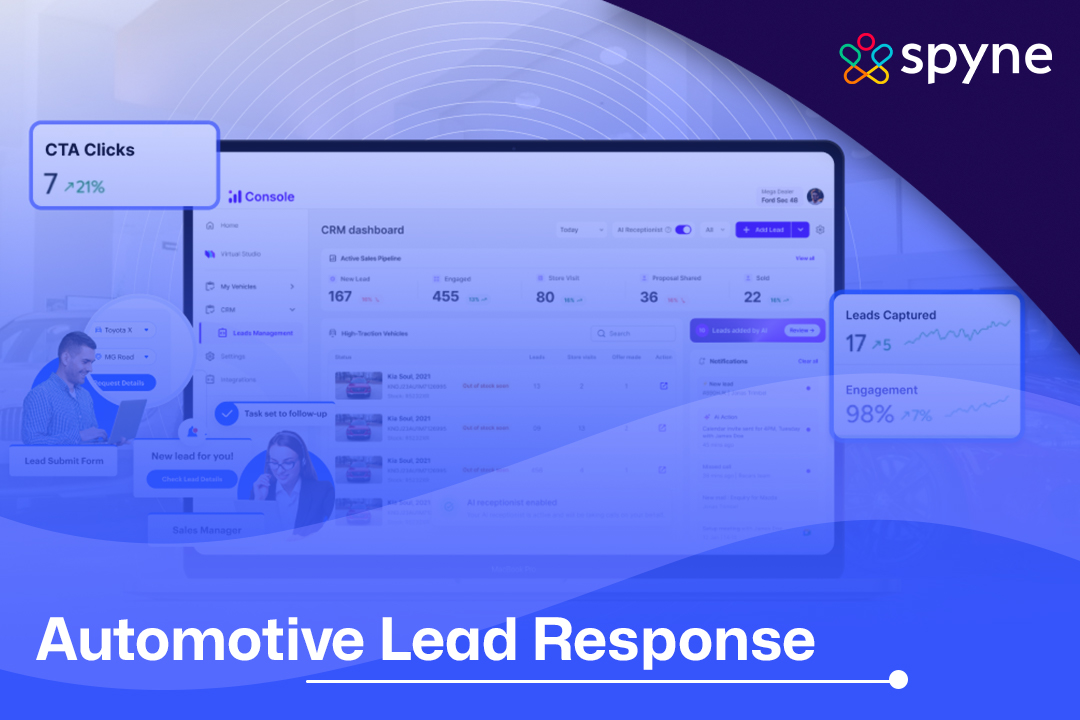
Automotive Lead Response

Best Automotive Lead Response Solutions: Convert Every Lead Into A Deal

Aman Bhardwaj
April 16, 2026
March 19, 2025
5 Min Read
5 Min Read
Automotive Lead Response

Want to increase your sales but missing out on multiple leads? Securing a potential lead means responding within 30 minutes of the lead reaching you. Responding late or with robotic texts means slipping away your leads. As buyers scroll through multiple websites, they are exposed to various dealerships. So, whoever contacts them first effectively gets the sale. 

That’s how the modern car-buying journey works. Having offers is great to attract buyers, but responding earliest is what brings you sales. And this is where your automotive lead response strategy comes into play.

If you are tired of missing out on your leads for any reason, then this blog is definitely for you. In this blog, we will explore why fast and effective responses really matter and what common mistakes dealerships make. Together, you will explore how Spyne’s AI-powered solutions are helping dealerships around the globe respond faster, smarter, and effectively.


What is the Automotive Lead Response?

How you respond and how fast you respond to your leads or potential car buyers who have shown interest in your cars is automotive lead response. Usually, leads come from multiple sources, like your website, social media, or marketplace. Further, it starts with the moment someone clicks “Contact Dealer” and ends when that person either buys a car from you or someone else. Further, according to studies, buyers are more likely to purchase a car from a dealership that connects first and responds like a human, not with repetitive robotic texts.


What is the response time for automotive sales leads?

Wondering what could be the ideal time to respond to automotive sales leads? Well, it is within 5 minutes of inquiry. A Harvard Business Review study found that companies responding within 5 minutes are 100 times more likely to engage a prospect than those that wait 30 minutes. However, if you respond after 30 minutes, then it may decrease the chances of successfully qualifying a lead by 21 times. That’s why it’s always important to respond to each inquiry within 5 minutes.


What is the Need for Speed in Automotive Lead Response

Today’s car buyers expect a lot from dealerships, from booking a test drive to financing options. Further, according to studies, it is found that 90% of buyers expect a reply within 10 minutes of inquiry. And a buyer always goes through various dealerships’ websites. So, you and your competitors have similar leads. Hence, whoever connects with the buyer first secures the lead and converts it into a deal. And if you want to sell your cars faster than your competitors, then you need a fast and reliable auto dealer lead answering solution.



What Are The Mistakes of Automotive Lead Response & How to Avoid Them?

If you are thinking that you are the only one missing out on potential leads, then that’s not true. Even dealerships with the best marketing campaigns often lose potential buyers due to mistakes they make while responding. Let’s take a moment to discover these mistakes dealerships often make and how you can avoid them:


1. Late Responses

Many dealerships sometimes take hours or even a day to reply. Late responses mean responding to a dead lead. In fact, according to the studies, 78% of car buyers choose the first dealership that contacts them.

How to Avoid Late Responses in Automotive Leads?

The best strategy to avoid this mistake is to utilize advanced AI technologies. Various integrated AI-powered solutions offer dealerships with AI that operates 24/7, so that even if you get a lead at midnight or on weekends, the AI connects to them instantly.


2. Generic & Robotic Replies

If you are still using generic chatbots that reply with generic robotic texts like “Thanks for your inquiry. Our team will contact you soon.”, then you are making a big mistake because these replies kill engagement and feel impersonal. Buyers these days have higher expectations. They want replies from someone in your team who can actually help with their queries.

How Do You Avoid Generic & Robotic Replies in Automotive?

Avoid using traditional chatbots and instead use advanced chatbots like Spyne’s conversational AI, which provide you personalized responses that sound natural and humanly.


3. Lack of Follow-Up

Many dealerships don’t take follow-ups from buyers because they don’t know when to take follow-ups. They usually stop after sending one message. Also, around 60% of leads require at least two follow-ups before making a purchase decision.

What Are the Best Days to Follow Up With Auto Car Leads?

Usually, Tuesdays and Thursdays are considered prime days for follow-ups. Because on Tuesdays, people have had time to settle into their week. They are more focused and responsive on Tuesdays compared to Mondays. And on Thursdays, most buyers search for cars who are actually planning to visit dealerships and make a purchase.


4. Not Tracking Performance

Not tracking your response performance? Then you’re making a big mistake. If you don’t measure your response time, then how will you know what’s working and what’s not?

How To Track Response Performance In Automotive?

You have to track calls and the key metrics, like the average response time of your dealership, the follow-up rate, lead-to-appointment conversion, and contact success rate. You can utilize a car dealership phone system to track all the inbound and outbound calls.


5. Poor Communication or Untrained Staff

If your salesperson has poor communication skills or has an untrained staff, then fast responses are meaningless. It can feel flat if your team’s tone feels pushy, robotic, or uninformed. Buyers expect a consultant, not a telemarketer.

How to avoid poor communication?

Train your sales team to continue conversations naturally after an automated message. AI can start the conversation, but expertise should close the deal.


Key Components of Effective Automotive Lead Response

What do you call an effective automotive lead response strategy? How an effective auto dealer lead answering helps in qualifying a lead. Well, there are five essential pillars of effectively responding to your auto car leads:

1. Speed: Timing is important when responding to a buyer inquiry. So, responding within 5 minutes just after receiving the inquiry is an effective way to convert each buyer query into a deal.

2. Personalization: Whether it’s a salesperson or a chatbot responding to a buyer, the response shouldn’t sound robotic and repetitive. An effective response always mentions the lead’s name, car, and query details while responding.

3. Consistency: Don’t just leave your auto car leads with a single message. Buyers might move to another dealership to purchase a car that consistently and instantly helps the buyer. Keeping the messaging aligned across email, call, and chat makes an effective lead response.

4. Follow-up Plan: Taking follow-ups from potential buyers helps in solving their queries and guiding them. Maybe not now, but hopefully in the future, they might purchase a car from your dealership.

5. Tracking & Analytics: Keep monitoring automotive calls and analysing response performance. How many buyers are showing interest in your cars, and how many are actually willing to buy one from your dealership? Keeping track helps in improving response performance.


Strategies for Successful Automotive Lead Response

Wondering how top automotive dealerships and OEMs successfully convert most of the automobile leads into leads with responses? Here are the best practices for auto lead response to turn leads into bookings and bookings into sales:

1. Automate first contact: Let advanced AI handle your first touchpoint instantly. There are multiple integrated AI tools, like Spyne’s conversational AI. These tools help your dealership handle all the inbound inquiries just after they reach you.

2. Use smart routing: AI can help you turn people’s interest into a booking, but if you want to convert them into a deal, you always need a salesperson. Hence, ensure that each lead is assigned to the right salesperson.

3. Segment leads: Organize every lead based on its prioritization. Prioritize high-intent automobile leads and customize your approach accordingly. This will help you first connect with the leads with a higher potential of becoming buyers. You can utilize AI lead scoring tools to prioritize the leads.

4. Balance AI + human touch: Let AI tools handle all the initial inquiries for fast responses to engage with buyers. However, AI can not add emotions, so for that, let humans interact with buyers.

5. Keep Optimizing: Ensure that you keep optimizing the performance metrics of your responses weekly. Analyze how many deals you have confirmed, how many backed out, and how many need follow-ups.


Best Automotive Lead Response Tools for the Automotive Industry

Whether it’s internet car leads or showroom inquiries, faster responses are important for every dealership. Below are the top tools that help dealerships manage and improve their automotive lead management strategy:

1. Spyne: Spyne gives your dealership a real edge with its AI-powered automated lead response, automotive chatbots, and call bot solutions. These engage leads 24/7, qualify them, and route them to your sales team or CRM in real-time.

2. Podium: Podium’s Business Development Center helps you automate lead replies, send personalized messages, and stay connected with customers. It integrates with your CRM and speeds up follow-ups across text, chat, and email. Pricing starts at $399/month.

3. VinSolutions: VinSolutions brings together automotive lead management and engagement platform features, lead tracking, customer info, and sales tools in one place. It gives sales teams the info they need to follow up quickly and personally. 

4. Elead: Elead supports automotive lead follow-up software, CRM features, and custom workflows. It helps you respond faster, track performance, and connect with more prospects without losing the personal touch. Pricing typically begins at $500/month.

5. DealerSocket: DealerSocket gives you tools to capture, manage, and respond to leads, all while tracking their progress through the sales funnel. Its intuitive interface and analytics help you improve both the speed and the quality of lead response. Starts at $750/month.

6. CDK Global: CDK Global offers robust CRM features, auto lead management, and marketing automation built for large and mid-size dealerships. It’s a solid solution for dealers needing a fast, scalable way to handle lead response. Pricing is custom-based on dealership needs.


Meet Vini: Spyne’s Conversational AI Agent For Dealerships

Don’t misunderstand Spyne’s AI conversational tool with any other chatbot. It is a virtual AI agent for your dealership that instantly responds to all your leads, whether they are inbound or outbound. Let’s take a moment to explore how Spyne is the best solution for auto dealer lead management and fast responses:

1. Instant Responses: With our advanced, integrated AI-powered solution, you can instantly respond to every lead you get at any time. Even if it’s a holiday or weekend, our conversational AI “Vini” never misses out on any leads that you get.

2. Personalized Responses: You can personalize your responses at “Vini”. This feature avoids repetitive robotic responses. It responds to every lead based on their personal needs and requirements.

3. Smart Lead Routing: The conversational AI first analyses the need and requirement of a buyer, then automatically assigns it to the right sales representative. Allowing sales representatives to close the deal effectively.

4. Omnichannel Communication: Our AI system connects via multiple channels, including chat, website, WhatsApp, and social ads. It gathers leads through numerous channels and organizes them into one ecosystem, easy to track and analyze.

5. Personalized Responses: Our conversational AI offers personalized responses. You can personalize your dealership responses according to the buyer’s needs and requirements. “Vini” is an all-in-one AI agent. Whether you need a receptionist, a finance advisor, or a salesperson, you get it all in one place.

6. Operates 24/7: Our automotive 24-hour answering AI agent operates without a break. So you don’t have to worry about missing out on any leads, even if they come at midnight, on holidays, or on weekends. 

 

Conclusion

In today’s competitive automotive market, your first auto dealer lead answering is your first impression and sometimes your only chance. Buyers don’t wait anymore. And if you don’t respond fast, your competitor will. It’s a competition between dealerships in automotive lead response. Whoever responds first qualifies for the deals.

Spyne’s conversational AI “Vini” is an all-in-one agent that provides personalized automotive phone answers for your dealerships. Also, our AI-integrated agent interacts with buyers more like a salesperson, so you don’t have to worry about repetitive robotic responses. Try Vini now, the automotive lead management that responds to every lead that comes to you at any time, no more missing out on any leads.

SHARE THIS POST

CONTENT

THE SPYNE STORY

Built to Handle Massive Scale

5M+
5M+
Read More
Images processed every month​
75+
75+
Read More
Computer vision models deployed
10+
10+
Read More
Fortune 500 clients
100+
100+
Read More
Enterprise customers and partners
Previous
Next
FAQs

Got questions? We've got answers.

Find answers to common questions about Spyne and its capabilities.
  • Q1: What is automotive lead response and why does it matter for dealerships?

    Automotive lead response is the process of responding to customer inquiries, whether they come through website form submissions, phone calls, chat, text messages, or third-party marketplaces like AutoTrader and CarGurus. It matters because speed and quality of response are the single biggest controllable factors in dealership lead conversion. Harvard Business Review research found that responding within five minutes makes you 21 times more likely to qualify a lead compared to responding after 30 minutes. Other studies show the probability of connecting drops by 100 times if you wait more than an hour. Yet DAS Technology’s 2025 study of over 1,700 dealerships found that 19% still took over an hour to respond, and 74% did not include a price quote in their reply. Every minute of delay and every piece of missing information pushes the customer toward a competitor who replied first.

  • Q2: What is the ideal lead response time for car dealerships?

    The benchmark target is under five minutes for internet leads and under 60 seconds for phone calls. DAS Technology’s 2024 data showed that 61% of dealerships responded within 15 minutes, up from 55% in 2022, but nearly 40% still took longer than 15 minutes. For phone leads, Car Wars data across roughly 3,000 dealerships found average hold times of over three minutes, with 31.8% of unconnected calls resulting from customers hanging up while on hold. The reality is that customer expectations have accelerated: over 80% expect a response within 10 minutes. Dealerships that consistently respond under five minutes close significantly more leads than those operating in the 15 to 30 minute range, even when the slower dealerships have better pricing or inventory.

  • Q3: What should a high-quality lead response include?

    Speed alone is not enough if the response is generic or incomplete. A high-converting lead response should include acknowledgment of the specific vehicle the customer inquired about, including year, make, model, and stock number. It should confirm vehicle availability. It should include pricing or at minimum a price range with a clear reason to visit for the final number. Payment estimates or financing options add significant value, yet DAS Technology’s study found 91% of dealers exclude payment details. Multiple photos of the actual vehicle, not just stock images, should be included. A personalized message that references any specific questions or comments the customer included in their inquiry is essential. A clear call to action such as scheduling a test drive, coming in for a trade-in evaluation, or connecting with a specific sales consultant gives the customer a concrete next step. Finally, alternative vehicle suggestions if the requested vehicle is sold or may not be the best fit show that you are invested in helping, not just responding.

  • Q4: What is the difference between a "clock-stopper" response and a real lead response?

    A clock-stopper is an automated reply that satisfies OEM response time mandates but provides no real value to the customer. It typically reads something like “Thank you for your inquiry, a member of our team will be in touch shortly.” It stops the clock on your CRM’s response time metric, but it does not answer the customer’s question, confirm availability, provide pricing, or give them any reason to wait for your follow-up instead of contacting the next dealership. Industry experts and OEMs are increasingly flagging clock-stoppers as inadequate, particularly during business hours when a substantive response should be possible. The shift in best practice is toward intelligent automation that provides real, vehicle-specific information instantly, such as confirming availability and including a price quote, while simultaneously alerting a human team member to follow up with a personalized touch.

  • Q5: How should dealerships handle after-hours lead response?

    This is one of the most critical gaps in dealership operations. Industry data indicates that 56% of new leads are submitted after business hours, yet most dealerships have no live coverage during these periods. Sending a generic auto-reply at 9 PM and following up at 9 AM the next day means the customer has had 12 hours to submit inquiries to other dealers who may have responded instantly. Effective after-hours strategies include AI-powered conversational agents that can answer vehicle questions, provide pricing, and book appointments in real time regardless of the hour. Spyne’s Vini AI, for example, engages every after-hours inquiry instantly across phone, chat, and web, qualifies the lead, shares inventory details, and books an appointment directly into the CRM. When the sales team arrives the next morning, they find booked appointments and complete lead data rather than a queue of cold leads waiting to be contacted.

  • Q6: Why do phone leads require a different response strategy than internet leads?

    Phone leads convert to appointments at nearly double the rate of internet leads, roughly 75% versus 40% according to industry benchmarks. This makes phone leads the highest-intent channel a dealership has. Yet phone response is treated as a staffing problem rather than a strategy problem at most stores. The customer calling your dealership has already done their research and is ready to take the next step. If they hit hold, get transferred multiple times, or reach voicemail, the sale is likely lost. An effective phone lead response strategy requires answering every call within three rings or less, routing to the right department without excessive transfers, having trained agents or AI voice agents ready to provide real-time inventory information and book appointments, and capturing the lead in CRM even if the call does not result in an immediate appointment. Dealerships using AI phone agents like Vini AI achieve 100% inbound call coverage with under 60-second response times, ensuring no phone lead goes unanswered regardless of call volume or time of day.

  • Q7: What is the best multichannel lead response strategy for dealerships?

    The most effective approach coordinates multiple channels in a sequenced cadence rather than relying on a single touchpoint. A proven multichannel sequence after receiving an internet lead looks like this: within the first two minutes, send a personalized text message acknowledging the specific vehicle and confirming availability, since text has the highest open and engagement rates. Within five minutes, send a detailed email with vehicle photos, pricing, payment options, and a clear call to action. Within ten minutes, attempt a phone call or have an AI agent initiate a voice conversation. If no contact is made, follow up with a second text the next day and a phone call attempt on day two. Continue a structured follow-up cadence over the next seven to ten days across text, email, and phone. The key is that each touchpoint adds new information or value rather than repeating the same generic message. AI platforms like Vini AI can orchestrate this entire sequence automatically, ensuring consistent timing and personalization without depending on individual agent discipline.

  • Q8: How much revenue do dealerships lose from slow or poor lead response?

    The losses are substantial and compound over time. Foureyes’ 2024 report found that 43.2% of all sales leads were mishandled, and 14.1% were never logged into the CRM at all. Among leads that returned to a dealer’s website after already submitting an inquiry, 65% had not received a follow-up within 24 hours, and 61.6% were not contacted for eight or more days. When you consider that the average gross profit on a new vehicle sale ranges from $2,000 to $4,000 and used vehicles can carry similar or higher margins, even a modest improvement in lead response can translate to significant monthly revenue. If a dealership receives 500 internet leads per month and improves its response time from 30 minutes to under 5 minutes, the increase in connection and appointment rates alone can generate dozens of additional sales annually. Dealerships using AI-powered lead response consistently report a 20 to 25% lift in lead-to-appointment conversion rates.

  • Q9: What are the biggest mistakes dealerships make with lead response?

    Based on the DAS Technology 2025 study and broader industry data, the most common failures include responding too slowly, with nearly 40% of dealerships still taking longer than 15 minutes. Not reading or addressing the customer’s specific questions or comments in the inquiry is extremely common. Failing to include pricing, with 74% of dealers omitting a price quote entirely. Not providing payment or financing information, with 91% excluding payment details. Sending generic auto-responder emails that provide no vehicle-specific value. Not including photos of the actual vehicle, with 90% omitting multiple images. Failing to suggest alternative vehicles if the requested one is unavailable, with 89% not offering alternatives. Not following up persistently enough, with many dealers making one or two attempts and giving up. And not having any after-hours coverage, leaving more than half of all leads waiting until the next business day for a response.

  • Q10: Can AI fully automate lead response for dealerships?

    AI can automate the initial response and a significant portion of the follow-up process, which is where most dealerships lose leads. AI-powered platforms can instantly acknowledge the inquiry with vehicle-specific information, confirm availability and provide pricing in real time, answer customer questions about features, financing, and trade-in processes, schedule appointments directly into the CRM and dealership calendar, execute a structured multichannel follow-up cadence across text, email, and phone, and log every interaction with full context and source attribution. What AI does not replace is the human relationship-building that happens once a customer is engaged and ready for a nuanced conversation about trade-in negotiations, complex financing scenarios, or specific vehicle comparisons that require emotional intelligence. Spyne’s Vini AI handles the high-volume, time-sensitive first response and follow-up automatically, ensuring 100% coverage and sub-60-second response times 24/7, while routing qualified, engaged buyers to your sales team for the conversations that require a human touch.

  • Q11: How should dealerships measure their lead response performance?

    Q11: How should dealerships measure their lead response performance?
    The essential KPIs to track include average response time segmented by channel (phone, web form, chat, text), percentage of leads responded to within 5 minutes, 15 minutes, and 60 minutes, lead-to-appointment conversion rate, appointment show rate, response quality score (does the reply include vehicle confirmation, pricing, photos, and a CTA), CRM logging rate (percentage of leads properly documented with source attribution), after-hours response coverage rate, and lead-to-sale conversion rate by source. Most dealerships only track response time because it is the metric OEMs measure, but response time without response quality is meaningless. A five-minute reply that says “Thanks for your interest, when can you come in?” is barely more effective than no reply at all. The best-performing dealerships track both speed and substance, reviewing a sample of actual responses weekly to ensure they meet quality standards.

  • Q12: What is the average lead response time in the automotive industry right now?

    According to DAS Technology’s 2025 Lead Response Study analyzing over 1,700 dealerships during Q3 and Q4 of 2024, 61% of dealerships responded within 15 minutes, improved from 55% in 2022. However, 19% still took over an hour. For phone leads specifically, Car Wars data from nearly 3,000 dealerships showed average hold times exceeding three minutes, with roughly a third of calls going unconnected due to customers abandoning hold. Other industry surveys have found average email response times across all industries ranging from 42 to 47 hours, with automotive tracking similarly in many cases. The gap between top-performing dealerships (responding in under two minutes with rich, personalized content) and average dealerships (responding in 15 to 60 minutes with generic templates) represents one of the largest competitive advantages available in automotive retail today. AI-powered response tools are the primary reason top performers are able to maintain sub-five-minute response times consistently across all hours and channels.

Related Articles

THE SPYNE STORY

Built to Handle Massive Scale

5M+

Images processed every month

75+

Computer vision models deployed

10+

Fortune 500 clients

100+

Enterprise customers and partners

Recent Blogs

Ready to Revolutionize
Your Workflow?

Join thousands of forward-thinking companies already using Spyne to dominate their industries.

Bring the studio
to your cars.

Let's get Started

Just drop in your details to book a Demo