
| Executive Summary
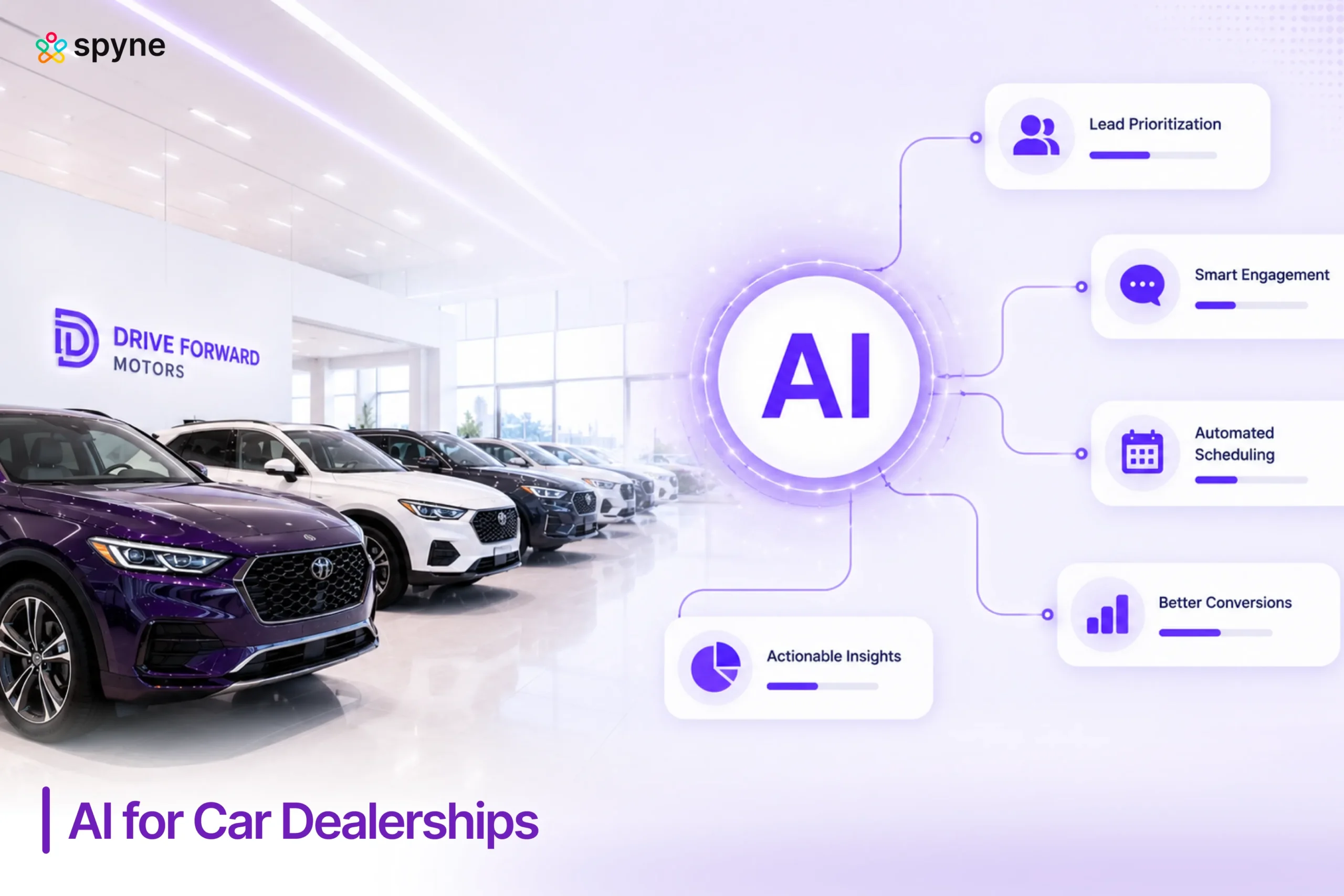
Dealership AI in 2026 covers two categories: communication AI, which handles calls, leads, follow-up, and service scheduling, and merchandising AI, which handles vehicle photography and inventory presentation. Most stores see ROI from communication AI first. Vini AI deploys in 10–14 days, resolves 70% of routine inbound without human intervention, and has demonstrated first-week revenue recovery from un-worked CRM leads across franchise stores. Merchandising AI (Studio AI) eliminates the photography bottleneck that keeps vehicles off the market and compounds holding cost daily. |
Most dealers have sat through three or more AI pitches in the past 12 months. The demos are structurally identical, fast responses, clean dashboards, a name-brand case study. What they rarely include is a straight answer to the actual question: which problem does this solve, what does it cost, and how is success measured?
Car Wars tracked roughly 53 million inbound service calls in 2025 and identified approximately 19 million missed opportunities. At a $450 average RO value, that is not an answering problem, it is a revenue problem. This post covers what dealership AI does operationally, where the ROI math holds, and what separates platforms worth evaluating from ones that become a cancelled line item.
What Does AI for Car Dealerships Actually Do? The Two Categories Every DP Needs to Separate
Dealership AI covers two distinct operational categories that solve different problems for different departments on different timelines. Most vendors pitch both in a single demo, which is how dealers end up buying something that addresses the wrong problem first.
- Communication AI handles everything that happens between a customer and the store before they arrive: inbound calls, internet lead qualification, appointment booking, service scheduling, after-hours coverage, and outbound follow-up on cold CRM leads. The measurable output is appointments in the calendar and complete records in the CRM. The stakeholders who care about this are the GSM, Internet Director, and Fixed Ops Director.
- Merchandising AI handles everything that affects how inventory performs online before a customer ever contacts the store: vehicle photography, background processing, 360 spins, VDP presentation, and marketplace syndication. The output is faster time-to-frontline and higher VDP engagement per unit. The Used Car Manager and the DP watching holding costs are the ones who feel this directly.
A dealer losing deals to competitors who respond faster has a communication problem. A dealer watching aged inventory sit past 45 days has a merchandising problem. They are not the same problem and they do not share the same solution. Most stores should address communication first, the ROI timeline is shorter and deployment is simpler.
Dealership AI covers two categories, communication (calls, leads, scheduling) and merchandising (photography, inventory presentation). Communication AI delivers faster ROI. Most single-rooftop deployments start there.
How Do Dealerships Lose Revenue From Missed Calls and Slow Lead Response?
The number most dealers underestimate is not their missed call rate, it is what happens after the miss.
Car Wars tracked roughly 53 million inbound service calls in 2025 and identified approximately 19 million missed opportunities. Of those missed calls, 53% went to voicemail and 29% of callers abandoned after being placed on hold. Even when a buying signal was present, only 44% of missed opportunity calls received any follow-up at all in 2025 (Car Wars, NADA 2026).
That is not a staffing problem in isolation. It is a structural gap between when customers show intent and when dealerships are operationally equipped to respond.
The revenue math for a single-rooftop store:
| Variable | Number |
| Average inbound service calls per week | 200 |
| Industry average connect rate (Car Wars 2025) | ~65% |
| Missed calls per week | ~70 |
| Average RO value | $450 |
| Weekly missed revenue exposure | $31,500 |
| Monthly missed revenue exposure | ~$126,000 |
This table uses conservative assumptions. It excludes sales leads, after-hours internet inquiries, and cold CRM leads with no second contact attempt. Foureyes’ 2025 Automotive Dealer Benchmarks Report found that 43.2% of dealership sales leads were mishandled, missed calls, leads not logged to the CRM, lapsed follow-up, or slow responses, and 14.1% of leads were never entered into the CRM at all.
A store cannot follow up on leads it has not recorded.
What Does Vini AI Actually Do on a Dealership Call? The Exact Operational Workflow
Vini AI is a conversational AI platform built specifically for automotive retail. It handles inbound sales calls, service scheduling, internet lead qualification, and outbound CRM re-engagement from a single deployment. Here is what that looks like in practice, step by step.
# Step 1: Instant Response Across Every Channel
A lead arrives via a VDP form, an inbound call, or an SMS at any hour. Vini AI responds in under 5 seconds. This is not a confirmation email or an auto-reply, it is an active qualifying conversation. Industry data shows that responding within 60 seconds makes a dealership 21 times more likely to qualify that lead than waiting just 5 minutes. The first-responder advantage compounds: dealers who respond first win 78% of deals.
# Step 2: Live Inventory Verification
Before quoting availability or booking a slot, Vini AI checks live DMS inventory to confirm the vehicle is in stock and the service bay or sales calendar has the capacity. This is the operational difference between a capable chatbot and a system that actually functions as dealership infrastructure. A chatbot confirms interest; Vini AI confirms availability against a live data source.
# Step 3: Structured Lead Qualification
Vini AI runs a structured qualification sequence covering:
- Vehicle of interest (confirmed against live inventory)
- Payment target and financing intent
- Trade-in status (yes/no, rough value expectation)
- Purchase or service timeline
- Preferred contact channel for follow-up
This qualification data writes directly to the CRM, not as a note, but as structured fields, so when a BDC rep or ISM opens the record, the full context is already there.
# Step 4: Direct DMS Appointment Booking
Vini AI books the appointment directly into the DMS calendar, CDK, Reynolds & Reynolds, Tekion, VinSolutions, DealerSocket, or Elead. The appointment is confirmed to the customer during the same conversation, without a human touching the scheduler. This is write-back integration, which is categorically different from read-only platforms that capture intent and create a task for someone to action manually.
# Step 5: CRM Record Completion and Lead Flagging
Every handled interaction writes a complete customer record: vehicle confirmed, payment range, trade-in status, timeline, preferred contact channel, and full conversation transcript. High-intent leads are flagged in the CRM queue. When the Internet Director or BDC manager logs in, the queue is already sorted by intent level, not by submission timestamp.
# Step 6: Escalation With Full Context
When a conversation requires human judgment, a price negotiation, a complaint, or a complex financing question, Vini AI escalates immediately. The escalation fires with the complete conversation transcript attached, so the rep picks up with full context rather than a cold transfer. Escalation rate decreases week over week as the system learns store-specific edge cases.
The outcome: A lead submitted at 11:30 PM Saturday has been qualified, scheduled, and logged before the Internet Director arrives Monday morning. Without Vini AI, that same lead sits in an unworked overnight queue, and the buyer has likely already committed to a competing store.
Calculating Dealership AI ROI Before Signing, The Three Numbers That Matter
Dealership AI ROI comes from three measurable revenue leaks that exist at most franchise stores. These numbers can be calculated from data already inside the phone system and CRM, no vendor involvement required.
1. The Missed Call Baseline
Pull 30 days of inbound call volume from the phone tracking system. Pull the connect rate. The gap between calls received and calls connected is the missed-call number. Car Wars’ 2025 data puts the industry average connect rate at 62.39% for sales calls, meaning roughly 4 in 10 inbound sales calls are not reaching a live person.
At a $450 average RO value and 200 inbound service calls per week, a store running a 65% connect rate is leaving approximately $31,500 in weekly service revenue exposure unaddressed. Over a month, that is $126,000, before accounting for any sales lead miss.
2. The CRM Dead-Lead Count
Filter the CRM for leads with zero activity in the last 30 days that never received a second contact attempt. Foureyes’ 2025 benchmarks found that 43% of internet leads receive no second contact attempt, and the average dealership is sitting on hundreds of these records. At $1,528 average front-end gross and a conservative 10% close rate on re-engagement, a store with 300 un-worked leads is looking at roughly $45,840 in recoverable gross, from leads already in the system, not from new ad spend.
3. The After-Hours Lead Gap
40% of dealership leads arrive between 6 PM and 9 AM. Filter the CRM for leads submitted outside business hours and check average time-to-first-contact for that segment. If the number is 8–14 hours, those leads are being worked after competing stores have already responded. First-responder advantage data is consistent: dealers who respond first win 78% of deals. Every hour of delay reduces that advantage materially.
What the numbers mean for platform cost: Vini AI is priced at $1,000–$1,500 per agent per month. A store recovering 10 missed service calls per week at $450 RO value covers the full monthly platform cost in the first week of operation. The CRM re-engagement wave, un-worked leads already in the system, typically produces the second measurable revenue impact by day 30.
| Revenue Leak | Calculation Method | Recoverable Amount (Example Store) |
| Missed service calls | Weekly missed calls × avg RO value | ~$31,500/week |
| CRM dead leads | Un-worked leads × 10% close × $1,528 gross | ~$45,840 recoverable |
| After-hours lead lag | After-hours leads × win-rate degradation per hour | Deal-dependent; high structural risk |
DMS and CRM Integration for Dealership AI?
Every AI vendor claims to integrate with the DMS and CRM. The question that determines whether the platform closes the communication gap or simply covers it is whether the integration is read-only or write-back.
1. Read-Only Integration: What It Can and Cannot Do
Read-only integration allows the AI to query the DMS for available appointment slots and pull basic customer records. It cannot write anything back. A human still has to confirm the appointment, update the CRM record, log the conversation, and manually close the loop.
In practice, this means the AI functions as a better-interface answering service. It can tell a customer that 10 AM Tuesday is available. It cannot book the slot, which means the caller has to wait for confirmation, the slot can be taken by another booking in the meantime, and the BDC still carries the full administrative load.
2. Write-Back Integration: The Operational Difference
Write-back integration means the AI books the appointment directly into the live DMS scheduler, writes the customer record, logs the full conversation transcript, and updates the lead status, without any human touchpoint in between. The appointment is confirmed to the customer during the call. The slot is held. The CRM record is complete before anyone on the team sees it.
Vini AI’s integration is bi-directional: the system reads live calendar availability and writes confirmed appointments back into the scheduler during the call, with no manual step required. Vini AI integrates natively with CDK Drive, Reynolds & Reynolds, Tekion, VinSolutions, DealerSocket, Xtime, and Dealertrack, more than 50 CRM and DMS integrations in total.
The Integration Question Every Dealer Should Ask Before Signing?
Q. Why the Distinction Matters for Fixed Ops Specifically
The distinction between capturing intent (a CRM note) versus booking a confirmed appointment (a live slot in the scheduler) is where most fixed ops AI platforms fall short. A system that captures a caller’s preferred service time and creates a task for an advisor to confirm is not scheduling, it is a voicemail with better grammar. At a $450 average RO value and 158 missed or unconfirmed service calls per month, the difference between intent capture and confirmed booking represents over $52,000 in unrecovered service revenue before any downstream retention impact is considered.
Q. What to Ask Any Vendor Before Signing?
Ask any vendor to demonstrate a live write-back to the specific DMS in use, integration claims and actual integration depth can differ significantly.
Three questions that reveal integration depth:
- Is the integration read-only or write-back? Ask them to show a live booking writing back to the DMS scheduler during the demo, not just pulling available slots.
- Does it integrate with the specific DMS version in use? CDK Drive, CDK Global, and legacy CDK setups have different API structures. Reynolds ERA and Reynolds Power DMS are different products. Confirm the exact version.
- Can a reference customer on the same DMS at a comparable call volume be provided? A reference call is worth more than any demo session.
Q. DMS Integration Comparison: What to Expect From Each Platform
| DMS Platform | Integration Type to Confirm | Common Limitation |
| CDK Drive | Write-back to service scheduler + CRM | Third-party API access historically gated; confirm current access tier |
| Reynolds & Reynolds | Write-back to ERA-IGNITE scheduler | Closed ecosystem; confirm certified interface status |
| Tekion ARC | Native write-back via open API | Cloud-native; fastest integration timeline of the three |
| VinSolutions | Write-back to CRM lead and appointment modules | Cox ecosystem; confirm field mapping for qualification data |
| DealerSocket | Write-back to CRM and desking | Verify appointment module separately from lead module |
Three Pre-Deployment Decisions That Determine Whether Dealership AI Delivers ROI or Gets Cancelled
Most failed dealership AI deployments are not product failures. They are sequencing and process failures that happen in the 30 days before the first call goes live. Three decisions made before deployment determine whether the investment pays off in the first month or becomes a cancelled line item by month four.
Decision 1: Deploy the Right Category First
Dealers who simultaneously deploy communication AI, merchandising AI, and a new CRM integration in month one typically take 4–6 months to see measurable results and often attribute the delay to the AI itself. Dealers who deploy communication AI on inbound calls first, measure the result for 30 days, and then expand see ROI in the first week. Sequence matters more than scope, particularly at single-rooftop stores where management bandwidth is limited.
The most common sequencing mistake is starting with outbound CRM re-engagement before stabilising inbound call coverage. Outbound is the second wave of ROI. Inbound call coverage is the first, it stops the leak before trying to recover what has already been lost.
Decision 2: Define the Escalation Protocol Before Go-Live
Vini AI escalates to a human when a conversation requires judgment: a price negotiation, a customer complaint, or a complex financing question. The escalation fires with the full conversation transcript attached. But if the protocol is not defined before launch, who receives the escalation, how fast, with what response obligation, those escalations become worse customer experiences than a missed call. A buyer mid-conversation who gets transferred with no context loses trust in the store, not in the AI.
The escalation protocol is a process decision, not a platform decision. It must be agreed on and tested before any call goes live. Define the handler, the response SLA, and the fallback if the primary handler is unavailable.
Decision 3: Measure Gross Recovered, Not Activity Volume
Calls handled, messages sent, and appointments booked are activity metrics. A DP who asks “is this working?” and receives “we handled 400 calls this month” has no operational information. The metric that actually answers the question is: how many appointments booked by Vini AI resulted in a closed deal, and what was the combined gross on those deals versus the monthly platform cost?
A single rooftop recovering 8–10 missed appointments per month at $1,528 average front-end gross yields $12,000–$15,000 in recoverable gross. Against a $1,000–$1,500 monthly platform cost, that is a positive ROI in the first 30 days without counting service revenue or outbound re-engagement. Activity metrics will not surface that number. Gross recovered will.
Read the full evaluation of conversational AI platforms with specific due-diligence questions and integration red flags.

Closing Thoughts
The dealerships getting the most from AI in 2026 are not the ones who deployed the most tools. They calculated three revenue leaks, missed calls, un-worked CRM leads, after-hours response lag, from their own data before signing anything. Then they deployed Vini AI on inbound calls first, defined an escalation protocol before go-live, and measured gross recovered rather than activity volume.
Car Wars tracked 19 million missed service opportunities in 2025. Most of those stores did not know their number until they pulled it. The math supports the investment at most franchised rooftops. See what Vini AI recovers from an existing call log in the first week, book a demo with Spyne.