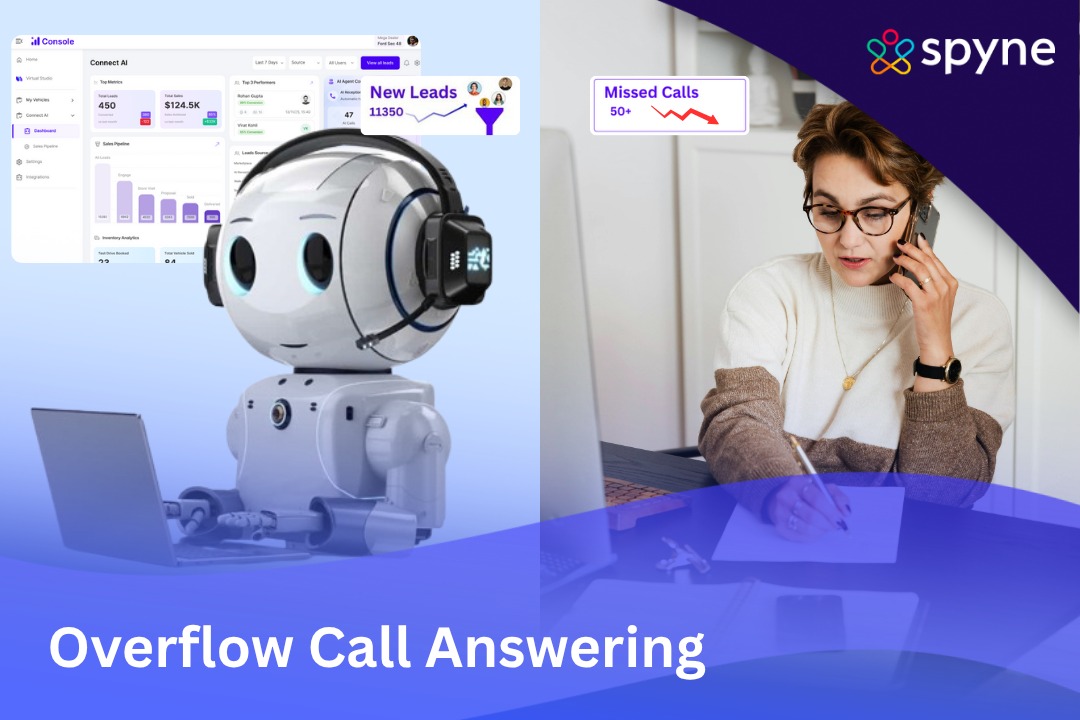

Businesses that handle varying inbound call volumes are facing an increasing number of missed calls. Unanswered calls or lengthy wait times during peak hours, after-hours inquiries, and staff shortages can result in lost opportunities and frustrated customers. Overflow call answering addresses this gap in an organized manner by ensuring inbound calls are handled when key teams are busy or unavailable, allowing for greater response during peak call periods.
To fix this, several businesses use voicemail, recruit more staff, or extend their working hours. While these solutions may give temporary help, they usually raise costs and provide inconsistent user experiences.
This article explores what overflow call answering is, what it enables, and how businesses use it to manage growing call demand without losing conversations.
What is Overflow Call Answering?
Overflow call answering is the practice of using a secondary setup for answering inbound calls when a primary team is unable to respond. During periods of high call volume, these incoming calls are directed to trained answering resources that step in to engage callers. This ensures conversations continue even when internal agents have reached capacity.
While overflow call answering is useful across industries, it becomes especially critical in high-intent businesses like automotive sales and service. For many car dealerships, overflow call answering functions as an extension of their existing automotive answering service, providing backup coverage when demand exceeds availability.
10 Key Features of Inbound Overflow Call Answering Services
Overflow call answering services are designed to maintain continuity when inbound call demand exceeds internal capacity. While implementations may vary, most effective setups share a common set of features that allow dealerships to handle call surges without disrupting customer experience.
1. Intelligent call routing
Calls are automatically redirected using auto-attendant phone systems when predefined conditions, such as queue length, wait time, or agent availability, are fulfilled. This ensures callers are routed to the right answering resource instead of being placed on hold indefinitely.
2. After-hours call coverage
Call Overflow answering service isn’t limited to peak hours. Many dealers rely on after-hours answering services to ensure inbound calls are answered outside standard operating hours.
3. Live or automated call answering options
Depending on business needs, dealers can use AI voice agents to handle live calls or deploy automated systems like voicebots to balance responsiveness and scalability.
4. Appointment scheduling and call resolution
AI phone call systems often support basic actions such as booking appointments, capturing requests, or resolving common inquiries during the call itself.
5. Lead capture and qualification
Instead of just answering calls, overflow systems actively capture caller details, intent, and context and feed this data into BDC workflows, enabling structured follow-ups and stronger lead management.
6. Call summaries and transcripts
Call monitoring software captures conversation data, allowing internal teams to pick up where the overflow interaction ended without losing context.
7. CRM and system integration
Modern overflow setups integrate with call tracking tools, CRM, and call management tools, ensuring call data flows into existing workflows. Live call tracking further enables dealers to use AI call analytics for making informed decisions.
8. Custom scripts and workflows
Dealerships define scripts, escalation paths, and data capture through sales solutions, keeping primary and overflow calls consistent.
9. Multilingual and bilingual call handling
For dealers serving diverse audiences, answering services overflow call management may also support bilingual answering services, helping ensure language is not a barrier during high-volume periods.
10. Escalation and warm transfer options
When necessary, calls can be handled through omnichannel contact centers, allowing escalation to internal teams or live transfers. This ensures that urgent or high-value conversations receive immediate attention.
10 Benefits of Overflow Call Answering Services
Beyond just additional call coverage, inbound overflow call answering services directly impact customer experience, operational efficiency, and dealership outcomes. Here’s how answering services overflow call management actually support day-to-day operations and long-term growth:
1. Never Miss A Call During Busy Hours
Call spikes are unpredictable. Overflow call answering supports car dealerships that aim to never miss a call, even if teams are tied up. Instead of hitting voicemail, callers reach someone who responds.
2. Scalable Business Operations
Hiring full-time staff to cover occasional call surges rarely makes sense. Call overflow answering service reduces reliance on call center outsourcing, helping dealerships scale support without long-term payroll commitments.
3. Effortless Lead Qualification & Appointment Setting
Even when teams are overloaded, important details like including names, requests, and appointment intent still get captured. This also improves lead response and ensures nothing depends on someone calling back later.
4. Professional Branding
Overflow calls don’t feel outsourced or disconnected. Backed by virtual assistants, call overflow answering services follow your scripts, your tone, and your routing rules, so callers experience the same level of professionalism every time.
5. Coverage Beyond the Front Desk
Overflow answering eliminates no-call no-show scenarios, particularly when teams are on lunch breaks, meetings, or after hours. Your support calls stay covered even when desks are empty.
6. Improved Customer Satisfaction
In many cases, not every caller needs a long conversation. With the help of an AI call bot, overflow setups handle basic routing, directions, business hours, or department transfers, ensuring interactions stay quick and frustration-free.
7. Improved Operational Efficiency & Flexibility
For small teams or solo operators, overflow answering acts like an extension of the dealership. Supported by an AI receptionist solution, calls get responded to without constantly forwarding phones or staying stuck to a mobile device.
8. Reduced Voicemail Drop-Offs
Voicemail is where leads go quiet. Overflow answering improves outbound workflows using AI outbound calling and keeps conversations alive.
9. Omnichannel Support
Some overflow setups support automotive text messaging responses when voice calls aren’t answered. This helps capture simple requests, appointment needs, or follow-ups without forcing a live conversation every time.
10. Cost Savings Without Losing Responsiveness
Overflow call answering service optimizes cost and coverage using auto dialer software. Dealerships stay responsive during high-demand moments without investing heavily in infrastructure or staffing they don’t always need.

How the Overflow Call Answering Service Works?
Handling call surges may appear difficult, but it is simple when set up correctly. Most dealerships handle overflow calls in practice by including AI cold calling and intelligent escalation workflows.
Here’s a step-by-step breakdown:
- Incoming calls are handled as usual: When a customer dials, the system first tries to connect them to the primary team that handles calls.
- Overflow conditions are triggered: The system routes calls to a backup setup when agents stay busy or hold times rise.
- Calls are redirected to trained resources: By answering questions, taking messages, and booking appointments, trained personnel handle overflow calls. Many setups now include AI phone answering services for faster and more consistent handling.
- Information is logged: The system records details from the call, such as name, request, or inquiries. Then the main team can follow up later. To ensure nothing gets lost, many dealers connect this with live call tracking.
- Escalation happens when needed: To prevent important conversations from getting delayed, urgent or complicated calls get passed back to the main team or a specialist.
- Follow-up completes the cycle: After the call, the information is fed into internal systems or CRMs, enabling timely follow-ups and preventing any conversation from slipping through the cracks.
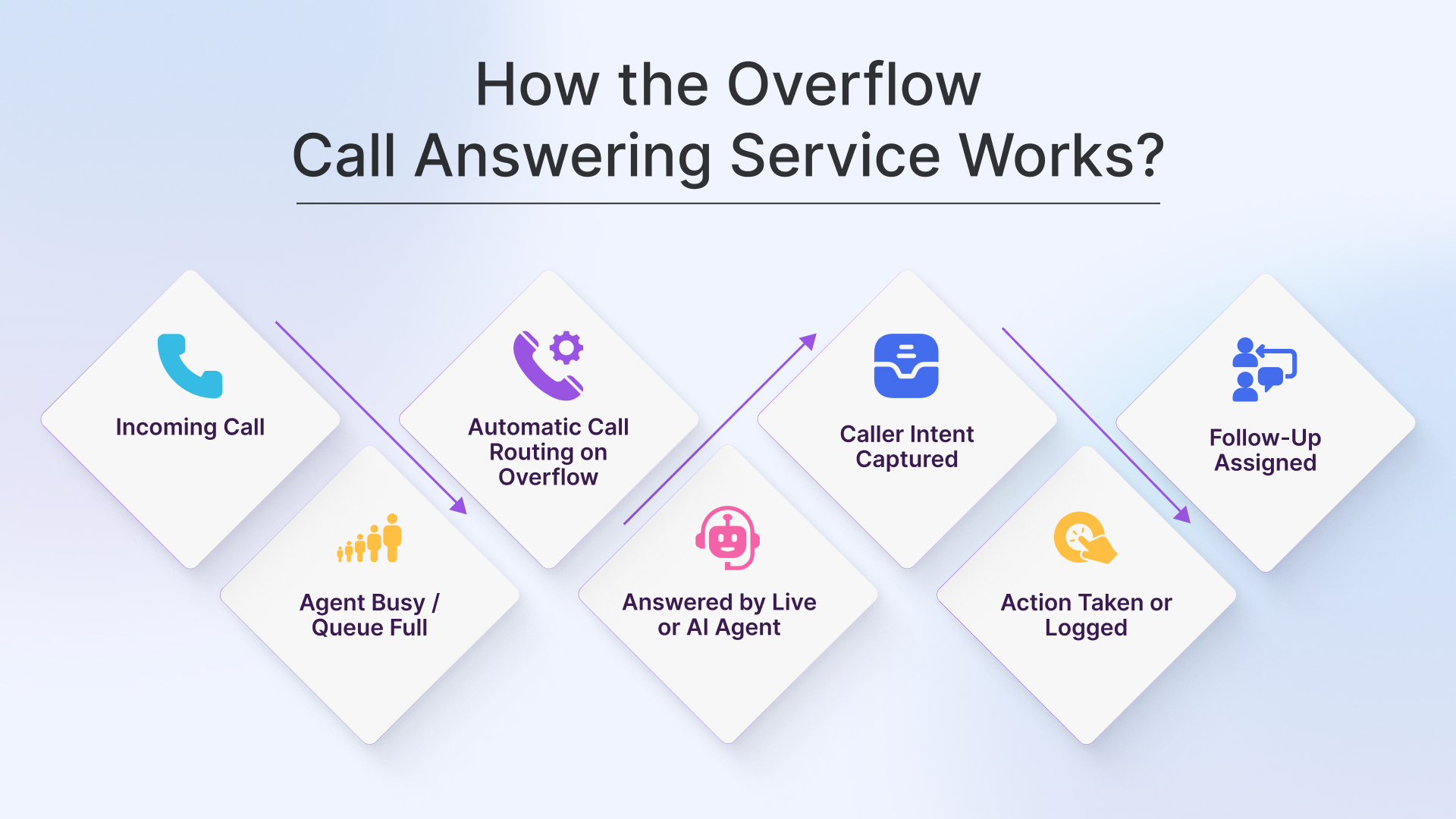
This approach ensures that inbound calls keep moving even when the primary team is fully engaged. Dealerships get coverage during peak periods, after-hours, or unexpected spikes, and customers still get the timely responses they expect.
Key Metrics to Measure Overflow Call Answering Performance
Measuring how well overflow call answering works is more than just counting answered calls. To have a real picture of performance, there are several practical metrics. Tracking these numbers helps teams see what’s working and what might need adjusting.
1. Call answer rate
This metric tracks how many calls agents answer, showing whether customers avoid long waits. This simple metric shows whether the system is doing its job.
2. Call abandonment rate
Sometimes people may hang up before anyone talks to them. If such instances occur frequently, it’s a sign that calls are taking too long to get answered. Tracking this metric helps spot bottlenecks and fix them.
3. Average speed to answer
How long does someone wait before a voice picks up? Even a few extra seconds can make a difference. Watching this number keeps response times in check.
4. First-call resolution
First-call resolution focuses on whether the customer gets what they need on the first call. This metric shows how effective the answering process is, whether handled internally or through overflow resources.
5. Average Handle Time
This metric shows the total average time taken per call (including conversation, hold, and wrap-up). A healthy handle time means callers get clear answers without unnecessary delays. Tracking this metric helps you balance speed with call quality.
6. Lead capture rate
Sales teams track leads captured during overflow calls to measure performance. Systems that log information properly help prevent missed opportunities. Many dealerships integrate this with a lead response solution for seamless follow-up.
7. Appointment booking rate
If calls result in scheduled appointments or service requests, that’s a direct sign of dealership impact.
8. 24/7 call coverage
Teams should track answered after-hours calls to understand how overflow answering covers availability gaps.
9. Conversion to follow-up
Not every answered call leads somewhere. This metric reveals how many calls actually turn into a scheduled service, a demo, or a follow-up conversation.
10. Customer satisfaction (CSAT)
Finally, asking clients directly how they felt about the transaction provides qualitative feedback. Callers expect fast responses and respectful treatment.
Why Automotive Businesses Need an Overflow Call Answering Solution?
Automotive businesses handle a steady mix of sales inquiries, service requests, and follow-ups, often across multiple locations and time zones. Therefore, peak hours, promotions, and after-hours periods strain teams as call volumes spike. Even short delays can mean missed test drives, unbooked service appointments, or lost leads.
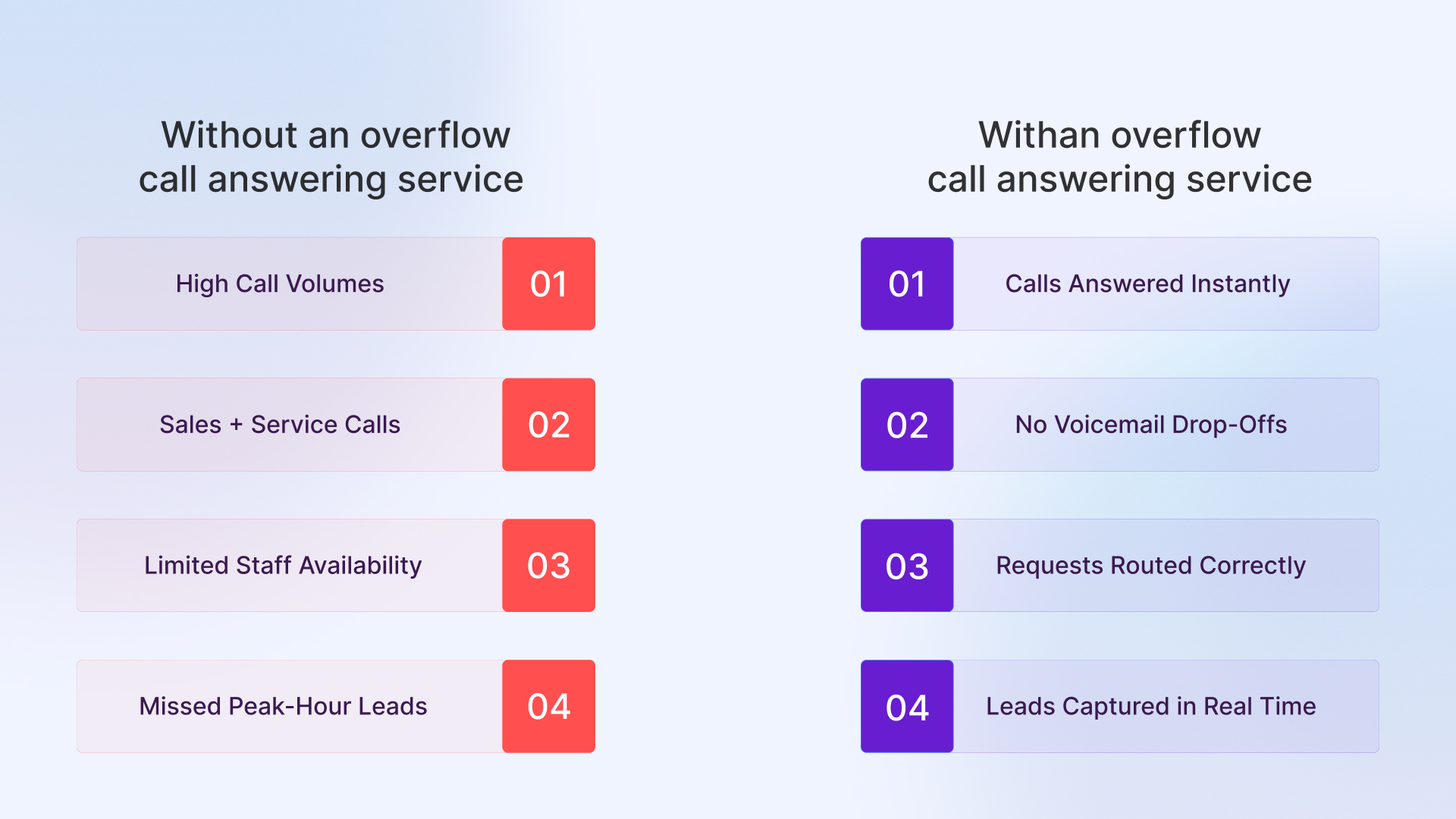
Overflow call answering works as an automotive sales solution that helps dealerships stay accessible during these high-demand moments. By ensuring every inbound call is acknowledged, logged, and routed correctly, automotive teams maintain consistency across locations while keeping response times tight, without overwhelming sales, service, or automotive BDC staff.
Why Spyne is the Best Overflow Call Answering Solution for Your Automotive Business?
Call overflow usually isn’t a planning problem but a timing one. Calls come in when teams are busy, short-staffed, or already on another line. That’s where Spyne fits in. Built for high-volume, customer-facing automotive dealerships, Spyne combines call intelligence with conversational AI to make sure no call goes unanswered.
At the center of this is Vini, Spyne’s conversational AI voice assistant that ensures overflow calls don’t get pushed aside or parked in voicemail. When human teams hit capacity, Vini takes the role of an automotive call center outsourcing solution to answer calls, capture intent, log details, and move conversations forward. The system handles, records, and routes surge calls, and helps teams stay in control even during peak hours or after closing time.
1. Always-On Call Handling
When call volumes spike, Vini automatically takes over overflow. Instead of ending with a voicemail, customers hear a real response. Calls are routed to trained agents for a seamless caller experience, and automotive call tracking enables teams to have fewer missed opportunities.
2. Integrated Follow-Ups
Vini takes the role of an automotive virtual assistant to ensure that all overflow calls answered are not isolated events. Call details, intent, and requests are captured as they happen. Automotive call monitoring software ensures that when teams follow up later, they know exactly what the caller needed without any second-guessing.
3. Clear Outcomes from Every Call
Just because a call overflowed does not always mean it’s low value. Vini captures lead information, qualifies intent, and supports scheduling when needed. It acts as an AI receptionist and ensures every answered call stays visible and measurable.
4. Coverage Beyond Office Hours (and Languages)
Calls don’t stop after closing time, and neither should your support be. Vini handles after-hours and overflow calls together, capturing requests and setting expectations clearly. With a built-in automotive after-hours answering service, customers are acknowledged instead of ignored.
5. Fewer Interruptions for Your Team
Sales and service teams aren’t pulled in different directions anymore. Vini works as an automotive lead response solution while your staff focuses on active customers. This eases pressure on teams, stabilizes workflows, and ensures phones stop being a distraction.
6. Visible Business Impact
With all these in place, your dealership gets:
- Faster responses to customer inquiries
- Reliable lead capture
- Consistent follow-ups
- Scalable coverage without extra staff
- Enhanced customer satisfaction

Conclusion
Staffing gaps and after-hours inquiries often lead to missed calls at car dealerships. The usual fixes, including voicemail, extra staffing, or extended shifts, often add cost without truly solving the problem. Inbound overflow call answering services offer a more reliable way to keep conversations moving.
Spyne’s conversational AI, Vini, enables this by answering calls, capturing intent, and keeping follow-ups on track. Spyne enables your dealership to stay responsive without adding pressure by providing solutions such as AI reception, automated lead follow-ups, and seamless integration with your systems.
Book a free demo with us to learn how Spyne can convert missed calls into handled conversations and increase customer satisfaction for your dealership.