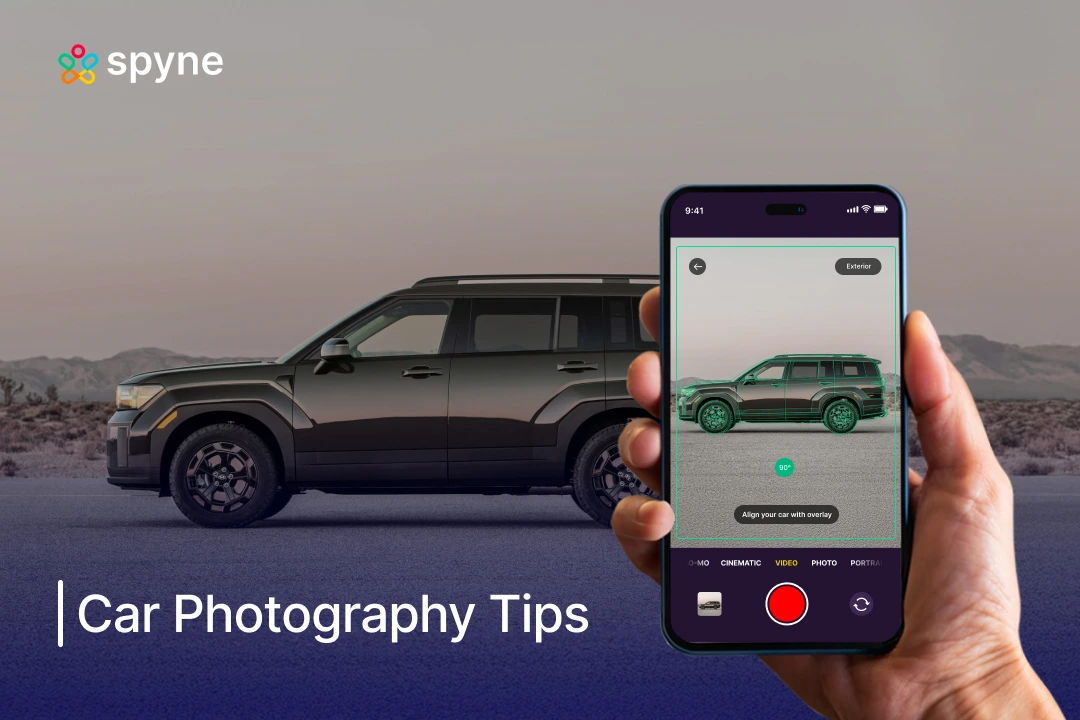

The difference between a car that gets shortlisted and one that gets ignored comes down to how it’s presented in the first few seconds of a scroll. Reflections, lighting consistency, background distractions, even slight angle distortions can signal quality or throw people away instantly.
Car buying these days has become a visual-first and research-led decision. Before specs, pricing, or even considering a dealership visit, buyers form an impression based entirely on what they see. Every detail, from lighting and angles to framing and consistency, directly influences trust, engagement, and conversion outcomes.
Industry studies reinforce this shift, showing that well-merchandised vehicle listings consistently attract higher engagement. Professionally executed visuals can increase click-through rates by up to 47% while also helping vehicles sell faster.
If you’re searching for actionable car photography tips that actually improve clicks, engagement, and conversions, you’re in the right place. In this guide, we break down the most practical, car photography tips and tricks used by professionals and high-performing dealerships.
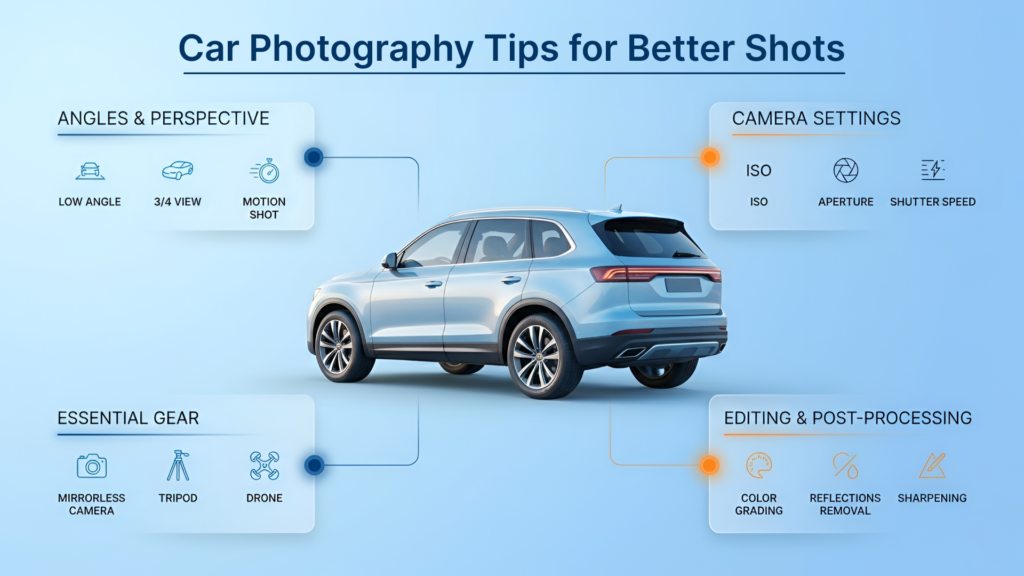
Top 30 Car Photography Tips for Better Shots
The most effective tips for car photography begin well before the first shot is taken. A thoughtfully chosen location shapes lighting, reflections, and overall composition, setting the foundation for clean, high-impact visuals. Here are some car photography tips and tricks to get started.
1. Scout Your Location Before the Shoot
A strong car photo starts with the right location. The environment shapes how the car looks, how light falls on it, and how clean the final image feels. Planning this in advance helps you avoid distractions and control the shot.
- Choose clean, uncluttered environments (avoid poles, signage, distractions).
- Match the setting to the car, for example, open roads talk performance, whereas neutral spaces/backgrounds for dealership listings.
- Observe how light behaves (watch reflections from glass, water, bright surfaces).
- Prefer open areas for better light control.
Pro tip: Preview the frame through your camera, what looks clean in person may not look clean in-shot.
2. Pick the Right Car Photography Gear
The right gear helps you control reflections, perspective, and sharpness. You don’t need the most expensive setup, but you do need the right tools to get consistent, professional results.
- Use a 24–70mm lens to maintain natural proportions and avoid distortion
- Avoid ultra-wide lenses, they exaggerate curves and misrepresent the car’s shape
- Add a CPL filter to reduce reflections on glass and paint, and enhance color depth
- Keep ISO low (100–200) for sharper, noise-free images across inventory
- Shoot at f/8–f/11 to keep the entire car in focus from front to rear
- Use a tripod for consistent framing, essential for scalable dealership shoots
- For motion shots, use a slow shutter (1/50–1/60) to create controlled background blur
- Use 50–85mm focal lengths for a more compressed, premium-looking perspective
- Clean lenses and surfaces, dust and smudges stand out on reflective panels
- Keep a microfiber cloth handy for quick on-site corrections
Pro tip: Among the most effective car dealership photography tips is this, gear enables control, but consistent car photography lighting, clean reflections, and repeatable angles drive real results at scale.
3. Shoot During Golden Hour for the Best Lighting
Among the most essential car photography tips, mastering light is what separates average shots from scroll-stopping visuals. Golden hour offers soft, directional light that enhances reflections, contours, and paint finish without overpowering the frame.
- Shoot early morning or late evening for warm, balanced tones
- Avoid harsh midday sunlight that creates strong reflections and blown highlights
- Use soft light to highlight curves, edges, and surface details
- Position the car so light falls across the body, not directly overhead
Pro tip: If timing is limited, overcast skies act as a natural diffuser, one of the most reliable automotive photography tips for consistent results.
4. Use the Right Angles to Add Depth and Character
Knowing good car photography angles are a core part of effective car photography tips, as they define how a vehicle is perceived in a single frame. The right perspective adds depth, presence, and a sense of motion, even in static shots.
- Shoot from a low angle to create a powerful, aggressive stance (key in luxury car photography tips)
- Use front three-quarter angles to add depth and dimension
- Try rear three-quarter shots for a dynamic, balanced composition
- Capture side profiles for clean, catalog-style visuals
- Avoid eye-level shots that flatten the car’s shape
Pro tip: Experiment with multiple positions, small shifts in angle can dramatically improve composition, a principle often emphasized in tips for car photography.
5. Use a Circular Polarizer to Control Reflections
One of the most practical car photography tips and tricks is managing reflections. Cars have reflective surfaces, and without control, you’ll capture unwanted glare instead of clean body lines.
- Use a CPL (circular polarizer) to reduce reflections on glass and paint
- Rotate the filter to control how much reflection you remove
- Enhance color depth, especially on darker vehicles
- Improve visibility inside the cabin, useful for car interior photography tips
Pro tip: A CPL doesn’t remove all reflections, it helps you control them. Slight reflections can actually add depth when used intentionally.
6. Get Composition Right to Make the Car Stand Out
Great composition is at the core of all automotive photography techniques. It ensures the car remains the focal point while guiding the viewer’s eye naturally through the frame.
- Avoid extreme wide angles up close to prevent distortion
- Keep the car as the brightest subject in the frame
- Leave enough breathing room around the car for a clean look
- Use the rule of thirds for balanced framing
- Keep horizons straight and backgrounds clean
Pro tip: Clean composition is one of the simplest car photography hacks, remove distractions first, and the image instantly looks more professional.
7. Use Motion Techniques to Add Life to Your Shots
If you want to go beyond static shots, motion is one of the most effective car photography techniques to create energy and realism. Even a parked car can feel dynamic with the right approach.
- Use panning with a slow shutter (around 1/50–1/60) to keep the car sharp while blurring the background
- Shoot rolling shots to capture the car in real-world motion
- Stabilize your movement to avoid losing sharpness on the subject
- Keep the focus locked on the car while tracking its movement
Motion blur techniques are widely used in automotive shoots because they simulate speed without requiring high-risk driving setups, making them a staple in both commercial and editorial automotive photography for car merchandising.
Pro tip: Start with slower speeds and adjust gradually, small changes in shutter speed can significantly impact the final shot.
8. Use the Right Aperture for Full Car Sharpness
Aperture control is one of the most important technical aspects of good car photography techniques. Unlike portraits, car photography requires consistent sharpness across the entire vehicle, not just a single focal point. Some car photography tips to remember:
- Use an aperture between f/8 and f/11 for optimal sharpness across the full car.
- Avoid very wide apertures (f/1.8–f/4), as they create shallow depth of field and blur key details
- For close-up or detail shots, open up the aperture slightly to isolate features
Depth & distance control:
- The closer you are to the car, the shallower your depth of field, step back if parts appear soft
- Shooting at an angle (not perfectly side-on) requires more depth, making f/8+ essential
- Focus roughly one-third into the car’s length to maximize sharpness across the frame
Advanced techniques used by professionals:
- In high-end shoots, photographers often use focus stacking (multiple images blended together) to achieve complete sharpness from front to back
- Tripods are commonly used to stabilize the frame, especially at smaller apertures with slower shutter speeds
- Maintaining sharpness is critical in automotive photography, as buyers and viewers tend to zoom into images to inspect details
Pro tip: If any part of the car looks soft, increase your aperture or step back slightly, sharpness across the full vehicle is non-negotiable in professional car photography.
9. Choose the Right Background to Enhance the Car
The background plays a critical role in how the car is perceived. One of the most overlooked car photography ideas is aligning the environment with the vehicle’s identity to create a cohesive visual story.
- Match the backdrop to the car, for example, cityscapes to shoot luxury/premium vehicles where as highways/open landscapes work best for sports & performance cars
- Avoid cluttered or busy backgrounds that distract from the subject
- Use natural or architectural elements to frame the car
- Ensure strong contrast so the car stands out clearly
Pro tip: A simple, clean car photography backdrop will almost always outperform a visually busy scene.
10. Maintain Consistency Across All Car Images
Consistency is key, especially in dealership and inventory shoots. One of the best car photography tips would be to focus on creating a uniform visual standard across all listings to build trust and professionalism.
- Keep angles, framing, and lighting consistent across vehicles
- Use the same background or setup for inventory shoots
- Maintain uniform exposure and color tones
- Follow a fixed shot list (front, rear, side, interior, details)
Pro tip: Consistency is not just aesthetic, it directly impacts perceived inventory quality, a key factor in how to take car photos that convert.
11. Use Leading Lines to Guide Attention to the Car
Strong composition is a key part of advanced automotive photography techniques. Leading lines help direct the viewer’s eye naturally toward the car, making the image more engaging and intentional.
- Use roads, lane markings, bridges, or architectural lines to guide focus
- Position the car where the lines converge for maximum impact
- Keep the lines subtle, avoid overpowering the subject
- Combine with rule of thirds for stronger framing
You’ll often see this in high-end campaigns and cinematic car photography techniques for beginners, where visual flow plays a major role in storytelling.
Pro tip: Look for natural lines in your environment before placing the car, they can elevate even simple shots.
12. Frame the Car Creatively to Add Depth
Framing adds layers to your composition and is widely used in creative car photoshoot to make images feel more immersive and less flat.
- Use elements like trees, windows, gates, or structures to frame the car
- Shoot through objects (foreground blur) to create depth
- Keep the frame subtle so it enhances, not blocks but the subject
- Use symmetry when possible for a more polished look
This approach is commonly used in editorial shoots and luxury car photography tips, where visual storytelling and depth are critical to elevating perception.
Pro tip: Framing works best when it feels natural, avoid forcing elements that distract from the car.
13. Control Distortion to Maintain Accurate Proportions
One of the most overlooked tips for automotive photography is managing lens distortion. Poor lens choice or shooting too close can make the car look stretched or unrealistic.
- Avoid extreme wide-angle lenses when shooting up close
- Step back and zoom in slightly to maintain natural proportions
- Keep the car centered to reduce edge distortion
- Use mid-range focal lengths (like 35–70mm) for balanced results
This is especially important in how to photograph cars for listings, where accuracy directly impacts buyer trust.
Pro tip: If the car looks “off” or unnatural, it’s usually a focal length issue instead of composition.
14. Keep the Car Clean and Photo-Ready
Cleanliness is a foundational step in any car photography guide. Dust, smudges, or water spots become far more visible in high-resolution images and can reduce perceived quality.
- Wash and dry the car before shooting
- Remove fingerprints, dust, and streaks from surfaces
- Clean windows, tires, and interiors thoroughly
- Check for reflections of unwanted objects or people
Pro tip: Always do a final walkaround before shooting, small imperfections that are easier to fix in real life than in editing.
15. Keep the Background Simple to Avoid Distractions
Clean backgrounds are a core part of effective car photography tips for beginners. A cluttered scene can instantly reduce focus and make the car look less premium.
- Avoid busy elements like poles, wires, parked cars, and signage
- Use neutral or minimal environments to isolate the subject
- Create contrast so the car stands out clearly
- Keep the frame distraction-free from edge to edge
Pro tip: If something pulls your eye away from the car, it shouldn’t be in the frame.
16. Shoot Car Interiors with Balanced Lighting
Interior shots are one of the most critical yet challenging parts of car interior photography tips. Unlike exteriors, you’re dealing with tight spaces, mixed light sources, and reflective surfaces, all of which can easily ruin detail if not controlled.
- Use natural light through windows as your primary source to keep colors accurate
- Avoid mixed lighting (sunlight + cabin lights), as it creates unnatural color casts
- Shoot during early morning or late afternoon for softer, even light inside the cabin
- Slightly underexpose the shot to preserve highlights on screens, chrome, and trims
- Keep the camera level to avoid distorted dashboards and misaligned lines
- Use a wide but controlled focal length (around 24–35mm) to capture space without heavy distortion
- Focus on key areas: dashboard, infotainment, steering wheel, seats, and textures
In dealership listings, car interior photography often influences decision-making as much as exterior shots, buyers want to clearly see condition, features, and comfort before visiting.
Pro tip: Turn off the car screen or reduce brightness slightly, overexposed screens can distract and reduce perceived quality.
17. Keep Horizons Straight for a Professional Look
Straight lines are a basic but critical part of professional car photography tips. Tilted horizons or uneven framing instantly make images look unpolished and reduce trust in the visuals.
- Always align the horizon or ground line before capturing the shot
- Use your camera’s gridlines or level indicator for accuracy
- Keep vertical elements (buildings, poles) straight to avoid skewed perspective
- Double-check alignment when shooting at low or angled positions
Pro tip: Fixing minor tilt in editing is possible, but correcting it in-camera ensures better framing and avoids unnecessary cropping.
18. Use Reflections Creatively, Not Distractingly
Reflections are unavoidable in car sales photography, but when used intentionally, they can enhance depth and visual appeal instead of ruining the shot.
- Control reflections using angles rather than eliminating them completely
- Use reflective surfaces (glass, water, buildings) to add symmetry or interest
- Avoid unwanted reflections of people, poles, or clutter
- Slight reflections can highlight curves and paint quality
Pro tip: Move around the car while observing reflections, they change dramatically with small position shifts.
19. Plan a Shot List Before You Start Shooting
Planning is a key part of how to take car photos efficiently, especially for dealership or inventory shoots where consistency matters.
- Create a fixed list: front, rear, side, three-quarter, interior, and detail shots
- Maintain the same sequence for every car to ensure uniformity
- Cover all buyer-relevant angles and features
- Avoid missing key shots that require reshoots
A fundamental automotive photography tip is to adopt a structured approach that delivers consistent results across listings and aligns with professional photography workflows.
Pro tip: Following a repeatable shot list speeds up shoots and improves overall image quality consistency.
20. Experiment with Different Perspectives to Find the Best Shot
Exploring multiple perspectives is a core part of car photography ideas. The first angle you try is rarely the best, small shifts can completely change how the car looks.
- Move around the car instead of shooting from one position
- Try low, mid, and slightly elevated angles
- Adjust distance and focal length for different visual effects
- Compare shots to identify what highlights the car best
Pro tip: Don’t settle for one frame, shoot variations and pick the strongest composition later.
21. Highlight the Car’s Best Features Intentionally
Great photos focus on what makes the car unique, an essential principle in tips on car photography that improves both aesthetics and buyer appeal.
- Identify standout elements (grille, headlights, wheels, interiors)
- Use lighting and angles to emphasize these features
- Avoid generic framing that hides key design details
- Prioritize features that influence buyer decisions
Pro tip: What would a buyer want to see first? Frame your shot around that answer.
22. Capture Detail Shots to Highlight Craftsmanship
Close-up shots are essential in any car photography guide because they showcase what wide shots cannot, design, build quality, and character. These details often influence buyer perception more than full car images.
- Focus on wheels, badges, headlights, interiors, and textures
- Use tighter framing to isolate design elements
- Highlight materials like leather, stitching, and finishes (key for premium vehicles)
- Ensure proper lighting to avoid harsh reflections in close-ups
Pro tip: Treat detail shots as storytelling elements, they help translate craftsmanship into perceived value, a core principle in creative car photography.
23. Shoot Multiple Variations for Better Selection
Capturing multiple versions of the same shot is a key habit in how to take pictures of cars effectively. It gives you flexibility and ensures you don’t miss the best frame.
- Take multiple shots with small changes in angle and framing
- Adjust exposure slightly across shots for safety
- Capture both wide and tight compositions
- Review and select only the strongest images
Pro tip: One extra minute shooting variations can save hours of regret later.
24. Use a Tripod for Maximum Stability and Consistency
Stability is fundamental in cameras for car photography, especially when shooting in low light or maintaining consistency across multiple shots.
- Use a tripod to eliminate camera shake and ensure sharp images
- Essential when shooting at higher apertures (f/8–f/11) with slower shutter speeds
- Helps maintain identical framing across multiple vehicles (ideal for dealership shoots)
- Enables advanced techniques like long exposures and focus stacking
Tripods are widely used in professional workflows because even slight movement can reduce image clarity, especially in high-resolution automotive shoots.
Pro tip: Lock your frame once and adjust the car for consistent results across listings.
25. Use Natural Light Before Relying on Artificial Sources
One of the best car photography tips for dealerships is to rely on natural light, as it delivers accurate colors, minimizes reflections, and keeps your inventory visuals consistent.
- Shoot during golden hour for soft, directional light
- Use overcast conditions for even, diffused lighting
- Avoid harsh direct sunlight that creates strong reflections and shadows
- Position the car to make the most of available light
In dealership workflows, natural lighting setups are preferred because they are scalable, repeatable, and cost-effective across large inventories.
Pro tip: If the light feels too harsh, reposition the car instead of adjusting settings, light direction has a bigger impact than intensity.
26. Edit Your Photos to Enhance, Not Overprocess
Editing is a key part of modern car photography tips, but the goal is to enhance the image, not make it look artificial. Clean, realistic edits improve clarity while maintaining trust in the visuals.
- Adjust exposure, contrast, and white balance for accurate colors
- Remove minor distractions (dust, reflections, background clutter)
- Keep colors natural, avoid over-saturation or heavy filters
- Ensure consistency across all images, especially in car dealership photography tips workflows
Good editing aligns with automotive photography tips that prioritize realism, especially for listings where buyers expect accurate representation.
Pro tip: If the edit is noticeable, it’s probably too much and subtlety always wins.
27. Tell a Story Through Your Car Photos
Strong visuals go beyond documentation, they create emotion. One of the most effective tips for car photography is to think beyond the car and focus on the story you’re telling.
- Match the environment, lighting, and angle to the car’s identity
- Show the car in a real-world context (driving, parked, lifestyle setting)
- Combine wide shots, detail shots, and motion for a complete narrative
- Keep the composition intentional, not random
This car photography approach is widely used in advanced editorial shoots, where the car is framed as part of a larger story, its environment, purpose, and personality.
Pro tip: Ask yourself, what does this car represent? Let that guide your shot.
28. Choose the Right Time of Day for Consistent Results
Timing plays a major role in car photography, especially when you want consistent lighting across multiple shots.
- Shoot at the same time of day to maintain uniform lighting
- Prefer early morning or late evening for soft, directional light
- Avoid switching between lighting conditions within the same shoot
- Plan shoots in advance based on sunlight direction
Pro tip: Consistency in lighting makes your entire set of images look more polished and intentional.
29. Keep the Car Positioned Strategically in the Frame
Positioning is a fundamental part of strong visuals and one of the most practical car photography tips. How you place the car within the frame directly impacts balance, focus, and overall appeal. Do it this way:
- Place the car slightly off-center using the rule of thirds
- Ensure the wheels are straight for a clean, controlled look
- Align the car with the environment (road direction, lines, background)
- Avoid awkward cropping that cuts off key parts of the car
Strong positioning is one of the simplest yet most effective car photography tips to improve composition instantly.
Pro tip: Small adjustments in positioning can dramatically improve balance and visual appeal.
30. Maintain Consistency Across All Car Images
Consistency is one of the most critical car dealership photography tips, especially when shooting multiple vehicles for listings. Uniform visuals create a professional look and build buyer trust.
- Use the same angles, framing, and sequence for every car
- Keep lighting, exposure, and color tones consistent
- Follow a fixed shot list (front, rear, side, interior, details)
- Ensure backgrounds and positioning remain unifor
For dealers, this is probably the best automotive photography tip, where repeatable processes help scale high-quality output across large inventories.
Pro tip: Consistency doesn’t just improve aesthetics, it directly impacts how reliable and premium your inventory appears online.
Why Dealerships Choose Spyne for High-Performing Automotive Visuals?
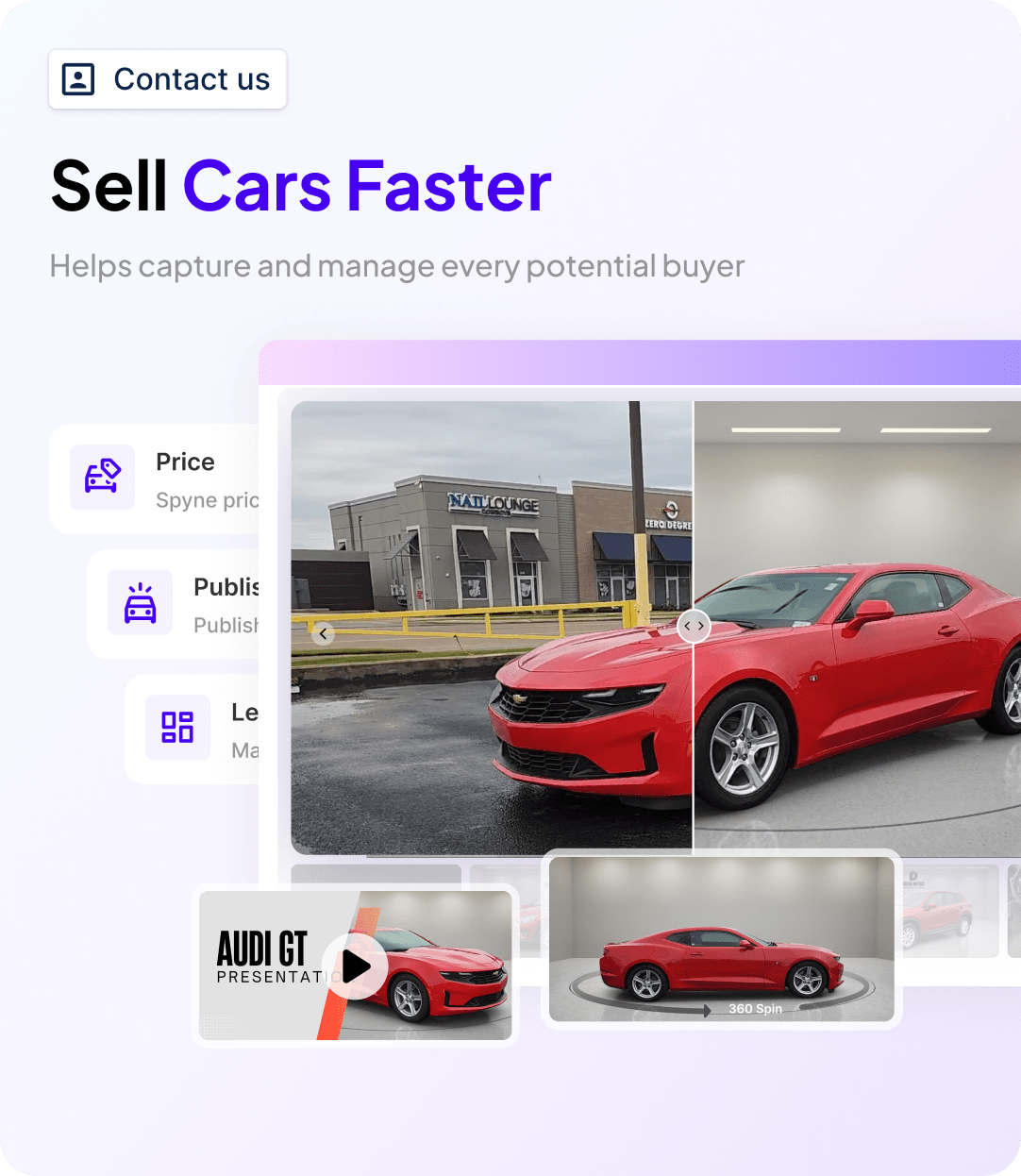
Your inventory is only as strong as how it looks online. Inconsistent, low-quality vehicle images don’t just get ignored, they actively cost you clicks, trust, and deals. In a market where first impressions are digital, Spyne’s AI-powered virtual car studio ensures every listing performs like a top seller.
Transforming Dealership Visuals with AI-Powered Studio AI
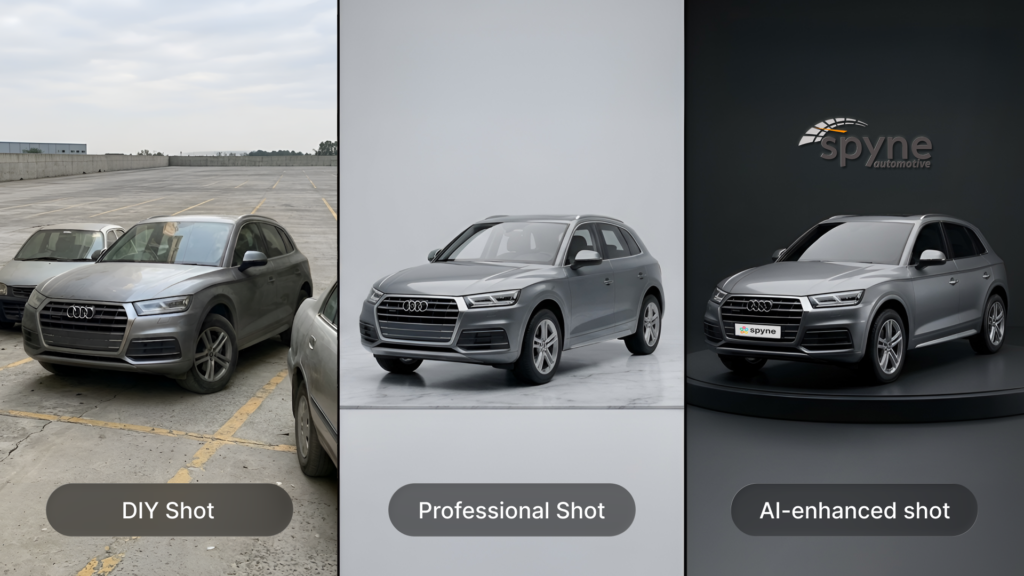
Spyne’s Studio AI is built for dealerships that need more than good photos, they need consistent, high-conversion visuals at scale. Manual photography workflows are slow, inconsistent, and hard to standardize across inventory. Studio AI replaces that with an automated, AI-led production system that delivers studio-grade results every time.
From a single raw image, dealers can instantly generate polished, marketplace-ready visuals in minutes, without expensive shoots, manual edits, or operational bottlenecks.
Key Capabilities That Redefine Car Photography at Scale:
- AI-Powered Car Photo Editing
Spyne’s car photo editing tool automatically enhances lighting, sharpness, and exposure, turning inconsistent or poorly captured images into clean, high-quality visuals. Dealerships using optimized visuals often see higher click-through rates (CTR) and stronger listing engagement, as buyers are more likely to interact with clear, well-presented inventory.
- Immersive Video Tour Creation
Transform listings into dynamic, video-first experiences with immersive video tours that bring vehicles to life. Buyers engage with motion-led visuals that better showcase design, condition, and key details, creating a richer, more interactive experience. This often leads to higher engagement, longer time-on-page, and faster buyer decision-making, especially for high-intent shoppers.
- Car Colour Changer & Advanced Retouching
Try editing tools like the car color changer and intelligent retouching to refine vehicle presentation by correcting tones, enhancing surfaces, and removing unwanted elements like stickers or reflections. Cleaner, more accurate visuals can help reduce friction in the buying journey and shorten time-to-sale, especially for high-intent shoppers.
- Car Background Editing for Consistency
With car background editing tools, dealerships can replace distracting or uneven environments with clean, premium backdrops. Consistent visuals across listings help build trust and can contribute to improved buyer confidence and higher inquiry rates, especially on marketplaces where presentation directly impacts perceived value.

Conclusion
Car photography today sits at the center of how inventory gets discovered, evaluated, and shortlisted. The difference between a scroll-past listing and a high-intent lead often comes down to how well your visuals communicate quality, clarity, and consistency. Applying the right car photography tips is not about aesthetics alone; it is about creating images that reduce uncertainty and move buyers closer to action.
For dealerships, the real shift is moving from one-off good photos to a system that delivers this standard across every vehicle, every time.
Book a demo to see how you can operationalize high-quality visuals at scale and join dealerships already driving stronger engagement, higher conversions, and faster time-to-sale.