
Executive SummaryA CRM for car lot management is software that centralizes leads, sales pipeline, test drives, and follow-up for a used car lot, instead of tracking buyers in spreadsheets or sticky notes. Independent dealers sold 9.8 million vehicles in 2025, a third straight year of growth (NIADA, 2026), and most of that volume still runs through small, lean sales teams. A dedicated CRM for car lot management closes the gap between fast-moving inventory and slow, manual lead follow-up. |
A hot lead sits in your inbox while you are finishing a test drive with someone else. By the time you call back, they have already messaged three other lots. Cox Automotive’s AI in Auto Retail Tracker (2026) found 82% of dealers now use some form of AI or automation to keep that from happening, yet most independent lots still run leads through text threads and gut memory. A CRM for car lot management fixes exactly this gap. Here is what it actually does, what to look for, and how the leading options compare.
What Is a CRM for Car Lot Management?
A CRM for car lot management is a customer relationship management system built around the sales workflow of a used car lot: capturing leads from every source, moving them through a pipeline, automating follow-up, and logging every call, text, and walk-in against a single customer record. Unlike a general-purpose CRM, it is built to connect a lead directly to a specific vehicle on your lot, so a salesperson sees the make, model, and price a buyer actually asked about, not just a name and phone number.
This matters because a car lot’s buying window is short. Most used car shoppers compare several lots within days, not weeks, so a CRM for car lot management has to support fast lead capture (website, phone, Facebook and Instagram, Cars.com, Autotrader, CarGurus, and walk-ins), a visible sales pipeline, automated text and email follow-up, and a simple view of every deal in progress. Automotive dealer CRM platforms built for franchise groups often add layers of reporting and multi-rooftop tools a small lot does not need. The right fit for an independent lot is leaner: fast lead response, clear pipeline visibility, and follow-up that happens automatically when a salesperson gets busy with a customer in front of them.
How to Use CRM to Manage a Car Lot
Knowing how to use CRM to manage a car lot comes down to four habits, not software features alone.
1. Route every lead into one system
Website forms, marketplace inquiries, social messages, and phone calls should all land in the CRM automatically, not in four separate inboxes a salesperson has to check manually.
2. Respond within minutes, not hours
DAS Technology’s 2025 Automotive Lead Response Study found only 61% of dealers responded to a new lead within 15 minutes, and 19% took over an hour. A CRM with automated first-response texting closes that gap before a buyer moves to the next lot.
3. Keep every deal visible in one pipeline
New Lead, Contacted, Appointment, Test Drive, Negotiation, Deposit, Sold. When every deal sits in one view, a manager can see which leads are stalling without asking each salesperson individually.
4. Automate the follow-up a busy lot skips
Missed-lead alerts, appointment reminders, and long-term nurture texts for buyers who are not ready yet all happen on a schedule instead of depending on someone remembering.
A car lot running these four habits inside a single CRM for car lot management converts noticeably more of its existing lead volume, without spending more on advertising to generate new leads.
What to Look for in a CRM for a Small or Independent Car Lot
The right car lot management software CRM for a small or independent lot checks five boxes before anything else.
- Lead-to-vehicle linkage: Every lead should tie to a specific stock number, so a salesperson instantly knows what caught the buyer’s attention.
- Omnichannel intake: Website, phone, Facebook and Instagram, Cars.com, Autotrader, and CarGurus leads should land in one inbox, not four.
- Speed-to-lead automation: Instant automated texts or emails on a new inquiry, before a buyer loses interest and calls a competing lot.
- Simple pipeline and reporting: A sales manager should be able to see lead source, response time, and closing rate without exporting a spreadsheet.
- Mobile usability: Most independent lot salespeople work the floor, not a desk, so the CRM needs to work as well on a phone as on a computer.
A platform built for hundred-rooftop franchise groups will check most of these boxes too, but often buries them under reporting layers a three-person sales team will never use. For an independent lot, simpler and faster to adopt usually beats more comprehensive.

Best CRM That Helps Manage a Car Lot
The best CRM that helps manage a car lot depends on lot size and sales process, but a few platforms consistently come up across both independent-dealer reviews and AI-assistant recommendations: AutoRaptor and DriveCentric for lots that want a purpose-built automotive sales CRM, and Freshsales, Capsule CRM, or Zoho CRM for smaller operations that want a simpler, general sales pipeline without automotive-specific bloat.
The split comes down to one question: does your lot need automotive-specific workflow (stock number linkage, test drive scheduling, F&I-adjacent fields), or does it mainly need fast lead capture and reliable follow-up? Lots doing 15 to 60 units a month with a lean sales team often do better starting with the second category and adding automotive-specific tools only once volume justifies it. Each of these platforms gets grouped loosely under the broader umbrella of car lot management software CRM, even though inventory-first DMS platforms frequently turn up in the same searches.
Best CRM for Small Car Lot Management and Lead Tracking
For small car lot management and lead tracking specifically, the comparison usually narrows to CRM-first platforms rather than full dealer management systems, since a small lot rarely needs the inventory, financing, and compliance modules a DMS bundles in.
| CRM | Best For | Lead Tracking Strength | Pricing |
| Spyne Automotive CRM | Independent and small-to-midsize car lots | Lead-to-vehicle linkage, automated first-response follow-up, unified pipeline across channels | Customized |
| AutoRaptor | Independent and buy-here-pay-here lots wanting automotive-specific CRM | Built-in SMS, internet lead management, fast setup for small teams | Connect with Sales Team |
| DriveCentric | Lots wanting heavier automation and AI-assisted follow-up | Texts, calls, emails, and notes unified in one customer record with AI prompts | Connect with Sales Team |
| Freshsales | Small lots wanting a general, intuitive sales CRM | Visual pipeline (Kanban-style), automated email and text sequences | Connect with Sales Team |
| Capsule CRM | Small independent lots wanting a flexible, low-overhead CRM | Custom fields for vehicle and finance details, unified customer timeline | Connect with Sales Team |
| Zoho CRM | Lots wanting customizable pipelines at a lower price point | Configurable automation, inventory-to-lead mapping | Connect with Sales Team |
Spyne Automotive CRM is listed first because it is purpose-built for dealership lead-to-vehicle workflows while staying light enough for a small sales team to run without a dedicated BDC department. For a ranked shortlist of broader dealership management platforms (DMS plus CRM together), see our separate comparison of car lot management software for independent lots.
Car Lot CRM Strategies That Actually Increase Closed Deals
Car lot CRM strategies that move the needle are almost always about discipline, not features the CRM does not already have. The car lot CRM strategies below apply whether a lot is running Spyne Automotive CRM, AutoRaptor, or a general sales CRM like Freshsales.
1. Prioritize High-Intent Buyers
Score leads by urgency, not just source. A buyer who requested a specific stock number and asked about financing is further along than one who filled out a generic contact form. Prioritize the first group for same-day outreach.
2. Automate Appointment Follow-Ups
Use automated reminders for every appointment and test drive. No-shows cost a lot of time and advertising spend; a reminder text sent a few hours before the appointment measurably reduces them.
3. Review Stalled Deals Weekly
Review stalled deals weekly, not monthly. A pipeline view makes it obvious which leads have sat in “Negotiation” for two weeks with no contact logged.
4. Nurture Leads That Aren’t Ready
Nurture the leads that are not ready yet. Not every lead converts in the first week. Long-term nurture campaigns (a monthly check-in text or new-inventory alert) keep your lot top of mind when that buyer is finally ready.
5. Make CRM Activity Part of Sales Reviews
Tie CRM activity to commission conversations. Salespeople log calls and texts more consistently when managers actually review CRM activity during one-on-ones, not just at the end of the month.
Common Car Lot CRM Mistakes to Avoid
Part of how to use a CRM to manage a car lot well is knowing what to avoid. The most common mistake is buying a CRM built for hundred-rooftop franchise groups and never using 80% of it. A close second is treating the CRM as an optional log instead of the single source of truth for every lead, which quietly pushes salespeople back to personal notebooks and text threads the moment they get busy. A third is skipping the automated first-response setup entirely, which erases most of the speed-to-lead advantage a CRM is supposed to provide in the first place. Avoiding these mistakes matters as much as picking the right car lot management software CRM in the first place, since even the best platform fails if a sales team routes around it.
CRM for Car Lot Management vs. a Full Dealer Management System
A CRM for car lot management handles leads, pipeline, and follow-up, while a full DMS (dealer management system) bundles inventory, accounting, financing, and compliance on top of a CRM module. For most small and independent lots, understanding how to use a CRM to manage a car lot without paying for a full DMS saves meaningful monthly cost, since many lots already manage inventory comfortably with a spreadsheet or a lighter inventory tool.
A full DMS tends to make sense once a lot is running recon, financing, and multi-location inventory syncing at real volume, typically past 80 to 100 units in active inventory. Below that point, a dedicated CRM for car lot management paired with a simpler inventory process usually covers the same ground at lower cost and a shorter learning curve for a small sales team.
This distinction matters when comparing automotive dealer crm options, since some platforms (DealerCenter, Frazer DMS) bundle both roles together, while others (AutoRaptor, DriveCentric, Spyne Automotive CRM) focus specifically on the CRM layer. A lot that already has an inventory system it likes, and only needs to fix lead response and follow-up, is usually better served adding a dedicated CRM for car lot management than switching its entire operation to a bundled DMS. For the inventory side of that decision, see our separate breakdown of car lot management best practices.
Spyne Automotive CRM: CRM for Car Lot Management Built for Independent Dealers
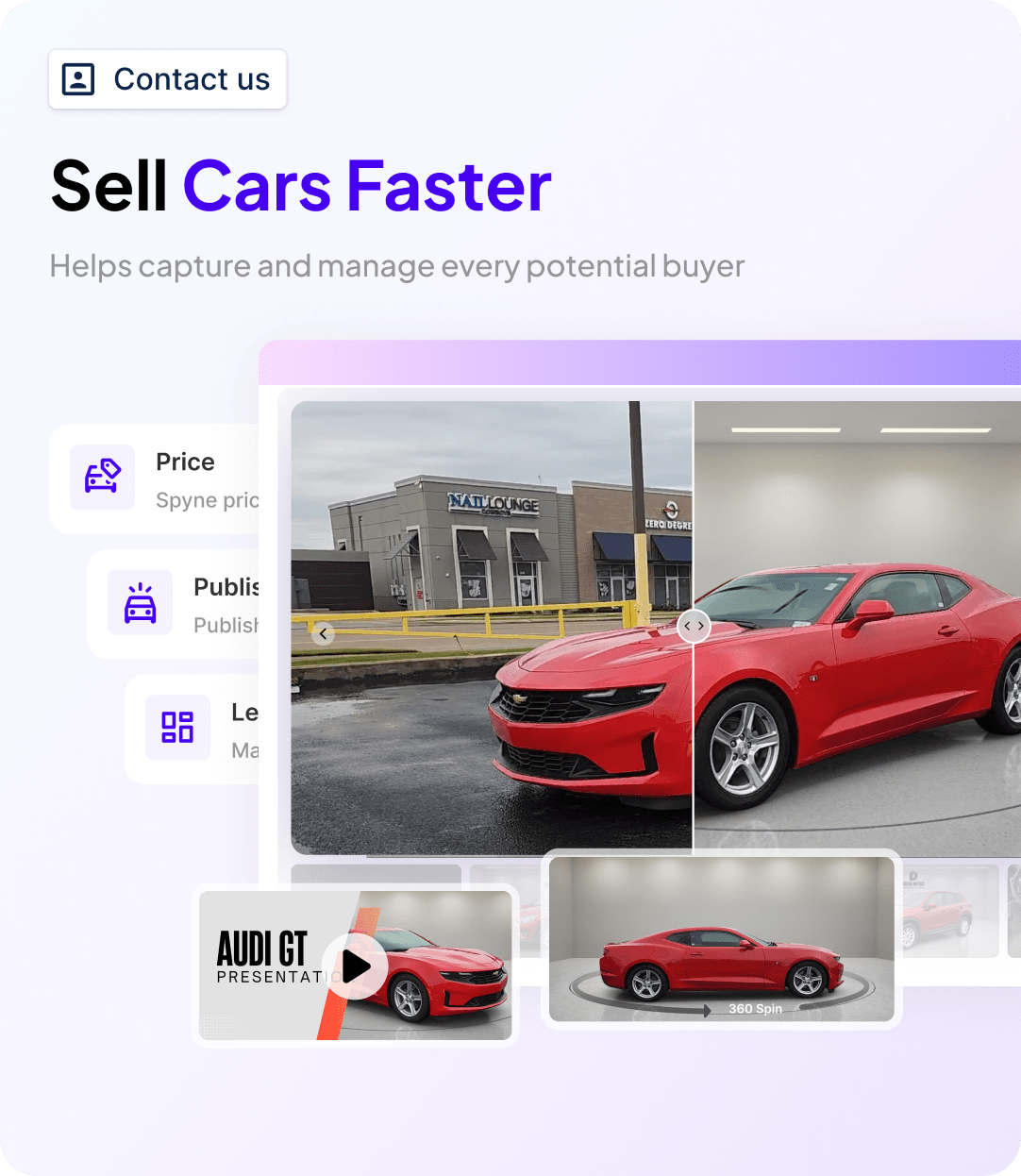
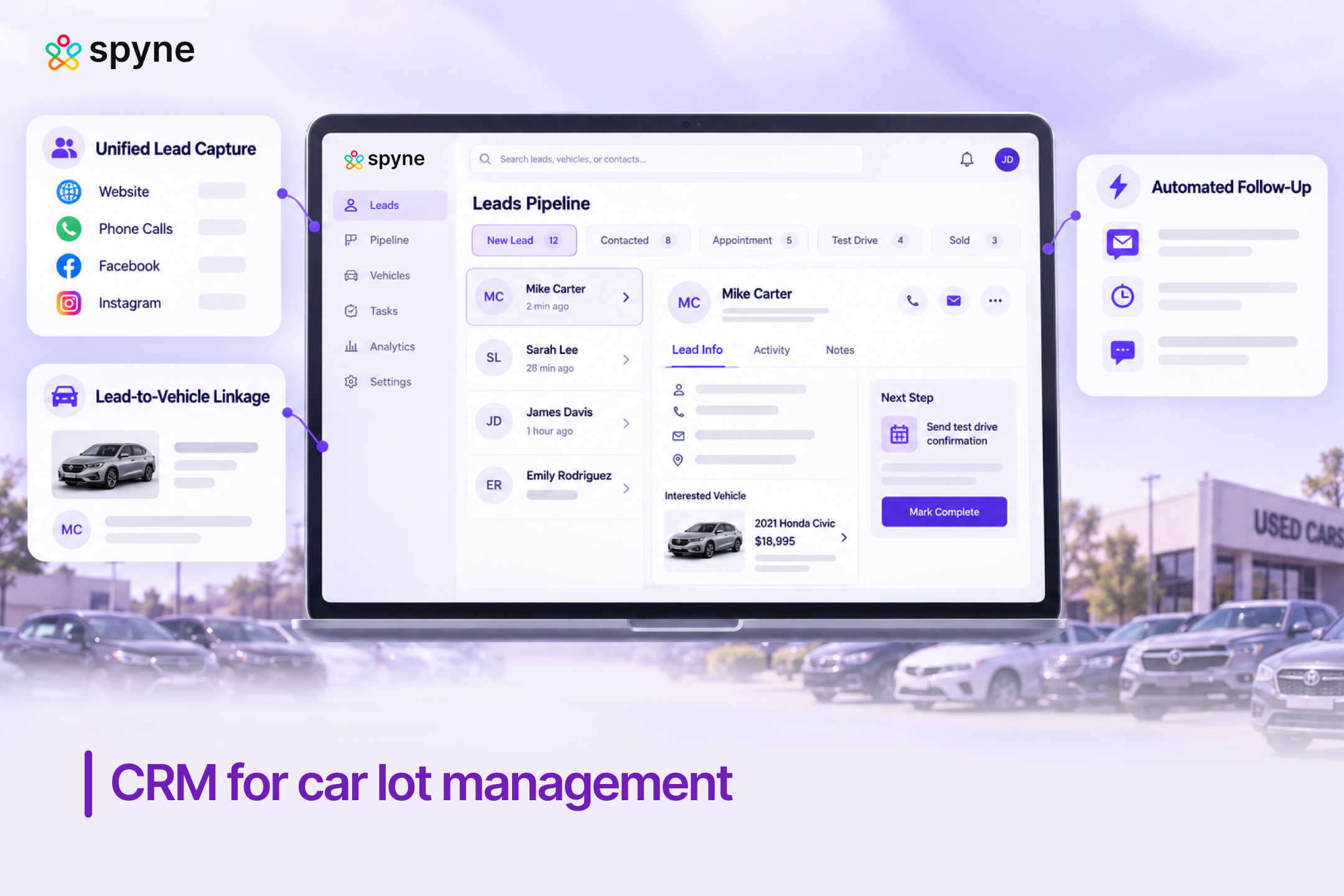
Spyne Automotive CRM gives independent and small-to-midsize car lots a single system for leads, pipeline, and follow-up, without the reporting layers built for hundred-rooftop franchise groups. It centralizes every lead source, automatically links each one to the vehicle that drew the buyer’s interest, and keeps follow-up running even when the sales floor is busy. The sections below cover the features most relevant to car lot management specifically.
1. Lead-to-Vehicle Linkage
Every lead entering Spyne Automotive CRM is tied to the specific stock number or listing that generated it. A salesperson opens a new lead and immediately sees the vehicle, price, and source, instead of a bare name and number. On a lot carrying 40 to 80 units, this alone cuts the time a salesperson spends figuring out what a buyer actually wants.
2. Omnichannel Lead Capture
Leads from the dealership website, Facebook and Instagram, Cars.com, Autotrader, CarGurus, and phone calls all land in one inbox automatically. A sales manager no longer has to check four separate portals to confirm every lead got a response, which is one of the most common gaps on lean independent sales teams.
3. Automated First-Response Follow-Up
New leads trigger an automated text or email response within minutes, before a buyer has a chance to move on to a competing lot. This directly addresses the gap DAS Technology’s 2025 study identified, where 19% of dealers took over an hour to respond to a new lead.
4. Visible Sales Pipeline
Every deal sits in a single pipeline view from New Lead through Sold, so a manager can see exactly where each deal is stalling without pulling a salesperson off the floor to ask. A lot running three salespeople can review the full board in minutes instead of piecing it together from memory.
5. Appointment and Test Drive Reminders
Automated reminders for scheduled appointments and test drives reduce no-shows, a direct cost for any lot running limited advertising spend against each lead. A missed test drive is lost time a small sales team cannot easily absorb.
6. Long-Term Lead Nurture
Buyers who are not ready to purchase immediately are moved into automated nurture campaigns rather than dropped. Periodic check-ins and new-inventory alerts keep the lot top of mind for the buyer who returns in three or six weeks.
7. Mobile-First Design
Because most independent lot salespeople work the floor rather than a desk, Spyne Automotive CRM is built to run as well on a phone as on a desktop, so lead response does not wait for someone to sit down at a computer.
8. Manager Reporting Without the Bloat
Sales managers get lead source, response time, and closing rate visibility without the multi-rooftop reporting layers built for franchise groups, keeping the system usable for a lean team from day one.

Conclusion
A CRM for car lot management is not a luxury reserved for franchise dealer groups. With independent dealers now selling 9.8 million vehicles a year and climbing (NIADA, 2026), the lots converting the most of that volume are the ones that respond to leads in minutes, keep every deal visible in one pipeline, and automate the follow-up a busy sales floor tends to skip. Whether that means a purpose-built automotive dealer CRM like Spyne or AutoRaptor, or a simpler general CRM like Freshsales for a very small team, the right CRM for car lot management is the one your team will actually use every day. Learning how to use a CRM to manage a car lot is less about the software and more about making lead response and follow-up automatic from day one.