
Executive SummaryAn AI automotive CRM pairs lead management with autonomous, agentic AI that qualifies, follows up, and books appointments without a rep touching every record. Cox Automotive’s 2026 AI in Auto Retail Tracker found 82% of dealers now use AI somewhere in their operations, yet only 29% have adjusted to how AI-powered shoppers actually search and buy. Spyne’s Automotive CRM closes that gap with built-in AI chat, lead scoring, and automated follow-up, recovering deals a slower, manual process would lose overnight. |
Your BDC clocks out at 6 PM. Your best lead doesn’t. Cox Automotive’s 2026 tracker found 63% of shoppers plan to use AI on their next purchase, while only 29% of dealers have adjusted how they sell to them. That gap is where deals die overnight and on weekends. An AI automotive CRM is built to close it, not with a scripted chatbot, but with software that works the lead while your team is off the clock. Here’s what separates a real one from a rebrand.
What Is an AI Automotive CRM, and How Is It Different From a CRM With a Chatbot Bolted On?
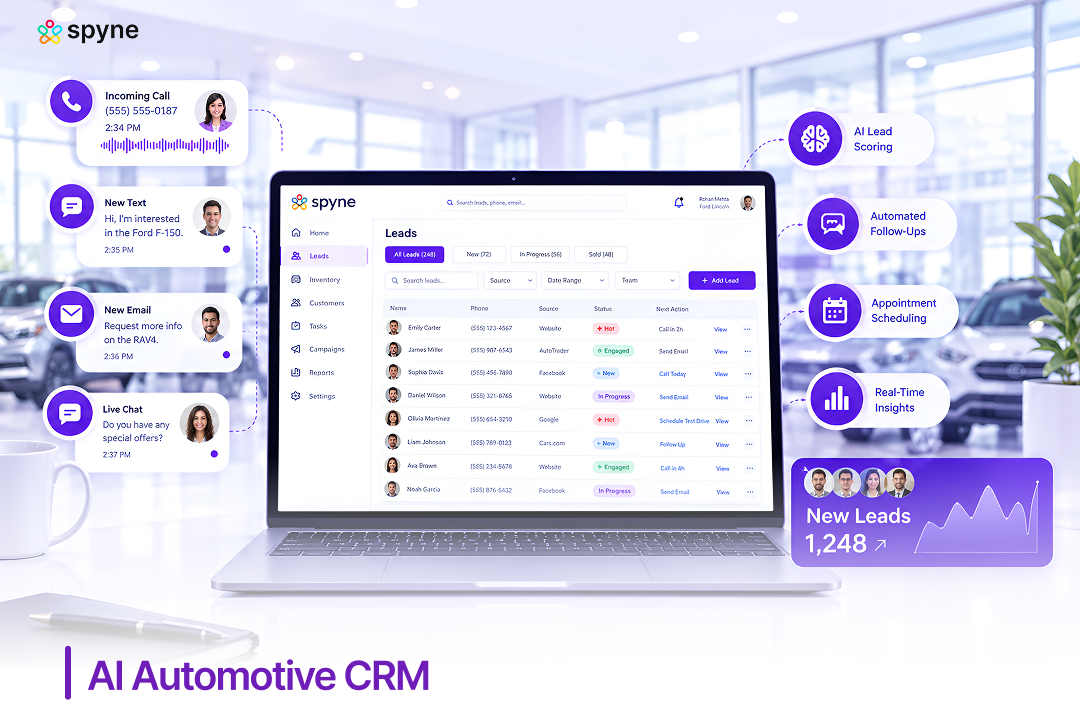
An AI automotive CRM is dealership CRM software where AI is part of the core workflow, not a widget added to an existing pipeline. It scores leads on purchase intent, routes them to the right rep or channel, holds a real qualifying conversation over chat or text, and logs every step back into the pipeline automatically. A bolted-on chatbot, by contrast, answers a question and stops. It doesn’t update the deal record, doesn’t decide the next best action, and doesn’t follow up three days later if the customer goes quiet.
The tell is what happens after the first message. If the system only replies, it’s a chatbot with a CRM behind it. If it qualifies, schedules, updates the record, and re-engages on its own timeline, you’re looking at an actual AI automotive CRM. That distinction matters more than any feature list, because it’s the difference between software that answers and software that sells. For the fundamentals this article assumes you already know, see this guide to automotive CRM software.
Picture a used-SUV shopper who messages at 8:40 PM about a specific VIN. A bolted-on chatbot confirms the car is in stock and stops there, leaving a human to notice the message the next morning. An AI automotive CRM checks lot inventory, confirms trim and price, asks a qualifying question about trade-in or financing, and proposes a Saturday test-drive slot before the shopper closes the tab. The rep walks in Monday to a booked appointment instead of a cold lead a competitor already worked.
In practice, an AI automotive CRM is built to carry a lead through the whole path a dealership actually sells on, not just the first reply:
- Lead arrives from a dealership site, Cars.com, Autotrader, CarGurus, TrueCar, or an OEM source.
- AI conversation engages the shopper within seconds over chat, text, or web, at any hour.
- Qualification confirms budget, trade-in, and vehicle interest before a rep is looped in.
- Appointment gets booked directly against real lot inventory, not a guess.
- Showroom and test drive happen with a rep who already has full context from the AI-summarized handoff.
- Deal and delivery move through the same record the AI built, with no re-entry.
- Service and repeat purchase get triggered later from the same customer profile, closing the loop instead of starting a new one.
Why an Agentic CRM for Car Dealerships Beats a Chatbot Bolted Onto Your Pipeline
An agentic CRM for car dealerships takes multi-step action toward a goal (book the appointment, requalify a cold lead, escalate a hot one) without a human approving each step. A rules-based chatbot only executes pre-written if-then scripts and hands off the moment a conversation leaves the script.
That difference shows up fastest after hours. Cox Automotive (2026) reports that dealers who have not adjusted to AI-driven shopping behavior are the same dealers still routing after-hours and weekend leads to voicemail or a next-day callback list. An agentic CRM for car dealerships doesn’t wait for Monday. It engages the lead in real time, checks inventory, proposes a time slot, and puts a qualified appointment on a rep’s calendar before the store opens. Salesforce’s 2025 automotive research found 70% of car owners would let an AI agent handle scheduling on their behalf rather than book it themselves, which is exactly the behavior a chatbot script can’t capture but an agentic system can. This is the same principle behind conversational AI for dealerships the value is in the follow-through, not the first reply.
What Should a CRM With AI Capabilities Actually Do for Your Dealership?
A CRM with AI capabilities worth paying for should handle the following without a rep initiating each action:
1. Speed-to-lead response and prioritization
Rank incoming leads by purchase intent using source, vehicle interest, and response behavior, so reps work the hottest leads first instead of working the pipeline in the order it arrived. Speed-to-lead is the metric that separates a real AI automotive CRM from one that just looks busy.
2. Conversational AI chat
A CRM with AI chat should hold a full back-and-forth over web chat, SMS, or email, answer inventory and pricing questions accurately, and hand off to a human only when the conversation genuinely needs one.
3. Automated, multi-touch follow-up
Leads that go cold get re-engaged on a schedule (same day, three days, two weeks) without a rep setting a reminder.
4. Appointment scheduling tied to real inventory
The system checks what’s actually on the lot before proposing a test-drive time, instead of booking against a car that sold last week.
5. Equity mining and trade-in signals
Scans the existing customer database against current market values, loan payoffs, and lease-end dates to flag drivers already in positive equity, so reps get a warm trade-in lead instead of cold-calling the full database.
6. AI-summarized handoffs
When a conversation needs a human, the system hands the rep a written summary of what the customer asked and what they’re ready to do next, not a raw chat log they have to re-read from the top.
7. Unified activity logging
Every AI-handled touch gets written back to the customer record automatically, so managers see full history without asking a rep to log it manually.
8. Service lane and repeat-customer triggers
The same AI that manages a sales lead should be able to route service reminders and recall outreach through an automotive service CRM, since retention runs through the same customer record.
9. Manager-level visibility
Real-time dashboards showing which leads AI is handling, which it has escalated, and where response times are slipping.
If a platform is missing more than one or two of these, it’s a CRM with an AI feature attached, not a CRM with AI capabilities built into the core pipeline. For the fuller baseline list beyond the AI layer, see these automotive CRM features.

The Best AI CRM for Automotive Dealerships in 2026: How the Leading Platforms Compare
There’s no single best AI CRM for automotive dealerships for every store. An independent lot, a five-rooftop group, and an enterprise dealer group weigh AI depth, price, and DMS integration (CDK, Reynolds and Reynolds, Dealertrack, Tekion) differently. Two names worth naming directly, though neither markets itself primarily as agentic AI: Reynolds and Reynolds, which leans on DMS alignment and compliance, and ELEAD, CDK’s CRM brand built around BDC workflow. For a broader look at dealership CRM providers beyond AI depth alone, see the full roundup. Here’s how the platforms most often shortlisted for AI depth actually compare.
| Platform | Agentic AI / AI Chat Depth | Best Fit | |
| Spyne Automotive CRM | AI receptionist qualifies and engages leads over chat and text, with automated lead scoring, smart assignment, and multi-touch follow-up logged back to the record automatically. | Independent and franchise dealers who want agentic follow-up without stitching together separate point tools. | |
| DriveCentric | AI Agents feature handles initial lead response and follow-up reminders inside a broader sales-and-service engagement platform. | Dealers who want one login across texting, video, and marketing automation. | |
| CDK Modern Retail CRM | AI Virtual Assistant routes and responds to leads; AI Writing & Summaries drafts replies and condenses conversations for reps. | Larger stores already on CDK’s DMS ecosystem who want AI layered onto existing workflows. | |
| Tekion (Salesperson AI) | Markets itself as the most explicitly agentic of the group: 24/7 response, automated multi-day follow-up, appointment booking, and intelligent handoff with conversation summaries. | Cloud-native dealers moving off legacy DMS platforms who want AI as the default, not an add-on. | |
| Salesforce Automotive (Agentforce) | Branded the “#1 Agentic CRM for automotive,” with broad AI-driven alerts, insights, and process automation across an enterprise platform. | Multi-rooftop groups and OEM-adjacent operations that need a CRM alongside a wider enterprise Salesforce footprint. | |
| VinSolutions | AI-assisted lead scoring and connected data inside the Cox Automotive ecosystem, with AI depth strongest where it’s paired with other Cox tools. | Franchise dealers already using other Cox Automotive products (vAuto, Dealertrack). | |
| DealerSocket | Predictive AI for lead scoring within a franchise-oriented CRM, with deeper DMS integration than most independents need. | Franchise networks and dealer groups running standardized processes across rooftops. | |
| AutoRaptor | Lighter AI layer focused on lead tracking and reporting rather than autonomous multi-step engagement; strongest for transparent, unlimited-user pricing. | Independent and BHPH dealers prioritizing budget and simplicity over deep AI automation. |
The pattern across this list: the platforms with the deepest agentic behavior (Spyne, Tekion, and Salesforce’s Agentforce positioning) are the ones built to act on a lead without a rep initiating each step. The rest layer AI-branded features onto workflows that were designed before AI chat was standard, which is a real distinction, not a knock. A five-year-old CRM with a new AI module bolted on will behave differently under load than one built agentic from the pipeline up.
How to Evaluate an AI Automotive CRM Before You Sign a Contract
Evaluating an AI automotive CRM before a demo turns into a contract comes down to three questions, in this order:
1. Does it act, or does it just answer?
Ask the vendor to show a lead going cold and getting re-engaged automatically three days later, live, in the demo. If they can only show a single chat exchange, that’s the ceiling of what it does.
2. Where does the data actually live?
Confirm whether AI-handled conversations write back to the CRM record in real time or batch-sync overnight. A gap here means your reports are always a day behind what actually happened with a lead.
3. What happens when it’s wrong?
Every AI system misreads a lead occasionally. Ask how escalation to a human works, how fast it happens, and whether a manager can see it happening in real time rather than finding out from a lost deal.
4. Does it handle consent correctly?
An AI automotive CRM is sending automated texts, calls, and emails at scale, which means it has to respect TCPA, CAN-SPAM, and state-level privacy and opt-out rules by default, not as a setting a dealer has to configure and hope holds up.
Red flags: pricing only available after a 45-minute discovery call, AI demos that are clearly scripted rather than live, and any vendor who can’t name what DMS platforms they sync with in real time versus overnight batch. Ask, too, whether the AI was trained on automotive sales conversations or adapted from a generic customer-service bot, since the second version tends to misread trims, incentives, and trade-in value. Once live, the same discipline applies to tracking automotive CRM metrics, not just the initial demo.
What Does an AI Automotive CRM Cost, and What’s the Payback?
Most AI automotive CRM platforms price on a custom quote rather than a published rate card, because cost scales with rooftop count, lead volume, and which AI modules (chat, voice, service scheduling) a dealer turns on. Expect a real sales conversation before a number, not a self-serve checkout.
The variables that move the quote are worth asking about directly. A single independent lot with moderate lead volume typically activates chat engagement and follow-up automation only, keeping scope narrower. A multi-rooftop franchise group adds voice AI, service scheduling, and cross-store reporting, which is where the quote climbs, because more channels and locations mean more conversations to handle, not vendor padding. Ask any vendor to break the quote down by module rather than accept one bundled number.
The payback case is more concrete than the price tag. Spyne’s own deployment data shows a single dealership, Paragon Honda, recovered $310,000 in previously missed opportunity in one week after AI-based lead engagement went live, consistent with what happens when a store stops losing after-hours and weekend leads to slow manual response. Set against Cox Automotive’s finding that 82% of dealers already use AI but only 29% have adjusted their process to match AI-driven shoppers, the dealers seeing payback fastest are matching process to technology, not just installing it. Track it with the automotive CRM reports most platforms already generate, so payback stays a running number instead of a one-time claim.
Spyne Automotive CRM: Agentic AI Automotive CRM Built for Real Dealership Workflows
Spyne’s automotive CRM software is built for dealerships that want an agentic CRM for car dealerships without stitching together a chatbot, a lead-scoring tool, and a follow-up sequencer from three different vendors. It centralizes lead intake across web, chat, SMS, phone, and third-party sources into one pipeline, then lets AI work that pipeline continuously instead of waiting for a rep to open it. Spyne’s AI automotive CRM is built around one idea: a lead shouldn’t sit unworked because it arrived at 9 PM on a Saturday.
1. AI Receptionist for instant engagement
Answers and qualifies inbound chat, text, and web leads within seconds, day or night, and hands off to a rep with full context once a lead is ready to talk terms.
2. AI Lead Scoring
Ranks every lead by purchase intent using source quality, vehicle interest, and behavior, so reps see the hottest opportunities first instead of a flat, unsorted queue.
3. Smart Lead Assignment
Routes each qualified lead to the right rep automatically based on availability, specialty, or current workload, cutting the lag between qualification and first human contact.
4. Automated, multi-touch follow-up
Re-engages leads that go quiet on a set cadence across chat, email, and text, so a cold lead doesn’t require a rep to remember to circle back.
5. Unified activity logging
Every AI-handled touch and hand-off writes back to the customer record in real time, giving managers a complete history without manual data entry.
6. Real-time performance dashboards
Shows exactly which leads AI is handling, where response time is slipping, and which reps are converting fastest, so managers can coach with data instead of guesswork.
7. Custom workflow automation
Lets a dealership configure how AI escalates, when it hands off, and what triggers a service or retention touch, rather than forcing every store into one fixed script.
Dealerships evaluating a CRM with AI chat and a CRM with AI capabilities side by side tend to land on the same test: does it act on a lead without being told to, every time, at 2 AM and on a Sunday. That’s the bar Spyne’s Automotive CRM is built to clear.

Conclusion
The right AI automotive CRM doesn’t just store contacts better than a spreadsheet. It acts on them, at the exact hours your team can’t, and logs everything it does so a manager can verify it actually happened. The platforms worth shortlisting in 2026, Spyne included, are the ones built agentic from the pipeline up rather than the ones with a chat widget added to a decade-old system. Test that distinction live in every demo before you sign anything.