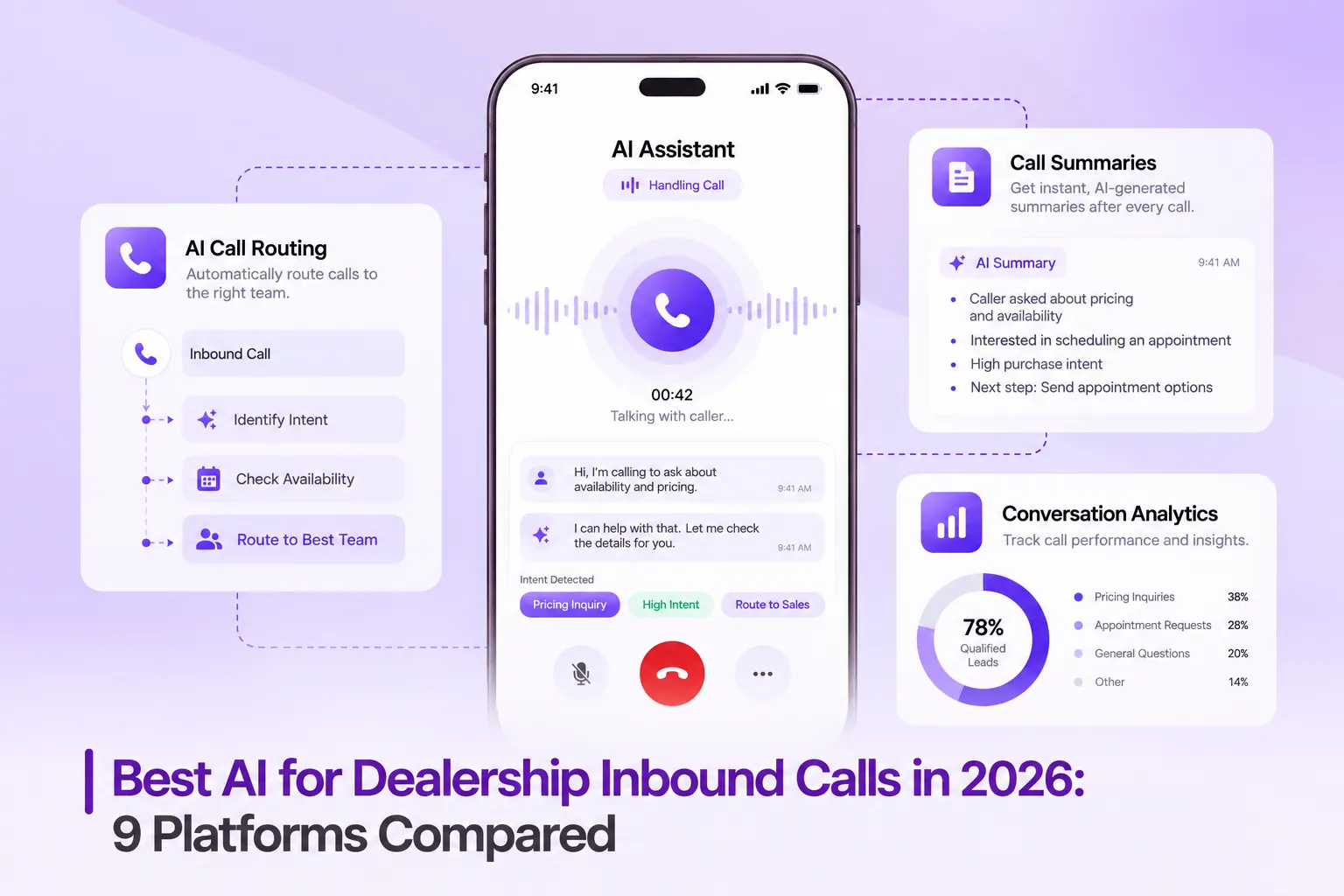

| Executive Summary: The best AI for dealership inbound calls should do considerably more than answer the phone. It should understand why the customer called, handle routine sales and service requests, book appointments, route complex conversations, and record the outcome inside dealership systems. That gap remains substantial: Foureyes found 42.7% of qualified dealership sales leads were mishandled in 2025, while 15.2% never entered the CRM. Car Wars also reported a 62.39% average Sales Connect score for 2025. Vini AI by Spyne combines 24/7 call coverage with qualification, appointment workflows, CRM-connected context, and human handoffs across sales and service. |
Inbound calls remain one of the dealership’s highest-intent customer touchpoints, yet the phone process still breaks during call spikes, lunch coverage, weekends, and after hours. Foureyes’ 2026 benchmark found connected dealership customers still spent roughly 73 seconds on hold, while Car Wars reported that a meaningful share of sales calls never successfully connected.
AI adoption is also moving quickly. CDK reports 39% of dealerships now use AI, with another 27% planning adoption within a year. This guide compares nine automotive AI platforms based on the call-handling capabilities that matter inside a U.S. dealership.
Why Are Dealerships Automating Inbound Calls in 2026?
Dealerships are automating inbound calls because call volume and customer expectations do not follow staffing schedules. AI gives the store additional capacity during peaks and after hours while protecting the BDC, service advisors, and front desk from repetitive intake work.
The operational data makes the gap clear. Car Wars reported an average 62.39% Sales Connect score for 2025, while its broader phone research found nearly one-third of unsuccessful calls were lost before a conversation began. Foureyes separately found 42.7% of qualified sales leads were mishandled during 2025.
Staffing pressure adds another layer. NADA recorded 42% annualized dealership employee turnover in 2024, with sales consultant turnover reaching 66%.
That is why modern dealership call overflow automation is increasingly designed as additional operating capacity, rather than another voicemail or call-forwarding system.
What Should AI Inbound Call Software Actually Handle?
Good dealership inbound call AI should take a caller from first ring to a completed next step whenever the request is routine. Answering the phone without completing the task only moves the bottleneck somewhere else.
A dealership should expect the AI to handle:
- Sales, service, parts, and general dealership inquiries
- Vehicle availability and basic inventory questions
- Lead qualification and intent capture
- Test-drive and showroom appointment requests
- Service scheduling and rescheduling
- Business hours, location, recall, and common FAQ requests
- Department or employee routing
- Context-rich warm transfers
- Callback creation when a human is unavailable
- CRM, DMS, or scheduler logging
- After-hours and peak-volume calls
- Conversation summaries, transcripts, and outcomes
This distinction matters when comparing an AI receptionist for car dealerships against a traditional IVR. An IVR primarily routes calls. Conversational AI can understand the request and complete supported workflows before deciding whether a human is required.
What Are the Best AI Platforms for Dealership Inbound Calls in 2026?
The strongest dealership AI call platforms now compete on what happens after the call is answered. Dealers should compare appointment completion, dealership-system access, routing logic, CRM or DMS write-back, failed-transfer recovery, after-hours coverage, and reporting rather than evaluating voice quality alone.
| Platform | Best Fit | Verified Inbound Scope | Direct Appointment Capability |
| Spyne Vini AI | Full dealership sales and service automation | Sales, service, BDC, parts, finance | Yes |
| Clearline | Broad dealership inbound automation | Sales, service, parts, finance | Yes |
| Numa | High-volume stores and dealer groups | Reception, sales and fixed ops | Yes |
| Toma | High-volume service and enterprise operations | Voice, SMS and email | Yes |
| Mia | Reception, sales and service automation | Reception, sales, service | Yes |
| BDC.AI | AI receptionist plus BDC automation | Reception, sales, service | Yes |
| STELLA Automotive AI | Reception and fixed ops workflows | Reception, sales, service | Yes |
| Flai | Service-heavy dealerships needing multi-channel coverage | Calls, SMS and email across sales and service | Yes |
| Kimoby Voice | Service departments fixing missed-call handling | Missed and overflow service calls | No, currently routes requests to advisors |
1. Spyne Vini AI: Best for End-to-End Dealership Call Automation
Best for: Dealerships that want inbound call automation connected to sales, service, qualification, appointments, customer routing, CRM workflows, and continued follow-up.
Vini AI is Spyne’s conversational AI platform built specifically around automotive dealership conversations. Instead of stopping at call answering, Vini can capture caller intent, qualify the customer, answer supported inventory or service questions, schedule appointments, update dealership systems, and decide when the conversation should move to a human.
That wider workflow matters because inbound calls rarely end with a single question. A sales caller may start by asking whether a Civic is available, move into pricing, ask about vehicle history, and then request a test drive. A service caller may ask about availability, change an appointment, or call outside service-drive hours. Vini is designed to keep those steps within the same conversation.
How Vini handles inbound sales calls
For sales teams, Vini can respond around the clock and gather information including the vehicle a buyer wants, budget, purchase intent, and other lead details before the salesperson gets involved.
Vini supports:
- 24/7 inbound lead capture
- Buyer qualification
- Inventory-aware customer conversations
- Vehicle and Carfax-related inquiries
- Test-drive and showroom appointment booking
- Lead routing based on intent
- CRM synchronization
- Follow-up when the conversation does not convert immediately
The advantage for the BDC is capacity. Reps do not need to spend the same amount of time handling basic intake before identifying which callers actually require a salesperson. High-intent conversations can move to the team with the context already captured.
How Vini handles inbound service calls
Service creates a different phone problem. Advisors are often busiest with customers in the lane during the same periods when inbound call demand peaks.
Vini can handle appointment scheduling, real-time rescheduling, service inquiries, reminders, and post-service follow-up. It can also continue taking service requests outside business hours rather than sending the customer to voicemail.
For franchise dealerships, Spyne describes Vini checking availability and booking after-hours service appointments directly into the dealership’s scheduling workflow.
What performance has Vini delivered?
Vini AI has a 99.9% connect rate and 33% lead-to-visit rate on Spyne’s automotive AI offering.
At Paragon Honda, Vini AI was deployed across inbound and outbound workflows to address unanswered calls, delayed response, recall outreach, and team capacity. The dealership recorded:
- $314,000 recovered in 30 days
- 48% appointment-to-sale rate
- 53% recall connect rate
- 33% recall booking rate
The useful takeaway is the workflow behind those numbers. Vini covered inbound demand while also qualifying customers and moving recall conversations toward appointments, giving the existing sales and service teams more completed opportunities to work.
2. Clearline: Best for Broad Dealership Inbound Workflows
Best for: Dealers wanting one AI layer across sales, service, parts, and finance calls.
Clearline’s Luna answers inbound calls during business hours, peak periods, and after close. It identifies why the customer is calling, handles supported requests, checks live calendar availability, books service or sales appointments, and routes conversations that require staff involvement with context attached.
Its official inbound page lists 100% calls answered, a 1.2-second average answer time, 1,900+ calls handled at one store during its first month, and 30%+ of service appointments booked by AI. Clearline also states that it connects to the dealership’s existing phone system rather than requiring a phone-system replacement.
Clearline’s CRM product also writes appointments and outcomes into connected dealership systems and automatically records calls, emails, texts, bookings, and next actions.
3. Numa: Best for Call Routing Plus Connected Dealership Workflows
Best for: Franchise stores and multi-rooftop groups that want AI reception connected with broader fixed ops and sales workflows.
Numa’s Operator answers inbound calls 24/7, understands caller intent, handles common questions, and routes customers without a traditional phone tree. When a transferred call is unanswered, Operator can return to the customer instead of dropping the call directly into voicemail. Numa lists 1,400+ dealerships, 95% routing precision, and 24/7 answering for Operator.
Numa should not be treated as routing-only, however. Its wider AI operating system supports service and sales appointment workflows with DMS and CRM connectivity. Numa states that its scheduling AI can read real-time availability, book appointments, confirm them, and write service bookings into dealership systems.
4. Toma: Best for High-Volume Fixed Ops and Enterprise Call Automation
Best for: Dealer groups and service operations processing significant inbound volume.
Toma handles inbound customer interactions across phone, SMS, and email. Its official product page says the AI can resolve customer questions, book appointments, or route conversations to employees while working with the dealer’s DMS, CRM, and scheduler.
Toma also has a useful failed-transfer safeguard. Its “Transfer Clawback” can recover a call when the employee receiving the transfer does not answer, then capture the request and create follow-up context instead of losing the caller.
At Martin Management Group, Toma handled 22,000+ customer interactions, booked 9,000+ service appointments, and reduced BDC workload by more than 40% during the first 90 days. The case study attributes more than $2 million in service revenue to those booked appointments.
5. Mia: Best for Reception, Sales, and Service Call Automation
Best for: Dealerships wanting one conversational AI system across the front desk, sales department, and service lane.
Mia answers dealership calls 24/7/365 and supports intelligent routing, appointment booking, inventory questions, CRM logging, and multilingual conversations.
Its reception product integrates with dealership systems including CDK, Tekion, VinSolutions, Reynolds & Reynolds, Dealertrack, vAuto, and Xtime. Mia states that these connections allow it to check current inventory, book appointments inside dealership scheduling systems, and notify staff when leads require attention.
For service specifically, Mia says it books appointments directly into dealership systems and supports after-hours scheduling, recalls, service reminders, and customer questions. Its current service page lists an 80% booking conversion rate across the product’s service workflow.
6. BDC.AI: Best for Pairing AI Reception With AI BDC Workflows
Best for: Stores wanting inbound reception, sales engagement, and service automation from the same vendor.
BDC.AI currently offers three primary dealership agents: Sales, Service, and Receptionist AI. Its receptionist answers inbound calls, manages scheduling and questions, and transfers customers when needed. The Sales and Service agents expand that workflow into follow-up, qualification, recalls, declined-service outreach, and appointment generation.
BDC.AI lists sub-one-second pickup, 24/7 coverage, support for 10+ languages, and a 100% answer rate for its receptionist offering. It also lists dealership integrations across DMS, CRM, service schedulers, inventory systems, and websites.
The company’s website currently lists pricing beginning at $595 per month, although actual dealership pricing will depend on deployment scope.
7. STELLA Automotive AI: Best for AI Reception and Service Workflows
Best for: Dealerships focused on replacing rigid phone-tree experiences while adding AI-supported reception and service automation.
STELLA Reception answers calls on the first ring, operates 24/7/365, supports simultaneous calls, answers common dealership questions, records and transcribes calls, and routes callers by employee, role, or department.
STELLA’s wider product suite adds dedicated Sales and Service agents. Its Service Agent books appointments into dealership schedulers, while the company states its broader system integrates with DMS platforms, schedulers, CRMs, and marketing tools using real-time and bi-directional integrations.
STELLA is also an approved FordDirect vendor, with the company’s Ford page describing 24/7 inbound answering alongside sales and service appointment booking.
8. Flai: Best for Service-Heavy, Multi-Channel Dealership Communication
Best for: Dealers that want AI phone handling tied closely to service appointments, recalls, callbacks, SMS, and email.
Flai handles calls, SMS, and email across dealership workflows. Its voice AI can schedule service appointments, book test drives, answer supported inventory questions, qualify leads, and transfer customers to dealership employees when human involvement is required.
Flai also supports warm transfers, smart callback assignments, multilingual conversations, and simultaneous call handling. The company states that its system connects with dealership schedulers, DMS platforms, and CRMs.
At Glendale Infiniti, Flai handled more than 1,800 calls per month, produced 160+ service appointments, and recorded zero missed calls after being deployed as the dealership’s AI receptionist.
9. Kimoby Voice: Best for Recovering Missed Service Calls
Best for: Service departments whose biggest phone problem is missed calls rather than autonomous appointment booking.
Kimoby Voice takes a narrower approach than the platforms above. When an advisor cannot answer, Voice identifies the caller using dealership records, matches the customer with an open repair order and advisor where applicable, captures the reason for calling, and creates a recording, transcript, AI summary, and sentiment indicator.
Customers can also move the conversation to text rather than waiting on hold. Kimoby works with existing dealership phone lines and lists DMS connections including CDK, Reynolds & Reynolds, PBS, Tekion, Serti, Dealer Vu, and Quorum.
Important limitation: Kimoby states that Voice does not currently book appointments directly. It captures the request and routes it to the appropriate advisor, who completes the booking. Direct Voice booking is listed as a future capability.
Which AI Inbound Call Platform Fits Different Dealership Needs?
The right AI depends on the operational gap you are fixing. A full-store conversational layer and a missed-call service assistant can both be useful, but they solve very different problems.
- Full sales + service automation: Vini AI, Clearline, Mia, BDC.AI
- High-volume fixed ops: Toma, Numa, STELLA, Flai
- Main-line reception and routing: Numa Operator, Mia, BDC.AI
- Missed-call service recovery: Kimoby Voice
- Inbound plus wider conversational workflows: Vini AI, Clearline, Toma, Mia, BDC.AI
Dealers evaluating AI voice agents for dealership sales teams should therefore start with the workflow they need completed, rather than selecting whichever demo has the most human-sounding voice.
What Should a Dealership Test Before Buying an AI Call Platform?
A dealership should test the AI against real store scenarios before signing. A polished demo means little if the agent fails when inventory changes, a transfer rings out, or a service customer describes an unusual request.
Run at least these tests:
- Call after hours: Does it perform the same workflows at 9 PM?
- Ask about a real VIN: Can it retrieve accurate vehicle information?
- Book an actual appointment: Does it reserve a real slot or merely create a callback task?
- Force a failed transfer: What happens when the salesperson or advisor does not answer?
- Inspect the CRM record: Are notes, intent, outcome, and appointment details written correctly?
- Try a complicated request: Does the AI know when to escalate?
- Test multiple departments: Sales performance does not prove service performance.
- Review reporting: Managers should see answer rate, resolution, appointments, transfers, and outcomes.
The dealership lead response process should improve measurably after deployment, rather than produce another dashboard for the BDC manager to monitor.
What Should AI Handle, and What Should Dealership Employees Handle?
AI works best on high-volume, repeatable call workflows where speed and consistency matter. Humans should retain conversations where judgment, negotiation, accountability, or customer recovery carries more value than automation.
| AI Should Handle | Humans Should Handle |
| First-ring answering | Price negotiation |
| Basic inventory questions | Trade valuation |
| Lead qualification | Complex finance discussions |
| Routine service scheduling | Serious complaints or heat cases |
| Hours, directions and FAQs | Warranty disputes requiring judgment |
| Appointment confirmations | Deal structuring |
| Overflow and after-hours | Sensitive customer retention conversations |
| CRM logging and summaries | Final sales closing |
The objective is not to automate every dealership conversation. The better operating model uses AI to make sure a qualified customer reaches the right person without waiting, repeating information, or disappearing into voicemail.
Which Metrics Should Dealers Track During a 30-Day AI Call Pilot?
A dealership should measure outcomes, not simply the number of calls the AI answered. Answer rate is the starting point; appointment and customer outcomes show whether the deployment works operationally.
Track:
- Inbound call connection rate
- Average answer time
- AI resolution rate
- Appointment-set rate
- Appointment show rate
- After-hours appointments
- Successful transfer rate
- Failed-transfer recovery
- CRM write-back accuracy
- Calls requiring human escalation
- Sales versus service results
- Customer complaints or negative sentiment
CDK’s 2026 research found 69% of dealerships already using AI say it has positively affected their business, but individual dealership ROI still depends on how well the AI is integrated into real workflows.
Conclusion
Inbound call AI should be judged by what happens after the phone gets answered. In 2026, the meaningful gap between platforms is increasingly found in appointment completion, automotive data access, CRM and DMS connectivity, failed-transfer recovery, and the ability to work across both sales and service. A natural voice with weak workflow integration still leaves employees cleaning up the call afterward.
The most useful deployment starts with a measurable problem, such as after-hours calls or service overflow, and proves the impact through booked appointments and completed outcomes. See how Spyne’s AI for car dealerships connects customer conversations with dealership workflows, and book a demo with Spyne to test Vini AI against your real inbound calls.
Disclaimer: Spyne is not affiliated with, associated with, endorsed by, or in partnership with any third-party company mentioned in this article. All product information is based on publicly available information from official company websites and pages accessed at the time of writing. Features, integrations, pricing, and capabilities may change, so dealerships should verify current details directly with each provider before making a purchasing decision.