

If you run or manage a call center today, you have likely wondered, “Will AI replace call center agents?” Well, it is a valid concern. With the rise of automation, chatbots, and voice AI, many businesses are already using technology to handle calls, book appointments, and even manage customer interactions.
But the reality is more nuanced. AI is not replacing humans. It is changing how call centers operate. It is taking over repetitive tasks, improving response speed, and helping teams handle more conversations without expanding headcount. At the same time, customer expectations are rising, with a stronger demand for faster, more personalized experiences.
In this blog, we will explore what AI can actually do today and where it still falls short. Together you will get to know “Will AI replace call center agents?”
The Current State of AI in Call Centers
AI is no longer something call centers are testing. It is already part of daily operations across industries like e-commerce, healthcare, and automotive. Today’s AI systems can answer calls, understand what customers are asking, route them to the right team, and even handle tasks like booking appointments or following up through calls and messages. Instead of agents handling every small query, AI now takes care of repetitive interactions quickly and consistently.
This shift is delivering real results. Businesses using AI call handling are seeing faster response times, lower costs, and more productive teams. More importantly, call centers are no longer just reacting to incoming calls. They are becoming proactive. AI helps reach missed leads, re-engage old prospects, and handle conversations even after business hours. But it is not replacing human teams. It works alongside them, making the entire system more efficient and effective.
What Can AI Actually Do in Call Centers Today?
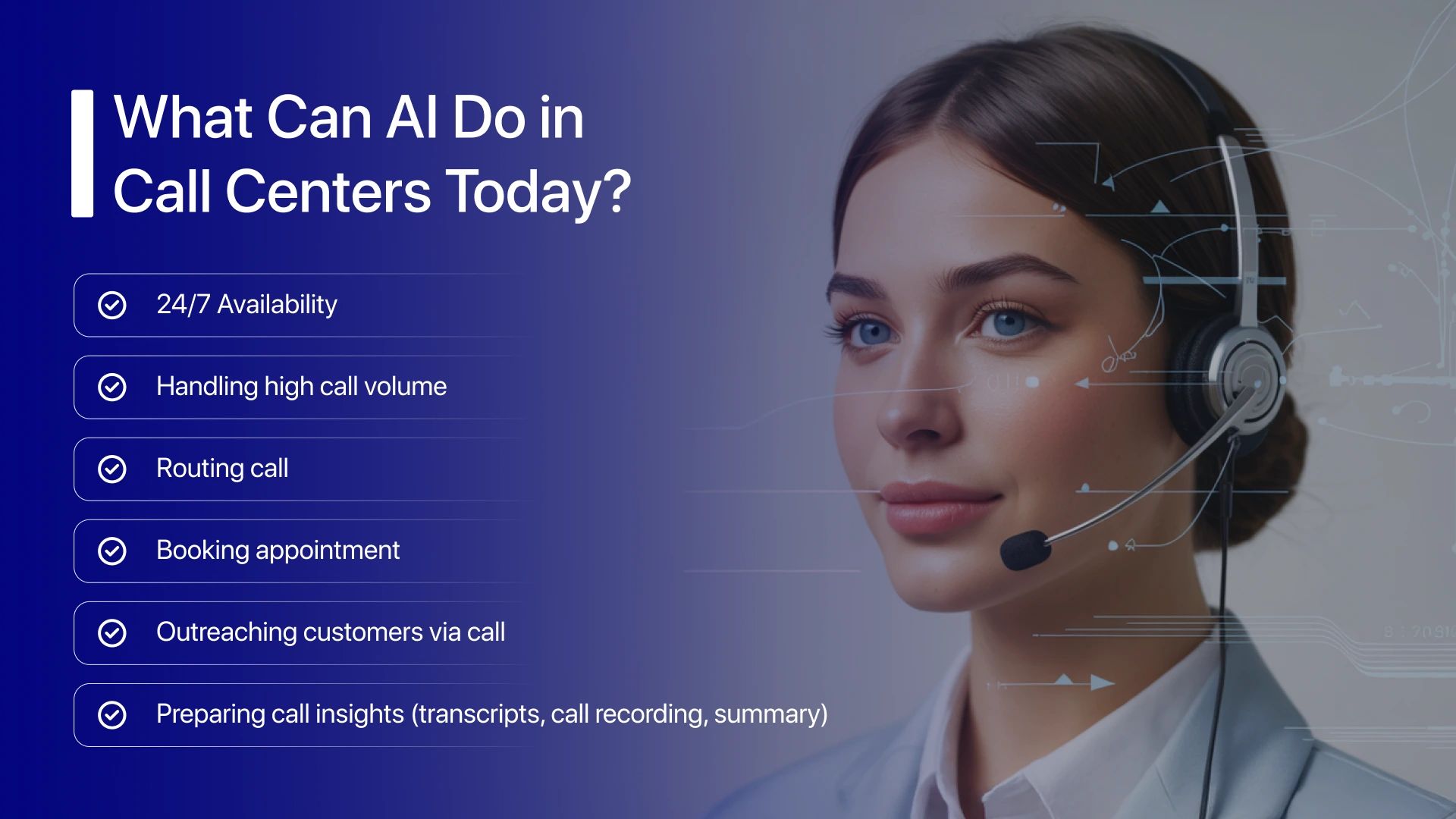
AI in call centers is actively handling a large part of the operations on its own. From answering queries to managing leads, many everyday tasks no longer need human involvement. Here’s what AI can take care of today.
1. Handle High-Volume, Repetitive Queries
AI phone call handling is highly efficient at answering common and predictable questions like working hours, availability, or basic service details. These queries follow a pattern, which makes them easy to automate. Instead of agents repeating the same responses all day, AI delivers instant and consistent answers.
2. Never Miss a Call
Missed calls often mean missed business, especially during peak hours or after closing time. AI ensures every call is answered instantly, no matter the volume or time of day. It can handle multiple conversations at once and operate 24/7 without breaks.
3. Smart Routing
AI in call centers understands customer intent, behavior, and requirements and routes calls to the right agent at the right time whenever needed. This helps businesses to reduce wait times and boost first call resolution for customers.
4. Lead Qualification
An AI inbound call center can quickly understand customer intent by asking simple but relevant questions like budget, preference, or timeline. Based on responses, it can identify serious buyers and filter out low-intent leads. This helps sales teams focus only on the most promising opportunities.
5. Appointment Scheduling
AI can manage the entire booking process without human help. It checks availability, suggests time slots, and confirms appointments in real time. This removes delays and makes scheduling smooth for both customers and teams.
6. Follow-Ups at Scale
Follow-ups are often missed due to workload, but AI powered outbound call center software handles them consistently. It can reconnect with missed leads, send reminders, and engage old prospects automatically. This ensures no opportunity is lost, even at scale.
7. Call Summaries and Insights
After every interaction, AI can generate clear summaries and capture key details. It updates CRM systems automatically, reducing manual effort for agents. This keeps data organized and helps teams make better decisions.

Where AI Falls Short & What It Still Cannot Replace?
AI can handle speed and scale through inbound and outbound call centers, but there are clear areas where it still falls short. There’s no AI to replace call center agents when it comes to judgment, emotion, and experience. That is where people continue to make the biggest difference.
1. Emotional Understanding
AI for call centers can detect keywords, but it cannot truly feel or understand emotions. When a customer is upset or confused, they not only seek answers but also want to feel heard. Human agents understand this and adjust their tone, show empathy, and respond in a way that builds comfort and trust.
2. Complex Problem Solving
AI call center agents work best with structured and predictable scenarios. When a situation becomes messy or involves multiple issues, it struggles to respond effectively. Human agents can think critically, connect different points, and find solutions that are not pre-defined.
3. Relationship Building
Strong customer relationships are built over time through real conversations and personal attention. In industries like automotive, trust plays a big role in repeat business. While AI can assist with communication, it cannot replace the human connection that builds long-term loyalty.
4. Handling Sensitive Conversations
Some conversations need a human touch, especially when emotions are involved. Situations like complaints, refunds, or escalations require patience and understanding. Customers expect to speak with a real person who can listen and respond thoughtfully.
5. Contextual Judgment and Flexibility
AI call center follows patterns and data, but it lacks real-world judgment. Humans can read between the lines, adapt to unexpected situations, and make decisions based on context. This flexibility is critical in conversations where there is no clear script to follow.
AI Is Not Replacing Agents, It’s Changing Their Role
The real shift of AI in call centers is not about replacing people. Instead, it is about changing what they focus on. Earlier, agents spent most of their time handling basic queries, repeating the same information, and managing simple requests. Now, AI inbound call center software takes over these repetitive tasks, freeing up time for more important work.
This allows agents to focus on meaningful conversations that actually drive results, like closing sales, solving complex issues, and building customer relationships. Instead of routine work, their role becomes more strategic and impactful, helping them grow their skills while delivering better outcomes for the business.
How Many Call Center Jobs Will AI Actually Replace?
People saying AI will replace call center jobs and agents is not actually true. AI in call centers is reshaping them. Routine, repetitive tasks are gradually being automated, while human roles are becoming more focused on conversations that require thinking, empathy, and decision-making. The overall shift is toward smaller, more efficient teams that deliver better results with the help of AI.
- Basic, repetitive roles will gradually reduce
- High-skill, customer-focused roles will grow
- Hiring will shift toward quality over quantity
- Agent productivity will significantly increase
- Teams will become leaner but more effective
Top 10 Risks and Limitations of Over-Relying on AI in Call Centers
Generic AI chatbots for call centers can improve speed and efficiency, but relying too much on them can create gaps in customer experience. Without the right balance, automation can start affecting quality instead of improving it.
1. Poor Customer Experience
If AI in contact center is not trained well, it can misunderstand queries or provide incorrect answers. This creates frustration, especially when customers expect quick and accurate help. Over time, repeated poor interactions can hurt brand perception.
2. Limited Personalization
Artificial Intelligence in call centers often uses standard responses, which can feel generic to customers. People expect conversations that reflect their specific needs and context. When interactions feel robotic, engagement and satisfaction can drop.
3. Over-Automation
Trying to automate every interaction can make it hard for customers to reach a human. This becomes a problem in situations that require real understanding. As a result, customers may feel stuck or ignored.
4. Heavy Dependence on Data
AI systems depend entirely on the quality of data they are trained on. If the data is outdated or incomplete, performance suffers. This can lead to inaccurate responses and inconsistent experiences.
5. Customer Trust Gaps
Not all customers are comfortable interacting with AI, especially in important scenarios. Many still prefer speaking with a real person for clarity and reassurance. Lack of human interaction can reduce trust in the brand.
6. Difficulty Handling Edge Cases
AI performs well in predictable situations but struggles with unusual or complex queries. When conversations go beyond their training, AI chatbots may fail to respond effectively. This can leave customer issues unresolved.
7. Lack of Emotional Sensitivity
AI call center agents cannot truly understand emotions like frustration or urgency. It may respond in ways that feel inappropriate in sensitive situations. This can make the interaction feel impersonal or disconnected.
8. Integration Challenges
Adding AI to existing systems is not always seamless. Poor integration with tools like CRM can create workflow issues. Instead of improving efficiency, it can sometimes slow things down.
9. Ongoing Maintenance and Training
AI voice agents need continuous updates and monitoring to stay effective. Without regular improvements, their performance can decline over time. This requires ongoing effort and resources from the team.
10. Risk of Overdependence
Relying too much on AI can reduce human involvement and flexibility. If the system fails or faces issues, teams may struggle to manage operations. A balanced approach is needed to avoid such risks.
How to Prepare Your AI for Call Center Without Losing the Human Touch?
Bringing Artificial Intelligence in call center is not just about adding new tools. It is about building the right strategy so that technology and people work together. The goal is to improve efficiency without losing the personal experience customers expect.
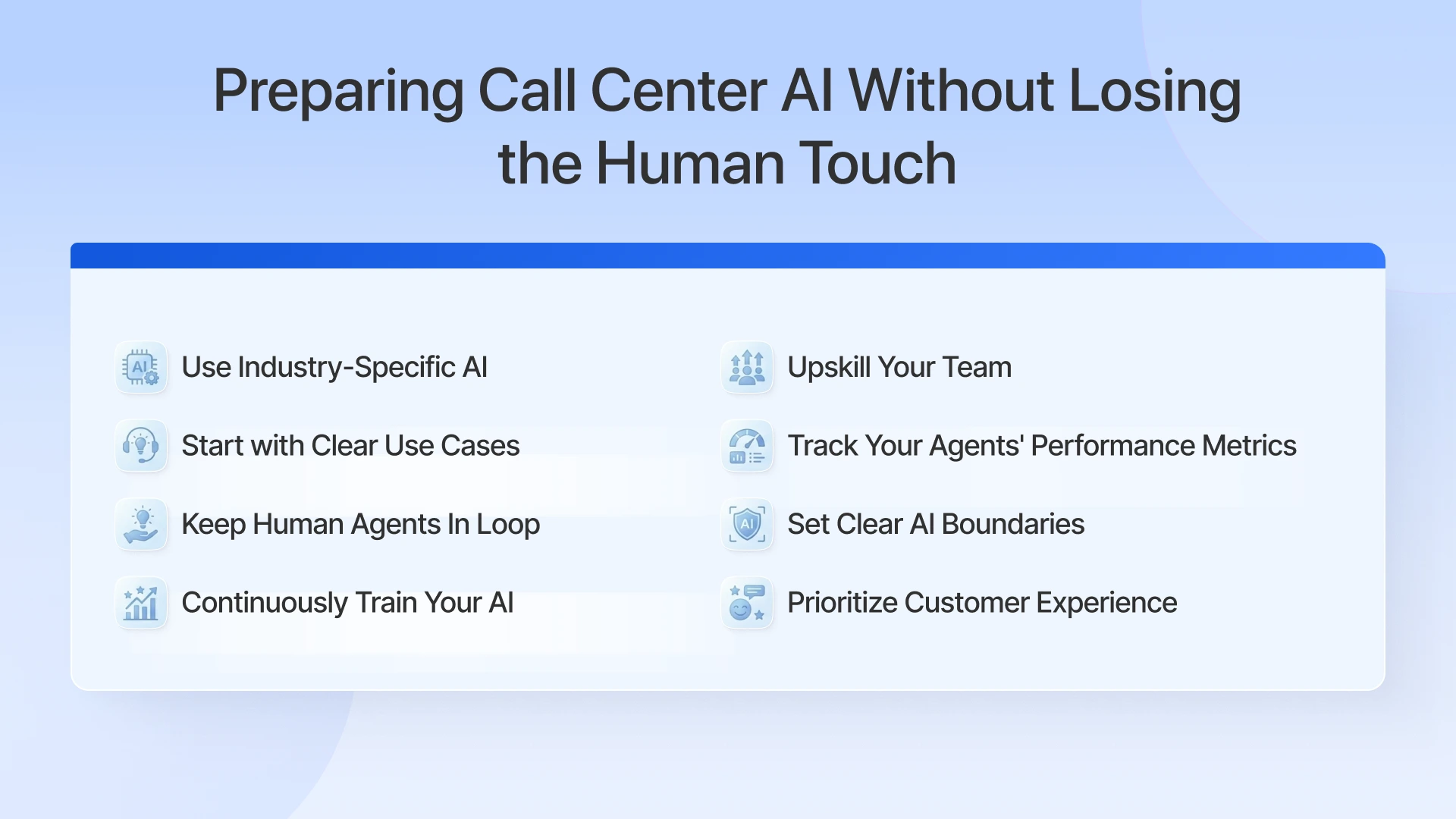
1. Choose Industry-Specific Conversational AI
The first thing you need to do is choose the best AI for your call center, specifically built for your industry niche. Unlike generic chatbots, these are more advanced and understand your industry, products, services, and customers better.
2. Start with Clear Use Cases
Automate phone calls, but not everything from day one. Begin with areas like missed call handling, basic inquiries, or appointment scheduling. These are simple, high-impact use cases that deliver quick and measurable results.
3. Keep Humans in the Loop
AI should support your team, not replace human access. Always give customers the option to speak with a real agent when needed. This balance ensures efficiency without compromising customer trust.
4. Train Your AI Continuously
AI is only as good as the data behind it. Regularly train your AI for call centers by updating scripts, reviewing conversations, and fixing gaps in responses. Continuous improvement helps maintain accuracy and relevance over time.
5. Upskill Your Team
As AI call center agents handle routine work, your human agents need to focus on more complex and meaningful interactions. Train your team to manage advanced conversations, use AI tools effectively, and deliver better customer experiences.
6. Monitor Performance Closely
Track your AI in-bond and outbound call center KPI like resolution rates, customer satisfaction, and conversions. These insights help you understand what is working and where improvements are needed. Data-driven decisions keep your system effective.
7. Set Clear Boundaries for AI
Define what AI should handle and where humans should step in. Not every interaction should be automated, especially sensitive or complex ones. Clear boundaries help maintain quality and control.
8. Focus on Customer Experience First
Technology should enhance the customer journey, not complicate it. Design your AI interactions to feel smooth, helpful, and natural. Keeping the customer experience at the center ensures long-term success.
How Spyne’s Vini AI Works Alongside Dealership Teams
In the automotive industry, speed and follow-up can directly impact revenue. A missed call is often a missed opportunity, and delayed responses can push buyers to competitors. That is exactly where Spyne fits in with its AI-powered solutions, helping dealerships stay responsive without increasing workload.
1. Always-On Call Handling
Our conversational AI “Vini” answers every incoming call instantly, whether it is during business hours or after. There is no waiting time for customers and no missed opportunities for your team. Every inquiry gets captured from the first touchpoint.
2. Lead Qualification in Real Time
It asks smart, relevant questions to understand what the buyer is looking for. Based on responses, it identifies high-intent leads and filters them for your team. This ensures your sales reps spend time only on serious prospects.
3. Appointment Booking Without Delays
Customers can schedule test drives or service appointments instantly without back-and-forth. Our AI automotive call center software checks availability and confirms bookings in real time. This improves convenience and increases show-up rates.
4. Automated Follow-Ups
Our AI consistently reconnects with missed calls, old leads, and inactive prospects. It ensures no potential customer slips through the cracks. This helps revive opportunities that would otherwise be lost.
5. Works With Your Team, Not Against Them
Instead of replacing agents, Spyne’s AI and call center team work together to reduce their workload. Repetitive tasks are handled through our AI call bot for car dealerships. This allows your team to focus on meaningful conversations and closing deals. It acts as support, not a substitute.
6. Instant Response to Every Lead
Speed is critical in automotive sales, and our conversational AI ensures every lead gets an immediate response. Whether it is a new inquiry or a follow-up, customers are engaged instantly. This reduces drop-offs and improves conversion chances.
7. Consistent Customer Experience
Unlike generic AI, Vini understands customer intent, emotions, and behavior in real time during the call. Using this data, it delivers consistent, personalized, and human-like responses every time. There are no missed details or inconsistent responses. This builds a reliable and professional customer experience.
8. Seamless CRM Updates
Every interaction is automatically recorded and updated in your system. This keeps your data organized without extra manual effort. Your team always has the latest context before speaking to a lead.
9. Handles High Call Volumes Effortlessly
During peak hours or campaigns, call volumes can spike quickly. Our conversational AI acts as an automotive BPO and manages multiple conversations at once without delays. This ensures smooth operations even during high demand.
10. Improves Team Productivity
By taking over repetitive tasks, Spyne’s AI automotive call center services free up time for your agents. They can focus on high-value conversations instead of routine queries. This leads to better performance and higher efficiency across the team.

Conclusion
Will AI replace call center agents? Well, no, AI will not replace call centers. In fact, it is reshaping how they operate. It removes inefficiencies, speeds up responses, and helps businesses handle more conversations without constantly increasing team size. Instead of doing repetitive tasks, human agents can now focus on what actually drives impact.
At the same time, the human element matters more than ever. Customers still value empathy, trust, and real conversations. Further in the automotive industry, businesses using AI employees in car dealerships alongside human agents see better conversions, stronger relationships, and long-term growth. If you want to capture every lead and respond instantly, Spyne’s Vini AI can help you do it without adding extra workload. Book a demo now!