
Every missed call, delayed response, and manual task reduces dealership efficiency and costs revenue. At the average dealership, roughly one in three inbound calls never reaches a live person, and nearly a third of those callers hang up instead of leaving a voicemail. These everyday operational gaps are why more dealers are turning to AI to improve dealership efficiency instead of simply adding headcount.
AI is becoming a standard part of automotive retail. Today, 57% of dealership professionals already use AI, and 81% believe it will continue to shape the future of dealership operations. From automating customer conversations to streamlining dealership operations, modern AI dealership software helps teams work faster, improve customer experience, and reduce operating costs.
This guide explains what dealership efficiency really means, where AI delivers the biggest impact, the ROI you can expect, common implementation mistakes to avoid, and how to evaluate the right AI solution for your dealership.
What Dealership Efficiency Means, and Why It’s Hard to Achieve?
Dealership efficiency is the ability to generate more sales, service revenue, and customer satisfaction from the same people, leads, and inventory, without increasing operating costs at the same pace.
Rather than measuring activity, dealership efficiency is reflected in business outcomes such as faster lead response times, higher appointment conversion rates, quicker inventory turnover, and more completed repair orders. Whether you operate a single rooftop or a large dealer group, the goal is the same: maximize productivity without sacrificing the customer experience.
For dealerships evaluating AI to improve dealership efficiency, these operational challenges typically fall into three categories:
- Fragmented communication and missed opportunities: Nearly one in three callers who don’t reach a live person hang up instead of leaving a voicemail, while the average dealership answers only about 65% of inbound calls. Every missed conversation is a potential sale or service appointment lost.
- Manual, repetitive workflows: Teams spend hours on data entry, appointment scheduling, CRM updates, and follow-up tasks instead of serving customers and closing deals.
- Disconnected systems and data silos: When your DMS, CRM, phone system, and merchandising platform don’t work together, lead response slows, reporting becomes fragmented, and managers lack real-time visibility into dealership performance. Issues like missed after-hours leads often surface days later instead of when they can still be recovered.
How does AI Improve Dealership Efficiency?
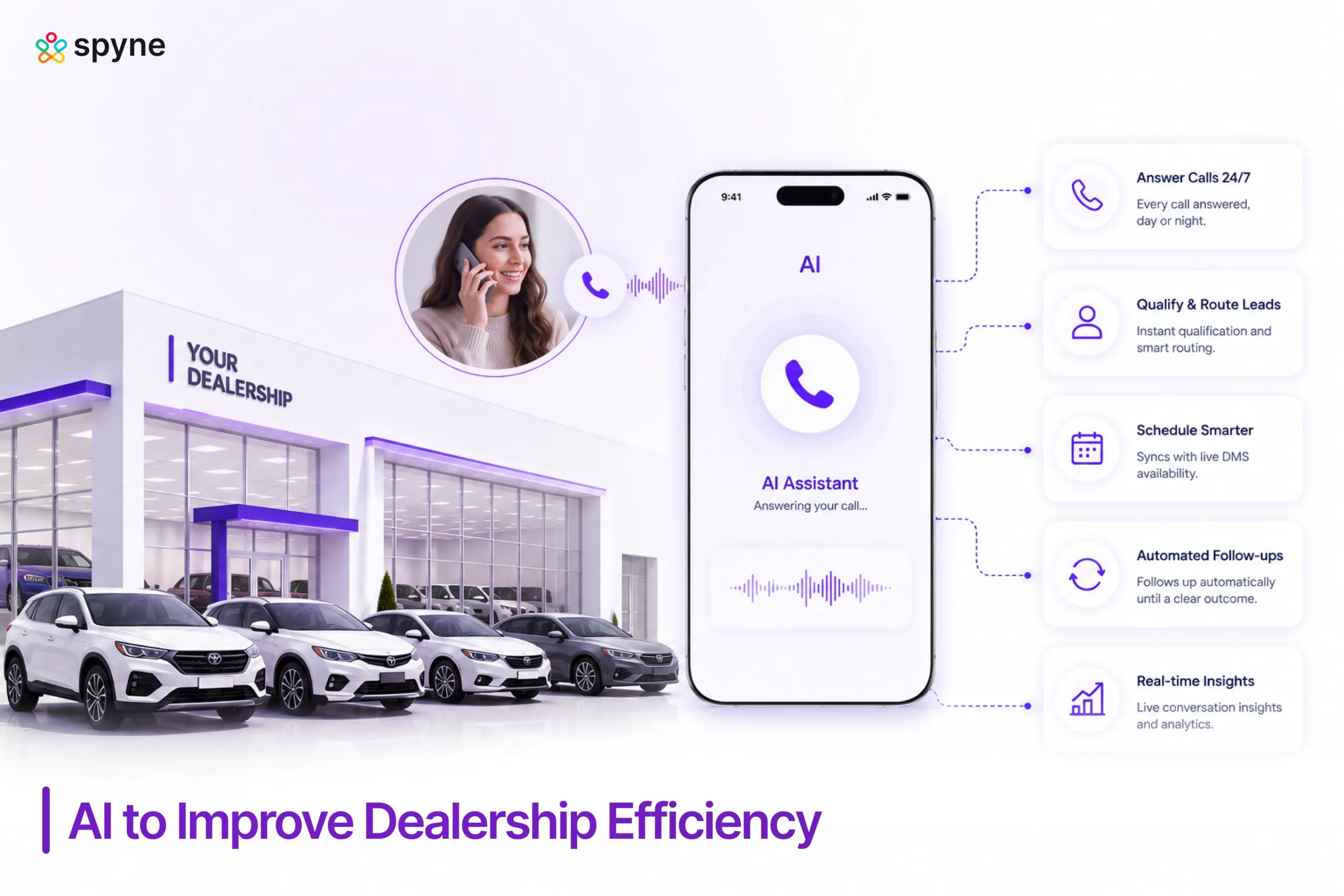
AI improves dealership efficiency by automating repetitive, time-sensitive workflows that slow down sales, BDC, and service teams. Instead of relying on additional headcount, AI dealership software handles routine tasks like answering every call, qualifying leads, scheduling appointments, and capturing customer data in real time. This allows dealership staff to spend less time on administrative work and more time selling, servicing, and building customer relationships.
| Task | Manual Process | AI-Powered Process |
| Answering inbound calls | Limited to staffed hours; ~65% connection rate | Every call answered, 24/7 |
| Lead response | Delayed during busy periods | Instant qualification and routing |
| Appointment scheduling | Manual back-and-forth | Synced with live DMS availability |
| Follow-up | Inconsistent and often stops after 2-3 attempts | Automated until a clear outcome |
| Reporting | Manual and delayed | Real-time conversation insights and analytics |
Dealers are already investing in AI to improve dealership efficiency. In fact, 63% say AI investment is critical to long-term success, and 60% are actively testing AI tools in their operations. Beyond reducing manual work, AI helps dealerships respond faster, recover more opportunities, and make better operational decisions with real-time data. McKinsey estimates that generative AI could create $310 billion in value through improved marketing and customer interactions across retail, highlighting the broader opportunity for dealerships adopting AI-powered automation.
Where AI Delivers the Biggest Impact Across Every Dealership Department?
The impact of AI isn’t limited to one team or workflow. Different departments face different operational challenges, from slow lead response and inconsistent follow-up to manual scheduling, delayed merchandising, and fragmented reporting. AI addresses each of these bottlenecks differently, helping dealerships improve productivity, customer experience, and operational efficiency across the board.
Here’s how AI delivers measurable efficiency gains across each department:
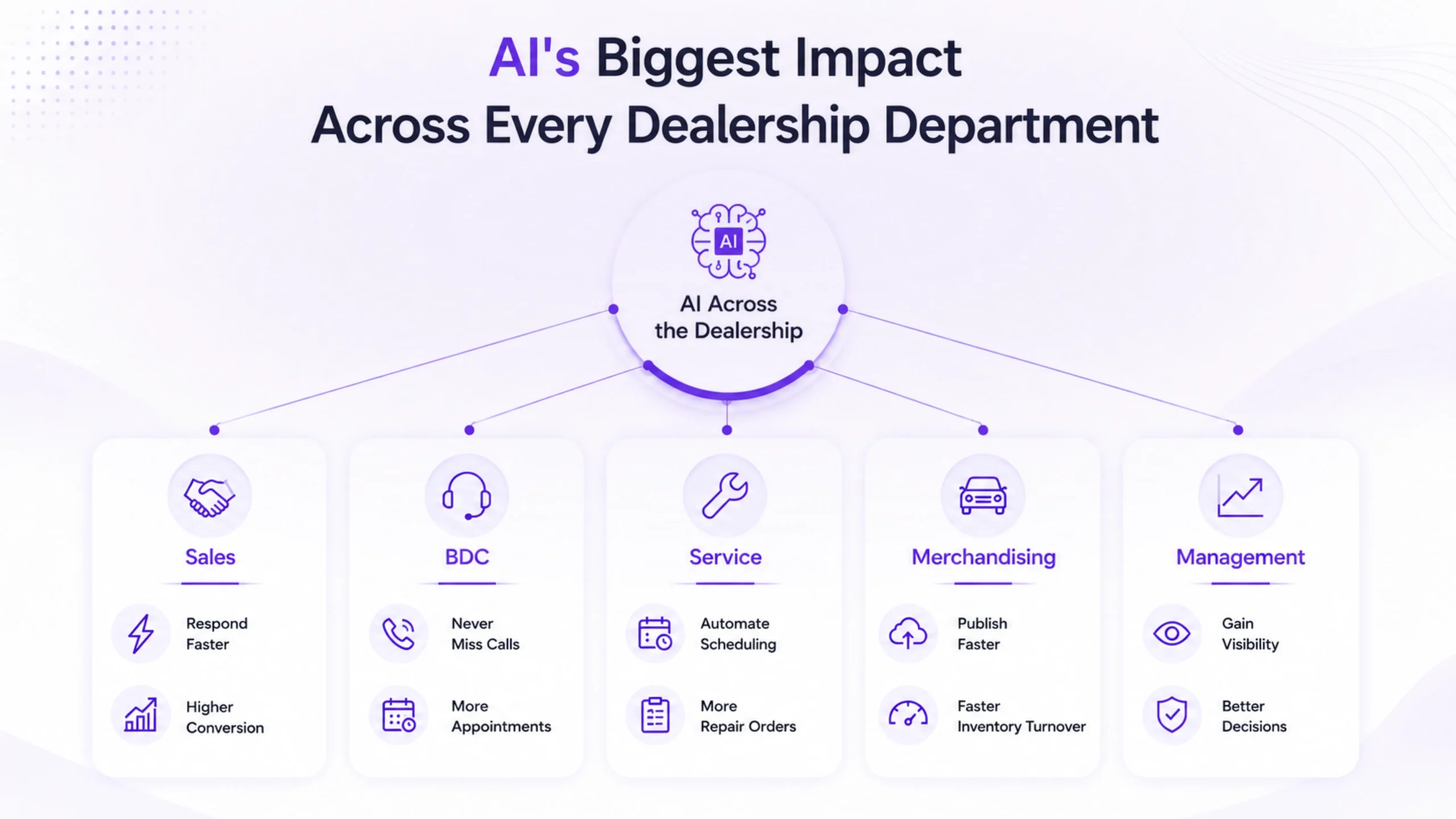
AI for Sales Teams and Lead Management
AI improves sales efficiency by shortening the time between a lead’s first inquiry and a salesperson’s response, while ensuring every prospect receives timely, consistent follow-up instead of going cold. Sales is also where dealers expect AI to have the biggest impact, with 68% of dealerships believing their sales department would benefit most from AI, largely because representatives struggle to consistently log activity and maintain follow-up.
AI automates lead qualification, captures every customer interaction, and maintains a complete follow-up history without relying on manual CRM updates. It also streamlines pricing and deal documentation by calculating costs and creating an audit trail that would otherwise require manual effort from the sales team. Together, these capabilities help dealerships respond faster, improve lead conversion, and reduce administrative workload. To measure the impact of these improvements, track key automotive BDC metrics such as lead response time, appointment rates, and follow-up performance.
AI for BDC and Customer Communication
AI improves BDC efficiency by ensuring every call, chat, and message receives an immediate response, even after hours, on weekends, and during peak demand. This helps address one of the biggest operational gaps in dealerships, where 31.8% of unanswered calls end in a hang-up, and another 32.3% go to voicemail, leaving many inbound opportunities without a live response. It’s also why 91% of customer service leaders say they’re under pressure to adopt AI in 2026, according to Gartner.
AI can answer customer inquiries 24/7, qualify and route leads, schedule appointments, and automate follow-up without adding headcount. The result is faster lead response, fewer missed opportunities, and a more consistent customer experience across every interaction. For dealerships looking to eliminate missed calls and deliver round-the-clock customer support, an AI receptionist can automate inbound communication while integrating seamlessly into existing BDC workflows.
AI for Service Departments and Fixed Ops
AI improves service efficiency by automating appointment scheduling, reminders, and routine customer communication, allowing service advisors and technicians to spend less time on administrative tasks and more time servicing vehicles. Modern AI solutions can answer inbound service calls, check vehicle history, verify appointment availability using real-time DMS data, and handle scheduling automatically, reducing pressure during peak call periods. The result is fewer missed appointments, higher service capacity, and a more predictable service operation without increasing advisor headcount.
AI for Merchandising and Inventory Operations
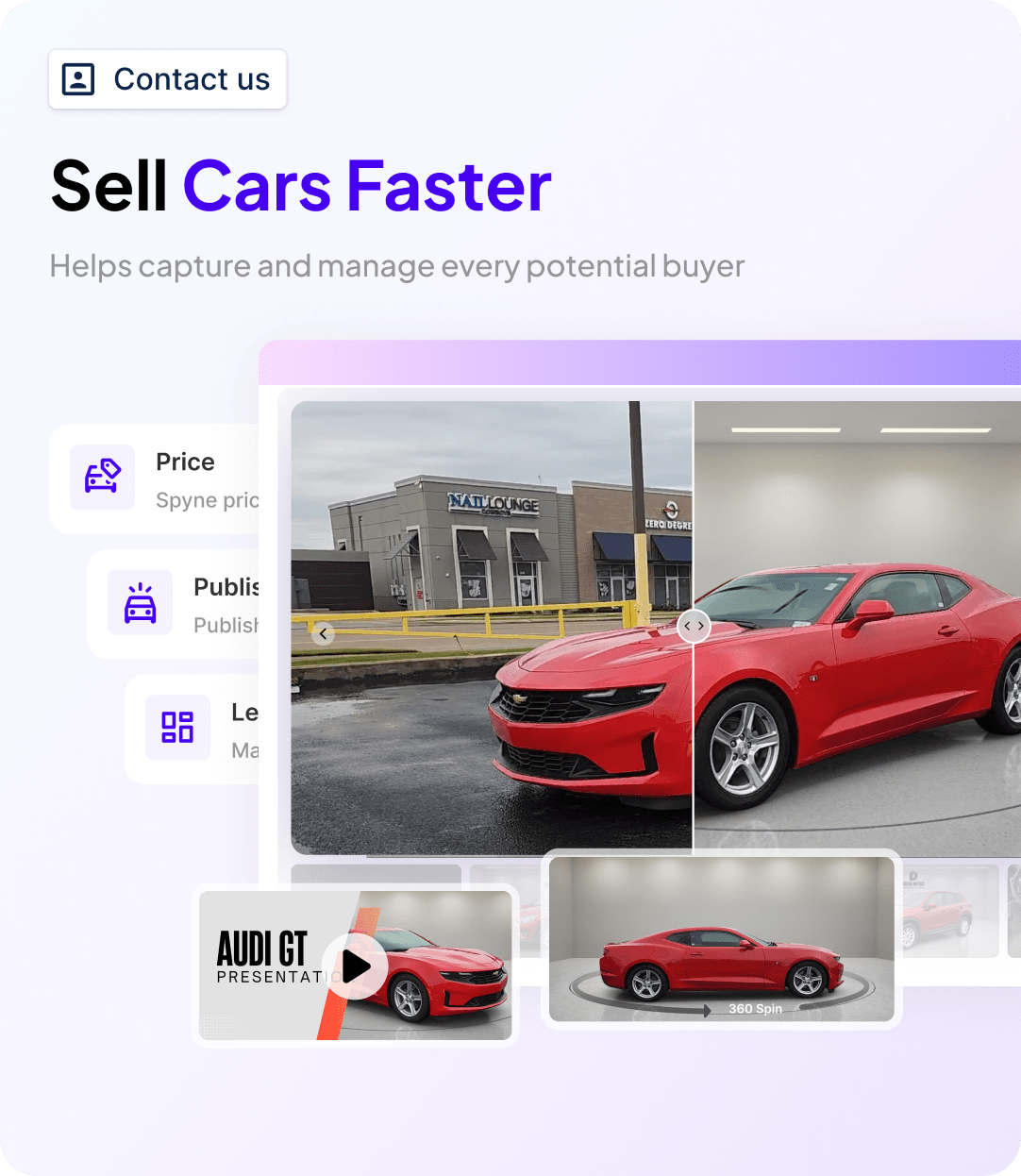
AI improves merchandising efficiency by reducing the time between a vehicle arriving on the lot and being listed online with high-quality photos, rotating car views, and video tours. Manual photography and content creation often become bottlenecks between reconditioning and merchandising, delaying inventory from reaching online buyers. AI-powered merchandising tools automate car photography, virtual staging, and content generation, helping dealerships publish listings faster and maintain a consistent online presence.
The result is shorter time-to-market, improved inventory visibility, and more opportunities to generate leads before vehicles begin to age on the lot. Even a delay of a few days in publishing a listing can reduce search visibility and slow inventory turnover, with the impact compounding across the entire inventory.
AI for Reporting and Management Visibility
AI improves management visibility by consolidating call, chat, and lead data into a single reporting layer instead of leaving it scattered across phone systems, spreadsheets, and CRM logs. This gives GMs and dealer principals real-time insight into lead response, team performance, and operational bottlenecks, allowing them to identify issues before they impact revenue rather than waiting for manual reports.
For multi-rooftop dealer groups, AI also standardizes reporting across locations, making it easier to compare performance, identify best practices, and make data-driven decisions from a single source of truth.

Measuring the ROI of AI for Dealership Efficiency
A practical way to estimate the ROI of AI to improve dealership efficiency is to use your own operational data rather than relying on industry averages:
- Count how many calls, chats, or leads your dealership misses or delays responding to in a typical month.
- Multiply that number by your average gross profit per vehicle sale or average repair order value.
- Apply a conservative recovery rate; many dealerships recover 10-20% of previously lost opportunities once response coverage becomes consistent.
- Compare the recovered revenue against the monthly cost of the AI platform.
For example, a dealership missing 40 calls per month, with an average gross profit of $2,500 per vehicle and a 15% recovery rate, could recover approximately $15,000 in monthly revenue, which is well above the cost of most AI solutions.
The opportunity is backed by broader sales trends as well. Industry data shows that sales teams using AI-powered sales agents are 3.7 times more likely to meet quota than those that don’t. In dealerships, the strongest ROI typically comes from high-volume functions like BDC and sales, where even small improvements in response time and follow-up can translate into significant revenue gains. This growing focus on operational efficiency is also reflected in how dealerships are evaluating the best AI platform for dealership groups.
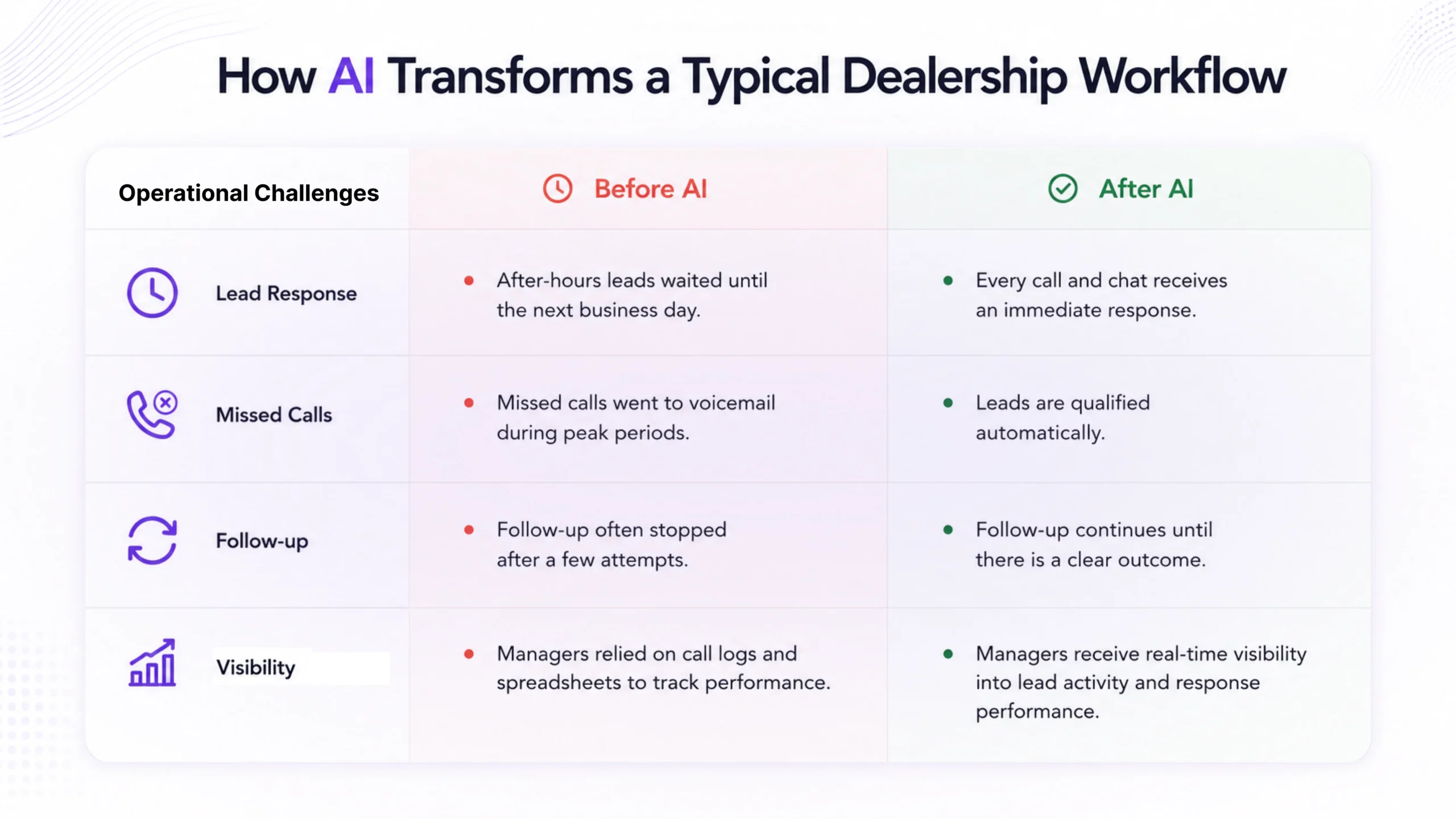
Illustrative Workflow: Before and After AI Adoption
Common Mistakes When Implementing AI for Dealership Efficiency
Even the best AI solutions can fall short if they’re implemented without a clear strategy. Here are the most common mistakes dealerships make:
- Treating AI as fully autonomous: AI should handle routine conversations while seamlessly escalating complex requests, financing questions, or customer complaints to a human. Without a clear handoff process, customer experience suffers.
- Choosing disconnected point solutions: AI that doesn’t integrate with your DMS, CRM, and communication systems creates new data silos and forces staff to duplicate work, limiting efficiency gains.
- Rolling out AI across every department at once: Start with high-impact areas like BDC or sales, measure the results, then expand to service, merchandising, and other workflows. A phased rollout makes adoption easier and ROI easier to measure.
- Overlooking staff training and adoption: AI delivers the best results when employees understand how it fits into their workflows and trust the handoff between automation and human teams. Without buy-in, adoption becomes inconsistent, and efficiency gains are harder to sustain.
How to Evaluate AI Dealership Software?
Choosing the right AI to improve dealership efficiency goes beyond adding another tool to your tech stack. The best AI solutions integrate with your existing systems, automate dealership-specific workflows, and provide the visibility needed to improve performance over time.
Use the checklist below to evaluate AI dealership software before making a decision.
| Criterion | Why it Matters | Ask the Vendor |
| DMS/CRM integration | Prevents data silos and keeps customer data synchronized | Does this sync with our DMS and CRM in real time? |
| Automotive-specific AI | Understands dealership workflows, inventory, and customer interactions | Is this trained specifically for automotive dealerships? |
| Implementation & onboarding | Faster deployment leads to quicker ROI | What’s the typical implementation timeline, and what support is included? |
| Reporting & performance insights | Provides the visibility needed to optimize operations | Can I access conversation-level, department-level, and performance reporting? |
| Human handoff | Ensures complex conversations reach the right team member | How and when does the AI transfer conversations to a team member? |
| Scalability | Supports business growth without added complexity | Can this scale across multiple rooftops without additional complexity? |
| Security & data privacy | Protects customer data and supports compliance | How is customer data stored, secured, and used? |
| Pricing model | Determines how ROI scales over time | Does pricing scale with call and lead volume, or is it a fixed subscription? |
The best AI dealership software should fit seamlessly into your existing operations instead of creating new processes for your team to manage. Prioritize solutions that integrate with your core systems, automate high-impact workflows, and provide the reporting needed to continuously improve dealership efficiency.
How Spyne Brings AI-Powered Dealership Efficiency Together?
Throughout this guide, we’ve explored how AI improves dealership efficiency by reducing missed opportunities, automating repetitive workflows, and giving teams better operational visibility. Spyne brings these capabilities together in a single AI platform purpose-built for automotive retail.
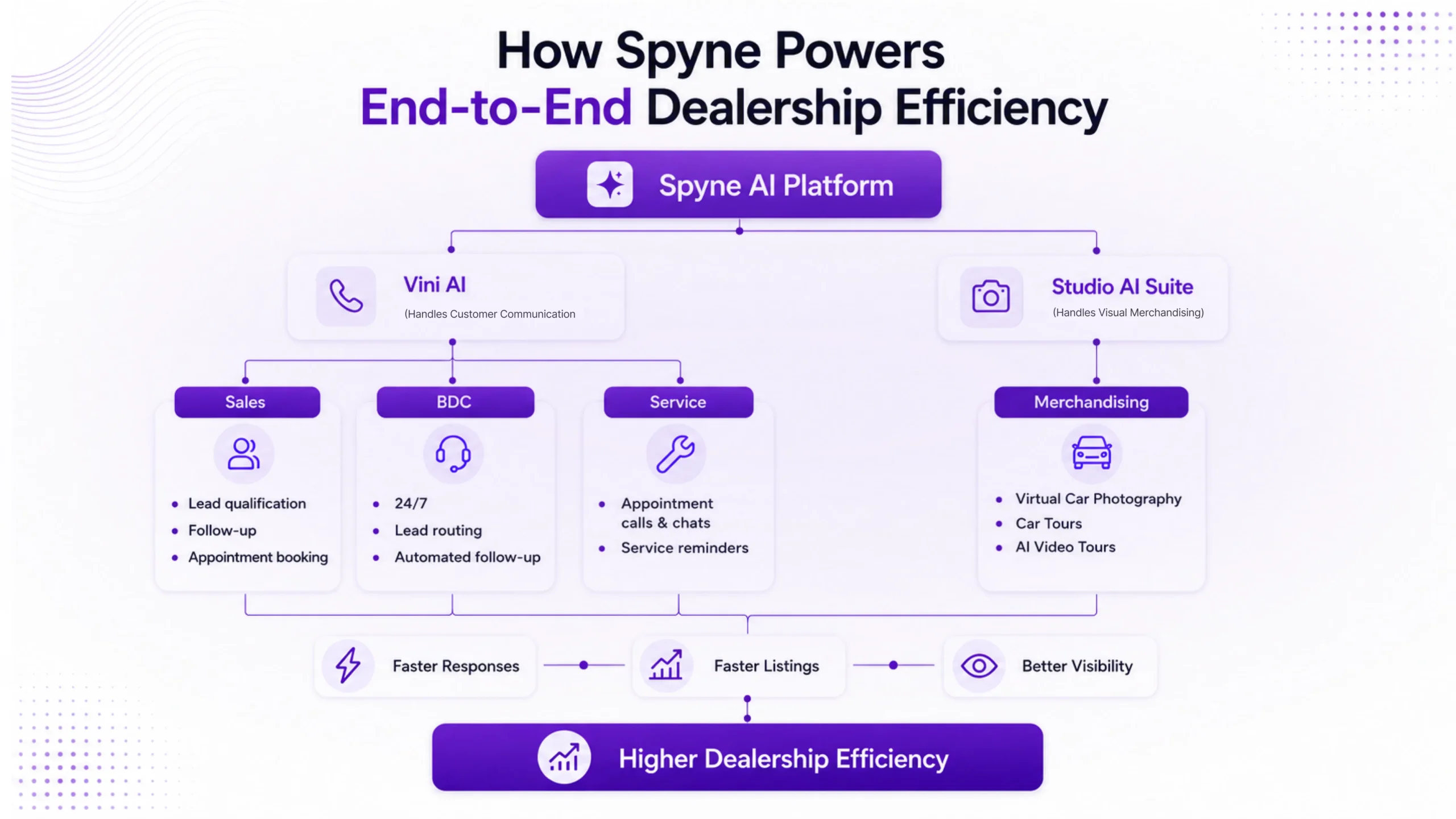
Vini AI helps dealerships answer every customer conversation across calls, chats, and messaging 24/7, automatically qualify and route leads, schedule appointments using live DMS data, and maintain consistent follow-up until there’s a clear outcome. It also provides conversation-level reporting, giving sales, BDC, and service managers complete visibility into response times, team performance, and customer interactions.
For merchandising teams, Studio AI Suite accelerates vehicle listing turnaround with virtual car photography, rotating car tours, and AI-generated vehicle videos, helping dealerships publish high-quality inventory faster without adding photography resources.
Together, these capabilities enable dealerships to improve customer communication, streamline merchandising, and increase operational efficiency, all while working alongside existing DMS and CRM systems rather than replacing them.

Conclusion
AI improves dealership efficiency by taking repetitive, time-consuming work off your team’s plate, allowing them to focus on the customer interactions that drive revenue. From missed calls and inconsistent follow-up to slow merchandising and limited reporting, AI helps dealerships automate repetitive work, respond faster, and make better decisions with real-time insights.
The most successful dealerships don’t try to transform every department overnight. They start with their highest-friction workflows, measure the results, and expand AI where it delivers the greatest impact. Choosing an AI platform that integrates with your existing DMS and CRM, supports dealership-specific workflows, and provides clear performance visibility is key to achieving long-term efficiency gains.
If you’re ready to see how an end-to-end AI platform can help your dealership improve lead response, streamline operations, and accelerate inventory merchandising, book a personalized demo and discover how Spyne can help you build a more efficient dealership.