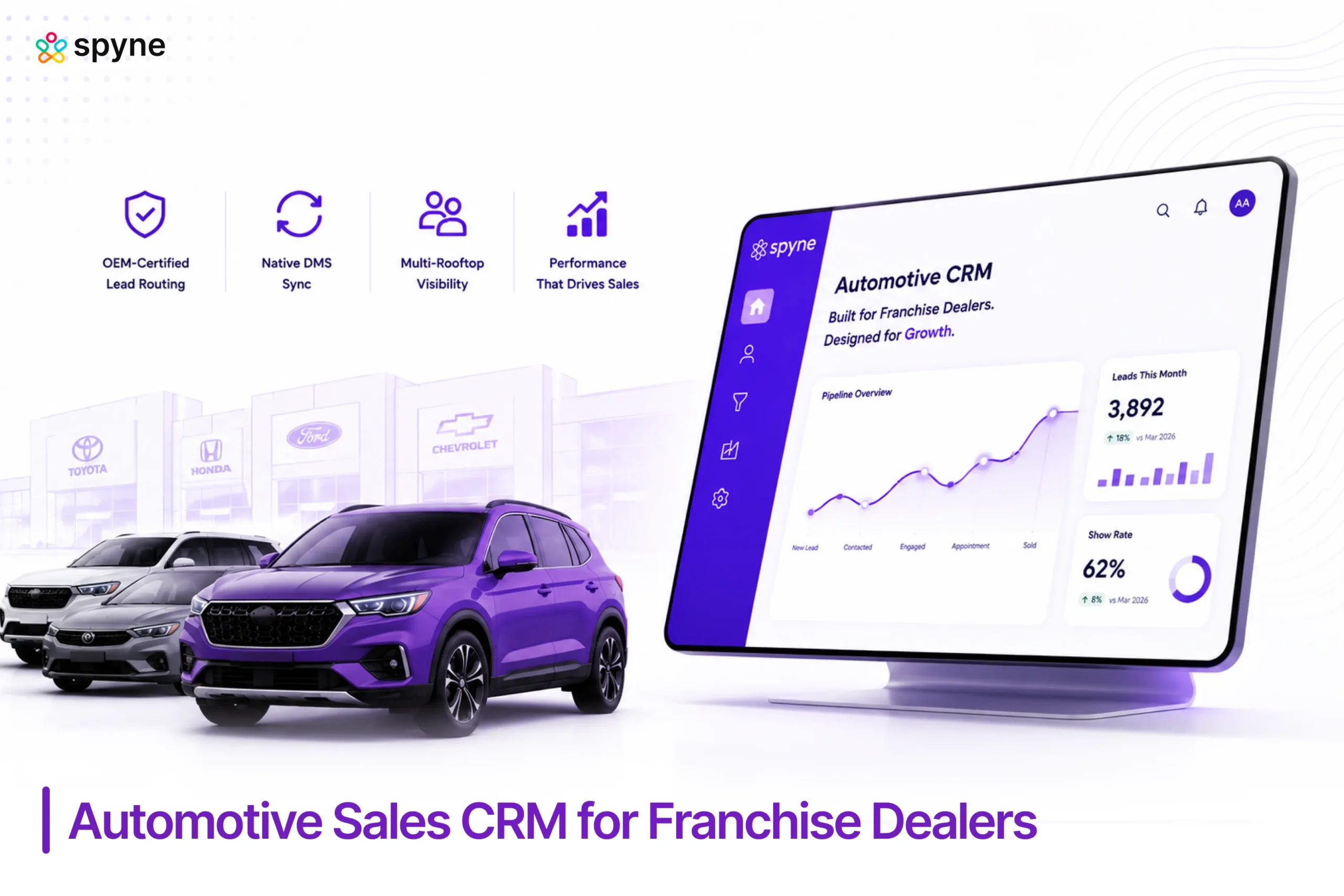

Executive SummaryAn automotive sales CRM for franchise dealers must handle OEM-certified lead routing, native DMS sync, and visual pipeline tracking across every rooftop a group operates. Pied Piper’s 2026 PSI study scored franchise dealers at 71 out of 100 on lead response, a 6-point gain from 2025, yet Foureyes lead-attribution data shows 43% of internet leads across 22,500 dealerships still get mishandled. Spyne Automotive CRM closes that gap with OEM-ready workflows built for multi-brand groups. |
A single-rooftop CRM breaks the moment a dealer group adds a second brand. Certification rules change by manufacturer, DMS feeds fork, and a sales manager juggling three franchises in one spreadsheet loses leads between the cracks. NADA’s 2025 data shows 8.6% of new-vehicle dealership operators now run six or more stores, and that share is growing every year. This guide breaks down what an automotive sales CRM for franchise dealers actually needs, how it compares to tools built for independent lots, and where Spyne Automotive CRM fits.
Why Franchise Dealerships Need a Different Automotive Sales CRM Than Independent Lots
Franchise dealerships answer to a manufacturer, not just to their own sales floor. An automotive sales CRM for franchise dealers has to pass OEM certification for lead handling, sync bidirectionally with a certified DMS (CDK, Reynolds and Reynolds, Tekion, or Dealertrack), and report on rooftop-level performance for group leadership, all without breaking single-brand simplicity for the sales team using it every day.
Independent lots do not carry this weight. A dealer running one used-car lot needs fast lead capture and a clean pipeline, not multi-brand certification tracking. Spyne covers that ground separately in its guide to CRM for independent car dealers, which goes deeper on affordable, single-location setups. This article stays on franchise territory: OEM compliance, multi-rooftop reporting, and the sales process complexity that comes with running more than one brand under one roof.
What Features Should an Automotive Sales CRM Have?
An automotive sales CRM should capture leads from every channel, route them by OEM rule, track the full sales pipeline visually, and hand off a qualified buyer to F&I without re-entering data. For franchise dealers specifically, five features separate a working CRM from a data graveyard.
1. OEM certification and DMS integration
Manufacturers update lead-handling standards annually, and a group carrying three brands needs its CRM certified against all three, with those certifications kept current. Missing a recertification window can mean a manufacturer warning or a temporary cut to direct lead flow, so this is not a one-time setup step, it is an ongoing maintenance job the CRM should track automatically. A CRM that writes changes to the DMS in real time (not on a nightly batch) prevents the duplicate records that make sales and service data untrustworthy, and it is the difference between a sales manager trusting the pipeline and re-checking it against a spreadsheet every morning.
2. Speed-to-lead automation
Pied Piper’s 2026 study found 51% of dealers deliver a “perfect response,” meaning every channel answered within 15 minutes, up from prior years but still leaving roughly half the industry behind. A CRM that auto-routes and auto-responds closes that gap without adding headcount.
3. Visual sales pipeline
A Kanban-style board that shows every deal by stage (inquiry, showroom visit, test drive, desking, F&I, delivered) lets a sales manager spot stalled deals in seconds instead of during a weekly meeting.
4. Equity mining and service-to-sales
Cox Automotive’s Dealer Sentiment data shows the average franchised dealership carries 3,000 to 8,000 sold customers in its DMS, with trade-in values still running 23% above pre-pandemic levels. A CRM that flags equity and lease-end opportunities automatically turns that database into an active pipeline instead of dead records.
5. Mobile access and F&I handoff
Salespeople work the lot, not a desk. A mobile app that scans a license, pulls inventory by VIN, and pushes a completed deal straight to F&I keeps the process moving without a re-entry step.

Automotive Sales CRM Strategies and Tips for Multi-Rooftop Franchise Groups
Franchise groups running multiple brands need automotive sales CRM strategies that standardize process without flattening what makes each rooftop different. Three tips consistently move the needle:
1. Standardize the follow-up SLA, not the sales script
Every rooftop should answer a lead within the same window (Pied Piper’s top performers respond by email or text within an hour, then call within 15 minutes), but each store keeps its own brand voice and OEM-required disclosures.
2. Run equity mining on a fixed cadence, not ad hoc
Set a monthly pull for lease-end and positive-equity customers by rooftop, then route those leads to the sales team, not just service. Foureyes lead-attribution data shows 14.1% of leads never get logged into the CRM at all; a scheduled equity pull avoids that failure mode entirely.
3. Report at the group level, not just the store level
A GM comparing close rate, response time, and pipeline velocity across five rooftops catches a struggling store weeks before a spreadsheet would. This is one of the most repeated automotive sales CRM tips from multi-rooftop GMs: the CRM that reports at both layers is the one that actually gets used by leadership. Without it, group-level reviews turn into five separate exports stitched together manually, and by the time a pattern shows up, the underperforming rooftop has already lost a month of pipeline.
These automotive sales CRM strategies work only if the underlying system can actually execute them. A CRM that requires a manual export to compare rooftops, or that cannot enforce a shared SLA without a workaround, turns every one of these tips into a process a GM has to police by hand instead of one the software runs on its own.
Best Automotive Sales CRM with Visual Pipeline Management
The strongest automotive sales CRM options for visual pipeline management combine a drag-and-drop deal board with franchise-specific data (DMS sync, OEM certification, equity mining) instead of treating pipeline visibility as a generic sales feature bolted onto the side. Spyne Automotive CRM, VinSolutions, DealerSocket, Elead, and AutoRaptor each take a different approach to that pipeline.
| CRM | Best For | Visual Pipeline Strength | Pricing |
| Spyne Automotive CRM | Franchise and multi-rooftop groups needing OEM-ready workflows with DMS sync | Drag-and-drop deal board mapped to franchise sales stages, with rooftop-level rollup reporting | Customized |
| VinSolutions | Large franchise groups on the Cox Automotive ecosystem | Data-dense pipeline view tied to equity mining and OEM lead certification | Connect with Sales Team |
| DealerSocket | Mid-to-large franchise dealerships wanting sales and service under one system | Structured pipeline stages (lead to F&I) with cross-department visibility | Connect with Sales Team |
| Elead (CDK) | Franchise dealerships with a dedicated BDC | Pipeline paired with BDC call-center workflows and desking tools | Connect with Sales Team |
| AutoRaptor | Independent and small franchise dealers wanting quick setup | Simple, mobile-first pipeline with less enterprise configuration | Connect with Sales Team |
Beyond this list, dealer-facing coverage from tools like DriveCentric and Tekion shows up frequently in franchise-CRM research for their pipeline UI, though neither carries the multi-brand certification depth franchise groups typically need at scale.
Automotive Sales CRM Comparison: What Changes for Franchise vs. Independent Dealers
An automotive sales CRM comparison between franchise and independent dealer needs comes down to certification and scale. Franchise groups need OEM-certified lead handling, multi-brand DMS sync, and rooftop-level reporting. An automotive sales CRM for independent dealers skips that complexity entirely: no OEM certification requirement, usually one location, and a lighter, faster setup built around a single sales team.
Automotive News data on the industry’s top 150 dealer groups shows those groups now represent 27% of new-car dealerships and control roughly a third of industry revenue, up from about 25% in 2019, so the franchise-versus-independent split is not shrinking. If your dealership is a single independent lot rather than a franchise operation, Spyne’s guide to CRM for independent car dealers covers the setup that fits that scale directly.
Spyne Automotive CRM: Purpose-Built Automotive Sales CRM for Franchise Dealers
Spyne Automotive CRM is built for the operational reality franchise dealerships face every day: multiple brands, one DMS to reconcile, and a sales floor that cannot afford to lose a lead between systems. It handles the OEM certification, DMS sync, and rooftop reporting that a generic sales CRM was never designed to carry, while keeping the day-to-day workflow simple enough for a salesperson to actually use it.
1. OEM-ready lead routing
Our CRM Leads are captured from the website, third-party listing sites, phone, and walk-in, then routed by brand and OEM rule so each manufacturer’s certification requirements stay current without manual tracking.
2. Bidirectional DMS sync
Changes made in the CRM write to the DMS in real time, so inventory, pricing, and customer records stay identical across both systems instead of drifting apart on a nightly batch.
3. Visual sales pipeline
A drag-and-drop board tracks every deal from inquiry through delivery, mapped to each franchise’s sales process, with stalled-deal alerts a sales manager can act on the same day.
4. Equity mining and service-to-sale
The automotive service CRM scans the customer database for lease-end and positive-equity accounts automatically, then routes those names to the sales team on a set cadence instead of leaving them buried in service records.
5. Mobile app for the sales floor
With our CRM software, your salespeople can scan a license, pull a VIN, and log a test drive from the lot, with the record syncing back to the desk in real time.
6. F&I handoff
A completed deal moves to F&I with financing details, trade-in valuation, and customer documents already attached, cutting the re-entry step that slows down delivery.
7. Group-level reporting
GMs and Dealer Principals see close rate, response time, and pipeline velocity by rooftop and by brand in one dashboard, not five separate logins.

Conclusion
Franchise dealerships cannot run on a CRM built for a single independent lot. Between OEM certification, DMS sync, and pipeline visibility across multiple rooftops, the requirements are structurally different, and the data backs that up: Pied Piper’s 2026 study shows even improving franchise dealers still average 71 out of 100 on lead response, while Foureyes puts lead mishandling at 43% industry-wide. An automotive sales CRM for franchise dealers that closes both gaps, speed and certification, is the one worth switching to. Spyne Automotive CRM was built to close exactly that gap for multi-rooftop groups. Book a demo!