
Customer expectations are evolving faster. People want instant responses, personalized interactions, and support available anytime they need it. And if you are still relying on a traditional call center, then you can meet these customer expectations. This is why switching to an AI call center solution is the best choice.
By combining conversational AI, automation, and real-time insights, AI call center software transforms how effectively businesses handle customer interactions. Let’s delve deeper into the blog and explore what an AI call center is, how it works, how it is better than traditional call centers, and more.
What is an AI Call Center?
An AI call center is a customer support department that handles customer interactions, routes calls intelligently, and collects customer data using AI technologies such as conversational AI, NLP (Natural Language Processing), and machine learning. The call center AI automation helps businesses enhance customer engagement and satisfaction by delivering 24/7 support with instant, personalized responses from AI agents.
Top 10 AI Call Center Features
AI call centers are powered by advanced features that go beyond basic automation to deliver smarter, faster, and more personalized customer interactions. From real-time insights to intelligent routing, these capabilities help businesses improve efficiency, enhance customer experience, and drive better outcomes.
1. Conversational AI
Conversational AI call center solutions, like Spyne, use call center voice AI agents who handle customer inquiries 24/7 without taking breaks. These AI agents make every interaction feel real and human-like, enhancing customer experience.
2. ACD (Automatic Call Distribution)
Through ACD (Automotive Call Distribution), AI for inbound call center smartly routes calls to the right agent or department at the right time based on customer intent, requirement, and CRM data. This ensures better outcomes in customer first interaction, boosting FCR (First Call Resolution) rates.
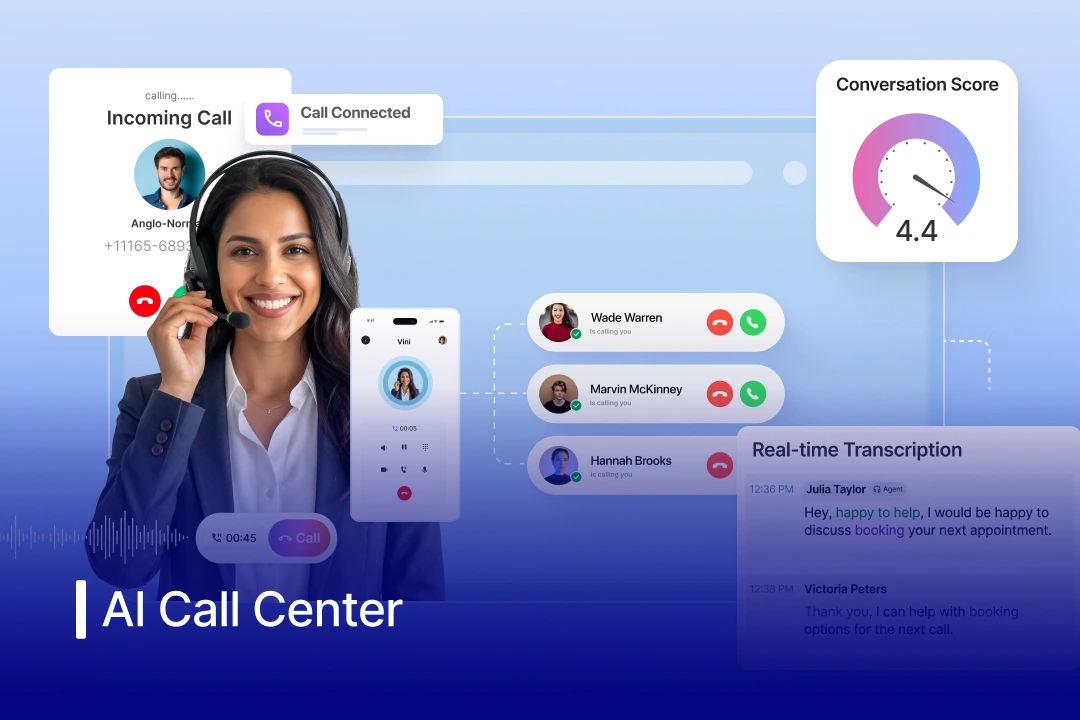
3. Real-Time Transcription
AI call center agents listen to what customers say and automatically transcribe each conversation in real-time. This helps agents to understand and identify customer emotions (anger, satisfaction, and urgency) and deliver personalized responses accordingly.
4. Automated Call Summaries
AI automatically prepares summaries and notes for each conversation. These call summaries and notes help agents get context of previous conversations when calls are routed to them. Having a conversation context before interacting with a customer helps agents avoid repetitive questions.
5. Real-Time Insights & Assistance
AI for call center captures customer data and delivers live suggestions to agents during calls, recommending next-best actions or relevant knowledge base articles. It also provides customer insights, helping agents make faster and smarter decisions while improving call outcomes.
6. Omnichannel
An AI call center solution offers your customers omnichannel support, unifying communication across multiple channels like voice, email, chat, SMS, and social media. This ensures the delivery of an enhanced customer experience while allowing conversations to continue across channels without losing context.
7. Predictive Dialing
An AI call center doesn’t just handle incoming customer calls. It also proactively connects with customers by automatically placing outbound calls using predictive dialing. This reduces idle time for agents, increases connection rates, boosts revenue-driven opportunities, and overall productivity in AI outbound call center software.
8. Sentiment Analysis
AI analyzes customer tone, speech, behavior patterns, and language in real-time to detect customer emotions and sentiments. This enables live and call center AI agents to adjust responses dynamically, de-escalating negative situations and enhancing positive interactions.
9. CRM Integration
AI for call center systems offers businesses a smooth integration with CRM platforms, ensuring all data is centralized and accessible to agents whenever needed. This allows for highly personalized conversations and ensures agents always have relevant information at their fingertips.
10. Call Analytics & Performance Tracking
AI agent call center tracks and analyzes every call to provide insights into agent performance, customer behavior, and operational efficiency. These AI analytics help businesses to identify trends, optimize workflows, and continuously improve customer service strategies.

Top 6 Benefits of an AI Call Center
AI call centers bring measurable business impact by combining automation with real-time intelligence to streamline operations and elevate customer interactions. From reducing costs to improving service quality, these benefits help businesses scale efficiently while delivering a seamless customer experience.
1. Improves Efficiency & Reduces Costs
AI streamlines routine tasks by automatically handling common customer inquiries. This allows businesses to manage a higher volume of calls without expanding their team, while keeping operational costs under control. AI call center tools help businesses save on operational costs by up to 30-50% or sometimes by 90%.
2. 24/7 Availability
AI voice call centers are powered by conversational AI chatbot call centers that work 24/7, handling calls, resolving queries, and guiding customers seamlessly without any downtime. This helps you deliver instant support to customers around the clock.
3. Enhanced Customer Satisfaction (CSAT)
By delivering instant and personalized responses while meeting customer expectations around the clock, it helps boost customer satisfaction. An AI call center ensures delivering consistent quality support and services to customers.
4. Agent Augmentation & Productivity
Agentic AI call center helps enhance human agents’ performance by providing real-time response suggestions, automatically summarizing calls, and generating post-call notes. This reduces average handle time (AHT), minimizes manual effort, and helps prevent agent burnout while improving overall efficiency.
5. Enhance FCR (First Call Resolution)
With smart routing, real-time insights, and customers’ previous conversation context, AI ensures that queries are resolved in the first interaction itself. This helps agents avoid repeat questions, enhancing overall customer experience.
6. Scalability & Flexibility
AI call centers can easily scale up or down according to call volumes without adding headcounts. This flexibility allows businesses to handle peak demand efficiently while maintaining consistent service quality.
How Does an AI Call Center Work?
AI call centers combine automation and intelligence to handle customer interactions more efficiently and accurately. By understanding, routing, and learning from every conversation, they streamline the entire support process.
1. IVAs (Intelligent Virtual Agents)
AI call centers include conversational AI voice agents who handle routine tasks such as order status, appointment booking, or FAQs. These virtual agents interact conversationally, reducing the need for human intervention in repetitive tasks.
2. Speech to Text & NLU (Natural Language Understanding)
AI converts the caller’s voice into text in real time and analyzes it using NLU. This helps AI to understand customer intent, context, and sentiment while delivering more accurate human-like responses.
3. Smart Routing
Instead of static IVR menus, AI dynamically routes calls based on intent, customer history, and urgency. This ensures customers are connected to the right department and the most suitable agent at the right time.
4. Real-Time Assistance
For live agents, AI acts as a co-pilot by suggesting responses, retrieving customer data, and guiding conversations. This improves agent productivity and ensures consistent, high-quality support.
5. Predictive Analytics
AI analyzes all interactions to identify patterns, common issues, and potential risks. These AI call analytics and insights help businesses anticipate customer needs, reduce churn, and improve overall service strategies.
6. Automated Post Call Work
After attending a customer call, AI automatically generates summaries, updates CRM systems, logs tickets, and categorizes interactions, eliminating manual work and saving time for agents.
Best 7 Use Cases of an AI Call Center Agent
AI call center agents go beyond basic automation. They actively support, optimize, and enhance every stage of customer interaction. Here are some of the most impactful use cases:
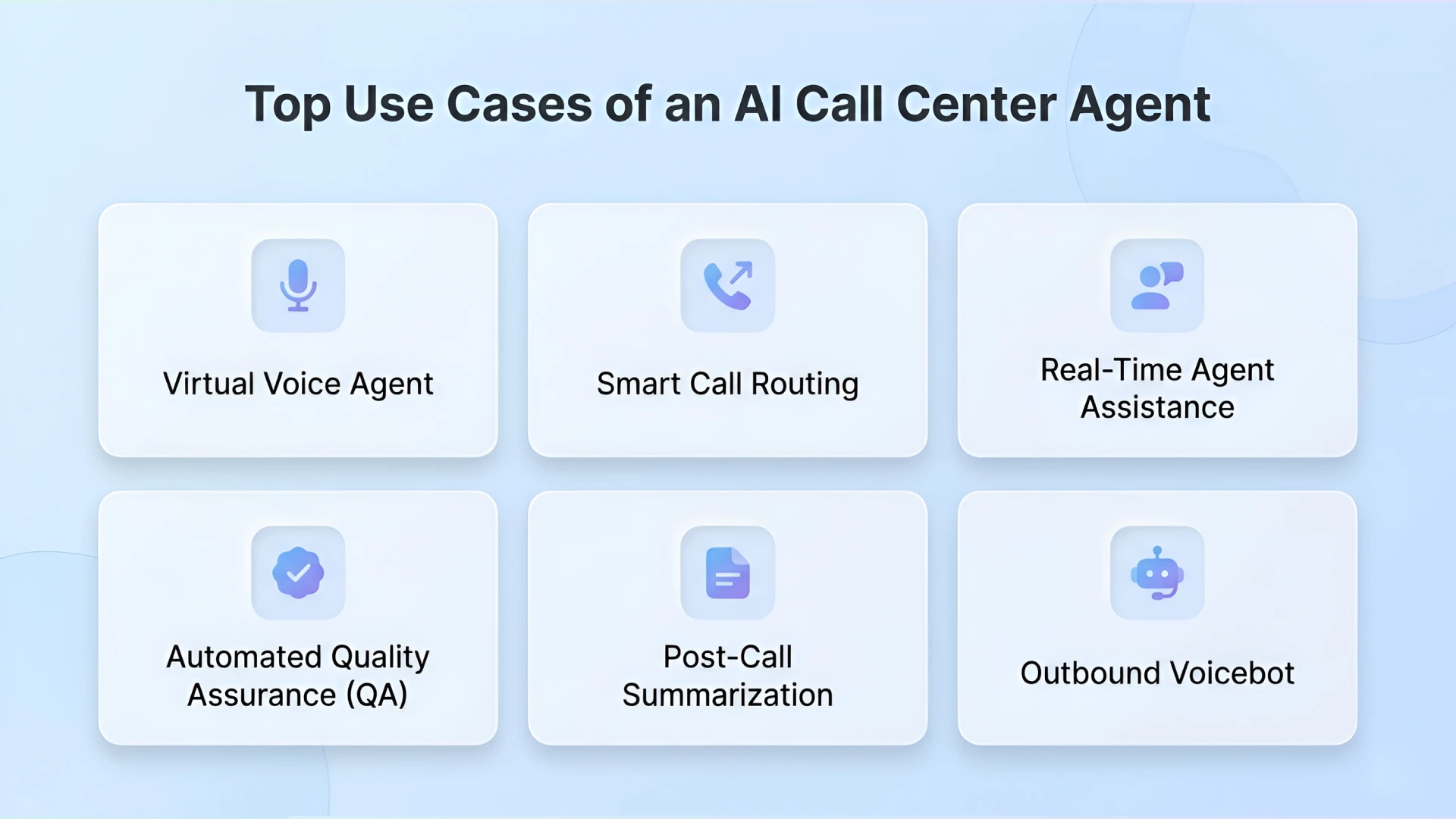
1. Virtual Voice Agent
Call center AI offers AI voice agents to businesses that handle customer inquiries via calls. These virtual agents interact with customers in a natural, human tone and handle large call volumes and routine or repetitive inquiries automatically.
2. Smart Call Routing
AI agents understand customer intent and requirements in real-time during the call. AI then automatically routes those calls to the appropriate department or human agent accordingly. This reduces wait times and boosts FCR (First Call Resolution) by up to 25%.
3. Real-Time Agent Assistance
AI also understands customer tone, behaviour, and sentiments during live calls and acts as a ‘co-pilot’, suggesting next responses. This helps agents to act faster while delivering an enhanced customer experience.
4. Automated Quality Assurance (QA)
An AI call center analyzes 100% of calls to evaluate service quality, average response time, and the outcome of each call. This helps businesses find gaps and take insightful actions accordingly, ensuring consistent delivery of quality service.
5. Post-Call Summarization
AI automates creating transcriptions and call summaries instantly after the conversation. This erodes manual after-call work (ACW), leaving plenty of time for your staff to focus on priority tasks such as meaningful conversations and closing deals effectively.
6. Outbound Voicebot
Voicebots at an AI call center not only handle incoming inquiries, but they also reach out to customers, following up and sending automated personalized reminders for appointment confirmations, payments, and promotional offers.
7. Predictive Customer Churn Prevention
AI agents analyze frustrated customer interaction patterns, behavior, tone, and intent to address their needs proactively. This helps build a strong relationship, trust, and boost customer satisfaction.
The Evolution of AI In Call Centres
AI has transformed call centres from reactive support systems into intelligent, proactive experience hubs. Here’s how this evolution has reshaped modern customer service:
1. From Manual Routing to AI Intelligent Call Routing
Traditional call centers use manual call routing, which is mostly rule-based and reactive. However, AI-driven call routing no longer relies on rigid IVRs or random agent allocation. Instead, AI analyzes customer intent, history, and sentiment in real time to route calls to the right agent or resolution path. This leads to faster resolutions, fewer transfers, and a smoother, more efficient customer experience.
2. From Reactive to Proactive Approach
Back in the days, traditional call centers relied on a reactive approach. But now, with AI powered call center solutions, modern call center AI relies on a proactive approach. AI has shifted support from problem-solving to problem prevention. Further, instead of waiting for customers to report issues, it analyzes patterns and predicts potential disruptions. This allows businesses to reach out first, resolve concerns early, and deliver a smoother, more reliable customer experience.
3. From Selective to Total QA
From selective to total QA, AI transforms quality assurance from limited sampling to complete visibility. Instead of reviewing just a few calls, AI powered call center speech analytics evaluate 100% of interactions in real-time for compliance, sentiment, and performance. This enables consistent scoring, faster feedback, and more targeted improvements across the entire customer experience.
4. From Manual Agent Execution to Real-Time Agent Assistance
Artificial Intelligence for call centers has shifted manual execution to AI-assisted service management. It reduced the operational burden on agents by automating tasks like call summaries, context retrieval, and system navigation. It provides real-time guidance, suggests responses, and guides agents during interactions. This allows agents to focus on high-value conversations, improving both efficiency and customer experience.
5. From Historical Reports to Real-Time Insights
Before AI in call centers, they relied on historical reporting for real-time insights. But AI has transformed this into an always-on AI system that operates 24/7. By analyzing every interaction, it uncovers trends, sentiment shifts, and potential risks as they happen. This enables faster decisions, proactive actions, and turns call centers into powerful, insight-driven engines for customer experience.
AI Call Centre vs Traditional Call Centre
AI call centers are transforming how businesses handle customer interactions by replacing manual processes with intelligent automation and real-time insights. Compared to traditional call centers, they deliver faster responses, better efficiency, and a more personalized customer experience.
| Traditional Call Centers | AI Powered Call Centers | Business Impact | |
| Call Distribution | Basic routing based on queues or fixed rules | Context-aware routing using intent, behavior, and history | Faster resolutions with minimal call transfers |
| Quality Monitoring | Limited call sampling is reviewed manually | Continuous evaluation of all interactions in real time | Improved consistency and service standards |
| Customer Sentiment Tracking | Occasional manual analysis | Instant sentiment detection during live conversations | Better personalization and customer satisfaction |
| Self-Service Options | Static IVR systems with limited flexibility | Dynamic, conversational AI handling complex queries | Reduced call load and quicker resolutions |
| Post-Call Processing | Agents manually log notes and updates | Automated summaries, tagging, and CRM updates | Saves time and boosts agent productivity |
| Agent Enablement | Agents switch between tools to find answers | AI copilots provide real-time suggestions and insights | Higher efficiency and confident interactions |
| Performance Tracking | Reports are generated weekly or monthly | Live dashboards with real-time performance data | Faster decision-making and issue resolution |
| Insights & Analytics | Historical and often incomplete data | Predictive insights from full interaction analysis | Enables proactive customer experience strategies |
| Workforce Planning | Based on past trends and assumptions | AI-driven forecasting using live demand patterns | More accurate staffing and resource allocation |
| Scalability | Requires hiring more agents to grow | Scales through automation and intelligent systems | Growth without proportional cost increase |
| Service Availability | Restricted to working hours | 24/7 support through AI agents | Always-on customer support |
| Experience Consistency | Depends on the agent’s skill and channel | Uniform experience across all touchpoints | Reliable and predictable service quality |
| Operational Cost | High cost per interaction | Lower cost through automation and efficiency | Improved margins and ROI |
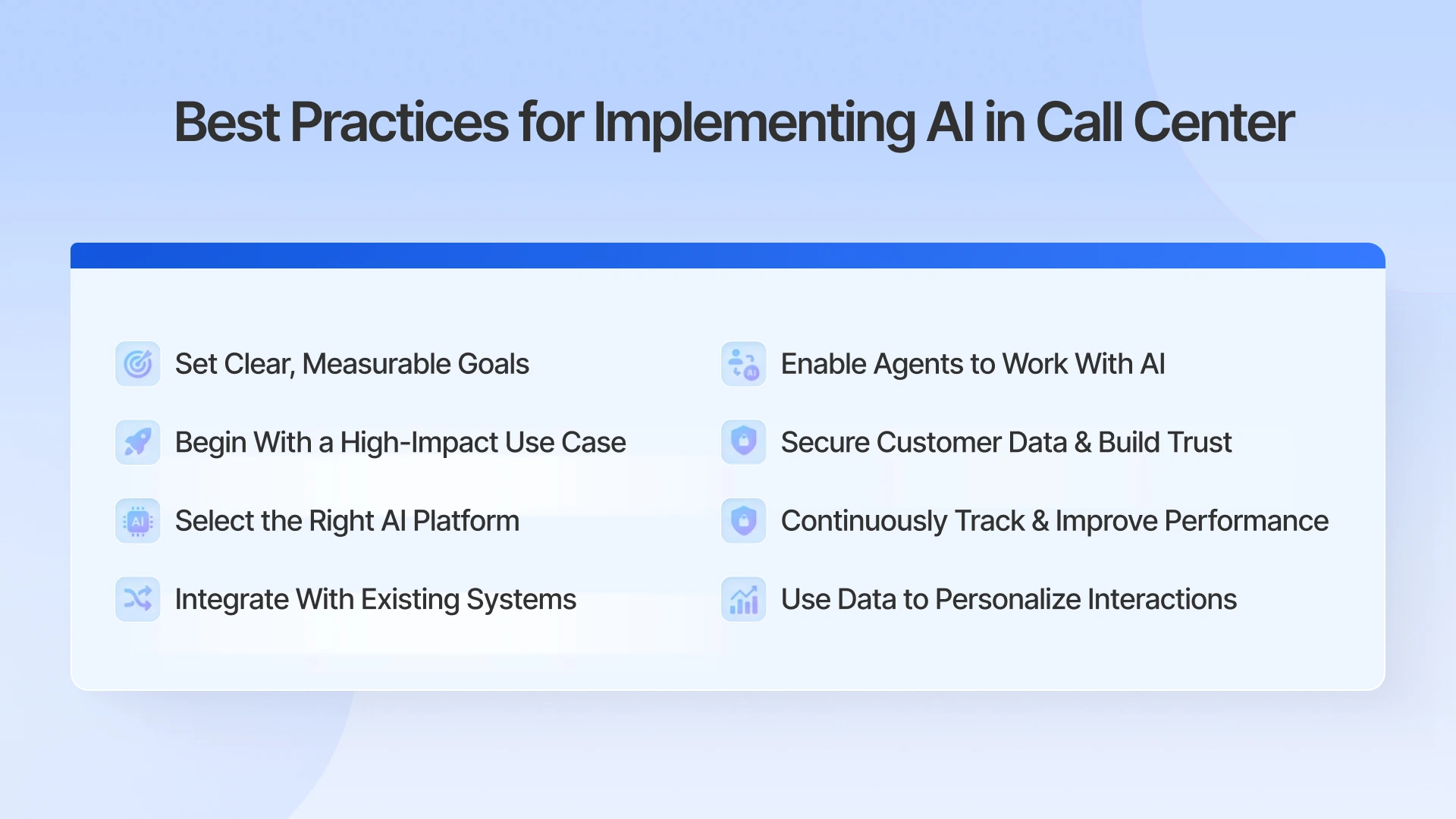
Best 8 Practices for Implementing AI in Call Centres
Successfully implementing Artificial Intelligence for call centres isn’t just about adopting new technology. It’s about aligning it with your business goals, processes, and customer expectations. Here are the key best practices to follow:
1. Define Your Goals & Objectives
The first thing you need to do is start defining clear and measurable goals that align with your business needs. Whether it’s improving CSAT(Customer Satisfaction Score), reducing AHT (Average Handle Time), or increasing FCR (First Call Resolution). Setting specific targets ensures your AI delivers real, trackable outcomes rather than vague improvements.
2. Start With a Specific Use Case
Once you know what you want to achieve, begin with any one specific use case, such as handling high-volume, repetitive tasks like FAQs, appointment booking, or order tracking. These quick wins help you prove ROI early and create a strong foundation before scaling AI to more complex workflows.
3. Choose the Right AI tools
When implementing call center AI software, make sure you choose the right AI. Select an AI solution that exactly fits your business requirements. Also, make sure the AI tool you choose comes with the most advanced features like conversational AI, smart routing, AI analytics, scalability, and more. Together, whenever picking the right tool for your business, ensure that it is specifically built for your niche or industry.
4. Ensure Proper Integration
Make sure the call center artificial intelligence you choose effectively connects with your existing system, such as CRM, help desk, DMS, and more. This ensures that your agents have the full context of each conversation during interactions to avoid repetitive questions. Proper integration makes sure that your business operates with a smooth workflow without any disruptions.
5. Train Your Agents
Together with integration, equip your team to work alongside AI and not compete with it. Provide consistent training sessions on how to use AI tools effectively, interpret insights, and deliver better, more personalized customer interactions. This unlocks numerous growth opportunities for your business, ensuring a smooth workflow with measurable outcomes.
6. Ensure Data Privacy & Security
Make sure the AI you integrate into your systems follows strict privacy regulations and implements strong security measures to protect customer data. Be transparent with customers on how data is collected, used, and secured. This helps you build a strong customer trust, making them your loyal or repeat customer.
7. Evaluate & Monitor AI Performance
Track inbound and outbound call center KPI on a daily basis using key metrics like CSAT(Customer Satisfaction Score), FCR (First Call Resolution), and AHT(Average Handle Time). Further, continuous monitoring and feedback help you refine your models, improve accuracy, and ensure your AI evolves with changing customer needs.
8. Focus on Personalization
Leverage customer data, past interactions, and preferences to deliver tailored experiences for your customers. AI helps customize responses, recommendations, and conversations, making every interaction more relevant, engaging, and connected for the customers. This helps you meet modern customer expectations of fast, reliable, and accurate responses.
Why is an AI Call Center Important for the Automotive Industry?
When most buyers are online searching for cars, sending inquiries, and booking test driving or appointments. Therefore, no matter the hour, being available for your customers is crucial for automotive businesses. AI-powered automotive call center software helps your business operate 24/7, so whenever customers see your cars and send inquiries, they get instant responses.
1. 24/7 Availability
An AI call center enables 24/7 connectivity for customers to your dealership. The virtual agents instantly respond to all incoming inquiries, even when the call volumes are high, and book appointments around the clock. This ensures that no inquiry goes unanswered even outside business hours.
2. Reduce Wait Times
AI for car dealerships delivers instant responses, 24/7 connectivity, and smart call routing. These ensure that whenever there is a need for human agents, calls are instantly routed to the right agents at the right time. This reduces wait time and boosts FCR (First Call Resolution).
3. Enhance Customer Experience
Car buyers these days expect a lot more from dealerships. Meeting those expectations helps you deliver an enhanced customer experience. These expectations include faster, personalized, connected, and accurate responses at their own convenience.
4. Enhance Operational Efficiency
By automating repetitive tasks such as answering FAQs, booking appointments, and managing inquiries, automotive call center services help reduce your staff workload. This allows them to focus on high-value customer interactions. It also integrates seamlessly with your dealership systems and automatically updates customer information in your CRM in real time, keeping all data centralized and easily accessible for your team whenever they need it.
5. Enhance Service Quality
Automotive AI call center ensures consistent, error-free responses across all interactions. Further, with real-time agent assistance and standardized workflows, customers receive reliable and high-quality support every time, around the clock.
6. Data-Driven Insights
Call center AI solutions analyze every interaction to uncover trends, customer behavior, and performance gaps. These insights help you make smarter decisions for your dealership and optimize operations to deliver a more personalized experience to your customers.
Why Spyne’s AI Call Center is the Perfect Choice For Automotive Businesses?
Spyne Artificial Intelligence Call Center is purpose-built for automotive businesses, combining intelligent automation with industry-specific capabilities. It helps dealerships capture more leads, streamline operations, and deliver faster, more personalized customer experiences at scale.
1. Conversational AI Voice Agents
Our call center AI solutions offer automotive businesses a conversational AI voice agent, “Vini” that interacts with customers naturally in a human-like tone. Our AI agent operates 24/7, handling customer interactions and booking appointments without getting tired.
2. Personalized Responses Deliver Instantly
Our AI analyzes and understands customer tone, behavior, intent, sentiment, and preferences during the call and delivers personalized responses accordingly. Our AI instantly responds to every inquiry, even outside business hours.
3. Reduces Operational Cost
By automating repetitive dealership tasks like call handling and scheduling, our AI reduces the need for a large support team, saving on hiring costs. This helps you scale effectively and leaves plenty of time for your team to focus on high-priority tasks.
4. Omnichannel Support
Buyers these days expect multi-channel communication support without losing the context. Our AI is not just limited to calling. It acts as a contact center artificial intelligence that enables you to connect with your customers across voice, text, and chat from a single platform. This ensures a consistent and seamless experience, no matter how customers choose to engage.
5. Scalability
Our call center automation AI easily handles large call volumes without operational issues. It helps you scale effortlessly, managing spikes in demand without compromising performance or response quality.
6. Seamless Integration
Our AI smoothly integrates with your existing CRM, DMS, and telephony systems, ensuring a smooth workflow within your dealership. This ensures real-time data sync and a unified view of every customer interaction.
7. AI Analytics
Our call center AI updates analytics and insights in real-time on each call to uncover actionable insights on behavior, intent, and performance. These real-time analytics help dealerships optimize operations, improve service quality, and make smarter, data-driven decisions.

Spyne vs Generic AI Call Center Solutions
Having a generic AI call center solution may help automate basic interactions, but it often lacks the depth and industry-specific intelligence needed for automotive BPO. Dealerships require more than just automation. They need AI in call center solutions that understand buyer intent, vehicle context, and lead management. This is where a specialized platform like Spyne stands out, delivering tailored experiences and driving real business outcomes.
| Spyne AI Call Center | Generic AI Call Center Solutions | |
| Industry Focus | Built specifically for automotive dealerships with domain-trained AI | General-purpose AI built for multiple industries |
| Lead Handling | Captures, qualifies, and follows up on leads automatically across channels | Basic lead capture often requires manual follow-up |
| Call Routing | Intelligent routing based on vehicle context, intent, and urgency | Rule-based or limited intent-based routing |
| Conversational Quality | Human-like, context-aware conversations tailored for car buyers | Scripted or generic conversational flows |
| Appointment Booking | Automated test drive & service scheduling with real-time system sync | Limited or semi-automated booking flows |
| Omnichannel Support | Unified communication across calls, chat, SMS, and web | Often fragmented across tools or channels |
| CRM & DMS Integration | Deep integration with dealership systems, auto-syncs all interactions | Basic or limited integrations requiring manual updates |
| Automation Level | End-to-end automation from inquiry handling to follow-ups | Partial automation with human dependency |
| Scalability | Handles unlimited conversations without increasing headcount | Scaling requires more agents or infrastructure |
| Data & Insights | Real-time analytics on customer behavior, intent, and performance | Delayed or limited reporting capabilities |
| Automotive Intelligence | Understands vehicle details (make, model, VIN, service needs) natively | Lacks industry-specific understanding |
| Proactive Engagement | Automated follow-ups, reminders, and re-engagement workflows | Mostly reactive, depends on inbound queries |
| Operational Efficiency | Reduces manual tasks and streamlines dealership workflows | Still requires manual intervention in multiple stages |
Conclusion
Having a call center automation AI is essential for businesses that want to unlock growth opportunities while delivering faster, smarter, and more personalized customer experiences. By combining automation with real-time intelligence, they help streamline operations, improve efficiency, and ensure every customer interaction is handled seamlessly.
For automotive businesses, Spyne’s AI call center is a perfect choice. It comes with numerous advanced AI features for automotive businesses, helping them scale and grow effectively. Want to see Spyne’s conversational AI in action for your call center? Book a demo now!