
Every day, businesses lose potential customers without even realizing it. A missed call during peak hours, a delayed response to an inquiry, or a lack of follow-up on a lead. These small gaps quietly turn into lost revenue and poor customer experiences. This is why understanding inbound and outbound meaning and implementing the right inbound and outbound call center services is critical for business growth. These call centers allow you to connect with your customers 24/7, enhance customer experience, and build trust and strong customer relationships through instant & personalized responses.
Let’s dive deeper into the blog and explore how inbound and outbound call center solutions actually help in business success.
What Is an Inbound Call Center?
An inbound call center is a customer support department that handles all incoming calls initiated by customers seeking assistance, technical support, or placing orders. Inbound call center agents primarily handle service requests, queries, and complaints to build customer loyalty and retention.
What Is an Outbound Call Center?
Outbound call center agents focus on proactively making calls to existing or potential customers. Outbound call center agents make these calls for telemarketing, lead generation, market research, and debt collection purposes to generate revenue and better customer engagement.

What Is the Difference Between Inbound and Outbound Call Centers?
Now that you understand what is inbound and outbound call center services, let’s discuss how they differ from each other. Well, both inbound and outbound call centers are equally important for business success, but they serve different purposes. Understanding the difference between inbound and outbound call center services helps businesses choose the right strategy. One receives customer calls, and the other makes calls to customers.
| Inbound Call Centers | Outbound Call Centers |
| Inbound call centers manage calls initiated by customers seeking support, information, or assistance. These interactions are typically service-driven and focus on resolving queries efficiently. | Outbound call centers proactively reach out to prospects or existing customers. These calls are designed to create opportunities, drive engagement, and generate business outcomes. |
| The primary role is to resolve customer issues, answer questions, and provide guidance. This includes handling technical support, billing concerns, complaints, and general inquiries. | Outbound teams focus on sales activities like cold calling, lead qualification, appointment setting, and follow-ups. The goal is to convert prospects and nurture potential customers. |
| Inbound interactions are centered around building trust through empathy, patience, and effective communication. This helps improve customer satisfaction and long-term retention. | Outbound interactions are focused on influencing decisions and driving conversions. Agents use persuasive communication to acquire new customers and increase revenue. |
| Inbound call centers operate reactively, responding to customer needs as they arise. Performance is measured through KPIs like First Call Resolution (FCR), Customer Satisfaction (CSAT), and Average Handle Time (AHT). | Outbound call centers take a proactive approach by initiating conversations. Success is measured through metrics like conversion rate, call volume, lead quality, and revenue generated. |
| Inbound centers rely on IVR, ACD, CRM systems, and smart routing to manage high call volumes efficiently. Agents require strong listening skills, empathy, attention to detail, and problem-solving abilities. | Outbound centers use predictive dialers, CRM tools, automation, and analytics platforms to optimize outreach. Agents need confidence, persuasion, resilience, and objection-handling skills to succeed. |
What Are The Types Of Inbound Calls?
Inbound calls widely depend on customer needs, such as seeking customer support, technical support, account details, or booking appointments. These calls are focused on resolving customer issues, building trust, and improving customer retention. These are key functions of inbound call center services within a modern inbound call center and outbound call center setup.
1. Customer Service
When customers initiate a call for general information about products, services, company policies, returns, or account updates are called customer service inbound calls. The goal here is to deliver quick, accurate support while ensuring a smooth customer experience.
2. Technical Support
In technical support inquiries, customers call seeking assistance with product malfunctions, software issues, or system setup issues. Whether it’s troubleshooting a malfunction or guiding someone through setup, agents need strong problem-solving skills and patience to resolve issues effectively and restore customer confidence.
3. Order Processing Inquiries
Order processing inquiries include calls to place new orders, track shipments, request returns, or resolve payment-related concerns. Handling these calls requires efficiency and clarity to ensure transactions are completed smoothly without errors.
4. Account & Billing Inquiries
These calls involve managing customer accounts, updating customer personal details, resolving billing issues, understating invoices, or handling subscription renewals and upgrades. While handling these inquiry calls, accuracy and transparency are critical for maintaining customer trust.
5. Inbound Sales Inquiries
Not all incoming calls are related to support. Many calls also come from potential customers exploring your products or services. These calls are also called warm leads. Customers often ask about pricing, features, or product comparisons. Handling these inquiries effectively brings you a sales opportunity.
6. Complaints & Feedback
When customers have a negative experience, they often call to register a complaint or share feedback. Handling these calls effectively, resolving issues quickly and empathetically, helps you enhance customer satisfaction and build trust.
7. Appointment Scheduling Inquiries
These inquiry calls include booking, rescheduling, or canceling appointments. These inquiry calls are common in various industries like automotive, healthcare, home services, etc. These calls require clear communication and efficient coordination.
What Are The Types of Outbound Calls?
As the outbound call center meaning suggests, it proactively reaches out to customers or prospects. These calls are primarily focused on revenue-driven activities such as sales, lead generation, customer engagement, and operational follow-ups. These calls help businesses create opportunities, nurture relationships, and drive measurable growth.
1. Cold Calling
Live cold calling or AI cold calling is made by agents to potential customers who have never previously interacted with your business. Since the outreach is unexpected, agents initiate these calls to introduce potential customers to your products or services.
2. Warm Calling
Warm calls involve prospects who have already shown some level of interest through a referral, event, or previous interaction. Because there’s prior familiarity, these calls are generally better received and often lead to higher conversion rates.
3. Lead Generation/Qualification
Lead generation calls are initiated to guide customers about the brand, product, or service, create customer interest, and gather key information. Agents assess whether they are a good fit to pursue through proactive calling. This helps build a strong sales pipeline, ensuring only qualified leads are passed to the sales team.
4. Telemarketing
Unlike lead generation, telemarketing outbound calls focus on selling a product or service through a direct sales pitch. These calls are more conversion-driven, aiming to close sales quickly by highlighting key benefits and creating urgency.
5. Market Research
Outbound calls for marketing research are where your agents call existing and potential customers to gather insights into their preferences, understand customer behavior, and monitor market trends. This valuable data will help you meet customer expectations and make better marketing strategies.
6. Appointment Setting & Confirmation
Outbound agents connect with prospects to schedule or confirm meetings with the sales team for demos or consultations. They ensure the timing aligns with the customer’s availability while keeping the process smooth and organized. At the same time, agents stay engaged to maintain interest and increase the chances of successful follow-ups.
7. Customer Satisfaction Surveys
These calls are made by agents to customers to collect feedback and understand their experiences with the product or service. They help identify gaps in service quality, measure customer satisfaction levels, and uncover opportunities to improve overall customer experience.
8. Follow-Up Calls
Follow-up calls focus on re-engaging prospects after an initial interaction, such as after sharing a proposal or demo. Agents use these calls to answer questions, address concerns, build trust, and guide prospects further down the sales funnel.
9. Reactivation/Retention Calls
These calls target past customers or users with inactive or expired memberships. Agents reach out to renew their interest, reintroduce value, and encourage them to continue or restart their relationship with the business.
How Can You Improve Your Inbound Call Strategy?
Improving your inbound call strategy is about creating faster, smoother, and more meaningful customer interactions. This includes utilizing AI-powered IVR, CRM integrated systems, and tracking KPIs for delivering an enhanced customer experience. Learn how you can improve your inbound call strategy:
1. Optimize Call Routing with AI & IVR
Use AI-powered inbound call center software like IVR and skill-based routing to direct callers to the right agent instantly. This reduces unnecessary transfers, shortens resolution time, and ensures customers connect with someone equipped to handle their issue. Smart routing also improves overall efficiency during peak call volumes.
2. Integrate CRM for Personalized Support
Equip agents with real-time access to customer history through CRM integration. This allows them to understand context instantly, avoid repetitive questions, and deliver tailored solutions. Personalized conversations significantly boost customer satisfaction and trust.
3. Reduce Wait Times & Improve Response Speed
Aim to answer calls within 20 seconds to minimize frustration and call abandonment. Faster response times create a strong first impression and increase the chances of successful resolution. Efficient queue management and staffing play a key role here.
4. Continuously Train Agents & Monitor Quality
Regular training helps agents improve communication, empathy, and problem-solving skills. Go beyond technical training, focus on active listening, professionalism, and handling difficult conversations. Use call recordings, role-based scenarios, and performance reviews to identify gaps and provide actionable feedback.
5. Define Clear Procedures & Call Flows
Create standardized yet flexible scripts and protocols for handling common scenarios like complaints, billing queries, and escalations. This ensures consistency across interactions while still allowing agents to personalize conversations when needed.
6. Track KPIs & Refine Your Strategy
Monitor key metrics like First Call Resolution (FCR), average handle time, and abandonment rates. These insights help identify bottlenecks and areas for improvement in your call flow. Continuous optimization based on data ensures long-term performance gains.
7. Adopt a Multichannel Support Approach
Ensure your inbound call strategy aligns with other support channels like email, chat, and social media. A seamless multichannel experience allows customers to switch between channels without repeating information, improving overall satisfaction and brand perception.
How Can You Improve Your Outbound Call Strategy?
Having an effective outbound call strategy is more than just dialing numbers. It’s about reaching the right prospects with the right message at the right time. An effective outbound call strategy includes a mix of preparation, personalization, and performance tracking. This clarity ensures every call contributes to business outcomes.
1. Define Clear Goals & KPIs
The first thing you need to do is define your business and what you want to achieve, like conversion rate, average handle time, and first-call close. Having a clear set of goals and outbound call center KPI helps agents stay focused and give measurable insights. This clarity ensures every call contributes to business outcomes.
2. Personalize Every Interaction
Know your customers before calling, understand their needs, role, and challenges. You can also leverage CRM data to personalize conversations so every interaction feels relevant. This will help you enhance customer engagement and increase conversion rate.
3. Leverage AI tools and systems
Use AI-powered dialers, CRM systems, and AI call analytics tools to streamline outbound operations. These tools help you automate repetitive tasks, improve call efficiency, and provide real-time insights for better decision-making. Also, it enables smarter targeting and enhances overall productivity for your agents.
4. Train & Motivate Agents Continuously
Train your agents, review calls, and help them refine their communication skills. Pair this with incentives and recognition programs to keep teams motivated and engaged. A confident and well-supported team performs more effectively on calls.
5. Optimize Timing & Maintain Data Quality
Timing plays a critical role in outbound success. For B2B calls, targeting mid-week windows like Wednesdays and Thursdays between 9–11 AM or 1–3 PM can significantly improve connection rates. At the same time, maintaining clean and updated contact lists is essential. Regular data hygiene helps avoid spam flags, improves deliverability, and ensures agents connect with the right prospects.
6. Use Pattern Interrupts to Stand Out
Instead of starting calls with a standard sales pitch, use a “pattern interrupt” approach. This could mean opening with a low-tone, conversational, or peer-to-peer style introduction that feels natural and unexpected. Breaking the usual sales pattern helps lower resistance and makes prospects more open to engaging in the conversation.
7. Refine the Offer & Call to Action (CTA)
Your call-to-action should feel like a benefit, not a pushy sales move. Instead of aiming for an immediate sale, offer a simple and low-commitment next step like a quick, informative meeting or demo. This makes it easier for prospects to say yes and keeps the conversation moving forward.
8. Create Feedback Loops & Optimize Continuously
Track key metrics and analyze call performance to identify skill gaps and areas for improvement. Using these insights, you can also personalize your scripts, enhancing customer engagement and brand awareness. Continuous feedback ensures your outbound strategy evolves and stays effective over time.
Skills Needed for Inbound vs Outbound Calls
Inbound and outbound calls require different skill sets based on how customer interactions happen. Inbound calls focus on empathy, active listening, and problem-solving to handle customer needs effectively. Whereas outbound calls require confidence, persuasion, and resilience to drive conversations, generate leads, and close sales. Let’s discuss in brief the skills needed for inbound vs outbound calls
Skills Required for an Inbound Call Center
1. Active Listening
When a customer initiates a call, they have something to say. Inbound call handling agents must listen to them carefully without interrupting. This helps agents clearly understand customer issues or inquiries, reduces repetitive questions, and avoids miscommunication. Strong listening skills are the foundation of effective problem resolution.
2. Empathy & Patience
Many customers often call when they are frustrated or confused. In these situations, agents need to stay calm, composed, and show empathy and patience to customers. This helps build trust and reassures customers that their concerns are being taken seriously. Handling these situations with a positive attitude helps maintain a good customer experience.
3. Problem Solving
Customers come with issues expecting faster resolutions. This is why inbound call center agents must have an agile mind and the ability to think quickly and find solutions, even in complex situations. This includes navigating systems efficiently and adapting to different types of queries. Strong problem-solving skills reduce resolution time and improve first-call success.
4. Product Knowledge
Every inbound call agent should have extensive knowledge of your company’s offerings. This allows agents to provide accurate and confident support. Whether it’s answering questions or troubleshooting issues, product knowledge helps in delivering effective solutions.
5. Communication & Attention to Details
Agents with good communication skills can clearly explain while maintaining a positive tone. At the same time, paying attention to small details, like account information or specific issues, makes a big difference in resolving problems correctly and efficiently.
6. Efficiency and Attention to Detail
Inbound agents must handle calls within a reasonable timeframe (Average Handle Time – AHT) while ensuring all critical information is captured accurately. Balancing speed with precision helps maintain productivity without compromising the quality of customer support.
Skills Required for Outbound Call Center
1. Persuasion & Closing Techniques
Outbound agents must be able to influence customer decisions through clear and compelling communication. They need to highlight value, handle conversations strategically, and guide prospects toward a decision. Strong closing skills help convert conversations into actual sales.
2. Time Awareness
Managing time effectively is crucial in outbound calling, where productivity is often measured by call volume and outcomes. Agents need to balance call duration while ensuring meaningful conversations. This helps maximize efficiency without compromising quality.
3. Resilience & Confidence
Rejections are common in outbound calling, so agents must stay confident and motivated. Resilience helps them handle repeated refusals without losing enthusiasm. A positive and confident tone also improves customer perception during calls.
4. Target-Driven Mindset
Outbound agents work towards specific goals like conversions, meetings booked, or leads generated. Staying focused on these targets helps maintain consistency and performance. A goal-oriented approach ensures every call contributes to business objectives.
5. Objection Handling
Customers often raise concerns or hesitate during outbound calls. Agents must be skilled at addressing objections calmly and turning them into opportunities. Effective objection handling builds trust and increases the chances of conversion.
6. Confidence and Assertiveness
Outbound agents need to initiate conversations with confidence and maintain control of the call flow. Being assertive helps them guide discussions effectively while keeping prospects engaged and moving toward a clear outcome.
7. Rapport Building
Quickly establishing trust with a stranger is essential in outbound calling. Agents who can build rapport early create a more comfortable and engaging experience, increasing the likelihood of positive responses and successful conversions.
Technologies Used In Inbound Call Centers vs Outbound Call Center Services
To understand what is call center inbound and outbound, you also need to look at the technologies behind them. While both rely on shared tools like CRM integration systems, call recording, and analytics, AI-powered voice agents, omnichannel support, and WFM (Workforce Management), their core technologies differ in how they handle customer interactions.
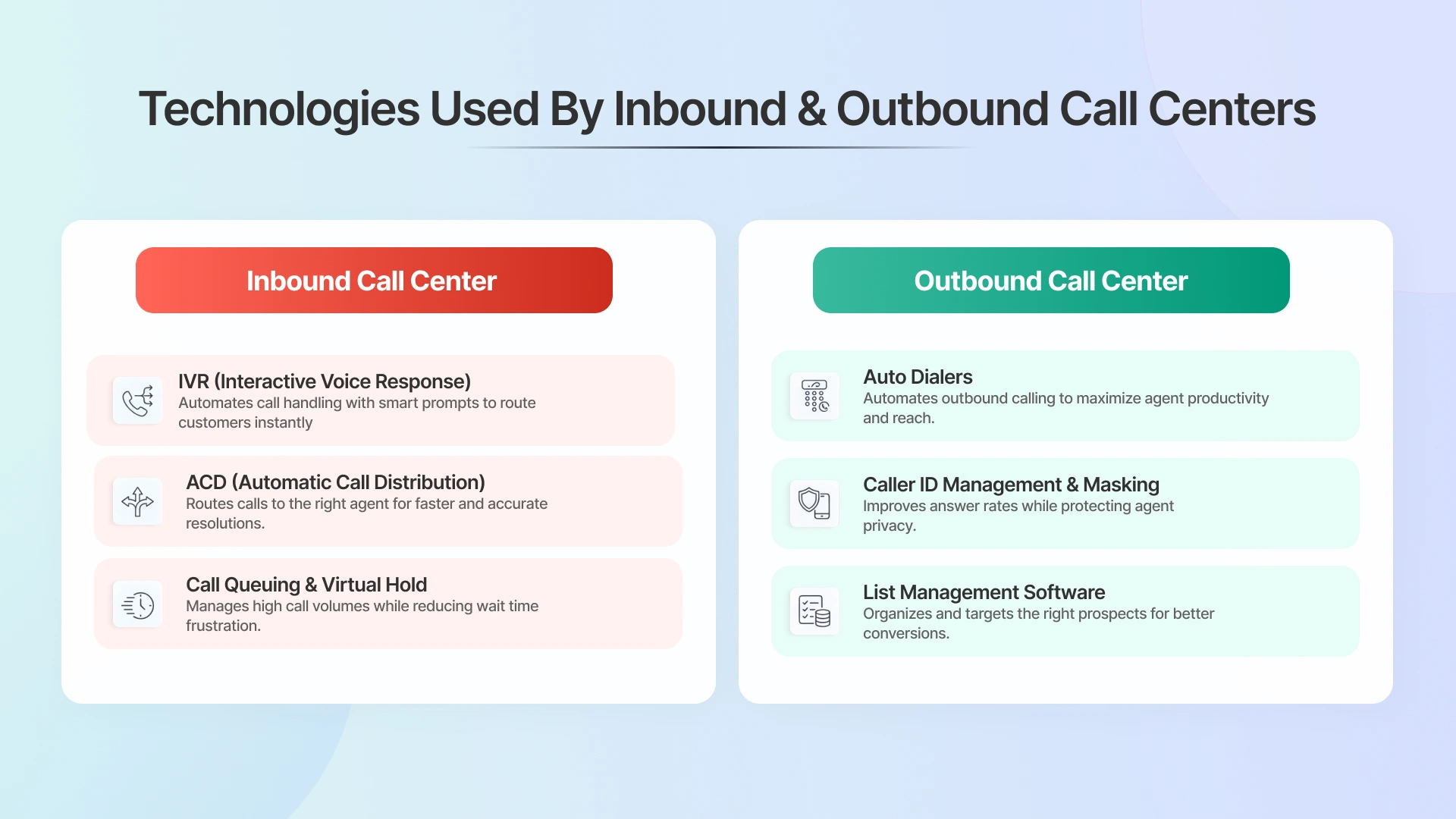
Technologies Used By Inbound Call Centers
1. IVR (Interactive Voice Response)
IVR (Interactive Voice Response) is the first touchpoint of every customer interaction. It interacts through automated voice prompts. This AI inbound call handling software collects essential information and guides customers. This reduces wait times and ensures smoother call handling from the start.
2. ACD (Automatic Call Distribution)
ACD intelligently routes incoming calls to the most suitable department or agent based on skill set, availability, or customer data. Automated inbound calls with smart routing ensure faster connections and enhance FCR (First Call Resolution) rates. It helps you by enhancing overall service efficiency.
3. Call Queuing & Virtual Hold
These AI phone call handling systems help your business manage high call volumes by placing customers in organized queues or offering callback options instead of waiting on hold. Virtual hold improves the customer experience by reducing frustration and perceived wait times.
4. Screen Pop/CRM Integration
Screen pop and CRM integration automatically display customer records the moment a call arrives. This gives agents instant access to previous interactions, purchase history, and relevant details, enabling more personalized conversations, faster issue resolution, and an overall improved customer experience.
Technologies Used By Outbound Call Centers
1. Auto Dialers
Automated dialers streamline the AI outbound calling process by automatically dialing numbers without human interference. This helps in minimizing idle time between calls while increasing customer outreach volume. This allows agents to focus on more conversations and conversions.
2. Caller ID Management & Masking
This technology displays local or familiar phone numbers to improve call answer rates. It also protects agent privacy by masking personal or business numbers during outbound calls. As a result, it builds trust while maintaining security and compliance.
3. Lead Management System
Lead management tools help you organize, filter, and prioritize contract lists for targeted outreach. They ensure agents are calling the right prospects while maintaining data accuracy and compliance. This will also help you improve your campaign efficiency and overall conversion rates.
Inbound vs Outbound Calls: Which Is Right for Your Business?
Many businesses struggle to choose the right call center for their needs. However, having a clear understanding of inbound call center vs outbound helps you find the right fit. Also, considering a few key factors helps you make the right decision. These include:
1. Assess Your Business Needs
The first thing you need to do is identify what you want to achieve. Is it to deliver enhanced customer support or boost conversion and sales? While inbound call centers are ideal for resolving customer queries and improving customer satisfaction, outbound call centers focus on lead generation and driving revenue.
2. Understand Your Customer Interaction Type
Understanding how you interact with your customers also helps you choose the right call center for your business. If your customers usually reach out to you for support, inquiries, or issue resolution, then you need an inbound call center. However, if you are reaching out to customers first, then you need an outbound call center.
3. Assess Challenges You are Facing
Another key factor in choosing the right call center is identifying the specific challenges your business faces when managing customer interactions. If you are struggling to handle high-volume incoming support calls, it means you need an inbound call center. But if you’re facing challenges in converting leads, then you need an AI outbound calling center. Solving your biggest bottlenecks should guide your choice.
4. Evaluate Resources & Budget
Evaluate what resources you need for your business. Is it inbound call handling agents or outbound call agents? Choosing the right approach depends on what resources you can allocate. Also, there are multiple inbound and outbound call center providers in the industry, so consider your budget too.
What About Hybrid? Combining Inbound and Outbound Call Centers in One Unified Solution
Many businesses tend to choose just one type of call center, but combining both inbound and outbound in call center can be a smarter approach. Earlier, managing both was expensive due to complete reliance on traditional systems and separate setups. Today, with advanced AI-powered 24/7 inbound and outbound call center solutions like Spyne’s Vini, businesses can manage both inbound and outbound calls seamlessly through a single, cost-efficient system.
This hybrid approach allows businesses to deliver faster support while proactively engaging potential customers at the same time. With a unified system, agents get complete visibility into customer interactions, enabling more personalized and efficient conversations. As a result, businesses can improve both customer experience and revenue growth without increasing operational complexity.
Top 6 Benefits of Cloud-Based CCaaS for Inbound and Outbound Contact Centers
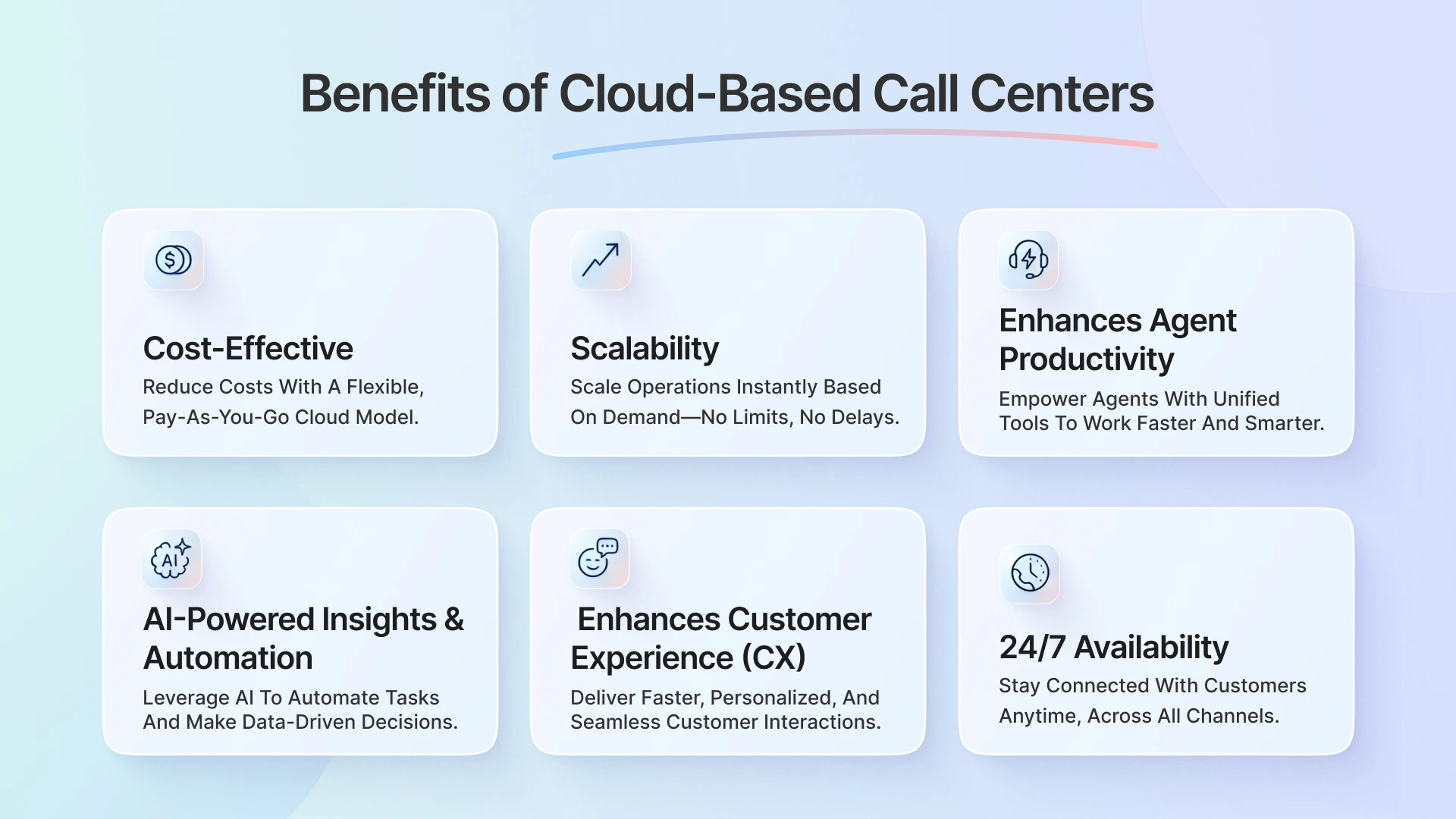
Cloud-based CCaaS (Contact Center as a Service) is transforming how businesses manage both inbound and outbound operations. By moving to the cloud, you can eliminate heavy infrastructure costs while gaining access to flexible, AI-powered tools. Let’s discuss in brief how CCaaS platforms benefit your business:
1. Cost-Effective
CCaaS eliminates the need for expensive on-premises hardware, servers, and maintenance. It allows you to switch to a subscription-based model and pay only for what you use. This helps reduce the upfront investment and ongoing operational expenses.
2. Scalability
Cloud-based contact centers help you easily scale operations up or down depending on demand. Whether it’s peak call volumes or slow periods, CCaaS adapts to the situation instantly. This flexibility ensures optimal resource utilization at all times.
3. Enhances Agent Productivity
With a centralized tool and customer data, your agents can work more efficiently without switching between systems. Automated workflows and smart routing reduce manual effort and idle time. This helps agents focus more on meaningful conversations.
4. AI-Powered Insights & Automations
CCaaS platforms offer advanced AI capabilities like chatbots, voice bots, and predictive analytics. These tools help you automate routine tasks and route calls smartly. Together, the CCaaS provides real-time insights, helping you make faster and data-driven decisions.
5. Enhances Customer Experience (CX)
The cloud-based contact centers help you deliver an enhanced customer experience through faster response times, personalized interactions, and seamless channel transitions. Agents have instant access to customer history, enabling quicker and more accurate resolutions.
6. 24/7 Availability
These cloud-based contact centers allow you to connect with your customers around the clock. Customers can reach out anytime through multiple channels, ensuring consistent availability. This improves customer satisfaction while helping you capture opportunities even after business hours.
From Call Center to Contact Center: The Evolution of Customer Engagement
Traditionally, outbound and inbound call centers were limited to handling customer interactions over phone calls. But today, these call centers have evolved into multichannel contact centers. These modern contact centers allow businesses to connect with customers across their preferred platforms, like chat, SMS, email, social media, and even video.
Modern contact centers are powered by flexible technologies like communication APIs, which make it easy to build and scale across channels. Also, you can start with voice support and gradually expand to include messaging, chat, and more, creating a unified and personalized customer experience that evolves with their needs.
Why Inbound and Outbound Call Centers for the Automotive Industry
Both inbound & outbound call centers are important for businesses and help to scale and grow while meeting customer satisfaction. From handling inquiries to following up on leads and driving after-sales engagement, automotive call center software ensures no opportunity is missed.
1. Enhanced Customer Experience (CX)
Car buyers expect a lot from dealerships, instant, accurate, and personalized responses based on their requirements. These inbound and outbound call centers allow you to meet these expectations, increasing customer satisfaction and delivering an enhanced customer experience.
2. Captures Every Opportunity
Having automotive call center services for your dealership helps you capture every sales opportunity. It ensures that no call gets unanswered or goes ignored. It captures every lead coming to your dealership, even outside business hours.
3. Increased Revenue
Capturing leads and sales opportunities even outside the business hours, inbound and outbound call centers help you upsell and cross-sell services. This helps dealerships generate consistent revenue beyond vehicle sales.
4. Efficiency & Cost Reduction
AI-powered outbound and inbound call center services like Spyne’s help you automate call handling while reducing manual workload and operational costs. This allows your staff to focus on high-value interactions and improves their productivity.
5. Better Appointment Scheduling & Management
Most car buyers browse cars online at midnight. Inbound & outbound call center software allows you to connect with your customers 24/7, even outside business hours. It allows your customers to easily book text drives or service appointments at their own convenience.
Why Choose Spyne for Smarter Inbound and Outbound Call Center Solutions
Choosing the right call center solution can make all the difference in how you engage, convert, and retain customers. With Spyne, you get an AI-powered platform that seamlessly manages both inbound and outbound calls while delivering speed, personalization, and efficiency at scale. Here’s how Spyne helps you turn every customer interaction into a growth opportunity.
1. Conversational AI Agents
With Spyne’s call center software, we offer you conversational AI agents who handle your appointment booking, answer customer calls, and resolve their inquiries with a natural and human-like tone and interactions. This helps reduce manual workload while maintaining high-quality conversations.
2. 24/7 Accessibility
Our inbound & outbound call center helps you stay available and connected to your customers. Whether it’s late-night inquiries or missed calls during peak hours, our conversational AI agent Vini ensures every interaction is captured. This helps you never miss a lead or support request.
3. Personalized Interactions
Our conversational AI call bot for car dealerships understands customer intent, behavior, and requirements, and accordingly delivers personalized responses to every customer. This helps making customer feel valued, enhancing their experience and building stronger relationships.
4. Omnichannel Support
Spyne enables you to connect with customers across multiple channels, including calls, SMS, chat, and more, from a single unified platform. This ensures consistent communication and a seamless customer experience, no matter where the interaction begins or continues.
5. Smart Call Routing
With intelligent routing capabilities, our call center solution ensures that every call is directed to the right agent or department. This reduces wait times, improves first-call resolution, and enhances overall efficiency. Customers get faster and more accurate support.
6. Boosts Conversion Rate
By instantly responding to leads and following up proactively through personalized responses, our AI agents boost conversion rates for your business. Further, timely engagement ensures prospects don’t go cold. This directly impacts your sales and revenue growth.
7. Scalability
Spyne’s AI-powered call overflow solution is built to grow with your business, allowing you to easily scale your inbound and outbound call operations based on demand. Whether you’re handling peak volumes or expanding to new locations, it ensures consistent performance without increasing operational complexity or costs.
8. Seamless Integration
We offer you a seamless integration of our inbound and outbound call centers with your existing CRM and business tools, giving agents complete visibility into customer data. This eliminates the need to switch between multiple platforms.

Conclusion
While both inbound and outbound call centers serve different purposes and require a unique set of skills, both are equally important for business success. Further, having a clear inbound vs outbound call center understanding helps you choose the right fit for your business. An inbound call center handles all incoming customer inquiries and resolves them, increasing customer satisfaction. Whereas an outbound call center makes calls to customers primarily for sales purposes. Now that you understand what is the difference between inbound and outbound call center solutions. It’s clear that combining both drives better results and opportunities. Businesses that combine both can deliver seamless support while also staying ahead in customer outreach.
With Spyne’s AI-Powered solutions, you can easily manage both inbound and outbound calls. Book a demo now and see Spyne’s AI in action.