
| Executive Summary
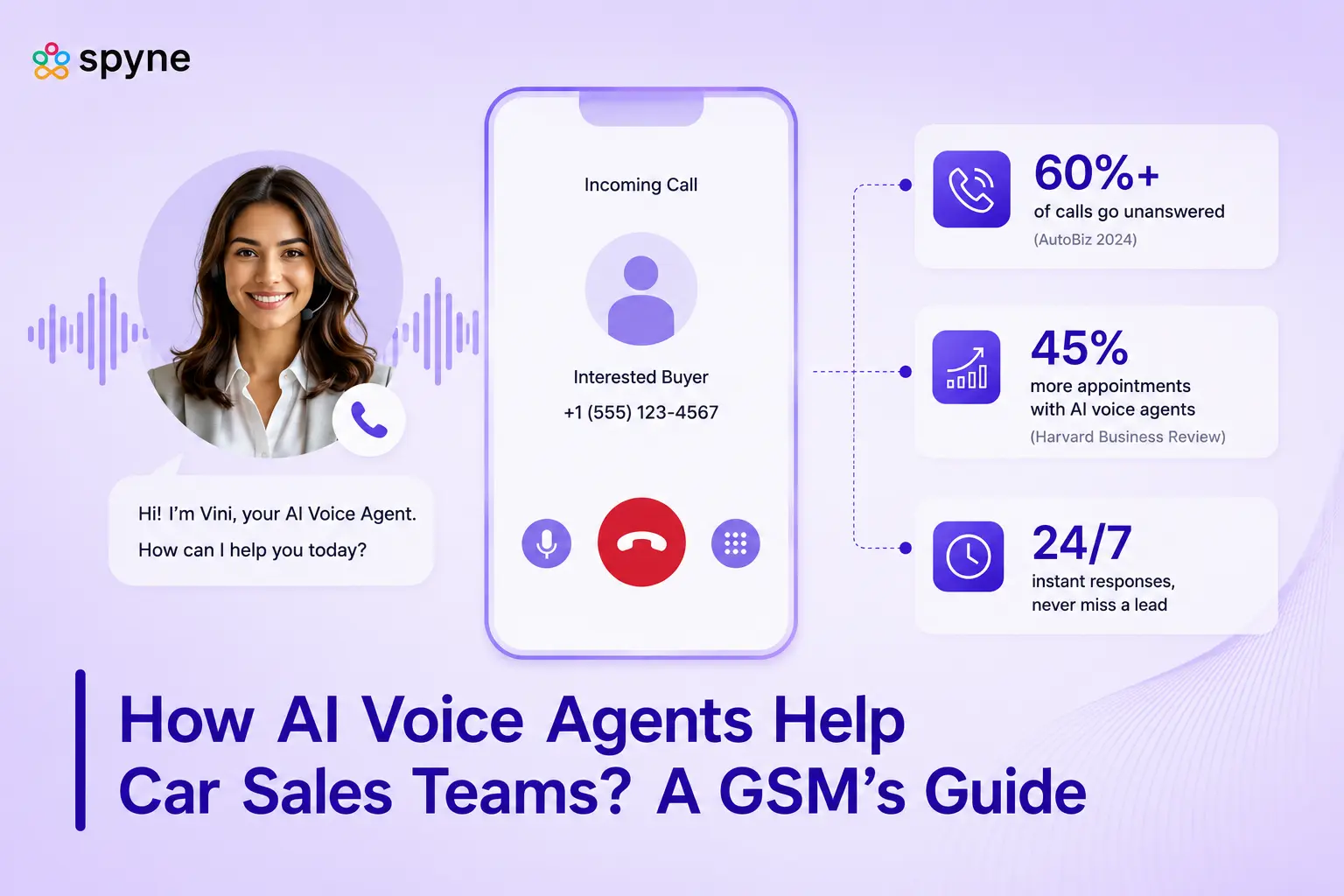
AI voice agents help dealership sales teams by answering every inbound sales call instantly, qualifying intent before a human picks up, and logging the outcome straight into the CRM. Vini AI, Spyne’s conversational AI, handles 70% of routine sales and service calls without human intervention, freeing reps to spend time on buyers who are ready to talk, not on intake. The problem this solves: sales teams that respond first close deals first, and most stores can’t guarantee that on every call, every time. |
A buyer calls asking about a specific trade-in and financing option while every rep on the floor is mid-walkaround. Car Wars tracked roughly 53 million inbound dealership calls in 2025 and found about 19 million missed, with only 65% of calls connecting to a live person. Phone leads convert to booked appointments at 74%, nearly double the 40% rate for internet leads (Foureyes, 2025), which makes the phone the highest-value channel most sales teams protect the least. This post covers what AI voice agents actually do for a sales team, not a reception desk, and where the human-vs-AI question genuinely matters.
What Do AI Voice Agents Actually Do for a Dealership Sales Team?
An AI voice agent for automotive sales handles the full call lifecycle, not just answering the phone. In practice, that means it:
- Answers every inbound call 24/7, including weekends and after close
- Qualifies buyers on budget, trade-in status, financing needs, and timeline
- Checks live inventory and answers vehicle-specific availability and pricing questions
- Books test drives directly into the sales calendar
- Calls back internet leads that didn’t answer the first time
- Re-engages cold or aged leads sitting untouched in the CRM
- Warm-transfers high-intent callers to a live rep with context already attached
- Logs call notes, transcripts, and summaries into the CRM automatically
Here’s an actual exchange, lightly trimmed, from a Vini AI call handling exactly this flow:
Caller: I could see a 2023 [truck] on the web. Can you tell me about that?
Vini: I didn’t find a 2023 in our inventory right now. Would you like to hear about similar trucks, or are you interested in another year?
Caller: Yeah, if you could let me know about another year.
Vini: We currently have a 2024 [comparable trim] available, priced at [price] with [mileage] miles. Would you like to know its features, or ask about previous owners?
Caller: Can I book an appointment for a test drive, this Wednesday?
Vini: Our store is open Wednesday from 9 AM to 5 PM. What time works best?
Caller: 2 PM.
Vini: You’re all set, I booked your test drive for Wednesday at 2 PM. Anything else I can help with?
Caller: I have a trade-in as well, I don’t have the details right now, but I’d want an evaluation done.
Vini: Absolutely. You can bring your trade-in during your test drive appointment, and our team will evaluate it on-site.
No script, no menu. The caller changed direction twice, from a specific vehicle that wasn’t in stock, to a comparable one, to booking, to raising a trade-in unprompted at the end, and the AI handled each turn without losing the thread or restarting the conversation.
How Do AI Voice Agents Help Sales Teams Close More Deals?
The mechanism is response speed, not volume. First-responder advantage is one of the most consistent findings in dealership sales data, and phone leads already convert at a higher rate than internet leads when someone actually picks up.
- Instant qualification on every inbound call — no caller sits on hold while reps are with walk-in customers
- Automated outbound on missed and aged leads — cold leads get worked without pulling a rep off the floor
- Context-rich warm transfers — reps pick up a call already knowing the caller’s vehicle interest and intent, instead of starting cold
- Consistent coverage during peak hours and after close — Monday mornings and weekend afternoons, when call volume spikes and reps are busiest on the lot
None of this replaces the sales conversation. It makes sure the sales conversation happens with someone who’s already engaged, not someone who gave up and called the next dealership on their list.
How Does an AI Voice Agent Spot a High-Intent Buyer on the Phone?
It reads what the caller actually says, not a script. Specific signals move a caller into the high-intent bucket:
- A named vehicle, trim, or VIN mentioned unprompted
- A trade-in brought up without being asked
- A stated timeline (“I want to buy this weekend”)
- Financing questions beyond general curiosity
A caller who says “just looking around” gets logged and nurtured differently than one who volunteers budget and urgency in the first thirty seconds. Here’s a real trade-in inquiry showing what that looks like in practice:
Caller: I was wondering, do you guys take trade-ins on new cars?
Vini: Absolutely, we do take trade-ins. What vehicle are you thinking of trading in?
Caller: A 2021 Ford Transit, cargo van.
Vini: Perfect. About how many miles are on it?
Caller: About 91,600.
Vini: Any major accidents or frame damage?
Caller: No.
Vini: Are you looking to trade it toward a specific model?
Caller: [Names a specific model.]
Vini: We have a few new options at [price range]. Which trim or color do you prefer?
In under 30 seconds, the caller volunteered a specific trade-in vehicle, mileage, accident history, and a target model, four intent signals in one exchange, all of it tagged and available to a rep before any human touched the call. High-intent calls like this get warm-transferred live with that context already visible. Lower-intent calls get queued for follow-up instead of consuming a rep’s time on the floor. That’s the entire point of CRM automation done properly: the record reflects reality the moment the call ends, not whenever someone gets around to typing notes.
Can AI Voice Agents Record and Summarize Sales Calls?
Yes, and by 2026 this is baseline, not a premium add-on. Every call is recorded, transcribed, and summarized automatically, with lead source, vehicle interest, and next steps written back into CRM and DMS systems like VinSolutions or CDK without a rep touching a keyboard.
Vini AI does this as a standard part of every call it handles, not a bolt-on reporting feature. Here’s what that precision looks like on an actual callback request:
Caller: Calling regarding an application, we’re missing the driver’s license to get it processed.
Vini: Got it, I’ve noted all of that. Let me get a callback scheduled for you right now… All set. I’ve got the callback request logged. They’ll reach out to the number on file. I’ve noted the application and that you’re missing the driver’s license to move forward. Anything else I can help with?
Nothing was left for a rep to reconstruct from memory. The specific reason for the call, what’s blocking it, and the callback preference were all captured and logged in the time it took to say them.
- Full call transcript and a short summary attached to the CRM record automatically
- Vehicle interest, budget signals, and trade-in mentions tagged for the rep’s next follow-up
- Appointment status and outcome logged the moment the call ends
- Summaries usable for coaching, a sales manager can review what happened on a call in 30 seconds instead of replaying a 6-minute recording
For a sales manager, this solves the accountability problem that exists on every floor: nobody has to trust memory for what was promised on a call, because it’s logged the same way, every time.
Is a Human or an AI Voice Agent Actually Better for Sales Calls?
This is the wrong question, and industry data backs that up rather than settling it in either direction. Pied Piper’s 2025 Service Telephone Effectiveness Study found AI completed phone interactions successfully 91% of the time, with an 86% appointment-set rate against 90% for human staff, close enough that the gap isn’t the deciding factor anymore.
The better framing is task allocation, not competition:
| Situation | Better handled by |
| After-hours or peak-hour call overflow | AI voice agent, always on |
| Repetitive qualification (budget, timeline, model interest) | AI voice agent, consistent every call |
| Complex negotiation or trade-in appraisal | Human rep |
| Relationship-building and closing | Human rep |
Escalation should be treated as a feature, not a failure of the AI, and that includes being honest when a live handoff isn’t possible. Here’s an actual call showing that fallback in practice:
Caller: Can I speak to [a specific salesperson]?
Vini: I’m not able to reach [them] directly right now. Would you like me to take a message or have [them] call you back?
Caller: Have him call me back.
Vini: Sure, I have a phone number ending in [redacted], is that the best number to call you back on?
Caller: Yes.
Vini: I’ll let [him] know to call you back at that number as soon as he’s available.
This is the honest version of escalation, not a live transfer succeeding, but the AI not pretending it can do something it can’t, and not leaving the caller stuck either. A caller who wants to book a test drive at 9pm doesn’t need to wait for a human to be available to do it, but a caller asking for a specific person gets a real answer, either a live transfer when the rep is reachable, or a logged callback when they’re not. Most dealerships that resist “AI answering phones” start with after-hours and peak-hour overflow only, calls the team physically can’t take anyway, and expand once the results are visible on the schedule.
What Should a GSM Actually Check Before Choosing a Voice Agent?
Evaluating vendors on voice naturalness alone is how dealerships end up with a system that sounds great and books nothing. Six things matter more:
- CRM and DMS integration depth — does it write back to VinSolutions, DealerSocket, CDK, or Reynolds & Reynolds natively, or does it require manual re-entry?
- Live inventory access — can it answer a specific trim or VIN question with real data, or does it deflect to “let me have someone call you back”?
- Warm-transfer quality — does the rep receive the caller’s context, or just a ringing phone with no notes?
- Outbound follow-up capability — does it only answer inbound, or can it also work aged leads and missed-call callbacks without a rep dialing manually?
- Call summary and coaching usefulness — are notes actually usable for coaching, or just a raw transcript dump?
- Deployment timeline — days, or weeks of custom configuration before it’s live on the floor?
You’ll come across names like Toma, Numa, Impel, Mia, and BDC.AI while evaluating this category, each with a different focus (fixed ops, communication orchestration, full lifecycle, phone coverage, BDC-specific outbound). For a full vendor-by-vendor breakdown on pricing, integrations, and voice quality, see Best AI Call Bots for Car Dealerships in 2026.
How Vini AI Supports Sales-Team Workflows
The features list is the same across most of this category by now, answer calls, book appointments, log the CRM. What actually differentiates a platform is what happens to the three numbers a GSM is measured on: BDC throughput, appointment set rate, and response SLA. Here’s where Vini AI moves each one.
- BDC throughput. Before Vini AI, a BDC rep spends the first hour of every shift triaging overnight voicemails and missed-call callbacks before touching a single qualified buyer. Vini AI answers those calls as they come in instead of letting them stack up, so the rep’s first hour is spent working leads that are already qualified and already have a next step attached, not sorting through what happened while the store was closed.
- Appointment set rate. This is where the qualification-before-transfer model pays off directly. A caller who’s already confirmed a specific vehicle, mileage-range interest, or trade-in intent to Vini AI is a warmer conversation than a cold inbound the rep has to qualify from scratch, and warmer conversations set appointments at a higher rate than cold ones by definition.
- Response SLA. The metric most GSMs track loosely (average response time across the team) becomes a guarantee instead of an average, because every call gets an instant answer regardless of what else is happening on the floor. There’s no “average” to miss when every single call clears the bar.
- What a GSM actually sees day to day: call volume handled versus escalated to a human, appointment bookings by source (inbound sales call, missed-call recovery, aged-lead outreach), and a running view of which calls converted to a showroom visit. This is oversight, not a black box, a GSM can audit any individual call’s transcript and outcome, not just trust an aggregate dashboard number.
The Paragon Honda result, in context: the dealership’s BDC was fielding a high volume of sales calls with intermittent after-hours and peak-hour coverage gaps, the same pattern most stores run into. After deploying Vini AI, the store recovered $310,000 in qualified appointments in the first week, driven almost entirely by calls that would previously have gone to voicemail or been worked cold days later. The number matters less than the mechanism behind it: the appointments existed the whole time, in missed calls and aged leads, they just weren’t being converted before a rep ever saw them.

Closing Thoughts
Every high-intent caller your reps miss on the lot is a deal your competitor’s phone picks up instead. Phone leads convert at a meaningfully higher rate than internet leads, and the deciding factor is almost always who responds first, not who has the better pitch. A sales team that guarantees instant response on every call isn’t working harder. It’s just not leaking deals it already paid ad spend to generate.
See what Vini AI recovers for your sales team in the first week. Book a demo with Spyne.