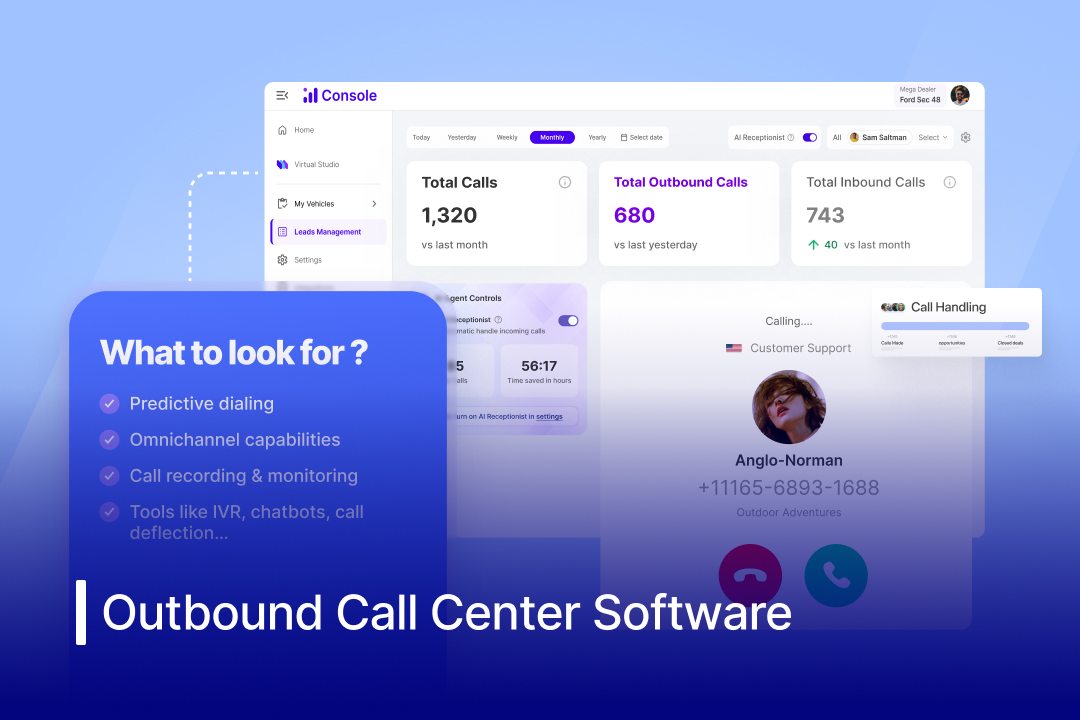

Leads do not arrive in a predictable sequence. Interest builds quickly, often within minutes, and delays in outreach reduce the likelihood of meaningful engagement. The challenge for most businesses is not demand gen., but how quick you’re to respond. An outbound call center software solution brings structure to that chaos by turning scattered follow-ups into a consistent, high-conversion process.
As expectations around response time and personalization continue to increase, outbound calling is becoming a system-driven function rather than an activity-driven one.
In this blog, you will learn how outbound calling software works, explore the 30 best outbound call center software options, understand key selection criteria, and learn how to choose the right solution for your business.
What is an Outbound Call Center?
An outbound call center is a business function where agents proactively make outgoing calls to prospects or existing customers, typically supported by automated dialing systems, to handle sales, follow-ups, and customer engagement activities. Unlike inbound support, where customers initiate contact, outbound calling is campaign-driven and goal-oriented.
What is an Outbound Call Center Software?
A call center software for outbound calling is a platform that enables businesses to run, automate, and optimize outbound calling campaigns at scale. It is a digital platform that enables businesses to proactively initiate calls to customers or prospects for sales, telemarketing, lead generation, or customer support activities such as surveys and collections. Among the core capabilities of the best outbound call center software is the ability to replace manual outreach with structured, data-driven workflows, helping teams connect with more prospects efficiently.
How Does an Outbound Call Center Work?
Platforms that offer outbound call center software solutions run on structured workflows that help teams reach the right prospects at the right time. Instead of manual calling, the process is streamlined through automation and data.
Here’s how it typically works:
- Lead list is uploaded or synced from CRM, website forms, or databases
- Leads are prioritized based on intent, behavior, or predefined criteria
- Dialers automatically place calls (auto, power, or predictive dialing)
- Agents or AI engage prospects using scripts or dynamic prompts
- Call outcomes are logged and synced back to the CRM
- Follow-ups are triggered automatically based on responses
This structured approach ensures faster outreach, higher connect rates, and consistent execution across campaigns.
Outbound vs Inbound Call Centers
While both are essential to customer communication, they serve different purposes and operate on different workflows:
| Aspect | Outbound Call Centers | Inbound Call Centers |
| Call Initiation | Business initiates the call | Customer initiates the call |
| Primary Use Cases | Sales outreach, lead qualification, follow-ups, surveys, collections | Customer support, inquiries, order tracking, complaints |
| Approach | Proactive | Reactive |
| Technology Used | Auto/predictive dialers, CRM, campaign management tools | IVR, call routing, ticketing systems, knowledge bases |
| Agent Role | Persuasion, engagement, conversion-focused | Problem-solving, support, resolution-focused |
| Success Metrics | Connect rate, conversion %, revenue/call, calls/hour | First call resolution (FCR), average handle time (AHT), CSAT |
| Scalability | High (automation, AI) | Moderate (staff-dependent) |
| Customer Interaction | Often first-touch or re-engagement conversations | Ongoing support and relationship management |
| Goal | Generate demand and drive revenue | Resolve issues and improve customer satisfaction |
30 Outbound Call Center Software Tools Worth Considering (2026)*
We’ve curated a list of 30 top outbound call center software solutions, with pricing, key features, and pros and cons, to help you confidently choose the right fit for your business.
1) Spyne (Vini AI) — AI Outbound Lead Engagement & Conversion Platform for Automotive
Best For: Automotive dealerships and dealer groups needing a purpose-built AI outbound agent to engage, qualify, and convert leads across sales, service, BDC, and parts.
Spyne’s conversational AI agent Vini is the only outbound automotive call center software in this list built exclusively for automotive dealerships. Currently rated 4.6 on G2, Vini is a 24/7 AI sales agent that sits directly on your dealership’s CRM and manages outbound engagement across every department. Vini AI reaches every contact in your CRM, re-engaging cold leads, recovering no-shows, and following up on dormant opportunities automatically. It handles two-way conversations across voice, SMS, and email, syncs in real time with your DMS and CRM, while supporting multi-location dealer groups from a single platform.
Pricing: Lite: Basic plan for premium vehicle, listings on day zero | Pro: For dealerships seeking maximum conversions. Book a demo to get custom-quoted based on dealership size, call volume, and features.
2) Five9 — AI-Powered Predictive Dialing & Compliance Platform
Best for: Mid-to-large enterprises running high-volume outbound or blended call center operations with strong compliance requirements
Five9 is a cloud contact center platform with predictive, power, progressive, preview, and TCPA-compliant dialing modes. It features built-in DNC compliance, AI Agent Assist for real-time guidance and after-call automation, CRM integrations, and intelligent call routing, maximizing agent talk time across outbound and blended operations.
Pricing: Starts at $149/user/month (Core plan) going up to $199/user/month (Optimum), with enterprise tiers available on custom quote.
3) Genesys Cloud CX — Enterprise Cloud Contact Center Platform
Best for: Large enterprises needing a scalable, omnichannel contact center with AI-driven workforce management
Genesys Cloud CX is a cloud-native experience orchestration platform Five9 trusted by over 4,800 organizations across 100+ countries. It offers predictive dialing, AI-powered routing, omnichannel engagement across voice, email, chat, SMS, and social, plus built-in workforce management, all in a single unified platform with a 99.996% uptime SLA.
Pricing: Starts at $75/user/month (CX1) going up to $240/user/month (CX3), with AI add-ons available on custom pricing.
4) NICE CXone — Advanced CX Analytics & Workforce Optimization
Best for: Enterprise contact centers prioritizing AI-driven workforce optimization, quality management, and deep CX analytics.
NICE CXone (CXone Mpower) is a cloud-native CCaaS platform combining omnichannel routing across 30+ digital channels, Enlighten AI for real-time agent guidance and sentiment analysis, and robust workforce engagement management, making it one of the most analytics-heavy and compliance-ready platforms in the market.
Pricing: Starts at $94/user/month (Digital Agent) up to $249/user/month (Ultimate Suite); custom enterprise pricing available.
5) Talkdesk — AI-Driven Contact Center with Fast Deployment
Best for: Mid-to-large enterprises seeking a fast-to-deploy, AI-native cloud contact center with industry-specific workflows
Talkdesk is a cloud-native CCaaS platform offering blended inbound/outbound calling, AI Copilot for real-time agent guidance, proactive outbound engagement, IVR flow builder, and industry-specific Experience Clouds. Known for its intuitive UI and quick setup, it’s particularly strong in retail, healthcare, and financial services verticals.
Pricing: Starts at $85/user/month (Digital Essentials) up to $165/user/month (Elite); Industry Experience Clouds at $225/user/month.
6) RingCentral (RingCX) — Enterprise Voice & CRM Integration
Best for: Growing businesses and enterprises needing a unified UCaaS + CCaaS platform with strong CRM integrations and omnichannel routing.
RingCX is a cloud-native contact center deeply integrated with RingCentral’s unified communications suite. It supports predictive, progressive, preview, and voice broadcast dialing across 20+ digital channels, with AI Agent Assist, skills-based routing, 250+ pre-built reports, and 50+ CRM integrations including Salesforce and Zendesk, all in a single agent workspace.
Pricing: Starts at $65/user/month; enterprise tier available on custom quote.
7) Vonage Contact Center — Flexible Omnichannel CCaaS
Best for: Mid-to-large businesses needing deep Salesforce or Microsoft Dynamics integration with omnichannel outbound capabilities
Vonage Contact Center (VCC) is an AI-powered cloud CCaaS platform offering skills-based routing, auto-dialing, omnichannel engagement across voice, chat, SMS, email, and video, AI Virtual Assistant, conversation analyzer for call transcription and QA, and real-time dashboards, with particularly strong native Salesforce integration, rated #1 on Salesforce AppExchange.
Pricing: Contact center pricing is custom quote only; no publicly listed per-seat pricing.
8) Podium — Messaging & Lead Conversion Platform (Automotive-specific)
Best for: Auto dealerships and local businesses needing AI-powered lead engagement, review management, and SMS-first outbound communication
Podium is an AI-powered lead conversion platform centralizing SMS, webchat, calls, and social messages into a unified inbox. Its AI Employee handles lead responses in under 1 minute, automates appointment scheduling, drives review collection, and supports outbound text campaigns, purpose-built for automotive dealerships and local service businesses.
Pricing: Core plan starts at $399/month; Pro at $599/month per location. Five9 Signature tier available on custom quote.
9) 8×8 Contact Center — Unified Communications with Analytics
Best for: Mid-to-large businesses seeking a unified UCaaS + CCaaS platform with strong international calling and built-in analytics.
8×8 Contact Center is a robust outbound call center software built on the XCaaS platform, combining omnichannel routing, preview/progressive/predictive dialing, AI-powered agent assist, speech analytics, workforce management, and post-call surveys, all backed by an industry-first 99.999% financially backed SLA across both UCaaS and CCaaS in a single platform.
Pricing: Contact Center plans start at ~$85/user/month; advanced CX Beyond tier (with outbound dialers, sentiment analytics & QA tools) ranges from $130–$150/user/month.
10) Avaya Experience Platform — Hybrid Cloud Contact Center
Best for: Large enterprises and mid-sized businesses needing a battle-tested, hybrid cloud outbound call center software with deep omnichannel routing & workforce optimization.
Avaya Experience Platform (AXP) is a hybrid cloud CCaaS built for flexible deployment, on-premises, private, or public cloud. It offers AI-powered skills-based routing, automated outbound dialing, omnichannel engagement across voice, email, chat, SMS, and social, contextual screen pops, and 120+ real-time and historical reporting templates, purpose-built for high-volume, compliance-heavy enterprise environments.
Pricing: Custom quote only, no publicly listed per-seat pricing.
11) Dialpad (Sell/Connect) — AI-Native Calling with Voice Intelligence
Best for: Teams looking for an AI-native outbound call center software with real-time coaching, voice transcription, and CRM-connected workflows.
Dialpad Sell is a sales-focused call center outbound software built on DialpadGPT, trained on 6B+ minutes of proprietary business conversations. It offers real-time transcription, live battle cards, sentiment analysis, Real-Time Assist (RTA) cards, AI call scoring, automated playbooks, and native integrations with Salesforce, Zendesk, and Google Workspace, all in a single AI-powered dialer interface.
Pricing: Dialpad Sell starts at $27/user/month (monthly) or $15/user/month (annual); AI Contact Center plans from $80–$150/user/month.
12) Aircall — CRM-First Cloud Calling Platform
Best for: SMBs and sales teams needing a CRM-integrated outbound call center software solution.
Aircall is a cloud-native call center outbound software built around CRM-first workflows. It offers Power Dialer, AI call transcription, sentiment analysis, live call monitoring, call whispering, smart IVR routing, voicemail drop, and 100+ integrations including Salesforce, HubSpot, and Zendesk, all accessible via a browser with zero hardware required.
Pricing: Essentials at $30/user/month; Professional at $50/user/month.
13) Volie — Automotive BDC & AI Communication Platform
Best for: Auto dealerships running dedicated BDC teams that need purpose-built automated outbound calling software for sales and service campaigns
Volie is an automotive-specific outbound call center software solution combining data management, campaign management, and communication management in one platform. Five9 It features automated dialing, AI-powered call scoring via Volie Intelligence (Pulse), DMS/CRM/OEM data normalization with 99.9% accuracy, omnichannel outreach across calls, SMS and email, and real-time agent performance dashboards.
Pricing: Custom pricing tailored by setup, single-store, centralized BDC, or multi-rooftop.
14) CloudTalk — Sales & Support Calling with Real-Time Sync
Best for: SMBs and mid-market sales teams needing a reliable outbound call center software solution with global reach, CRM sync, and AI-powered conversation intelligence.
CloudTalk is an AI-powered cloud call center outbound software offering Power Dialer, Smart Dialer, AI call transcription, sentiment analysis, skills-based routing, voicemail drop, and real-time dashboards, with coverage across 160+ countries, <20ms latency, and 80+ CRM integrations including HubSpot, Salesforce, and Pipedrive.
Pricing: Starter at $34/user/month; Essential at $39/user/month; Expert at $69/user/month; AI Conversation Intelligence add-on at $19/user/month; Custom plan on quote.
15) Nextiva — VoIP with Strong CX Capabilities
Best for: SMBs to mid-market teams needing a dependable best outbound call center software with omnichannel capabilities, predictive dialing, and strong voice quality
Nextiva is a cloud-based CCaaS platform offering blended inbound/outbound calling, predictive, progressive, and preview dialing modes, AI-powered call summaries, skills-based routing, dynamic scripting, voicemail drop, post-call surveys, and real-time dashboards, with a drag-and-drop journey builder for end-to-end campaign orchestration across voice, SMS, email, and chat.
Pricing: Enterprise Essential (best for outbound) starts at $75/agent/month (per-user), $129 concurrent pricing, or $0.018/agent/minute usage-based.
16) JustCall — SMB-Friendly Outbound Calling Software
Best for: Sales-driven SMBs and mid-market teams needing AI-augmented outbound call center software with deep CRM integration and multi-mode dialing.
JustCall’s AI Communication Suite offers Power, Predictive, and Dynamic dialer modes with AI transcription, sentiment analysis, voicemail drop, local presence dialing, and automated CRM logging. This cloud call center software integrates natively with 100+ tools including Salesforce, HubSpot, and Pipedrive, while managers get real-time monitoring, whisper coaching, and AI call summaries, making it a strong outbound call center solution for revenue teams of any size.
Pricing: AI Communication Suite starts at $39/user/month (monthly) or $29/user/month (billed annually); SalesPro suite for high-volume predictive dialing is $249/user/month.
17) CallHippo — Lightweight VoIP for Growing Teams
Best for: Cost-conscious startups needing global virtual numbers, parallel dialing, and omnichannel outbound call tools without enterprise pricing.
CallHippo is a cloud-based platform with skill-based routing, AI Copilot for live agents, call quality dashboards, and agent scorecards, all accessible from browser, desktop, or mobile. Its AI-powered Parallel Dialer software for outbound call center teams dials multiple leads simultaneously with intelligent number rotation to avoid spam flags, and integrates with HubSpot, Salesforce, and ZohO, making it one of the more accessible inbound call center software and outbound combo tools for growing teams.
Pricing: Tiered subscription model (typically entry-level SMB plans, scaling with features and users)
18) DealerSocket — Automotive CRM with Lead Management
Best for: Automotive dealerships needing tightly integrated outbound calling within a CRM-driven sales workflow.
DealerSocket centralizes customer data across sales, service, desking, communication, data mining, and digital retail, all within a single configurable platform with seamless OEM and DMS integrations. As one of the most specialized call center tools software options in automotive retail, enabling service managers to manage appointment scheduling, automated reminders, and service history, all synced bidirectionally with your DMS.
Pricing: Custom pricing based on dealership size, modules, and integrations
19) Ringover — Cloud Call Center Software with CRM Sync
Best for: Global teams needing a reliable outbound calling platform with unlimited international calling and deep CRM sync.
Ringover is a cloud contact center solution built for outbound sales and support at scale, offering power dialing, click-to-call, voicemail drop, and real-time analytics. It integrates deeply with CRMs to automate logging and workflows, while features like call monitoring, IVR, and AI conversation insights improve agent performance. A key differentiator is its unlimited calling to 100+ destinations, making it cost-effective for international outreach-heavy teams.
Pricing: Smart plan at $21/user/month, Business at $44/user/month, and Advanced at $54/user/month, all billed annually.
20) Freshdesk Contact Center — Support + Outbound Calling
Best for: Support-first teams within the Freshworks ecosystem that need one of the more unified types of call center software.
Freshdesk Contact Center (Freshcaller) supports advanced inbound routing, BYOC, number provisioning across 90+ countries, real-time collaboration, and voice AI capabilities for faster resolutions. As part of the broader Freshdesk Omni suite, this is one of the more complete call center tools list options for teams that want native Freshsales CRM sync, Power Dialer for outbound campaigns, and supervisor barge-in without stitching together separate vendors. There’s also a limited outbound call center software free tier available for teams just getting started.
Pricing: Free plan available; paid plans start at ~$15/agent/month + usage-based call charges
21) Numa — AI Voice & Outbound Engagement Platform for Dealerships
Best for: Auto dealerships needing an always-on outbound call center solution that rescues missed calls, automates outbound service campaigns, and unifies BDC, service, and sales teams.
Numa’s Smart Inbox connects Voice AI Agents with customer history, prior messages, service updates, and team notess, enabling the system to understand call intent, route conversations intelligently across service, sales, BDC, and parts, and escalate to human staff when needed. Quo As a specialized outbound call center CRM software for dealerships, it also includes an Opportunities module that converts hidden demand into booked revenue, and a LiveCSI feature that surfaces customer dissatisfaction in real time before relationships are lost. JustCall
Pricing: Quote-based.
22) TalkRoute — Multi-Device Business Calling System
Best for: Small businesses and solo operators looking for a simple, hardware-free outbound call center solution.
TalkRoute is a virtual phone system offering unlimited inbound and outbound calling, call forwarding to any device, multi-level IVR, call stacking, voicemail transcription, SMS/MMS, video conferencing, and call recording, all manageable from a web dashboard. Unlike heavier cloud call center software platforms, it requires no hardware or downloads.
Pricing: Starts at ~$19/month per account (not per user), scaling based on usage and features
23) Toma — AI Voice Agent & Outbound Campaign Automation for Dealerships
Best for: Franchise and independent dealerships looking for a deeply customizable cloud call center software that acts as a 24/7 AI voice agent for both inbound handling & outbound service campaigns.
Toma’s outbound capabilities include off-hour lead calling triggered instantly when a vehicle inquiry is submitted, automated service reminders, trade-in reminder campaigns, and recall outreach, all personalized using historical customer and vehicle data. As one of the more flexible call center software outbound tools in automotive, it integrates directly with CDK Global, Xtime, Dealertrack DMS, GoTo Connect, RingCentral, and PBS Systems, requiring no change to existing dealership workflows.
Pricing: Subscription model; quote-based.
24) PhoneBurner — High-Speed Power Dialer
Best for: Inside sales reps and SMB teams wanting the fastest, delay-free outbound call tools with no TCPA autodialer risk, voicemail drop, and built-in CRM workflow automation.
PhoneBurner’s power dialer dials up to 80 contacts per hour with zero telemarketer pause, one-click voicemail drop, automated email and SMS follow-up, ARMOR caller ID reputation monitoring, local presence dialing, and LeadStream for intelligent lead distribution. This makes it one of the most efficient inbound call center software alternatives for teams focused purely on outbound conversion.
Pricing: Unlimited dialing starts at $165/user/month.
25) PAM — Voice AI & Outbound CX Platform for Dealerships
Best for: Service-heavy dealerships that want a fast-deploying outbound call center software solution to eliminate missed calls, automate appointment follow-ups, and run targeted outbound campaigns from a single platform.
Pam’s outbound engine runs automated campaigns for recalls, oil change offers, and service reminders, with deep integrations across various platforms. As a specialized dialer software for outbound call center operations in automotive, it uses AI voice agents to handle outbound calls autonomously, routing to human staff only when needed and syncs all call activity and outcomes back to the DMS in real time, keeping every service advisor fully updated without manual logging.
Pricing: Demo-only model.
26) Squaretalk — Outbound Calling + SMS Campaign Platform
Best for: Mid-market sales and BPO teams that need a scalable outbound call center software solution.
Squaretalk’s Connect plan includes an integrated webphone, IVR, real-time monitoring, automated call distribution, and CRM integrations, while the Engage plan adds AI-powered predictive dialer capabilities, dynamic scripts with embedded lead data, and advanced campaign management features. As a true cloud call center software, it also supports AI transcription, sentiment analysis, and WhatsApp Business messaging across various countries.
Pricing: Connect at $40/user/month; Engage (predictive dialer) at $45/user/month; Scale plan is custom-priced for enterprise teams.
27) Novocall — Callback Automation & Lead Conversion Tool
Best for: SMBs and inbound-heavy sales teams looking for lightweight outbound call tools.
Novocall embeds a click-to-call widget on your website to automate instant callbacks, routes leads to the right rep based on language, location, or business function, and integrates with Facebook Lead Forms to capture and connect leads directly from ads. While not a full dialer software for outbound call center operations, it covers call tracking, CRM sync with Salesforce and HubSpot, and outbound cold calling automation for smaller teams.
Pricing: Starter plan at $19/month and Pro at $39/month (billed annually); custom plans available.
28) Zoho Voice — Calling within Zoho Ecosystem
Best for: Zoho CRM, Desk, or Zoho One users who need a native outbound call center solution without third-party telephony middleware, at pay-as-you-go rates.
Zoho Voice is a cloud telephony solution embedded within the Zoho ecosystem, enabling outbound and inbound calling directly from Zoho CRM and other apps. It supports click-to-call, call monitoring, IVR, call queues, and analytics, with contextual customer data available during calls. Its strength lies in native integration and ease of use, though advanced outbound features like predictive dialing are limited.
Pricing: Free Solo plan available (credits + number required); Business Phone and Enterprise Telephony editions are subscription-based with per-minute call billing.
29) Zoho Desk — Helpdesk with Outbound Capabilities
Best for: Support teams within the Zoho ecosystem that need a feature-rich inbound call center software and outbound calling tool embedded directly inside their helpdesk ticketing workflow.
Zoho Desk lets agents dial, receive, and manage calls directly from the unified interface, schedule follow-up calls with reminders, and send automated voice messages during non-business hours. It’s one of the more accessible outbound call centre software options for support-first teams, with a free tier included and a 15-day trial on all paid plans.
Pricing: Free plan (3 agents); Express $9, Standard $20, Professional $35, Enterprise $50/agent/month.
30) LiveAgent — Omnichannel Support + Calling
Best for: SMBs and mid-market support teams looking for an affordable, all-in-one call center software outbound and inbound platform with native ticketing, live chat, and social media in a single dashboard.
LiveAgent’s VoIP call center includes IVR, ACD, smart call routing, unlimited call recording, callback requests, HD video calls, and real-time monitoring, all unified with email, live chat, WhatsApp, Viber, Instagram, and Facebook. In any best outbound call center software comparison for budget-conscious teams, it stands out for packing 175+ features and 200+ integrations across all types of call center software use cases at a transparent flat-rate price.
Pricing: Small at $15, Medium $29, Large $49, Enterprise $69/agent/month.
31) Zendesk Talk — Customer Support with Voice Integration
Best for: Support-first teams already in the Zendesk ecosystem that need reliable outbound call center software tightly integrated with ticketing, live chat, and AI-powered QA.
Zendesk Talk embeds voice directly into the Agent Workspace, with AI call summaries auto-delivered post-call, quality assurance monitoring to detect churn risks, and over 1,700 marketplace integrations including RingCentral, Talkdesk, and Dialpad. JustcallIt covers the full range of call center tools software needs, IVR, call recording, skills-based routing, and live monitoring without leaving the Zendesk interface.
Pricing: Suite plans start at $19/agent/month (billed annually); Talk usage: calls, numbers, and recording, billed separately/minute.
32) Convoso — AI-Optimized Outbound Dialing Platform
Best for: High-volume sales and lead generation teams needing the most powerful dialer software for outbound call center operations with compliance automation and AI-driven contact rate optimization.
Convoso offers predictive, power, progressive, and preview dialing modes, 97% accurate voicemail detection, dynamic scripting, and Convoso Ignite, an AI system that automatically manages caller ID reputation and DID health to maximize answer rates. Built-in TCPA and DNC compliance tools make it a standout outbound call center software solution for regulated industries like insurance and solar.
Pricing: Custom pricing based on usage, volume, and feature requirements.
33) Matador — Conversational AI & Outbound Messaging for Dealerships
Best for: Dealerships wanting an omnichannel outbound call tools platform that connects AI-driven calls, SMS, email, and social messages into one seamless conversation flow.
Matador connects calls, texts, emails, social messages, and website chats into a single AI-handled conversation, turning every inbound inquiry into a booked appointment while enabling bulk outbound campaigns to thousands of customers in just a few clicks. For teams doing a best outbound call center software comparison in automotive, its AI Call Suite stands out, with dealerships reporting a 35% increase in booked appointments and a 60% reduction in call load after deployment.
Pricing: Quote-based
34) Readymode — Predictive Dialing Cloud Call Center Software
Best for: Mid-market and enterprise outbound teams needing a hybrid-cloud outbound call centre software with 20+ concurrent lines per agent.
Readymode is an call center outbound predictive dialer software supporting dynamic scripts with embedded lead data, skill-based queue routing, local presence dialing, and built-in TCPA/DNC compliance tools, no third-party CRM required. Readymode iQ adds caller ID reputation monitoring for a complete best outbound call center software comparison contender.
Pricing: Custom pricing based on seats, dialing volume, and feature modules.
35) STELLA Automotive AI — Enterprise Outbound Call Center Solution for Dealerships
Best for: Enterprise dealer groups and multi-rooftop franchise networks needing a scalable outbound call center software solution that automates BDC campaigns, recall outreach, and service follow-ups without adding headcount.
STELLA Catalyst, its dedicated outbound engine, contacts hundreds of customers in minutes, with dealerships reporting an average 36% callback rate on outbound campaigns. As a complete cloud call center software for automotive retail, it uses voice, text, and email to run conquest and retention outreach autonomously, with post-campaign DMS data analysis revealing clear insights into customer behavior and booked revenue.
Pricing: Quote-based only.
*We have no promotional tie-ups or collaborations with any of the platforms listed here. All pricing and feature details are independently sourced from publicly available data and may vary.
8 Key Benefits of Outbound Call Center Software
Instead of relying on rep-dependent execution, an outbound call center software solution can standardize outreach, improve response times, and drive more consistent conversions. Here’s how it benefits users and businesses:
1) Increased Efficiency Through Automation: Outbound platforms automate these workflows so reps can focus on conversations that move deals forward. With call queues, auto-logging, and pre-built sequences, AI outbound calling software reduces admin work and helps teams book more appointments efficiently.
2) Improved CSAT Through Proactive Outreach: Modern outbound contact center software triggers calls around key moments: post-inquiry follow-ups, test drive confirmations, finance drop-offs, or service due reminders.
3) Enhanced Customer Engagement with Context: With outbound call center CRM software, reps see exactly what the buyer has done, VDP views, price checks, trade-in activity before picking up the phone.
4) Improved Conversion Rates Across the Funnel: Structured call flows, disposition tracking, and analytics in call center outbound software help teams understand what’s actually converting and where drop-offs happen.
5) Scalability Without Adding Headcount: The best outbound call center software lets dealerships scale outreach without hiring more reps by automating sequences and prioritizing high-intent leads.
6) Smarter Pipeline Management: With intelligent routing and prioritization from a call center outbound predictive dialer software, high-value opportunities are contacted first and not buried under low-quality inquiries.
7) Higher Contact Rates: Features like local presence, smart call timing, and voicemail drops improve answer rates and make outreach more effective. A modern outbound call center software setup ensures consistent, high-reach engagement.
8) Improved Lead Management & Sales: A structured outbound call center software solution combined with outbound call center CRM software helps teams prioritize leads, personalize conversations, and convert more opportunities into revenue.
How to Choose the Right Outbound Call Center Solution
Choosing the right outbound call center software is less about ticking features and more about aligning the system with how your team actually works. The right AI call bot should directly impact contact rates, show rates, and revenue per lead.
Here’s a structured way to evaluate your options:
1. Assess Your Core Needs and Goals
Start by identifying what role the outbound call center software solution will play in your operation. Not every platform is built for the same outcome.
- Define your use case: Whether you’re running high-volume internet leads, re-engaging cold prospects, or driving service reminders, your workflow determines the type of system you need. For example, a BDC focused on fresh leads requires faster dialing and tighter follow-ups than a retention-focused team.
- Plan for scale: Dealership lead flow isn’t consistent, OEM pushes, seasonal spikes, and inventory changes can shift volumes overnight. Your system should handle these fluctuations without breaking follow-up cadence.
- Prioritize compliance: Built-in TCPA safeguards, DNC scrubbing, and consent tracking are critical. The more you scale outbound, the more exposed you are without automated compliance controls.
2. Evaluate Core Features and Technology
The effectiveness of any call center software outbound setup depends on how well it improves rep productivity and lead handling.
- Dialing capability: Look for predictive or power dialers that reduce idle time and maximize live connects. The right dialer software ensures reps are always in conversation, not waiting between calls.
- CRM integration: A strong outbound call center CRM software setup ensures every interaction is logged and accessible. Reps should see lead history, vehicle interest, and prior touchpoints before every call.
- Omnichannel outreach: Modern buyers don’t respond to calls alone. Systems should support SMS and email follow-ups to improve contact rates and maintain engagement.
- Caller reputation management: If your numbers get flagged as spam, your connect rates drop fast. Look for platforms that actively monitor and rotate caller IDs.
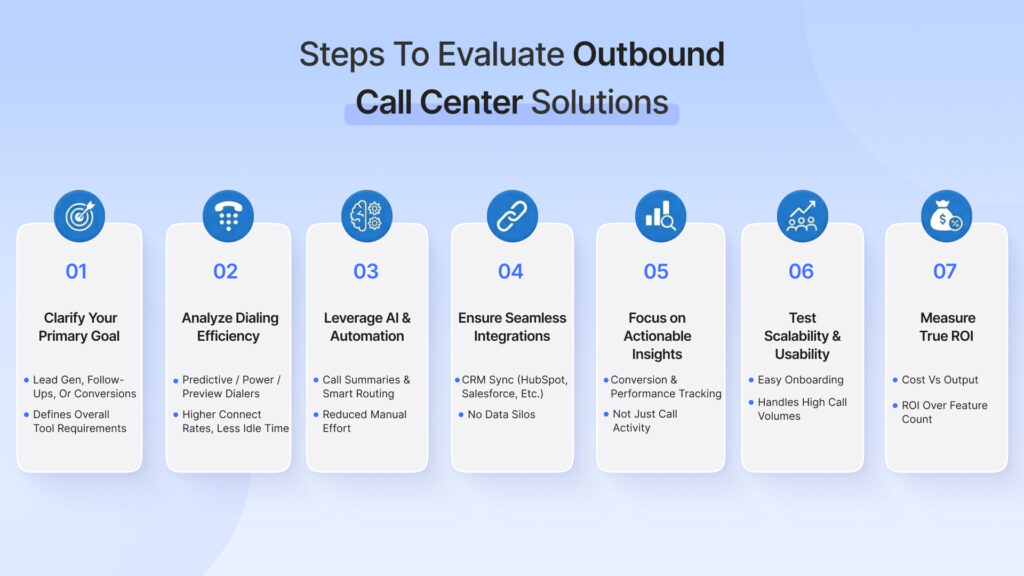
3. Focus on Analytics, Quality, and Usability
The best outbound call center software goes beyond execution by giving you clear visibility into what’s actually driving performance.
- Actionable reporting: Track metrics that matter, contact rate, appointment set rate, show rate, not just total calls made. This is where most teams miss optimization opportunities.
- Call monitoring and coaching: Recording and live monitoring help managers identify gaps in conversations and improve rep performance over time.
- Ease of use: If reps struggle to navigate the system, adoption drops. A clean, intuitive interface ensures your team focuses on selling, not managing tools.
4. Evaluate Vendor Fit and Long-Term Support
Choosing a call center outbound software provider is a decision about execution, not just features. The right partner helps you set up workflows, optimize follow-ups, and adapt as your lead flow changes, ensuring the system actually drives contact rates and conversions, not just activity.
- Onboarding and setup: The platform should help you structure workflows, lead routing, follow-up cadences, and call prioritization, not just provide access.
- Ongoing support: When volumes spike or campaigns shift, delays in support directly impact revenue. Fast, knowledgeable support is non-negotiable.
- Proof of performance: Look for real-world use cases, especially in automotive. The right outbound call center solutions provider should demonstrate improvements in contact rates, appointments, and conversions.
Selection Criteria for Outbound Call Center Software Solution
If you’ve evaluated different outbound tools, you’ll notice most platforms promise similar features. The difference comes down to how well the system handles real execution, speed, follow-ups, and conversion tracking. The best outbound call center software balances automation, control, and visibility to consistently move leads through the funnel and drive measurable ROI, serving the outbound call center KPI.
1) Throughput Driven by Lead Prioritization
A strong automated lead follow-up system prioritizes leads based on recency, behavior, and intent, ensuring reps are always working on the next best opportunity. Poorly designed tools push volume without context, leading to wasted calls and lower conversions. The right platform balances throughput with lead quality.
2) Omnichannel Follow-Ups That Keep Leads Engaged
Modern outbound contact center software extends beyond calls by layering SMS, email, and follow-up triggers into the workflow. Instead of repeating call attempts, the system should guide the next best action based on lead behavior. This structured, multi-touch approach keeps leads engaged across channels and improves overall response rates without increasing manual effort.
3) Speed-to-Lead That Captures Buyer Intent
The effectiveness of any call center software outbound strategy depends on how quickly leads are contacted. Systems should trigger immediate outreach and automatically prioritize new inquiries, ensuring no delay between intent and engagement. Faster response times consistently lead to higher contact rates and better conversion outcomes, especially when leads are actively evaluating options.
4) Dialing Flexibility That Adapts to Campaign Needs
Outbound workflows aren’t one-size-fits-all, and the right dialer software for outbound call center operations should reflect that. The best systems support multiple modes within one platform:
- Power dialing for steady, rep-paced outreach
- Call center outbound predictive dialer software to maximize talk time in high-volume campaigns
- Progressive dialing for balanced pacing and lower drop rates
- Preview dialing for context-heavy conversations
5) Reliability and Scalability That Hold Under Pressure
The best outbound call center software solution should perform consistently even when demand spikes. Campaign launches, seasonal traffic, or multiple lead sources can quickly increase call volume, and the system must handle this without delays or downtime. Cloud-based infrastructure ensures scalability, while stable performance protects contact rates and prevents missed opportunities during high-intent periods.
What Is a Cloud-Based Outbound Call Center and Why Does It Matter?
A cloud contact center is an internet-based, hosted communication platform that manages both inbound and outbound interactions across channels like voice, email, SMS, and social media. It operates without on-premise hardware, allowing agents to make and receive calls from anywhere using VoIP-enabled systems.
Often referred to as a virtual call center or CCaaS (Contact Center as a Service), cloud-based contact centers enable remote work, scale instantly with demand, and significantly reduce IT overhead.
7 Key Benefits of Cloud-Based Outbound Call Center Solutions
Why does the Automotive Industry need an Outbound Call Center?
Studies show 62.6% of automotive leads come through phone calls, and these calls convert 10–15× higher than web leads. Yet dealerships struggle to manage this demand, about 23% of dealership calls go unanswered, leading to lost sales and missed service appointments. Outbound call centers help dealerships close this gap by proactively following up with leads, confirming appointments, and re-engaging past customers.
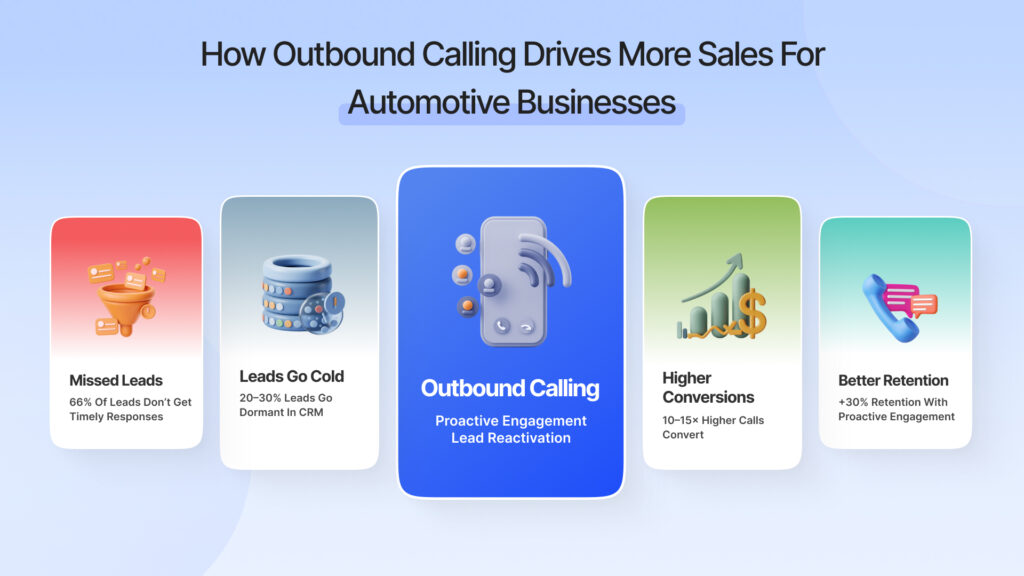
This matters because only ~2% of sales happen on the first contact, while 80% of deals require 5–12 follow-ups before closing.
Why Choose Spyne for Outbound Calling?
Most dealerships don’t lose deals because of lead quality, they lose them in the follow-up. Slow response times, inconsistent outreach, and missed after-hours opportunities quietly kill conversions. Spyne fixes this at the system level by bringing speed, structure, and intelligence into how every lead is engaged.
At the center of this is Vini by Spyne, an AI-powered outbound calling engine built specifically for dealership workflows. Vini doesn’t just dial, it qualifies, prioritizes, and follows up on leads in real time, ensuring every opportunity is worked with precision and consistency. Here’s what makes Spyne’s outbound call center software solution.
1) AI-Powered Outbound Dialing to Increase Contact Rates and Conversions
Uses intelligent dialing and prioritization to connect with more high-intent leads faster. Reduces manual effort and improves talk time, helping increase contact rates by 3–5x and driving more conversations per rep.
2) Automated Multi-Touch Follow-Ups to Reduce Lead Leakage
Runs structured follow-up sequences across calls and messages, ensuring every lead gets multiple attempts. Improves follow-up consistency and can increase contact rates by 30–50% compared to single-touch outreach.
3) Intelligent Lead Qualification to Improve Appointment Conversion
Qualifies leads in real time based on responses, intent, and context before routing or scheduling. Helps improve appointment booking rates by 20–30% by focusing reps on high-quality opportunities.
4) Built-In Appointment Scheduling to Increase Show Rates
Automatically books test drives and service appointments directly into your CRM and calendar. Reduces friction in the booking process and improves scheduling efficiency across the funnel.
5) 24/7 Outbound Coverage to Capture After-Hours Leads
Engages leads instantly, including after business hours when up to 30–40% of inquiries occur. Ensures no lead waits for the next day, improving speed-to-lead and conversion potential.
6) Real-Time Call Analytics and Transcripts for Better Follow-Ups
Captures every conversation with summaries, transcripts, and outcome tracking. The AI call analytics Gives teams full context for follow-ups and helps managers identify gaps in performance.
7) Multilingual Outreach to Expand Customer Reach
Supports conversations in multiple languages, helping dealerships engage a broader audience and improve response rates without increasing staffing.

Trends in Outbound Call Center Software (2026)
Outbound call center platforms are entering a phase where execution is increasingly AI-led rather than agent-led. The shift is less about rep productivity and more about rethinking how outreach, qualification, and follow-ups run at a system level. Here are the trends shaping what comes next:
- AI is Moving from Assistive to Autonomous: That said, conversational AI will now handle first-touch outreach. According to McKinsey & Company, generative AI can automate up to 30% of customer operations work, while Gartner projects conversational AI will significantly reduce reliance on human agents.
- Cloud-Native Platforms as the Execution Layer: Cloud is now the default foundation for outbound systems, enabling real-time data flow, rapid deployment, and instant scalability. According to Gartner, over 85% of organizations will adopt a cloud-first principle for new initiatives, reflecting this shift.
- AI-Directed Outbound and Voice-Led Execution: Outbound is moving from manual lead lists to AI-directed engagement, where systems decide the best time, channel, and sequence for outreach. IBM notes AI-driven automation can reduce service costs by up to 30%, making always-on outbound viable. The result is a system where prioritization and execution are driven by data, not rep intuition.
Conclusion
Outbound calling is no longer defined by the number of calls placed, but by how effectively each interaction is timed, contextual, and outcome-driven.
The right outbound call center software solution enables this shift by aligning speed, intelligence, and consistency across every touchpoint, helping teams move from reactive follow-ups to proactive pipeline generation.
If you are looking to bring this level of precision and performance to your outreach, book a demo with Spyne and see Vini in action.