
| Executive Summary
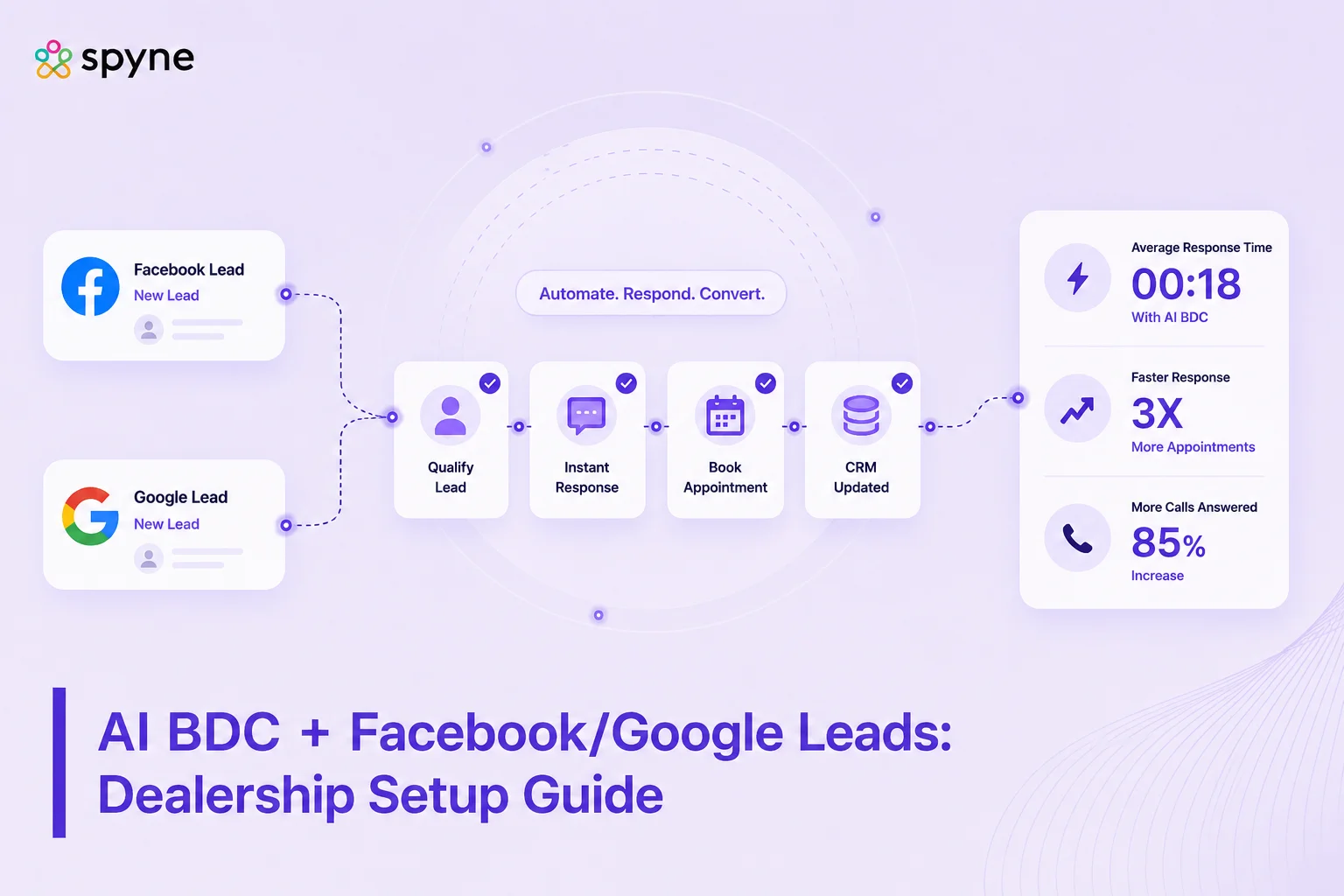
Integrating an AI BDC with Facebook and Google leads means routing every lead from Meta Lead Ads and Google Lead Form Extensions into the dealership CRM the moment it’s submitted, then putting a response in front of the customer before they move to another dealer. Vini AI connects to both lead sources, logs the lead correctly by source, and starts working it within seconds. Franchise dealers nationally still average a 71 out of 100 on internet lead response quality, per Pied Piper’s 2026 study. Paid leads that sit unworked past that window are ad spend with no return. |
A Facebook or Google lead doesn’t come with a phone call attached. It comes with a name, a phone number, and a closing window that starts shrinking the second the form gets submitted. Pied Piper’s 2026 Internet Lead Effectiveness study, now in its 15th year, found that only 51% of franchise dealers deliver what it calls a “perfect response” (a substantive reply across email, phone, and text) within 15 minutes. That’s after fifteen years of the industry knowing speed matters. Vini AI closes that gap by responding to Facebook and Google leads in under five seconds, before the CRM queue even builds up. This post covers the actual mechanics: how the lead gets from the ad platform into the CRM, and what has to happen after that for the integration to be worth anything.
What Does “Integrating AI BDC with Facebook and Google Leads” Actually Mean?
It means every lead submitted through a Meta Lead Ad or a Google Lead Form Extension lands in your CRM automatically, correctly tagged by source, and gets a first response before a human ever opens the record. Not a CSV download. Not a form that emails your inbox for someone to manually re-key into the CRM the next morning.
How the Data Actually Moves
- Facebook offers two paths: a bulk Graph API read (leads pulled in batches, the source of the once-a-day CSV habit) or a real-time webhook subscription to Facebook’s “leadgen” field, where Meta pushes a notification the instant a form is submitted.
- Google defaults to real time. Lead Form Extensions fire an HTTP POST to a dealership-configured webhook URL the moment a customer submits, authenticated with a webhook key so the endpoint can’t be spoofed.
- The CRM side runs on ADF/XML, the auto industry’s shared lead format. VinSolutions, DealerSocket, ELEAD, and ProMax all accept it through a dedicated ADF intake address, so a lead arriving this way carries request timestamp, vehicle year/make/model, and full contact details structured for automatic processing, not manual re-entry.
Why Do Facebook and Google Leads Go Cold Without AI BDC Integration?
Dealerships that rely on CSV downloads or a basic middleware connection (Zapier, LeadsBridge, or similar) without an AI response layer run into the same failure points, over and over:
- Data arrives, but nobody’s working it. Middleware moves the lead into the CRM. It doesn’t call, text, or qualify anyone. A lead sitting correctly filed in the CRM at 11 PM is still a lead nobody has talked to.
- Generic first response. A lead with only name and phone gets a form-letter “thanks for your interest” reply, the same one the customer has already seen from two other stores.
- No source-aware handling. A Facebook browser and a Google searcher get the identical script, even though one is comparison-shopping and the other has already decided to buy.
- Duplicate records. The same customer submits a Facebook form, then calls the main line an hour later. Without deduplication, that’s two lead-source entries for one buyer, and attribution reporting gets quietly wrong.
- No feedback loop. Meta and Google only optimize toward what gets reported back to them. If the only signal sent is “form submitted,” the ad platform keeps spending budget on people who fill out forms and never respond again.
What Is an AI BDC Integration, and How Is It Different?
An AI BDC integration doesn’t stop at data delivery. It’s the response layer sitting on top of the plumbing: the part that decides how fast to respond, which channel to use, what to say, and when to bring in a human.
Vini AI connects to Facebook and Google lead sources, maps vehicle of interest, trade-in details, and finance preference into CRM fields the sales team actually sees, and starts a source-aware first response, by text for a Facebook browser, by voice for a high-intent Google searcher, within seconds. That’s the functional difference between “the lead reached the CRM” and “the lead got worked.”
Not every platform marketed as AI BDC software for dealership handles Facebook and Google leads the same way, which is why the evaluation checklist further down is worth running before committing to one.
Manual/Middleware Setup vs. AI BDC Integration: Side by Side
| Factor | Manual / Middleware-Only Setup | AI BDC Integration (Vini AI) |
| Facebook delivery | Daily CSV export, or basic API pull | Real-time webhook or API delivery into CRM |
| Google delivery | Manual download or bare webhook with no follow-up | Real-time webhook, immediately actioned |
| First response | Manual, whenever staff opens the record | Vini AI responds in seconds (Spyne data) |
| Response channel | One script for every lead | Source-aware: text/WhatsApp for Facebook, voice for high-intent Google leads |
| Field mapping | Often name/phone only, rest buried in comments | Vehicle interest, trade-in, finance preference mapped to CRM fields |
| Duplicate handling | Same customer = two lead records | Matched and merged by phone/email |
| Lead-type routing | Every lead forced through a sales script | Routed to sales or service based on actual inquiry |
| Feedback to ad platforms | Form-submission event only | Qualification and appointment events sent back (Meta Conversion Leads, Google Enhanced Conversions) |
| Escalation to humans | No context carried over | Full conversation history handed to the BDC rep |
How Does Response Speed Affect Facebook and Google Lead Conversion?
Getting a lead into the CRM fast means nothing if it sits there once it arrives. Pied Piper’s 2026 study scored franchise dealers at 71 out of 100 on internet lead response quality, a 6-point improvement over 2025, and still found that when a lead required human follow-up, response scores dropped and customers were roughly twice as likely to get no personal reply at all. That gap, the difference between an automated form-fill acknowledgment and an actual conversation, is exactly what a Facebook or Google lead runs into on a manual setup.
The Saturday Surge Problem
Saturday is peak lot traffic and peak lead volume at most dealerships. If six Facebook and Google leads land within twenty minutes while the sales floor is full, a manual or middleware-only setup means those leads queue behind whatever the team gets to first. An AI BDC integration doesn’t experience a queue. Every one of those six leads gets a source-aware response the moment it lands, whether it’s one lead or twenty.
What Does AI BDC Integration With Facebook and Google Leads Look Like in Practice?
The mechanics above play out differently depending on how and when a lead actually arrives. These three situations come up in almost every dealership running Facebook and Google campaigns, and they show exactly where a manual setup and an AI BDC integration diverge.
#Scenario 1: The 9:47 PM Facebook Lead
A customer submits a Facebook Lead Ad form for a 2022 RAV4 on a Saturday night. On a CSV-based setup, that lead sits until Monday’s export. With Vini AI, a text goes out within seconds confirming the vehicle is on the lot and asking one qualifying question. By Monday morning, the internet sales team has either a scheduled appointment or a warm, logged conversation, not a three-day-old name with zero context.
#Scenario 2: The Duplicate Record
The same buyer fills out a Facebook form, then calls the dealership’s main line an hour later because they had a question the form didn’t cover. Without deduplication, that’s two separate lead-source entries, and the BDC manager’s Facebook-vs-phone attribution numbers are now wrong. Vini AI matches by phone and email and merges the two into a single record.
#Scenario 3: The Feedback Loop Gap
Two identical campaigns, same budget. One only reports form submissions to Meta and Google as the conversion event. The other reports “AI-qualified lead” and “appointment booked” back through Meta’s Conversion Leads integration and Google Enhanced Conversions. Over a 60-day flight, the second campaign’s cost per qualified lead drops, because the ad platform stops chasing people who fill out forms and go cold.
How to Evaluate a Facebook/Google Integration Before You Deploy It
Not every “AI BDC” claiming Facebook and Google integration actually does the same job. Before committing, check for these specifically:
- Is delivery real-time, or does it quietly rely on a daily batch pull? Ask whether Facebook leads move through the leadgen webhook subscription or a bulk API read on a schedule. The difference is hours, not seconds.
- Does it map vehicle, trade-in, and finance fields, or just name and phone? A demo that only shows contact fields populating is showing you half the job.
- Does it send qualification data back to Meta and Google, or only acknowledge the form-fill? If the platform can’t explain its Conversion Leads or Enhanced Conversions setup, the ad spend isn’t actually getting smarter over time.
- Does it deduplicate across sources? Ask to see what happens when the same customer submits a form and then calls in.
- Does it route sales vs. service leads correctly? Service inquiries show up inside sales-targeted campaigns more often than most dealers expect.
Is a Middleware-Only Setup Ever Enough for Facebook and Google Leads?
Not every dealership needs the full response layer on day one, and pretending otherwise doesn’t help anyone make a good decision. A basic middleware connection without AI-driven response can still be the right call in a few specific situations:
- Very low lead volume. A store running one small Facebook campaign generating a handful of leads a month may not need automated qualification on top of simple CRM delivery.
- Mid-migration bridge. A dealership switching CRM platforms may keep a basic middleware connection running temporarily rather than reconfiguring a full AI BDC integration mid-transition.
- Already deep in a vendor-specific setup. If a dealer group has heavily customized a middleware workflow across many rooftops, ripping it out for a single-store pilot may not be the first move.
For most independent and franchise dealerships running ongoing Facebook and Google campaigns with real lead volume, the response-layer gap is where the ad spend is actually being lost, not the delivery mechanism.
How to Set Up AI BDC Integration With Facebook and Google Leads
None of this requires a rebuild of your existing CRM or ad accounts, just the right sequence so nothing gets configured out of order. Here’s the setup in the order it actually needs to happen.
- Confirm your CRM’s ADF intake address (or native connection details, if the CRM supports one directly). Your CRM admin or vendor support team has this on file.
- Connect Facebook and Google as separate sources. They use different delivery mechanisms and need separate configuration, even if both ultimately land in the same CRM.
- Map the fields that matter, vehicle of interest, trade-in details, finance preference, not just name and contact info.
- Send a test lead through each platform’s own testing tool and confirm it appears in the CRM within seconds, with fields mapped correctly and the right source tag attached.
- Turn on the feedback loop (Meta Conversion Leads, Google Enhanced Conversions) so qualification outcomes flow back to the ad platforms, not just the form-submission event.
- Let Vini AI take the first response so every lead gets worked immediately, regardless of what time it lands or how many arrive at once.
How Does Vini AI Handle Facebook and Google Lead Integration?
Everything covered so far, delivery mechanics, field mapping, feedback loops, is the standard any integration should meet. What separates Vini AI is how it acts on that data the moment it lands, not just where it stores it. Here’s each piece of that workflow broken down.
Ingestion and field mapping
Vini AI connects to Facebook and Google lead sources and delivers each lead into the CRM with vehicle of interest, trade-in details, and finance preference already mapped, not just name and contact info. The BDC team opens a record that already says what the customer wants.
Source-aware first response
A Facebook lead gets a first-touch text or WhatsApp message calibrated for someone still browsing. A Google lead showing strong search intent gets a voice call. The channel is matched to how the customer actually behaves on each platform, not a single script applied to both.
Deduplication across sources
Vini AI matches by phone and email and merges a Facebook form-fill with a later phone call into a single CRM record, instead of letting attribution reporting split one buyer into two lead sources.
Correct routing by lead type
Sales-targeted campaigns generate service inquiries more often than dealers expect. Vini AI routes each lead into the correct workflow instead of running every lead through the same sales script regardless of what the customer actually asked.
Escalation with full context
Financing questions, trade-in negotiations, and multi-vehicle comparisons go to a BDC rep with the full conversation history attached, what the customer asked, what they said they wanted, and where the conversation left off.
Why this shows up in the numbers dealerships are already tracking. CDK Global’s January 2026 “AI at the Dealership” study found nearly 40% of U.S. dealerships are now actively using AI tools, with 77% of those integrating AI directly into existing systems rather than running it separately. Facebook and Google lead handling is one of the clearest places that shows up day to day, because it’s the volume that arrives fastest and gets worked least consistently without it.

The Bottom Line
The plumbing, getting a Facebook or Google lead into the CRM, has been solvable for years with middleware alone. That was never the part costing dealerships sales. The part that matters is what happens in the seconds after the data lands: whether the lead gets a source-aware response before it goes cold, whether the record has enough context to be useful, and whether the ad platform learns anything from what happens next. Franchise dealers nationally are still only hitting a 51% perfect-response rate within 15 minutes, per Pied Piper’s 2026 study. That gap is recoverable with the right response layer in place, not a faster CSV export. See what Vini AI recovers from your Facebook and Google campaigns in the first two weeks. Book a demo with Spyne.