
Phone calls remain one of the most valuable inbound touchpoints for businesses. Despite the growth of chat and email, many customers still prefer calling when they are ready to book, buy, or resolve an issue quickly. Yet handling every inbound call consistently remains a challenge for many teams.
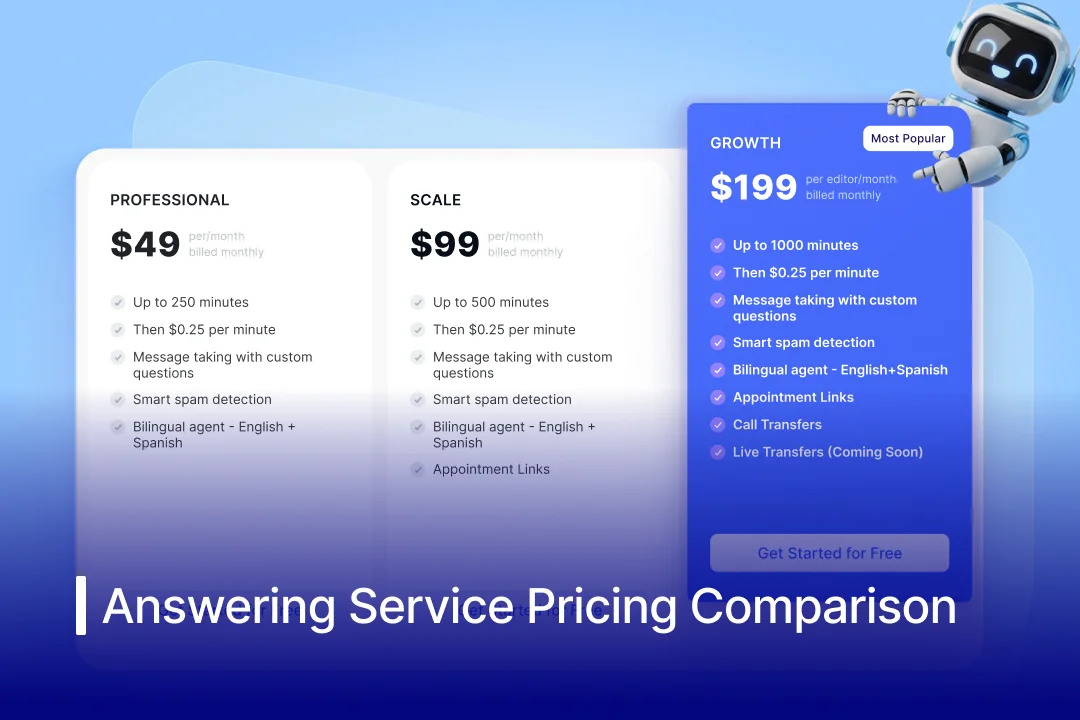
Answering services exist to close this gap by ensuring calls are handled even when internal teams are unavailable. However, costs vary widely depending on call volume, service coverage, and billing models. Answering service cost typically ranges from about $0.65 to $1.75 per minute or $50 to $500+ per month depending on usage and features.
By the end of this guide, you’ll understand models of answering services pricing, how to choose the right model, and answering service rates and pricing 2026.
How Much Does an Answering Service Cost in 2026?
Answering service pricing in 2026 varies widely based on call volume, service level, and coverage hours. Most businesses can expect to pay anywhere from $135 to $2,945+ per month, with small-to-medium businesses typically spending around $125–$400 monthly for standard live or automated answering services.
Costs increase as usage and complexity grow. Providers often charge $0.65–$1.75 per minute or $2.50–$4.50 per call, meaning higher call volumes, 24/7 availability, and advanced features like integrations or lead qualification can significantly raise monthly expenses.
Overview of Answering Service Pricing (2026)
To understand how pricing typically scales across providers, the following section provides a snapshot of common answering service pricing tiers in 2026.
| Minutes Included | Avg Monthly Cost | Estimated Calls Handled* | Typical Businesses | Key Features Included |
| 100 minutes | $135 – $250 | ~30–50 calls | Small businesses, local services | Basic call answering, message taking |
| 250 minutes | $330 – $525 | ~80–120 calls | Growing SMBs | Call forwarding, after-hours answering |
| 500 minutes | $495 – $925 | ~160–250 calls | Service businesses, clinics | Appointment scheduling, lead capture |
| 1,000 minutes | $950 – $1,595 | ~300–500 calls | High call-volume companies | CRM integrations, call routing |
| 2,500 minutes | $2,945+ | 800+ calls | Enterprises, call-heavy operations | Dedicated agents, advanced workflows |
*Estimated assuming 2–3 min. average call duration, which is typical for answering services.
In practice, the total cost of an answering service depends on call volume, service hours, and the pricing model used. Businesses with growing call demand often move between these tiers as their communication needs evolve.
What’s the Real Cost of a Missed Call?
A missed call is rarely just a missed conversation, it often represents lost revenue, wasted marketing spend, and a missed long-term customer relationship. For many service-driven businesses, phone calls are one of the highest-intent lead sources, meaning the financial impact of unanswered calls can add up quickly.
Here’s what businesses actually lose when calls go unanswered:
- Direct Revenue Loss: For many industries, a single inbound call can represent a high-value opportunity. Home service providers often see $300–$1,200 per booked job, professional services may generate $300–$700 per client, and even smaller transactions like restaurant bookings or reservations can represent $25–$30 in immediate value.
- Lost Customer Lifetime Value (LTV): The cost of a missed call rarely stops at the first transaction. Many industries rely heavily on repeat customers, ongoing service contracts, and referrals.
- Wasted Marketing Spend: Many inbound calls are generated from paid channels such as Google Ads, LinkedIn Ads, or local service marketplaces. When those calls go unanswered, the business still absorbs the customer acquisition cost, often $50–$70 or more per lead, without gaining the customer.
- Revenue Lost to Competitors: Customer patience on the phone is limited. Industry studies consistently show that around 80–85% of callers who can’t reach a business will immediately contact a competitor instead of calling back.
You can estimate the revenue impact of missed calls using a straightforward calculation:
Missed Calls × Conversion Rate × Average Transaction Value = Potential Revenue Lost
Example:
- 10 missed calls
- 30% average close rate (about 3 customers)
- $500 average service value
Potential revenue lost: 10 × 30% × $500 = $1,500
This means that just 10 unanswered calls could translate into $1,500 in lost business. Over a month, even a small number of missed calls each day can quietly add up to thousands of dollars in lost revenue, especially for businesses where inbound calls drive bookings, consultations, or service requests.
Common Answering Service Pricing Models
Most answering services price their offerings based on how calls are handled, how predictable call volume is, and whether interactions are managed by human receptionists, AI agents, or a hybrid of both.
For many small and mid-sized businesses, the typical answering service cost falls between $100 and $500 per month, though pricing increases with higher call volumes, specialized workflows, or full 24/7 coverage.
Below are the most widely used pricing models in the industry and how they typically work.
1. Per-Minute Pricing ($0.50 – $1.90 per minute)
In the per-minute billing structure, companies pay based on the total time agents spend handling calls, including the conversation itself, short hold periods, and sometimes brief administrative tasks after the call.
However, costs can rise quickly when call volumes increase or when conversations are lengthy, making it important to monitor usage closely.
Example:
Starter Plan: 100 minutes for $150/month
Growth Plan: 250 minutes for $350/month
Enterprise Plan: 500 minutes for $700/month
Additional minutes are typically billed between $1.50 and $2.50 per minute, which can significantly influence the final call answering service cost if call volumes exceed the included minutes.
2. Per-Call Pricing ($0.75 – $4.50 per call)
With per-call billing, businesses pay a fixed rate for each call handled, regardless of the length of the conversation. Per-call pricing is particularly effective for businesses where interactions are short and transactional, such as message taking, call routing, or collecting basic customer information.
Some providers also include different service tiers depending on how complex the interaction is.
Example:
Basic: $1.50 per call (message taking)
Standard: $2.75 per call (call routing + message)
Premium: $4.00 per call (appointment scheduling
Because pricing remains fixed regardless of call duration, this structure is often evaluated during an answering service pricing comparison when businesses want predictable billing.
3. Tiered Subscription Plans ($150 – $900+ per month)
Tiered subscription plans bundle a predefined number of minutes into a monthly plan. Instead of paying strictly for usage, businesses prepay for a block of call time, which often reduces the effective phone answering service cost compared with pure pay-as-you-go billing.
This model works well for organizations that experience consistent call patterns and want stable monthly expenses while still retaining the ability to scale.
Example:
Starter: 100 minutes for $199/month
Business: 250 minutes for $399/month
Enterprise: 500 minutes for $699/month
If usage exceeds the included limit, additional minutes are typically billed between $1.50 and $3.00 per minute, which can influence the overall answering service cost per month depending on call volume.
4. Flat-Rate Pricing ($300 – $1,500+ per month)
Flat-rate answering services charge a fixed monthly fee for high-volume or near-unlimited call handling. Rather than paying based on minutes or calls, businesses receive consistent coverage for a predictable monthly fee.
This structure is commonly used by companies that manage large inbound call volumes or require continuous support. Industries such as healthcare, legal services, and property management often adopt this model because the 24 hour answering service cost becomes easier to budget for.
Example:
Standard Plan: $399/month for unlimited weekday answering
Pro Plan: $799/month for extended hours and call routing
Premium Plan: $1,299/month for full 24/7 answering
5. Hybrid AI + Human Pricing ($50 – $300+ per month)
Modern answering platforms increasingly combine AI voice agents with human receptionists to reduce operational costs while maintaining service quality. In this hybrid approach, AI acts as an auto attendant handles routine inquiries such as greetings, FAQs, or call routing, while complex interactions are escalated to live agents.
Hybrid models also allow organizations to maintain 24/7 availability without paying full live staffing costs.
Example:
AI Basic: $79/month for automated call answering
AI + Human Assist: $199/month with live escalation
Advanced Automation: $299/month with CRM integration

Comparing Answering Service Costs Across Different Service Types
In 2026, answering services generally fall into four primary categories: AI-powered automation, fully staffed live answering services, hybrid models that combine AI with human agents, and virtual receptionist solutions.
The following comparison highlights how pricing and capabilities differ across these four service types.
1) AI / Automated Answering Services
AI-powered answering systems use conversational automation to greet callers, capture information, answer common questions, and route calls without requiring human agents. Because automation handles most interactions instantly and continuously, this model often represents the most efficient structure within modern AI answering service pricing.
Businesses using automated answering platforms typically pay between $20 and $300+ per month, depending on call volume, integrations, and automation capabilities.
2) Live Human Answering Services
Live answering services rely entirely on trained receptionists to manage inbound calls. Agents follow customized call scripts, capture customer details, route calls to the appropriate department, and often assist with lead intake or scheduling.
The telephone answering service cost for live receptionists usually ranges from $300 to more than $2,000 per month, depending on call volume and service hours. Many providers also charge per-minute rates that typically fall between $2.50 and $4.70 per minute.
3) Hybrid Answering Services
Hybrid answering services combine automation with human receptionists. In this model, voice bot handles routine tasks such as greeting callers, answering frequently asked questions, and routing calls, while live agents take over when conversations become complex or require human judgment.
Most hybrid answering platforms fall within the $250 to $1,000 monthly range, depending on call volume and the number of interactions transferred to human agents.
4) Virtual Receptionist Services
Virtual receptionist services function as an AI call bot for front desks for businesses. Instead of simply answering calls, virtual receptionists manage appointment scheduling, call routing, lead capture, and customer inquiries using customized scripts and business workflows.
Because these services often involve longer conversations and structured call management, the AI phone answering pricing model typically uses bundled minutes rather than per-call billing. For example, many providers charge between $135 and $250 for approximately 100 minutes, with larger plans reaching $1,595 or more for 1,000 minutes.
| Service Type | Typical Monthly Cost | Human Involvement | Setup Time | Integrations | Brand Tone & Voice Control | Availability | Scalability |
| AI / Automated Answering | $20 – $300+ | Fully automated | Fast (hours to 1–2 days) | CRM, scheduling tools, help desks | Moderate–High (scripted AI responses) | 24/7 by default | Very High |
| Live Human Answering | $300 – $2,000+ | Fully human receptionists | Moderate (several days to train agents) | Limited integrations depending on provider | High but depends on agent training | Business hours | Moderate |
| Hybrid Answering | $250 – $1,000 | AI + human escalation | Moderate (AI setup plus agent training) | Strong integrations with CRM and call routing tools | High with AI scripting and human backup | Usually 24/7 | High |
| Virtual Receptionist | $135 – $1,595 (minute bundles) | Dedicated AI receptionist | Moderate (workflow and scheduling setup) | CRM, calendar, scheduling systems | High due to customized call scripts | Business hours or extended hours | Moderate/High |
7 Key Factors That Affect Answering Service Pricing
Answering service costs rarely comes down to a single number. Two businesses using the same provider can end up paying very different monthly bills because pricing adjusts based on usage, service complexity, and operational requirements.
Most providers calculate pricing using a mix of minute bundles, per-call billing, and service tiers. The following factors usually have the biggest influence on what businesses ultimately pay.
1. Call Volume and Call Duration
Call activity is usually the largest driver of pricing. Most providers tie their billing structure to usage, meaning the number of calls and how long each conversation lasts directly affect the call answering service cost.
For example, basic message-taking calls may take less than a minute, while appointment scheduling, sales inquiries, or detailed customer intake can extend call duration significantly.
2. Service Hours and Coverage
Service availability significantly affects after hours answering service pricing. Coverage limited to business hours typically sits at the lowest price tier. Expanding coverage to extended hours, such as 7 AM to 9 PM, can increase pricing by roughly 10–20% due to additional staffing requirements.
Full-time availability increases costs even further. Businesses requiring continuous service often face a higher 24 hour answering service cost, with live receptionist services commonly costing 25–50% more than standard business-hour plans.
3. Call Complexity and Services
The complexity of call handling directly affects the telephone answering service pricing structure. Basic answering services that simply collect a caller’s name and message are usually the lowest-cost option.
4. Languages Requirements
Multilingual call handling can also affect answering service rates and pricing. Multilingual/Bilingual answering service providers typically charge 10–20% more than standard plans because specialized staff must be available to handle those calls.
5. Industry Requirements and Compliance
Certain industries require stricter processes for handling customer interactions. Healthcare providers, legal firms, and financial services companies often need secure systems, compliance protocols, and specialized training for agents.
6. Pricing Model and Contract Terms
The billing structure ultimately determines how the answering service monthly cost is calculated. Providers typically offer per-minute billing, answering service per call pricing, or flat subscription plans.
Selecting the wrong pricing structure can significantly affect the final cost for answering service. For example, businesses with longer conversations may see costs rise quickly under per-minute billing, while high call volumes can make per-call plans more expensive.
7. System Integration and Customization
Modern answering services often connect with calendars, CRMs, or industry-specific platforms. Basic calendar integrations with tools such as Google or Outlook are usually included in standard plans.
However, deeper integrations, such as CRM connections or industry software, can increase the cost of call answering service. CRM integrations may require $50–$200 in setup fees, while specialized software integrations can range from $100–$300 depending on the complexity of the workflow.
Best Answering Service Pricing Compared: Features & Costs
The comparison below breaks down answering service pricing, and features of popular providers so you can understand the real cost of an answering service before choosing the right platform for your business.
1. Spyne (Conversational AI Answering & Lead Conversion for Automotive Businesses)
Spyne offers a conversational AI agent called Vini, designed specifically for high-volume businesses such as automotive dealerships. Its pricing structure offers outbound calling and inbound calling which fits within modern AI phone answering service pricing models.
Key features:
- AI conversational agent (Vini) that answers calls, chats, and messages 24/7
- Automated lead capture and qualification during conversations
- Instant appointment and test-drive scheduling
- CRM and dealership system integrations
- AI-driven follow-ups and reminders for prospects
- Real-time analytics and conversation tracking dashboard
Pricing:
Spyne typically offers custom subscription pricing depending on integrations, deployment scale, and call volume.
2. Posh (Premium Live Virtual Receptionists)
Posh is designed for companies that prefer human receptionists and structured workflows. It’s often evaluated in live answering service pricing comparison reports because of its concierge-style support.
Key features:
- 24/7 live virtual receptionist answering
- Lead capture, appointment scheduling, and call transfers
- Message delivery via text, email, or the Posh mobile app
- Custom call handling instructions and scripts
- Bilingual receptionists and CRM integrations
- Task assistant for outbound calls and follow-ups
Pricing:
Starts at about $65 per month, with usage billed around $2.30 per receptionist minute. Higher tiers include bundled minutes (for example, 50, 100, or 200 minutes per month) with lower per-minute overage rates.
3. Goodcall (For AI-Powered Call Automation)
Goodcall represents the newer generation of automation platforms entering the AI answering service pricing category.
Key features:
- AI phone agent that answers inbound calls automatically
- Lead capture and message delivery via SMS, email, or CRM
- Customizable call flows and automation logic
- Appointment scheduling and call routing to staff
- Local business phone numbers with area code options
- Analytics and conversation tracking dashboard
Pricing:
Plans typically start around $59–$79 per agent/month, depending on how many unique callers interact with the AI each month. Compared to other services, this model often reduces call answering service cost since AI can handle unlimited simultaneous calls without adding receptionist minutes.
4. Allo (Simple, Transparent Answering Service Pricing)
Allo focuses on simple subscription tiers, making it easy for small businesses evaluating phone answering service pricing without dealing with minute-based billing.
Key features:
- Live virtual receptionists for inbound call answering
- Lead capture and message taking
- Appointment scheduling and call transfers
- Business hours and after-hours call coverage
- Simple dashboard to manage messages and calls
Pricing: Plans start around $18–$25 per month, with AI receptionist features available on higher tiers at about $32 per user/month.
5. Abby Connect (Professional Live Receptionists for Service Businesses)
Abby Connect targets service businesses that require trained receptionists representing the company brand.
Key features:
- U.S.-based live virtual receptionists answering calls in your company’s name.
- Call screening, transfers, and detailed message taking.
- Appointment scheduling and client intake form.
- Custom call handling scripts tailored to your business.
- CRM and calendar integrations.
- Mobile and desktop dashboard for call summaries and messages.
Pricing:
Plans begin around $329 per month for 100 receptionist minutes. Higher plans include 200 minutes for roughly $599/month and 500 minutes for about $1,380/month.
6. Numa (AI‑Powered Voice Solution for Automotive Service Teams)
Best for: Dealerships and service centers that want to automate high-volume service calls like appointment booking, status updates, and customer FAQs.
Key features:
- AI-powered voice assistant trained for automotive service workflows
- Automated service appointment scheduling and confirmations
- Answers common customer queries (service status, hours, availability)
- Call routing to advisors for complex or high-intent conversations
- SMS follow-ups and reminders to reduce no-shows
Pricing:
Based on industry benchmarks, plans are typically customized depending on call volume, number of rooftops, and integrations.
7. AnswerConnect (24/7 Live Answering and Customer Support)
AnswerConnect is widely known for round-the-clock receptionist coverage and is often compared in 24/7 answering service pricing benchmarks.
Key features:
- 24/7 live call answering
- Lead capture, order processing, and appointment scheduling
- Custom call scripts and routing rules
- CRM and helpdesk integrations
- Bilingual receptionists
- Website live chat support
Pricing:
Plans typically start around $350 per month for about 200 minutes, with a $49.99 setup fee and per-minute overage charges once plan limits are exceeded.
8. NextPhone (AI-Powered Call Answering With Unlimited Calls)
NextPhone provides an AI receptionist designed to answer calls instantly without per-minute billing. Its flat subscription model appeals to businesses that want predictable costs while handling higher call volumes.
Key features:
- AI receptionist that answers calls instantly and handles conversations.
- Lead qualification and automatic appointment booking.
- Real-time calendar sync and CRM integrations.
- Call transcripts and conversation summaries.
- Smart call routing and human transfer rules.
- 100+ integrations with tools like HubSpot and Zapier.
Pricing:
Starts at about $199 per month with unlimited calls, using a flat subscription model with no per-minute or per-call charges.
9. Smith.ai (Lead Qualification With Hybrid AI + Human Receptionists)
Smith.ai combines automation with trained receptionists, making it a hybrid solution in many answering service pricing comparison studies.
Key features:
- Hybrid AI + live receptionist call answering.
- Lead qualification and new client intake workflows.
- Appointment scheduling and calendar integrations.
- CRM and Zapier integrations for automated workflows.
- Call recording, transcripts, and follow-up via SMS or email.
- Outbound calling and payment collection support.
Pricing:
AI receptionist plans start around $95 per month, while live receptionist packages begin near $292.50 per month for about 30 calls, with additional calls billed separately.
How to Choose the Best Answering Service for Your Company?
Below are the key factors businesses should consider when choosing an answering service that delivers value without unnecessary costs.
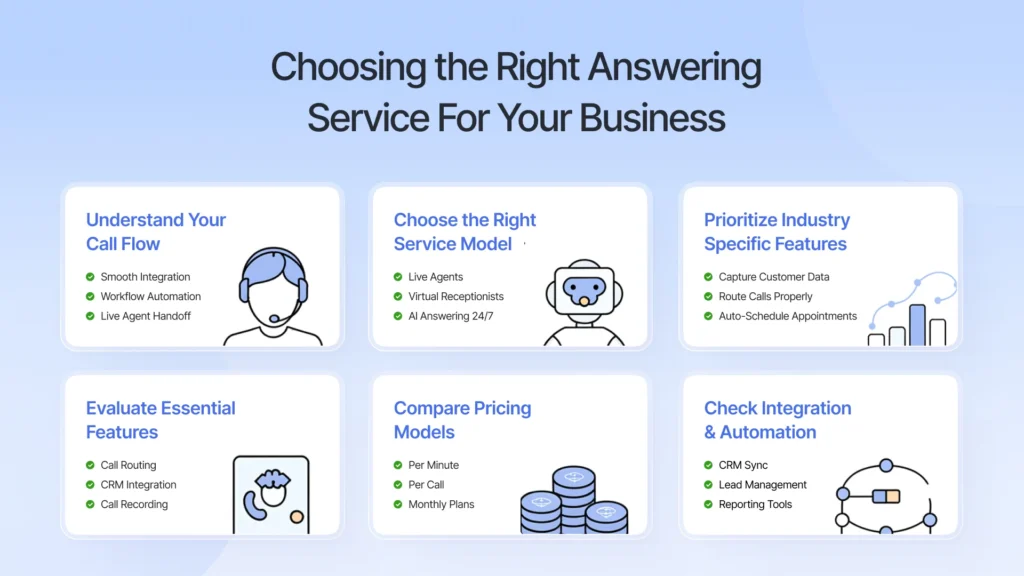
#1 Estimate Your Call Volume and Usage Patterns
The first step in evaluating phone answering service pricing is identifying how your business plans to use the service. Some companies require full front-desk support, while others only need a call overflow solution or weekend coverage.
For instance:
- Small businesses with light call traffic may only need 100–200 minutes per month.
- Companies with frequent inbound inquiries or support requests may require 500+ minutes or unlimited plans.
#2 Compare Pricing Models Carefully
Answering services structure their telephone answering service pricing using different billing models, and choosing the right one can significantly impact your monthly spend.
- Per-minute billing: You pay for the exact time agents spend handling calls.
- Per-call pricing: A flat rate is charged for each answered call.
- Bundled plans: Monthly subscriptions include a set number of minutes or calls.
For example, a company receiving 100 short calls per month may save money with per-call billing, while a business handling fewer but longer support calls may benefit from bundled minutes.
#3 Evaluate Core Features Beyond Basic Call Answering
After estimating your call volume and reviewing call answering service pricing, the next step is deciding what you actually need the service to handle. Start by clarifying the role the service will play in your operations.
Consider questions like:
- Do you only need basic message taking, or should agents assist with orders, refunds, or customer inquiries?
- Should the service act as a virtual receptionist, scheduling appointments or transferring calls to the right department?
- Is bilingual support important for your customer base?
- Does the service need to connect with your calendar, CRM, or helpdesk system so agents can log details and access customer history?
#4 Review Technology, Automation, and AI Capabilities
Look for platforms that use CRM integrations, automated call routing, and structured intake forms. For example, even reducing a call from 3 minutes to 2.5 minutes can noticeably lower the overall telephone answering service cost across hundreds of calls per month.
Some providers also offer AI-assisted call screening, where automation collects basic information or answers simple questions before routing the call to a live agent.
#5 Choose a Service That Can Scale With Your Business
Finally, businesses should evaluate whether the provider can support future growth. As call volumes increase, the answering service monthly cost may rise depending on usage limits or plan tiers.
Most businesses eventually move from entry-level plans ($75–$200/month) to higher tiers that support larger call volumes, 24/7 coverage, and more complex workflows.
Why Answering Services Are Critical for Automotive Businesses?
Automotive sales are highly time-sensitive, the dealership that responds first often wins the customer. Studies cited by McKinsey & Company show that responding to customer inquiries within minutes can increase conversion rates by up to 9×. Yet dealerships frequently miss calls when staff are assisting walk-in buyers or service customers.
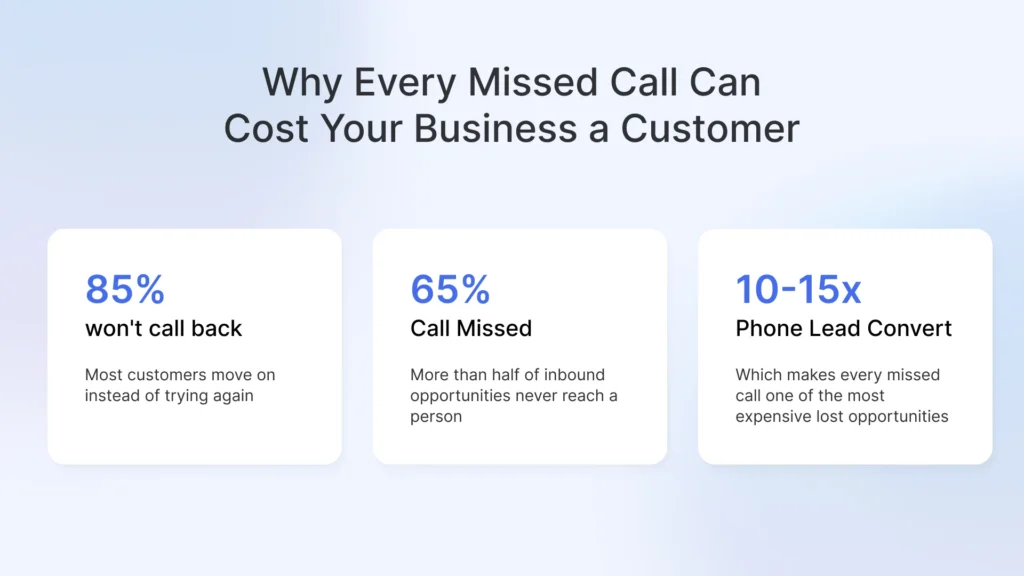
For example, a dealership receiving 120 inbound calls per week may miss 35–40% of them during peak hours. If even 20 of those missed calls are high-intent buyers asking about availability or test drives, the store could lose several potential sales simply due to delayed responses.
How Spyne’s Vini AI Ensures You Never Miss an Important Call?
Dealerships often lose high-intent buyers simply because calls go unanswered during busy showroom hours or after closing time. Spyne’s conversational AI, Vini, solves this by acting as an always-available answering system designed specifically for automotive retail.
For dealerships evaluating modern answering solutions, understanding Vini AI answering service pricing highlights how AI-powered systems can capture more opportunities while keeping operations efficient.
Here’s what Vini AI does:
- Answers every inbound call instantly, ensuring no lead is lost during peak hours or after business hours.
- Captures and qualifies lead, collects caller information, identifies intent, and logs details for the sales team.
- Schedules test drives and service appointments, integrates with dealership workflows to book visits automatically.
- Routes calls intelligently, transfers complex inquiries to the right department when human assistance is needed.
- Acts as an automotive answering service and handles inquiries 24*7, answers calls during evenings, weekends, and holidays when dealerships are typically closed.
- Supports multi-location dealerships, directs callers to the correct showroom or service center based on their needs.

Closing Thoughts
The right call handling service should match your actual call volume, adapt to varying call durations, and support the interactions your customers expect, whether that’s basic message-taking, lead capture, appointment booking, or intelligent call routing.
And Spyne’s conversational AI goes beyond basic call handling, managing repetitive interactions so businesses can respond faster, minimize missed calls, and maintain predictable operational costs.
If you’re also losing leads to unanswered inquiries, book a demo with Spyne to see how an AI answering service can help you capture every call that matters.