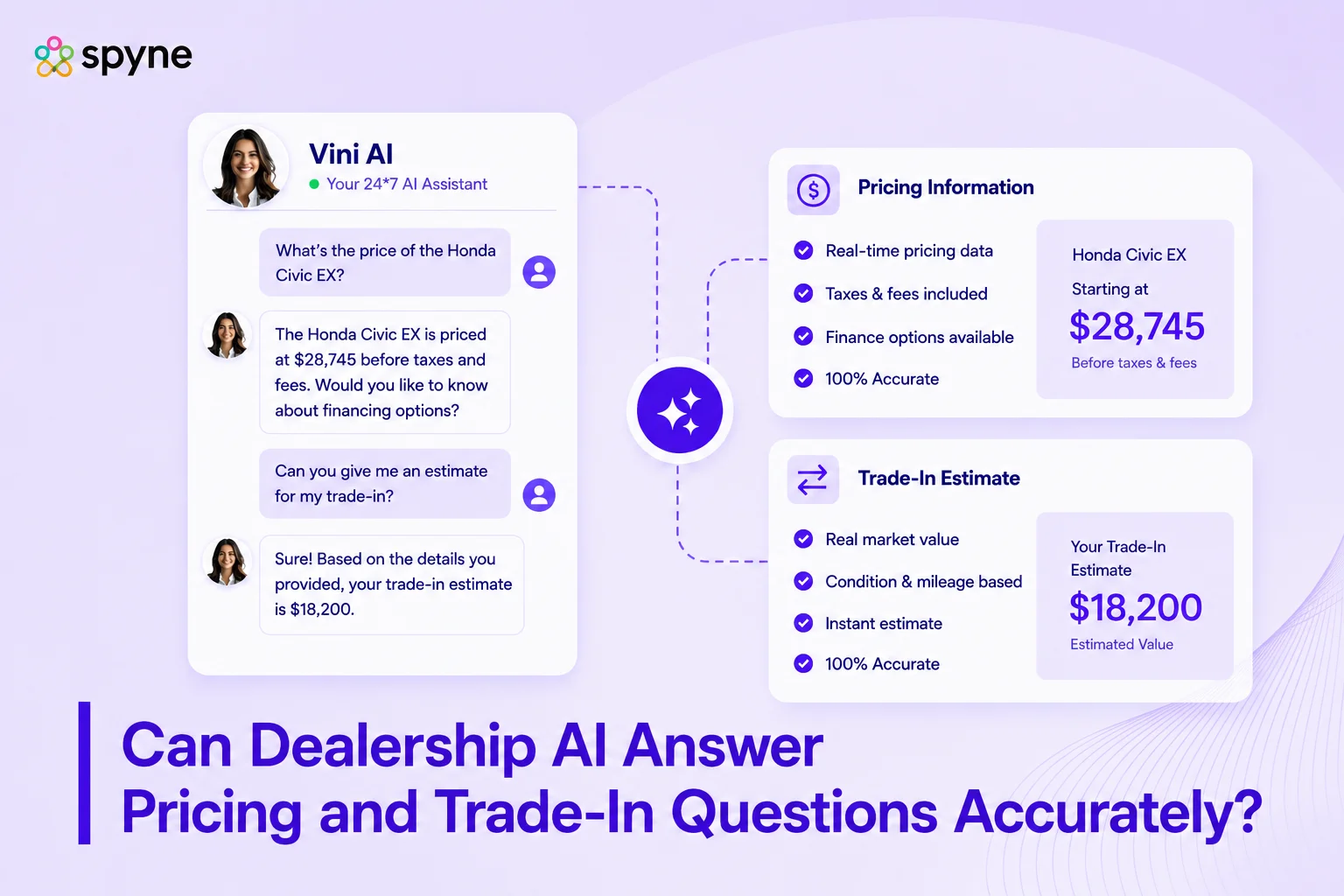

Customers often ask about advertised prices, monthly payments, incentives, trade values, and vehicle availability before agreeing to visit. Dealership AI for pricing and trade-ins can answer many of these questions, but accuracy depends on current inventory data, approved offer rules, reliable payment tools, and clear escalation paths across every inbound channel. The need is growing: Cox Automotive’s 2025 Car Buyer Journey Study, published in 2026, found that 37% of buyers wanted to finalize a vehicle’s price online, while only 19% actually did. This article explains which answers AI can provide, what information it should collect, and where sales, appraisal, or F&I staff must take over.
Can AI Chat Handle Complex Car Buyer Questions About Pricing and Trade-Ins?
Yes, dealership AI can accurately answer questions about advertised pricing, availability, vehicle specifications, approved offers, and estimated payments when connected to current dealership systems. It can also collect the details needed to qualify a trade-in opportunity. However, AI should not independently negotiate prices, generate a final out-the-door quote, guarantee financing terms, or assign a definitive trade-in value. Those decisions require dealership staff or approved appraisal, payment-calculation, and digital-retailing tools. Vini AI by Spyne applies this model by connecting verified inventory, vehicle-history, payment, and CRM information with dealership-controlled handoff rules.
Accuracy therefore depends less on how confidently the AI speaks and more on whether it retrieves the right data, follows dealership rules, and recognizes when verification is required.
Does Dealership AI Need Training or Live Data?
It needs both, but they solve different problems. Dealership-approved instructions teach the AI how to explain policies, ask qualification questions, and escalate sensitive requests. Live integrations supply changing facts such as inventory status, advertised prices, incentives, payment estimates, and CRM context.
Uploading an inventory spreadsheet into a knowledge base is not enough. The file begins aging as soon as a vehicle sells, a price changes, or an offer expires. A dependable AI setup separates stable knowledge from live operational data:
| Information layer | What belongs there | Preferred source |
| Inventory facts | VIN, stock number, status, mileage, trim, installed features, advertised price | Inventory management system or approved feed |
| Offers and incentives | Eligible vehicles, expiration dates, regions, stacking rules, customer qualifications | OEM or dealership-approved offer source |
| Payment information | Term, rate input, taxes, fees, down payment, applicable incentives | Approved payment-calculation or digital-retailing tool |
| Dealership FAQs | Hours, location, appraisal process, required documents, deposit and appointment policies | Approved dealership knowledge base |
| Customer and lead context | Vehicle of interest, timeline, trade details, prior conversation, assigned employee | CRM |
| Actions and escalation | Appointment availability, callback ownership, sales, appraisal, and F&I routing | CRM, calendar, and dealership routing rules |
The AI should retrieve each answer from the system designated as authoritative for that field. It should not blend an old FAQ, a website price, and a newer inventory feed into one confident response.
Vini AI follows this model through supported inventory, payment, vehicle-history, and CRM connections. The dealership still controls its approved FAQs, offer rules, routing logic, and the situations that require a person. Dealers can review Spyne’s broader dealership integration ecosystem, but they should confirm the exact data fields and writeback behavior supported by their own stack.
Which Pricing and Trade-In Questions Can Dealership AI Answer?
Dealership AI can answer factual questions supported by approved data, collect qualification details, and explain dealership processes. It should escalate questions that require judgment, negotiation, eligibility confirmation, or a binding financial decision.
| Customer question | Can dealership AI answer? | What is required? |
| Is this vehicle available? | Yes, conditionally | Current inventory feed and correct VIN match |
| What is the advertised price? | Yes | Verified dealership inventory or listing data |
| Are there incentives on this vehicle? | Conditionally | Current offer, vehicle, location, and eligibility data |
| What could my monthly payment be? | Conditionally | Approved payment calculator and required customer inputs |
| Is the price negotiable? | Human involvement required | Salesperson or manager authorization |
| What is the final out-the-door price? | Usually requires escalation | Taxes, fees, products, incentives, and complete deal structure |
| What information do you need about my trade? | Yes | Dealership-approved qualification workflow |
| What is my trade-in worth? | Appraisal required | Valuation tool, market data, and vehicle inspection |
| Can I trade a vehicle with a loan balance? | AI can explain the process | Payoff information and dealership review |
This separation matters because qualification is not valuation, and a payment estimate is not a credit approval or final contract.
How Do Inventory Feeds Keep AI Pricing Answers Accurate?
Inventory integrations allow conversational AI to retrieve vehicle-specific facts instead of answering from general model knowledge. Depending on the supported connection, the AI may access availability, VIN, stock number, advertised price, mileage, make, model, trim, drivetrain, features, and comparable vehicles currently in stock.
The AI must also translate natural shopper language into structured inventory filters. A request for “a three-row SUV under $40,000” combines body style, seating, and budget, while “Does this RAV4 have navigation?” requires an answer tied to the equipment on that specific VIN. If the feed does not include installed options or a window-sticker field, the AI should say that it cannot verify the feature and route the question to sales.
Can AI Integrate With Dealership Inventory Systems?
Yes. Dealership AI can connect with supported inventory management systems through APIs, scheduled files, or other approved data connections. During a conversation, it can use the shopper’s VDP, VIN, or stock number to identify the correct unit and retrieve available information.
Compatibility and functionality vary by vendor. Dealers should verify which inventory systems are supported, which fields are available, and whether the connection supplies read-only information or can trigger other actions. A generic claim such as “DMS integrated” does not prove the AI can retrieve VIN-level pricing during a live conversation.
For example, Vini AI has live vAuto and VINCUE inventory connections as of June 2026. These connections can support availability, vehicle features, prices, trim comparisons, and similar-vehicle recommendations when the relevant fields are present in the source feed.
Can AI Work With Dealership Inventory Feeds?
Yes, but “connected” does not always mean perfectly real time. Accuracy depends on feed-refresh frequency, VIN matching, source completeness, and the time required for sold or repriced units to move through connected systems.
A reliable setup should establish one approved source for each answer. The inventory system may supply availability and vehicle data, while a separate offer system supplies incentives. The CRM should store the customer’s question, vehicle of interest, and the next action.
What Happens When Inventory Information Conflicts?
When two approved systems show different prices or statuses, the AI should not choose the more convenient answer. It should:
- Explain that the information requires verification.
- Avoid confirming availability, price, or incentive eligibility.
- Offer a warm transfer or schedule a prompt callback.
- Record the unresolved question and vehicle details in the CRM.
Recently sold vehicles require special handling because a unit may remain visible between feed updates. The AI can offer similar vehicles, but it should not say the original unit is available until the status is verified.
For dealer groups, the same rule applies across rooftops. The AI should identify which store holds the vehicle, avoid implying that a transfer is guaranteed, and give the customer a clear next step if a comparable unit is located elsewhere.
How Should Dealership AI Handle Vehicle Pricing Questions?
Pricing questions should be divided into factual retrieval, conditional calculation, and human decision. Each category needs different data and guardrails.
#1 Advertised Vehicle Prices
AI can share a verified advertised price from an approved dealership source after confirming the exact vehicle. Matching by VIN or stock number is safer than relying only on year, make, and model because several similar units may carry different mileage, equipment, or pricing.
The answer should also preserve any conditions attached to the price. In March 2026, the Federal Trade Commission warned 97 auto groups about deceptive pricing practices, including prices that excluded mandatory fees, used rebates unavailable to every customer, or depended on dealer financing. An AI answer should never remove or obscure those conditions.
#2 Incentives and Special Offers
Before presenting an incentive, AI should verify the expiration date, eligible models or VINs, financing requirements, regional restrictions, and whether the offer depends on loyalty, conquest, military, or other qualifications. It should also confirm whether multiple offers can be combined.
The safe answer is not “You qualify for a $2,000 rebate” unless eligibility has been established. A better response identifies the available program, explains the known conditions, and offers staff verification.
#3 Price Negotiation
AI can capture a shopper’s objection, target price, or proposed offer. It can also notify the assigned salesperson and arrange a transfer. The sales team should decide whether to discount the unit, match another quote, include an accessory, or adjust the deal structure.
Unless a dealership has created a tightly controlled approval workflow, the AI should not suggest that a manager will accept the customer’s number.
#4 Monthly Payment Questions
A useful payment estimate requires more than the vehicle price. The calculation may depend on loan term, interest rate or credit tier, taxes, fees, incentives, cash down, trade equity, and applicable products.
When connected to an approved calculation tool, AI may present an estimated payment and identify the assumptions used. It should label the figure as an estimate, avoid promising a rate or approval, and transfer deal-structure questions to F&I. Without the required inputs or live calculation connection, the AI should collect the shopper’s payment target and arrange follow-up.
Vini AI can provide monthly lease or finance estimates through its live OfferLogix integration, which is a paid add-on. The estimate can incorporate supported inputs such as incentives, taxes, fees, and down payment impact. Without the integration or required inputs, Vini should qualify the request and move it to the appropriate employee.
#5 Final Out-the-Door Pricing
AI should not independently construct a final out-the-door quote from incomplete information. Taxes, registration, mandatory fees, protection products, financing, incentive eligibility, and trade equity can change the final amount.
It may explain what an OTD figure generally includes and collect the information needed for staff to prepare one. The final quote should come from the dealership’s approved desking or digital-retailing process.
How Does AI Qualify Pricing and Trade-In Leads?
AI qualifies a pricing or trade-in lead by collecting the information a salesperson, appraiser, or F&I manager needs to continue the deal. The conversation should adapt to the customer’s answers instead of presenting a long questionnaire.
Typical questions include:
- Which vehicle or stock number are you considering?
- When are you hoping to purchase?
- Are you planning to pay cash, finance, or lease?
- Do you have a target payment range?
- How much are you considering as a down payment?
- Do you have a vehicle to trade?
- What are its year, make, model, trim, and mileage?
- How would you describe its general condition?
- Has it had an accident or sustained major damage?
- Is the vehicle owned, financed, or leased?
- What is the estimated payoff, if applicable?
- When can you visit for a test drive or appraisal?
- Would you like help from a salesperson or F&I manager?
These answers help the dealership prioritize and prepare. They do not authorize the AI to approve financing, negotiate the sale price, or determine the trade’s value. For a deeper workflow, see Spyne’s guide to AI lead qualification for dealerships.
In Vini AI, the same qualification context can move into a warm transfer, callback task, appointment, or CRM note through a supported connection. The exact CRM action varies by system, so dealers should verify whether their integration creates a calendar appointment, changes a lead stage, or records the appointment as a note.
What Can Dealership AI Do With Trade-In Questions?
Dealership AI is effective at trade-in intake and education, but the final appraisal requires a valuation process and, in most cases, a physical inspection.
1. Information AI Can Collect
The AI can collect the VIN when available, year, make, model, trim, mileage, ownership status, general condition, accident or damage history, and estimated payoff. Dealers may also configure questions about keys, service records, warning lights, modifications, tire condition, and the customer’s preferred appraisal time.
The purpose is to create a complete handoff. The information helps the used-car manager or appraiser prepare, but it remains customer-reported until verified.
2. Information AI Can Explain
AI can explain how the appraisal process works, which ownership or payoff documents the customer should bring, and why an inspection may be necessary. It can also explain that an existing loan does not prevent a trade, but the verified payoff and appraised value affect the deal.
If the payoff exceeds the appraised value, AI may explain negative equity in general terms. Staff and lenders must determine how that amount is handled in the final deal.
3. Decisions AI Should Not Make
AI should not promise a guaranteed trade value, final purchase offer, payoff amount, or approval to roll negative equity into another loan. It should also avoid declaring that the customer has positive or negative equity before both the payoff and appraisal are verified.
4. The Correct Trade-In Handoff
Collect trade details → Log them in the CRM → Book the appraisal → Transfer the context to dealership staff → Verify the final value
The customer should not need to repeat the vehicle, mileage, payoff, and condition details after the transfer. A Vini warm transfer includes a conversation brief, helping the salesperson or appraiser continue from the context already collected rather than restarting the intake.
What Should Dealers Look for in AI for Payment Qualification?
The best-fit AI for F&I buyer education and payment qualification should explain general financing concepts, collect dealership-approved information, connect to an approved calculator, and know where education ends and a regulated credit decision begins.
The education gap remains substantial. Cox Automotive’s 2025 Car Buyer Journey Study, released in January 2026, found that 40% of buyers wanted to select F&I products online, while only 16% actually did. AI can help explain approved concepts and collect intent before the visit, but the dealership’s F&I process must handle recommendations, disclosures, lender decisions, and final terms.
Evaluate whether the system can:
- explain common financing and leasing terms in plain language;
- identify payment intent, budget concerns, and preferred deal structure;
- collect approved qualification information without requesting unnecessary sensitive data;
- use an approved payment-calculation integration;
- show the assumptions behind an estimated payment;
- avoid promising rates, terms, lender decisions, or credit approval;
- transfer complex questions to F&I with the conversation context; and
- write the relevant details and outcome to the CRM.
Conversational AI can prepare a customer for F&I, but it does not replace the F&I manager, lender decision, disclosures, or completed credit application. Spyne’s guide to AI for dealership F&I covers the broader department workflow.
What Causes Inaccurate AI Pricing Answers?
Most inaccurate answers come from weak data controls or missing escalation rules, not from one isolated wording problem.
| Failure point | Operational risk | Required control |
| Stale inventory feed | Sold vehicle presented as available | Define refresh expectations and verification fallback |
| Incorrect VIN match | Wrong price, trim, or history shared | Confirm VIN or stock number |
| Expired incentive | Customer receives an unavailable offer | Store dates, conditions, and eligible units |
| Conflicting system prices | AI selects an unsupported figure | Establish source priority and escalate conflicts |
| Missing eligibility conditions | Conditional offer sounds universal | Repeat all material conditions |
| Payment estimate presented as final | Customer expects an unapproved deal | Label assumptions and estimates clearly |
| Trade intake treated as appraisal | Customer expects a guaranteed value | Separate qualification from valuation |
| Unsupported question answered anyway | Confident but inaccurate response | Configure refusal and handoff rules |
Dealership policies also change. Offer rules, fees, hours, routing contacts, and approved FAQ answers should have owners and review dates.
What Guardrails Should Dealerships Configure?
Dealers should train the AI around approved sources, permitted actions, prohibited commitments, and escalation triggers. At minimum, configure these rules:
- Retrieve vehicle and pricing facts only from approved systems.
- Confirm the VIN or stock number before sharing unit-specific pricing.
- Never invent missing vehicle, offer, payment, or trade information.
- Check incentive dates, eligible units, regions, and customer conditions.
- Label payment figures as estimates and state the main assumptions.
- Never promise a finance rate, term, or approval.
- Do not negotiate pricing without a dealership-approved workflow.
- Do not assign a definitive trade-in value.
- Escalate conflicting, missing, sensitive, or unsupported requests.
- Record the customer’s question, source used, answer, and outcome in the CRM.
Before launch, dealerships should document these dependencies alongside CRM access, routing, scheduling, and ownership. The dealership conversational AI implementation guide explains the wider deployment process.
Vini AI keeps price negotiation off by default and does not perform trade-in valuations. Those boundaries should remain visible in the dealership’s configured workflow, so a request for a discount, final OTD figure, or guaranteed trade value moves to an authorized employee.
Example of an AI Pricing and Trade-In Conversation
Customer: Is the advertised price on this F-150 negotiable, and what could I get for my 2021 Silverado?
AI: I can confirm the advertised price and help prepare your trade for an appraisal. Are you asking about stock number F1842?
Customer: Yes.
AI: The verified advertised price for stock F1842 is $46,790. A sales manager would need to review any price adjustment. For your Silverado, what trim is it, and approximately how many miles does it have?
Customer: LTZ, about 58,000 miles. I still owe roughly $24,000.
AI: Thank you. I’ll note the LTZ trim, mileage, and estimated payoff. The final trade value requires the dealership to verify the vehicle’s condition and payoff. I can schedule an appraisal tomorrow at 4:30 p.m. or connect you with a salesperson now.
This response confirms known information, avoids making an unauthorized discount or trade promise, collects useful context, and advances the opportunity.
How Vini AI by Spyne Handles Pricing and Trade-In Conversations
Vini AI is Spyne’s automotive conversational AI platform for handling dealership inquiries, qualifying buying intent, and advancing verified opportunities toward a human conversation or appointment. For pricing and trade-in inquiries, its role extends beyond giving a canned FAQ response:
- Retrieves inventory-specific answers: Through live vAuto and VINCUE connections, Vini can discuss vehicle availability, advertised prices, features, trim differences, and similar units. The answer still depends on the fields and refresh timing supplied by the dealership’s inventory source.
- Uses VIN-level vehicle-history context: Vini’s live Carfax integration can share report URLs and available data about accident, ownership, service or maintenance history, open recalls, location history, and prior use. It should avoid answering beyond the information returned for that vehicle.
- Handles payment questions conditionally: With the live OfferLogix add-on enabled, Vini can share monthly lease or finance estimates using supported incentives, taxes, fees, and down payment inputs. It labels these figures as estimates and does not present them as lender approval or final contract terms.
- Qualifies the shopper and trade opportunity: Vini can collect the vehicle of interest, purchase timeline, financing preference, payment intent, trade details, and appraisal availability. This gives the sales, used-car, or F&I team a more complete opportunity than a name-and-number form.
- Moves the conversation toward action: Vini can book appointments, schedule callbacks, add conversation notes, update supported lead fields, or warm-transfer the customer with a brief. The exact writeback and appointment behavior depends on the dealership’s CRM connection.
- Keeps human decisions with dealership staff: Vini does not independently negotiate vehicle prices, provide final OTD numbers, value a trade, approve credit, close a deal, or sign documents. It transfers those requests to the correct person with the context already collected.
This combination makes Vini useful when the dealership wants AI to answer what can be verified, qualify what requires more information, and escalate what requires authority. It should not be positioned as guaranteeing perfectly real-time inventory because feed cycles and source-system response times vary.
How Should Dealerships Test AI Accuracy Before Launch?
Test the AI with real dealership scenarios, including cases where the correct response is to stop and escalate. A useful test set includes:
- an available vehicle with the correct advertised price;
- a recently sold unit still visible in the feed;
- an expired or customer-specific incentive;
- a request for an unapproved discount;
- a request for a final OTD quote;
- a payment question with missing inputs;
- a trade-in with an outstanding loan;
- a request for a guaranteed trade value;
- conflicting website and inventory-system prices;
- a temporary integration failure; and
- a customer requesting immediate human assistance.
Score each scenario for factual accuracy, correct source selection, qualification quality, escalation behavior, and CRM logging. Review failures by category, then correct the data mapping, approved answer, or escalation rule before expanding the deployment.
After launch, review actual conversations rather than measuring only total chat or call volume. Useful quality measures include:
| Accuracy measure | What it reveals |
| Verified-answer accuracy | Whether stated prices, availability, features, and offers match the approved source |
| Unsupported-answer rate | How often the AI gives an answer when it should acknowledge missing information |
| Sold-unit or stale-price incidents | Whether inventory refresh and conflict rules are working |
| Qualification completeness | Whether required pricing, payment, and trade details reach the CRM |
| Context carry-through | Whether the employee receives the vehicle, question, and customer details without repetition |
| Escalation completion | Whether transfers and callbacks reach an owner and receive a timely response |
| Repeat-question patterns | Which missing fields, FAQs, or policy rules should be improved next |
For Vini deployments, dealers can compare the conversation record with the connected inventory, payment, and CRM entries. A failure caused by missing source data requires a different fix from a failure caused by routing logic or an unsupported answer.

Closing Thoughts
Dealership AI is reliable when it retrieves factual answers from approved systems, applies the dealership’s offer and payment rules, and stops before a conversation becomes a negotiation, appraisal, or credit decision. The practical goal is not to make AI sound certain about every number. It is to give shoppers fast, useful answers while protecting the accuracy of the deal. Dealers should test sold units, expired offers, incomplete payment requests, and trade-in edge cases before launch, then monitor escalations and CRM records after go-live.
See how Vini AI uses verified dealership data to answer pricing and trade-in questions, qualify buyers, and route conversations to your team.