
Executive SummaryUsed car dealer CRM software centralizes leads from AutoTrader, CarGurus, and Facebook Marketplace, then automates follow-up before a shopper calls the next lot. Cox Automotive’s January 2026 data put used-vehicle days’ supply at 49 days nationally, so every day a lead sits unworked is inventory aging on the lot. DealerSocket, VinSolutions, Elead, AutoRaptor, and Spyne Automotive CRM are the platforms independent and used-car dealers compare most, each fitting a different rooftop size and DMS setup. |
A shopper fills out a CarGurus form on a 2021 Equinox at 9 p.m. By the time your sales rep sees it the next morning, three other lots have already texted back. This is the reality for roughly 52,000 independent used-car dealers competing against instant marketplace responses. Used car dealer CRM software exists to close that gap: capturing the lead, routing it, and starting the follow-up before the shopper moves on. Here’s how to pick the right one and use it well.
What Is Used Car Dealer CRM Software?
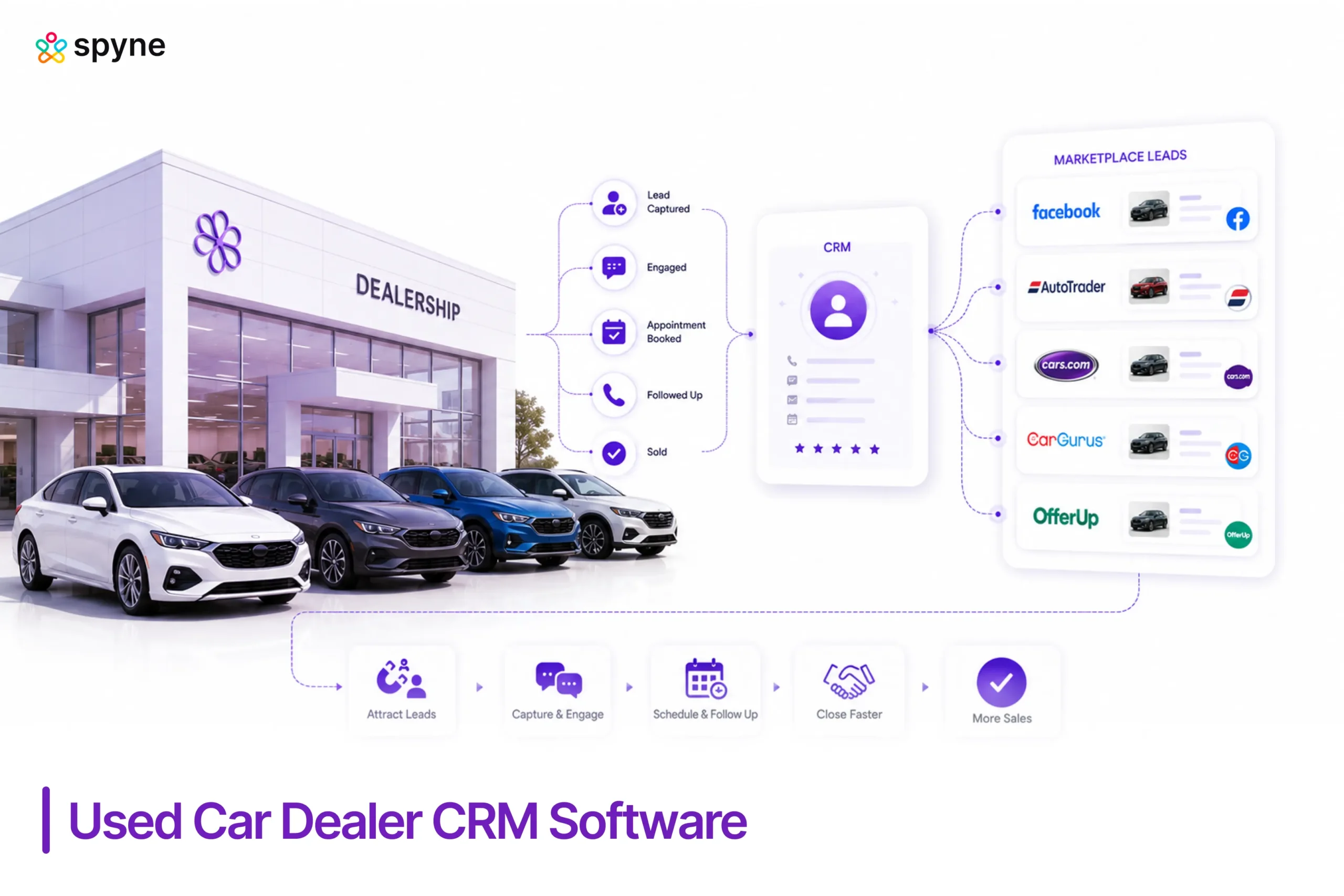
Used car dealer CRM software is a lead and customer management system built around how used-vehicle sales actually happen: multiple marketplace sources, fast-moving inventory, trade-in appraisals, and often subprime or buy-here-pay-here (BHPH) financing. Unlike a general sales CRM, it needs to ingest leads from AutoTrader, CarGurus, Facebook Marketplace, and a dealer’s own website into one pipeline, then match buyer preferences against a lot that can turn over in weeks rather than months.
The core job of used car dealer CRM software is speed and matching. Speed, because Cox Automotive’s 16th annual Car Buyer Journey study (released January 2026) found that dealers using AI-powered, integrated retail tools are seeing measurably higher buyer satisfaction scores than those still routing leads manually. Matching, because a used lot’s inventory changes constantly, and a CRM that tracks what a shopper actually wants can flag them the moment a matching trade-in lands.
Why Used-Car Dealers Need CRM Built for Used Inventory, Not Franchise Workflows
Franchise CRM workflows are built around OEM lead certification, warranty tracking, and manufacturer reporting. Used car dealer CRM software has to solve a different set of problems, and treating the two as interchangeable is one of the most common used car dealer CRM strategies mistakes independent dealers make.
What used-car operations actually need from a CRM:
- Marketplace lead ingestion: Leads arrive from AutoTrader, CarGurus, Facebook Marketplace, and Craigslist-style channels, often for a specific VIN. The CRM has to route each one without losing the vehicle context.
- Trade-in and appraisal tracking: Independent dealers source a meaningful share of inventory from trade-ins, so the CRM needs a place to log appraisal notes, not just a “won/lost” tag.
- BHPH and subprime workflows: Buy-here-pay-here dealers need customer payment history and lifecycle tracking inside the same record as the original sale conversation.
- Mobile-first data entry: Reps are on the lot, not at a desk, scanning a driver’s license or a VIN rather than typing into a browser tab.
- Inventory-to-buyer matching: When a new trade-in matches a dormant lead’s stated preferences, the system should surface that match automatically rather than relying on a rep’s memory.
These are the used car dealer CRM strategies that separate a platform a used lot can run daily operations on from one that was clearly built for a 40-person franchise BDC.

Best CRM Software for Used Car Dealers
Finding the best CRM for used car dealers usually comes down to five platforms: Spyne Automotive CRM, VinSolutions CRM, DealerSocket CRM, Elead CRM, and AutoRaptor. These are the names that come up most often when used-car and independent dealers run a used car dealer CRM comparison against their current used car dealer CRM software. None of them publish fixed pricing on their own websites, which is standard for B2B dealership software, so every quote below reflects publicly available feature information rather than list pricing.
| Platform | Best For | Key Features | Pricing |
| Spyne Automotive CRM | Used-car and independent dealers needing marketplace lead routing plus conversational AI follow-up | Omnichannel lead capture, automated SMS/email follow-up, inventory-to-buyer matching, reporting dashboard | Customized |
| VinSolutions CRM | Franchise and Cox Automotive-affiliated dealers | Deep OEM integrations, automated follow-up, customer insight dashboards | Connect with Sales Team |
| DealerSocket CRM | Larger used-car lots and multi-rooftop dealer groups | Lead tracking, desking tools, data mining for repeat-buyer trade-ins | Connect with Sales Team |
| Elead CRM | Dealers already on the CDK Global DMS ecosystem | Native DMS integration, tablet showroom workflow, CRM-native BDC tooling | Connect with Sales Team |
| AutoRaptor | Small to mid-size independent and BHPH dealers | Mobile license/VIN scanning, simple pipeline stages, unlimited-user plans | Connect with Sales Team |
For a single-rooftop independent lot, the practical shortlist is Spyne Automotive CRM or AutoRaptor, both built with a smaller sales team in mind. Multi-location used-car groups tend to need DealerSocket or VinSolutions for the reporting depth a general manager wants across rooftops. Dealers already running Elead’s DMS usually stay inside that ecosystem for the integration alone, even if the CRM itself takes more training time to run well.
How Does CRM Help Used Car Dealers Sell Faster?
CRM software helps used car dealers sell faster by closing the three gaps that cost the most deals: response time, follow-up consistency, and inventory-to-buyer matching.
1. Faster lead response
McKinsey’s 2026 Mobility Consumer Pulse survey found rising use of AI tools among car shoppers, particularly Gen Z and millennial buyers, for researching vehicles before ever contacting a dealer. That means by the time a lead reaches your CRM, the buyer has often already narrowed their choice, so the dealership that replies first usually gets the appointment. A used car dealer CRM software system routes and auto-acknowledges leads the moment they land, instead of waiting for a rep to check a shared inbox.
2. Consistent follow-up
A DAS Technology lead response study presented at NADA 2025, covering more than 1,700 dealerships, found persistent gaps in message quality and response consistency across the industry. A CRM closes that gap with scheduled reminders and automated touches for the “low-value” follow-ups, like a price-drop alert, so reps spend their time on active negotiations instead of retyping the same update.
3. Inventory-to-buyer matching
When a shopper’s stated budget, model, and mileage preferences sit in the CRM, a new trade-in or auction pickup can be matched to that buyer automatically. Instead of a lead going cold because the exact unit wasn’t in stock yet, the dealership can call before the vehicle is even detailed.
4. Shorter sales cycles
A visible pipeline from new inquiry through contacted, test drive, negotiation, and sold lets a sales manager spot a stalled deal in days, not weeks, and step in before the lead goes cold.
Used Car Dealer CRM Tips for Faster Turns
Choosing the best CRM for used car dealers is only half the job. These used car dealer CRM tips cover how independent and used-car dealers get more out of whatever used car dealer CRM software they already run:
1. Route marketplace leads by source, not just by rep: A CarGurus lead and a walk-in need different first messages; a CRM template built for one reads oddly for the other.
2. Log every trade-in offer, even declined ones: Declined trade-ins are still buyer-preference data for the next matching vehicle that arrives.
3. Set follow-up cadences past day three: Most dealership follow-up activity drops sharply after the first 48 hours, but a meaningful share of used-car buyers still purchase within that first week.
4. Use mobile scanning on the lot, not just at the desk: Reps who scan a license or VIN in the moment log more accurate data than reps who write it down to enter later.
5. Review lead-source reporting monthly: If AutoTrader leads convert at half the rate of CarGurus leads, that’s a marketing budget decision, not just a CRM setting.
None of these used car dealer CRM tips require a platform switch. They apply to whichever of the five vendors above a dealership already runs.
Common Mistakes Used Car Dealers Make With CRM Software
- Buying a franchise-oriented CRM for a used-car workflow: OEM certification tooling that a used lot never uses adds cost and training time without solving the actual problem.
- Skipping mobile setup: A CRM that only works well at a desktop terminal doesn’t match how used-car reps actually work the lot.
- Treating the CRM as a contact list: Without pipeline stages and matching rules, a CRM is just a nicer spreadsheet.
- Ignoring BHPH-specific needs: Dealers running subprime or in-house financing need payment-cycle visibility inside the same customer record, not a separate system.
Used Car Dealer CRM Comparison: What the Table Doesn’t Show
A feature table is a starting point, not the full used car dealer CRM comparison a dealer needs before switching platforms. Finding the best CRM for used car dealers means looking past the checkbox list. Three things matter more in practice than the checkbox list:
1. Setup and training time
AutoRaptor and Spyne Automotive CRM are generally quicker to get a small team up and running, while DealerSocket and Elead reward dealerships with a dedicated CRM administrator to manage the deeper configuration.
2. DMS dependency
Dealers already on CDK Global’s DMS tend to stay with Elead for the native connection alone, even when a competing CRM’s day-to-day interface is preferred by reps.
3. Where dealers actually talk about this
Threads on DealerRefresh and reviews on G2 consistently point to mobile ease of use and text-message reliability as the deciding factors for lot-based sales teams, more than any single feature on a spec sheet.
Spyne Automotive CRM: Used Car Dealer CRM Software Built for Marketplace Leads
Spyne Automotive CRM is built around the operational reality of used-car sales: leads arriving from multiple marketplaces for a specific vehicle, inventory that turns weekly, and sales teams working the lot on their phones rather than a desktop. It centralizes lead capture, follow-up, and inventory-matching into a single workflow instead of asking dealers to stitch marketplace tools together with a generic sales CRM. For independent and multi-rooftop used-car dealers alike, it fits alongside the existing DMS rather than requiring a full system replacement.
1. Multi-Channel Lead Capture
Capture leads from popular marketplaces, social platforms, and dealership websites in one centralized pipeline. Spyne automatically connects each inquiry to the specific vehicle a shopper is interested in, giving sales teams the right context for faster and more personalized follow-ups.
2. AI-Powered Customer Follow-Up
Engage every lead instantly with AI-powered conversations across calls and messages. Spyne helps dealerships respond to inquiries 24/7, ensuring late-night and after-hours shoppers receive timely responses before they move to another dealer.
3. Trade-In and Appraisal Management
Keep complete trade-in and appraisal details connected to each customer profile. Spyne stores vehicle preferences, appraisal notes, and previous interactions, helping dealerships identify future opportunities when matching inventory becomes available.
4. Intelligent Buyer-to-Inventory Matching
Reconnect with high-intent buyers by matching customer preferences with new inventory arrivals. Spyne identifies leads based on factors like budget, vehicle type, and mileage preferences, helping dealerships convert previously missed opportunities.
5. Mobile-First Sales Workflow
Give sales teams the ability to manage leads, capture trade-ins, and update customer information directly from the lot. Spyne’s mobile-friendly workflow reduces manual work and helps reps stay productive without relying on a desktop system.
6. Sales Pipeline and Performance Reporting
Track every customer interaction from first inquiry to final sale with clear pipeline visibility. Spyne provides insights into lead sources, conversion performance, and sales activity, helping managers understand what drives revenue.
7. Seamless DMS Integration
Connect Spyne with your existing dealership management system to improve sales operations without disrupting current workflows. Dealers can keep their inventory and accounting systems while adding powerful CRM capabilities for better lead management and customer engagement.

Conclusion
Used car dealer CRM software only earns its cost if it solves the problems specific to used-car sales: marketplace leads that need a fast reply, trade-ins that need to be logged even when declined, and inventory that turns too quickly for a rep to track from memory. Whether the choice comes down to AutoRaptor’s simplicity, DealerSocket’s reporting depth, or Elead’s DMS integration, the underlying used car dealer CRM strategies stay the same: respond fast, follow up consistently, and match buyers to inventory before a competitor does. Spyne Automotive CRM was built around exactly that used-car workflow, from first marketplace lead to signed deal. See it on your own lead flow. Book a demo today.