
| Executive Summary: This is a working checklist for scoring any dealership AI platform, voice, chat, or AI BDC, before signing a contract, not an article to read once. It covers seven core criteria: DMS write-back, live automotive accuracy, human handoff, reference customers, TCPA compliance, contract flexibility, and pricing, plus a due-diligence layer on data ownership and security certifications. A 13-category weighted scorecard then ranks finalists past demo polish. |
Nearly one in five dealerships still take over an hour to respond to an inbound lead, and 4% never respond at all (DAS Technology, 2025). That gap is exactly what most dealership AI pitches promise to close, which is why 74% of dealers now rank AI as a top priority for 2025 and 2026, pulling dozens of vendors into every GM’s inbox. Every pitch sounds the same until the follow-up question. This page is the tool for that follow-up: a 7-point vendor checklist, live test questions to run on the call, a due-diligence list for data and security, and a weighted scorecard to compare finalists on paper instead of on pitch quality.
What Problem Is Your Dealership AI Platform Actually Solving?
Name the specific gap before the first vendor call: missed calls during peak hours, cold leads going unworked, or a BDC team drowning in intake instead of working live buyers. A platform built for after-hours lead response and a platform built for service scheduling score very differently once you’re clear on which one you’re paying to fix. If you haven’t defined your criteria yet, start with the Dealership AI Buyer’s Guide before running this checklist.
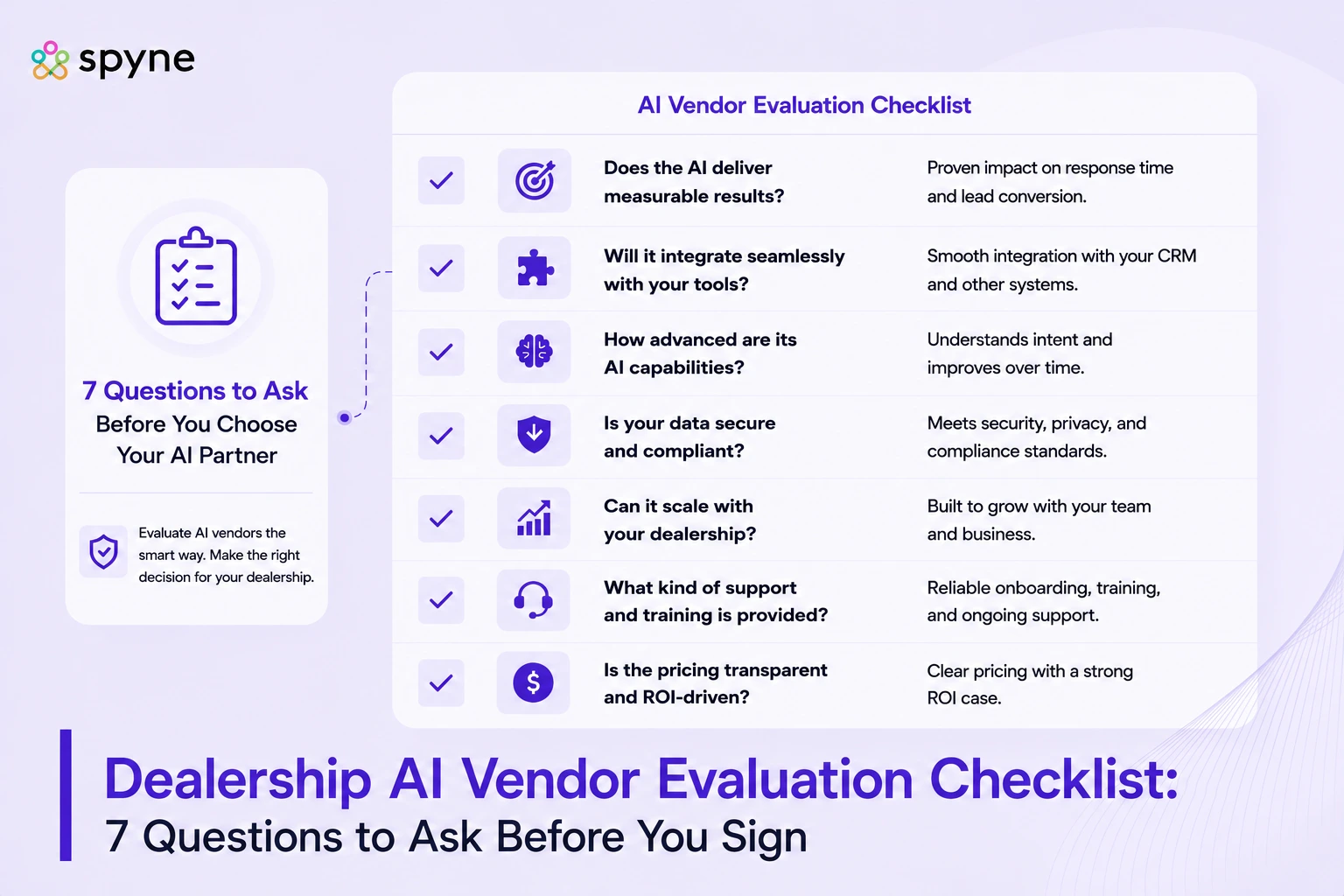
The 7-Point Dealership AI Vendor Checklist
Run every vendor through all seven rows on the same call. A vendor who scores clean on six and dodges the seventh has told you exactly where the product breaks.
| Criteria | Question to Ask the Vendor | What a Strong Answer Sounds Like | Red Flag Answer |
| DMS integration depth | Does this write back into our scheduler, or only read from it? | Names your DMS (VinSolutions, CDK, Reynolds) and gives a specific write-back example, such as booking directly into the service scheduler | “It integrates with most systems” — vague, no named DMS |
| Automotive knowledge | Can you run this against our actual inventory right now, live on this call? | Pulls your live inventory feed and answers a real VIN-level question correctly, on the spot | Only a scripted demo, no live test offered |
| Human handoff | What exactly triggers escalation, and does staff see full context? | Names a specific trigger, such as a financing question or price negotiation, and confirms the full transcript passes to staff | “It handles everything” |
| Reference customer | Can you connect us with a dealer on our exact DMS? | Offers a direct call with a comparable dealer within the week | No reference offered, or one on a different DMS |
| Security and compliance | How is consent tracked for outbound calls and texts? | Explains DNC scrubbing, consent capture, and AI disclosure without being asked twice | No clear TCPA answer |
| Contract flexibility | Can we start with one department and expand? | Offers a 30-day pilot or single-department start with no penalty to expand or exit | All-or-nothing contract, no trial period |
| Pricing model | Which pricing model applies, and is there a setup fee? | Asks about your call volume and lead sources before quoting, then itemizes the breakdown | Flat quote with no volume questions asked first |
Call-Handling Criteria Specific to Voice and BDC Vendors
If the vendor handles calls, chat, or lead intake, the seven core rows need a second layer specific to call-handling quality. This checklist won’t rank named vendors against each other, that comparison lives in the AI call bot buyer’s guide, but these are the questions to bring into any of those conversations:
- Automotive experience across departments. Ask whether the AI has handled sales, service, and parts calls, not just one department, and for how long.
- Lead response SLA. A vendor should state a specific number, such as under 60 seconds, not “fast” or “instant.”
- Call recording and QA scoring. Ask whether every call is recorded and reviewed, and how QA scores are shared with your team.
- OEM compliance requirements. If you carry a franchise brand, ask whether the vendor has handled that OEM’s specific call-handling rules before.
- Overflow versus fully outsourced coverage. Clarify whether the vendor only catches overflow when your team is busy, or fully replaces intake.
- Bilingual support. Ask whether Spanish-language calls are handled natively or routed elsewhere, if that matters for your market.
The Due-Diligence Checklist Most Dealers Skip
The seven-point checklist catches a bad vendor on the first call. It won’t catch a vendor whose data handling, model governance, or exit terms create problems six months in. These questions matter most for any AI vendor touching customer data or making decisions on your behalf, and they apply whether the platform handles calls, chat, or merchandising.
- Product and capabilities. Ask what the AI cannot yet do, not just what it can. A vendor who names specific limitations and accuracy metrics is more credible than one who claims no gaps. Ask how they measure hallucinations or incorrect outputs, and whether staff can see why the AI produced a given answer.
- Data privacy. Confirm whether your customer data is ever used to train models for other dealers, whether you can opt out of that entirely, and where the data is physically stored. Ask how long data is retained and whether you can force permanent deletion on request.
- Security. Ask which certifications the vendor holds, SOC 2 Type II or ISO 27001 are the standard answers. Confirm encryption in transit and at rest, and ask directly whether the vendor has disclosed a breach in the past, and how.
- Compliance. Beyond TCPA and DNC rules for outbound calls and texts, ask whether the vendor will sign a data processing agreement and how they handle a customer’s request to access or erase their own data.
- Model governance. Ask how often the underlying AI model changes, whether you get advance notice, and whether you can pin a specific version so a silent update doesn’t change call behavior overnight.
- Reliability. Get a specific uptime SLA in writing, not a verbal assurance. Ask what happens to inbound calls if the service goes down, and whether the vendor has a documented disaster recovery plan.
- Integration. Confirm what APIs exist, whether SSO is supported for your team’s login, and whether documentation is available for your IT contact to review before go-live.
- Pricing. Ask exactly what drives cost as usage grows, whether there are minimum commitments, and whether future price increases are capped in the contract.
- Ownership. Clarify who owns the call scripts, prompts, and configurations built specifically for your store, and what format your data is exported in if you leave.
- Support. Confirm support hours, guaranteed response times, and whether you get a named customer success manager instead of a shared ticket queue.
- Responsible AI. Ask how the vendor detects biased or harmful outputs, whether administrators can audit AI usage, and how a customer would report a bad response.
- Contract and legal. Get clarity on warranties, indemnities for IP infringement, limits of liability, and termination rights before you sign, not after a dispute starts.
If You Only Have 10 Minutes With the Vendor
These ten questions surface the most risk in the least time:
- Is our data ever used to train your models?
- Can we delete all our data at any time?
- What happens if your AI gives incorrect information to a customer?
- How do you validate model updates before releasing them?
- What security certifications do you hold?
- Can we export everything if we leave?
- What’s the biggest limitation of your product today?
- What costs typically surprise customers after deployment?
- What uptime and support SLAs do you guarantee?
- Can you provide a reference on our exact DMS?
Live Test Questions: What to Ask the Vendor’s AI, Not the Salesperson
Automotive knowledge is the one row you can verify in real time instead of taking on faith. Before the call ends, ask the vendor to run their AI against your actual inventory:
- “Do you have a certified 2023 Camry under $25,000 in stock right now?”
- “Can you book a service appointment for next Tuesday at 9 a.m.?”
- “What’s the difference between the LE and XLE trims on this VIN?”
- “A customer asks about financing on a vehicle that sold yesterday. What happens?”
Score the answers on correctness, whether the AI admits uncertainty instead of guessing, and how cleanly it escalates when it can’t verify something. Run the same four questions against every vendor on your list and compare the transcripts side by side. A vendor that fumbles a live test on your own inventory will not perform better once you’re a paying customer.
The Vendor Scorecard: How to Weight Each Category
Any vendor who failed DMS integration, human handoff, reference customer, or security and compliance in the checklist above is already out. Don’t score a disqualified vendor on the categories below, weighting a vague DMS answer more favorably just because the pricing was good defeats the point of gating in the first place.
For vendors who passed all four, score the rest on a weighted scale. Thirteen categories cover a dealership AI platform more completely than a single 1-to-5 gut check:
| Category | Weight | What to Evaluate |
| Automotive dealership expertise | 15% | Years serving dealerships, OEM knowledge, named reference dealers |
| DMS/CRM integration | 12% | Live write-back on CDK, Reynolds, Tekion, VinSolutions, DealerSocket |
| Appointment-setting effectiveness | 12% | Set rate, show rate, conversion after the appointment |
| Agent/AI quality and training | 10% | Automotive-specific training, onboarding process, ongoing QA |
| Service department capability | 8% | Recall campaigns, maintenance scheduling, repair order creation |
| Sales lead handling | 8% | Internet leads, phone-ups, follow-up cadence |
| Reporting and analytics | 8% | Dashboards, KPIs, call recordings, QA scoring |
| Customer experience | 7% | Speed to answer, bilingual support, brand consistency |
| Scalability | 5% | Multi-rooftop support, seasonal volume swings |
| Hours of coverage | 5% | 24/7, overflow-only, holiday coverage |
| Security and compliance | 4% | TCPA, encryption, named certifications |
| Implementation and onboarding | 3% | Timeline, training plan, pilot structure |
| Pricing | 3% | Transparency, total cost per outcome, not just the monthly fee |
Score each category 1 to 5, 5 being excellent and 1 being missing entirely, multiply by weight, and total out of 100.
Vendor Scoring Card
Copy this block once per vendor you’re evaluating, score each row 1 to 5, multiply by the weight from the table above, and compare the totals side by side.
| Category | Weight | Your Score (1–5) |
| Automotive dealership expertise | 15% | |
| DMS/CRM integration | 12% | |
| Appointment-setting effectiveness | 12% | |
| Agent/AI quality and training | 10% | |
| Service department capability | 8% | |
| Sales lead handling | 8% | |
| Reporting and analytics | 8% | |
| Customer experience | 7% | |
| Scalability | 5% | |
| Hours of coverage | 5% | |
| Security and compliance | 4% | |
| Implementation and onboarding | 3% | |
| Pricing | 3% | |
| Weighted total (out of 100) |
Fill out one card per vendor. The vendor with the highest weighted total, not the lowest monthly invoice, is the one to sign.
Why the Cheaper Vendor Isn’t Always the Better Score
Compare cost per appointment, not the monthly invoice. A vendor charging $4,500 a month that books 220 appointments costs about $20 per appointment. A vendor charging $3,200 a month that books only 95 appointments costs about $34 per appointment. The cheaper contract produced the more expensive outcome. Run this math before you sign, using the appointment numbers from your pilot, not the vendor’s projected numbers.
For the full pilot KPI list dealer groups should request before expanding past one rooftop, see Which AI Platform Is Right for Your Dealer Group’s Operation in 2026. For a deeper ranking of individual AI receptionist vendors against these same categories, see Best AI Receptionist Software for Car Dealerships.
How Vini AI Scores Against This Checklist?
Vini AI is Spyne’s conversational AI agent for dealership sales, service, and BDC, live across dealership accounts in the US. It runs on the DMS and CRM systems already in your store rather than sitting as a separate layer on top. Run it through the same seven rows you’d run any other vendor through:
| Checklist Criteria | What Vini AI does |
| DMS integration depth | Writes back into VinSolutions, DealerSocket, and CDK schedulers directly, not just reads from them |
| Automotive knowledge | Pulls from your live inventory feed and responds in under 5 seconds |
| Human handoff | Escalates on defined triggers, financing questions, price negotiation, anything it can’t verify, with the full transcript passed to staff |
| Reference customer | Paragon Honda recovered $310,000 in one week after go-live |
| Security and compliance | TCPA compliant, with DNC scrubbing, consent tracking, and AI disclosure on every call |
| Contract flexibility | Starts month-to-month, with the option to launch on one department before expanding |
| Pricing model | Scoped to your call volume and lead sources before a quote, not a flat rate |
On the weighted scorecard, Vini AI handles 70% of routine sales and service calls without human intervention, one platform covering both, not two separate tools with two separate contracts.

Closing Thoughts
Bring this checklist into your next vendor call, not after you’ve signed. Score every AI platform against these criteria before contract, not after go-live. Most dealerships find the missing DMS write-back or the dodged compliance answer in month two, when walking away is expensive. Book a demo with Spyne.