
| Executive Summary: A dealership communication bottleneck is a handoff failure between BDC, sales, and service, not a single missed call. CDK’s 2026 Modern Retail research found 40% of dealership employees name duplicate CRM leads as a top pain point, a direct symptom of departments that don’t share data. At a 100-unit store, closing a 5% conversion gap recovers roughly $36,750 in monthly net profit with the same team. Vini AI fixes this by writing every voice, chat, and SMS interaction back to one CRM record across departments, typically live within a week if your CRM is already integrated. |
Introduction
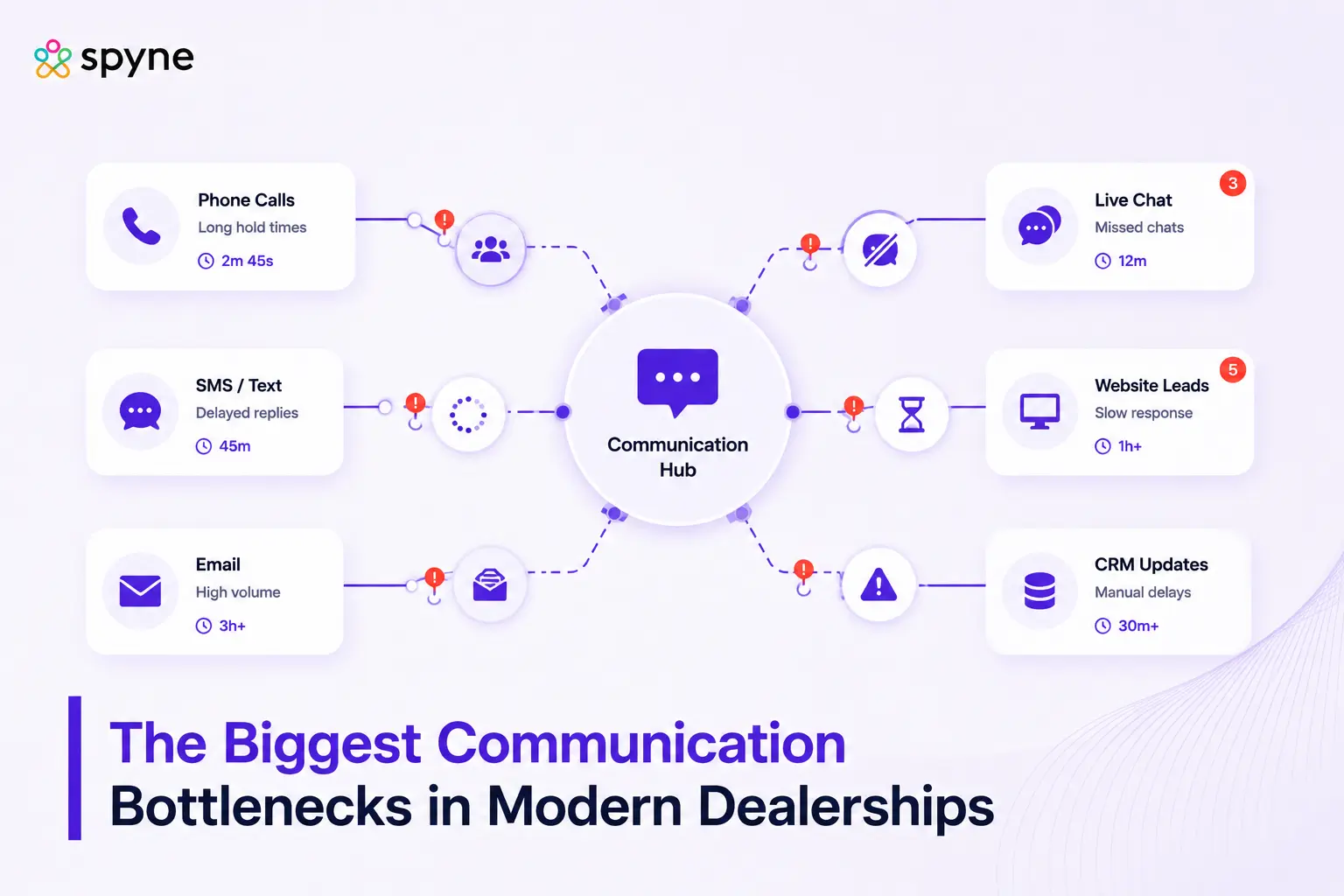
Your dealership has a phone system, a chat widget, and a CRM. Leads still vanish between them. Not because any single tool is broken, but because nobody engineered the handoff between BDC, sales, and service. Car Wars data shows the average dealership connects on only 63 to 65% of inbound calls, and CDK’s 2026 research found 40% of dealership staff cite duplicate CRM leads as a daily pain point, both symptoms of the same root cause: departments running on separate records. This piece breaks down exactly where handoffs fail, what each one costs, and how to evaluate a fix.
What Counts as a Communication Bottleneck at a Dealership?
A communication bottleneck is any point where customer context is lost as a lead moves between departments, not a single missed call or a slow text reply. Three handoffs account for nearly all of it: BDC to sales, sales to service, and BDC to service. At each one, information the next person actually needs, vehicle interest, promises made, service history, gets stripped away, forcing the customer to repeat themselves or wait for someone to catch up. Buying a better phone system, a better automotive chat tool, or a better CRM doesn’t fix this, because the failure lives in the gap between systems, not inside any one of them.
Where the BDC-to-Sales Handoff Actually Breaks
Leads don’t disappear because staff stop caring. They disappear because ownership becomes ambiguous the exact moment a lead is handed off, and ambiguous ownership is invisible until a customer is already gone.
The five points where this handoff typically fails
- Unclear ownership at transfer. BDC marks a lead “appointment set” and moves on. Sales doesn’t treat it as active until the customer physically walks in, leaving a dead zone in between where nobody is following up.
- A thin handoff. The salesperson receives a name and a phone number instead of the customer’s stated budget, trade-in interest, or timeline, so the first conversation restarts from zero.
- Slow response after transfer. An appointment gets booked through BDC, and the customer waits hours to hear from a salesperson, continuing to shop competitors in the meantime.
- Inconsistent CRM discipline. Notes are incomplete, tasks aren’t assigned, and lead status isn’t updated, so managers can’t tell where a lead is actually stuck.
- Misaligned incentives. BDC is measured on appointments set. Sales is measured on units sold. Neither team is measured on what happens to the customer in between, so neither prioritizes the handoff itself.
Assigning ownership at every stage
High-performing stores remove the ambiguity by defining exactly who owns the customer at each point in the journey, so there’s never a moment where two departments both assume the other has it:
| Stage | Owner |
| New internet or phone lead | BDC |
| Appointment confirmed | BDC |
| Customer arrives | Sales |
| No-show after 15 minutes | Sales and BDC jointly |
| Lost sale | BDC nurture campaign |
| Vehicle sold | Sales |
Diagnostic questions worth asking your own team
- How long does it take sales to contact a lead after BDC hands it off?
- Who owns a lead after an appointment is set but before the customer arrives?
- What percentage of confirmed appointments actually show up?
- How many “lost” leads get a follow-up within 24 hours?
- Can a manager identify uncontacted leads in real time, or only after the fact?
If your CRM can’t answer these in a few minutes, the issue is a process gap, not a staffing problem.
Where the Sales-to-Service Handoff Breaks Down
Sales and service run on entirely different incentive structures, and that gap is exactly why customer information stops moving between them. Sales is rewarded for closing deals. Service is rewarded for repair-order volume and lane throughput. Neither is measured on the customer’s experience crossing from one department to the other, so the handoff itself has no owner by design.
This shows up in two costly, specific ways at a dealership:
- Untracked commitments. A sales deal that includes reconditioning work, add-on installs, or a promised loaner arrives at service with no record of the commitment, forcing the advisor to renegotiate what the customer thought was already settled.
- Missed upgrade signals. A customer mentions wanting a newer model during a routine service visit, and that signal never reaches sales, even though it’s one of the highest-intent moments in the entire ownership cycle.
What actually fixes this, beyond “communicate better”
- Map the handoff explicitly. Document what information sales must pass to service, when the handoff happens, and who owns the customer at each stage, the same discipline used for the BDC-to-sales handoff above.
- Standardize what sales can promise. Define standard offerings, an approval process for exceptions, and clear service-level commitments, so a salesperson never promises something service can’t deliver on the customer’s first visit.
- Work from one shared record, not parallel notes. Sales and service should update the same CRM entry rather than keeping separate notes in email threads or paper logs.
- Build a short, recurring feedback loop. A 20 to 30 minute weekly sync between sales and service leads, covering upcoming deliveries, problem accounts, and recent misses, catches more breakdowns than any policy document.
- Share metrics that span both departments. Customer retention, renewal rate, and first-90-day satisfaction are outcomes both teams influence together; measuring only unit sales or RO count keeps the departments optimizing in different directions.
What Does a Disconnected CRM Actually Cost a Dealership?
A disconnected CRM costs a dealership in duplicate outreach, missed follow-ups, and leads contacted twice by two departments while a third customer gets contacted by no one. CDK’s 2026 Modern Retail research found 40% of dealership employees list duplicate CRM leads as a top daily pain point, a direct consequence of systems and departments that don’t share a single customer identifier. Separately, Car Wars’ most recent call-tracking data, cited by CBT News, puts average dealership phone connection rates at only 63 to 65%, meaning a third of inbound conversations never reach a live person in the first place, before a handoff even has a chance to happen.
The dollar impact scales with lead volume, not with staffing quality:
| Store Size | Monthly Lead Volume | Estimated Monthly Cost of Handoff Failures |
| Small (under 100 units/month) | Under 300 leads/month | Roughly $8,000 to $12,000 in missed or duplicated follow-ups |
| Mid-size (100 to 200 units/month) | 300 to 600 leads/month | Roughly $20,000 to $36,000; a 5% conversion gap closed at a 100-unit store alone adds $36,750 in monthly net profit |
| Large / dealer group (200+ units/month) | 600+ leads/month | Compounds across rooftops; an unaddressed handoff gap at group level can exceed $400,000 annually |
Insufficient data for a precise per-tier multi-rooftop breakdown. The large-group figure above is directional, not a validated benchmark, and should be checked against your own CRM export before being used in a board deck.
Is It Worth Consolidating Phone, Chat, and CRM Into One AI Platform?
It’s worth it once communication volume is high enough that staff are genuinely losing time switching between systems, not simply because consolidation sounds efficient on paper. The real advantage isn’t that one platform answers calls and chats. It’s that every interaction, phone, chat, email, and SMS, becomes visible in one customer history, so AI and human staff work from identical context regardless of which channel a conversation started on.
Where consolidation tends to pay off
- A sales or BDC team handling hundreds of conversations a week
- Customers who move between channels, calling after starting a web chat, or texting after a service call
- Manual CRM updates that consume real staff hours every day
- Multiple disconnected systems creating duplicate data entry
- A goal of automating routine inquiries while routing complex issues to a person
Where it may not be worth it yet
- A single-rooftop store with genuinely low inquiry volume
- Existing tools that already integrate well with each other
- A need for AI on only one channel, such as website chat alone
- Migration and retraining costs that would outweigh the realistic efficiency gain
Questions worth asking before choosing a platform
- Does it natively support voice, chat, SMS, and CRM, or is it stitching together third-party products behind the scenes?
- Can AI access customer history securely, with appropriate role-based permissions?
- How easily can a conversation hand off from AI to a human without losing context mid-thread?
- Does it produce measurable outcomes, reduced handling time, higher appointment rates, lower missed-call volume, not just activity counts?
- Can you export your data cleanly if you decide to switch vendors later?
The strongest business case almost always comes from reducing operational friction, not from replacing people. If staff are currently switching between systems, re-entering the same customer information twice, or repeating conversations across channels, consolidation tends to pay for itself quickly. If the existing workflow is already tight, the incremental gain may be smaller than the migration effort.
How to Evaluate a Platform That Connects BDC, Sales, and Service?
Evaluating a fix for this problem is different from evaluating a single-channel tool. The question isn’t “does it answer calls well,” it’s “does it keep BDC, sales, and service working from the same customer record.” Use this as a structured due-diligence pass, not a single yes/no question.
- Shared customer timeline. Every department should see the same interaction history, calls, texts, chats, appointments, notes, and service records, so a customer never has to repeat themselves moving between teams.
- Omnichannel coverage. Confirm native support for SMS, email, voice, web chat, and, where relevant, social messaging, with customers able to switch channels mid-conversation without losing context.
- Department handoffs, not just lead capture. A lead should move cleanly from BDC to sales, sales to finance, sales to service, and service back to sales for trade-in or upgrade opportunities, with conversation history following automatically at every step.
- CRM and DMS integration depth. The platform should write directly into your existing CRM and DMS rather than requiring staff to enter the same information twice in two systems.
- Automation that doesn’t feel robotic. Look for lead acknowledgment, appointment reminders, missed-call follow-up, and re-engagement campaigns, with an easy path for staff to take over a conversation mid-thread.
- Intelligent routing. Messages should reach the right team automatically based on inquiry type, existing customer status, vehicle owned, time of day, and store location for multi-rooftop groups.
- Appointment management. The system should schedule, confirm, reschedule, and remind automatically, and sync cleanly with both sales and service calendars.
- Outcome-based reporting. Push past activity metrics like calls made or texts sent. Look for response time, appointment set rate, appointment show rate, and, critically, handoff failure rate specifically, not just channel-level volume.
- Mobile accessibility. Salespeople, advisors, and managers need to respond, get notified, and pull up customer history from a phone, not just a desktop console.
- Compliance and security. For automotive specifically, confirm TCPA-compliant texting, opt-in and opt-out management, role-based permissions, and audit trails.
- AI capability depth. Suggested replies, conversation summaries, lead prioritization, and automated follow-up recommendations should genuinely save staff time, not just generate more dashboards to check.
- Ease of adoption. The most feature-complete platform is worthless if your team won’t use it. Evaluate onboarding time, interface simplicity, and vendor support quality, not just the feature list on a sales deck.
Questions to put directly to a vendor
- Can every department see the complete customer conversation, or only their own department’s slice of it?
- How exactly do conversations transfer between BDC, sales, and service, automatically or manually?
- Which CRMs and DMS platforms do you integrate with natively, and which require middleware?
- What automation is included out of the box versus requiring custom development?
- How do you measure and report on handoff failures specifically?
- What is a realistic implementation timeline for a store our size?
How Vini AI Closes These Handoff Gaps
Vini AI runs four dedicated agents, Sales Inbound, Sales Outbound, Service Inbound, and Service Outbound, and every one of them writes back to the same CRM record and Spyne Console, regardless of which channel or department the conversation started in. A customer who chats about a used car on Monday and calls about a service appointment on Thursday is recognized as one continuous relationship, not two disconnected contact records.
How AI Improves Dealership CSI Scores: Vini AI answers in under five seconds and handles around 70% of routine sales and service conversations without requiring human intervention. This allows BDC staff and service advisors to focus on qualified customer interactions instead of spending time piecing together information scattered across different systems.
| Bottleneck Type | Department Pair | Symptom | How Vini AI Closes It |
| Lost lead context | BDC to Sales | Salesperson receives a name and number, not stated intent | Full conversation history transfers automatically with the lead |
| Untracked commitments | Sales to Service | Customer arrives expecting a promised add-on with no record of it | Sales Outbound and Service Inbound agents share one customer file |
| Blind follow-up | BDC to Service | A campaign re-contacts a customer who already resolved the issue by phone | Service Inbound logs resolution status before any outbound campaign runs |
| Duplicate entry | All departments | The same customer is logged twice across two open records | One write-back to CRM and Spyne Console per contact, not per channel |

Closing Thoughts
Most dealerships have already bought the phone system, the chat tool, and the CRM. The real leak isn’t inside any one of them. It’s in the handoff between BDC, sales, and service, where context disappears and leads go cold waiting for someone to notice. A third of inbound calls never connect in the first place, and disconnected CRM records only compound that loss once a lead does get through. Fixing the channel isn’t enough. Fixing the handoff is what actually stops the leak. See what closing that gap looks like at your store: talk to Spyne about your handoff data.