
Executive SummaryUsed car inventory management software for dealer groups centralizes vehicle data, pricing, and transfers across every rooftop so no store buys, prices, or lets a car sit blind to what the rest of the group holds. Cox Automotive’s June 2026 data put used-vehicle days’ supply at 47 nationally, and NADA’s 2025 midyear report found the top 150 dealer groups now control roughly a third of industry revenue, up from a quarter in 2019, which makes group-wide used car inventory visibility a bigger lever every year. |
A vehicle sits ready to sell at Store B while Store A’s used car inventory manager cold-calls three lots looking for the same trim, unaware it is twelve miles away on the same P&L. NADA’s 2025 midyear count shows 90.7% of dealers still run five stores or fewer, but the groups above that line now hold a third of industry revenue, and most still coordinate used car inventory by phone and spreadsheet. This article walks through what group-wide used car inventory software actually needs to do, how the leading platforms compare, and where the coordination usually breaks.
What Is Used Car Inventory Management Software for Dealer Groups?
Used car inventory management software for dealer groups is a platform that tracks every used vehicle a dealership group owns, across every rooftop, in one connected system rather than in separate store-by-store spreadsheets or standalone DMS modules. It covers acquisition, appraisal, reconditioning status, pricing, merchandising, and reporting, and it adds a layer single-store tools do not need: shared visibility so any store can see, request, or transfer inventory sitting at another location in the same group.
For a single independent lot, used car inventory software mostly needs to manage one location’s acquisition-to-sale cycle; readers who only need that single-location overview can start with our broader breakdown of automotive inventory management software. For a dealer group, the same used car inventory management software (also searched as used car dealership inventory management software, since both terms describe the same category) also has to answer questions like which store is carrying a stale unit the longest, whether two rooftops are bidding against each other at the same auction, and how pricing rules apply consistently once a car crosses from one franchise’s lot to another’s.
The Used Car Inventory Problem That’s Unique to Multi-Rooftop Groups
Cross-store visibility, not acquisition volume, is what actually slows down used car inventory turn at dealer groups. A single store manager already knows their own lot. A group’s problem starts the moment a second rooftop enters the picture, because now no manager has a full view of the group’s used car inventory without asking someone else or opening a second system. None of this is a volume problem. It is a visibility problem, and it is the specific gap that group-focused used car inventory management software exists to close.
Where the Coordination Gap Shows Up
The pain shows up in a few recurring ways:
1. Manual cross-store searches
CDK Global’s own dealer-group product notes describe groups still relying on “phone calls, spreadsheets, and manual searches” to find out whether a vehicle a customer wants is sitting at a sister store.
2. Duplicate acquisition
Two rooftops in the same group can appraise or bid on similar units without knowing the other already has comparable inventory on the lot, which ties up more capital than the group needs tied up.
3. Inconsistent pricing across rooftops
Without a shared pricing rule set, the same trim and mileage can be priced differently at two stores ten minutes apart, which confuses shoppers cross-shopping the group’s own inventory online.
4. Reporting that only rolls up monthly, not daily
Store-level dashboards are common. Group-level, daily views of days’ supply, aging, and profit-per-day by rooftop are far less common, which means slow-moving used car inventory often goes unnoticed until it is already aged past 60 or 90 days.

Best Tools to Manage Used Car Inventory Across Dealer Group Rooftops
The best tools to manage used car inventory across dealer group rooftops are Spyne Inventory Management, vAuto, VinSolutions, DealerSocket, and CDK Global, five platforms built around enterprise-level, cross-store visibility rather than single-lot tracking. Independent and buy-here-pay-here lots tend to shop a different shortlist (DealerCenter, Frazer, AutoManager) built for single-location acquisition and financing workflows instead; see our full breakdown of used car inventory software for independent and BHPH dealers for that comparison. Dealer groups evaluating used car inventory software are typically comparing the narrower, more enterprise-oriented set above, because the buying decision hinges on group-wide visibility, not single-lot ease of use.
Top Used Car Inventory Software for Dealer Groups, Compared
| Software | Best For | Group-Level Strength |
| Spyne Inventory Management | Multi-rooftop groups needing one connected system for used car inventory tracking, pricing, transfers, and merchandising | Centralized dashboard, group-wide VIN tracking, and AI-assisted merchandising applied consistently across rooftops |
| vAuto (Provision) | High-volume dealers and groups focused on market-based pricing discipline | Aging visibility and live market pricing benchmarks that can be applied group-wide |
| VinSolutions (Inventory+) | Mid-size groups needing centralized inventory control and bulk edits | Bulk-edit tools and profit-per-day tracking across multiple rooftops |
| DealerSocket | Franchise groups already standardized on DealerSocket’s CRM and inventory stack | Inventory data tied to the group’s existing CRM and sales workflow |
| CDK Vehicle Inventory Suite | Groups wanting a single connected view tied into CDK’s DMS ecosystem | Customizable account groups for single-dashboard visibility across every rooftop, plus shared appraisal management |
How Group-Level Used Car Inventory Management Actually Works
Group-wide used car inventory management software is not one feature. It is four connected pieces working off the same data, and most of the platforms compared above handle at least two of the four reasonably well. Groups evaluating a switch should ask which of the four a candidate platform actually covers today, versus which ones are on a roadmap, since the gap between those two answers is usually where implementation timelines slip.
1. Central Acquisition and Allocation
Every appraisal, trade-in, and auction purchase feeds one group-wide system instead of a store-by-store log, cutting the duplicate-buying problem described above. Groups running Spyne Automotive CRM can also tie that acquisition data directly to lead and appraisal workflows.
2. Cross-Store Transfer Visibility
Once a car is logged group-wide, any store can see it, request it, and track its transfer status without a phone call. This is the piece CDK explicitly built its “connected view” around, and it is the single most requested capability from multi-rooftop groups evaluating used car inventory software.
3. Group-Wide Pricing Discipline
Pricing rules, floors, and market comparisons apply the same way whether a car is at the flagship store or the newest acquisition. That keeps the group from competing against itself online and keeps every store’s used car inventory priced against the same local market data.
4. Rolled-Up, Daily Reporting
Days’ supply, aging, and profit-per-day should be visible by rooftop and by group, updated daily rather than reconstructed at month-end. Cox Automotive’s June 2026 report put national used-vehicle days’ supply at 47, up two days from May, and a group without daily rooftop-level visibility into that number is finding out about aging inventory later than it should. For analytics-first platforms, see our car inventory software with analytics breakdown.
What Fragmented Used Car Inventory Actually Costs a Dealer Group
Fragmented used car inventory carries a real dollar cost, not just an operational headache. NIADA has put daily holding costs for a used vehicle at roughly $35 to $55 per unit, covering floor-plan interest, insurance, and lot space. That figure applies to any single dealership, but it compounds differently at a multi-rooftop group.
Picture a three-store group where two rooftops each acquire a similar mid-trim SUV in the same week, unaware the other already has one on the lot. At $45 a day in holding cost, every extra week either unit sits before someone notices the overlap adds roughly $315 in avoidable carrying cost, on a purchase that arguably should not have happened at all. Multiply that pattern across a 10-store group acquiring dozens of used vehicles a week, and the cost of not having shared visibility into used car inventory quickly outgrows the cost of the software meant to fix it.
The same math applies to pricing gaps. A unit priced above market at one rooftop simply sits longer, racking up the same $35 to $55 a day, while an identical unit at a sister store might already be moving at the right price. Group-wide used car dealership inventory management software exists specifically to catch both patterns before they turn into weeks of extra holding cost.
Decision Framework: Matching Used Car Inventory Software to Group Size
Not every dealer group needs the same depth of used car inventory management software, and buying more platform than the group’s structure requires is its own kind of waste. A rough way to think about fit by size:
1. Two to three rooftops
A shared dashboard and basic cross-store search often solves most of the visibility gap. Full enterprise reporting suites can be more platform than the group needs yet.
2. Four to ten rooftops
This is where group-wide pricing rules, daily rolled-up reporting, and a formal transfer workflow start paying for themselves, since informal phone-and-spreadsheet coordination breaks down reliably past this size.
3. More than ten rooftops, or multiple franchises
Integration with the group’s existing DMS or CRM stack becomes the deciding factor as much as the inventory features themselves, since a platform that does not connect cleanly to what is already in place adds a second system to maintain rather than replacing one.
Common Mistakes Dealer Groups Make Managing Used Car Inventory
1. Treating single-store software as good enough at scale
A tool built for one lot’s acquisition-to-sale cycle rarely has real cross-store transfer or group reporting built in, so groups bolt on spreadsheets to cover the gap.
2. Letting each rooftop set its own pricing rules
Independent pricing by store is how two locations in the same group end up undercutting each other on nearly identical units.
3. Reviewing group-wide inventory only at the monthly meeting
By the time aging used car inventory shows up in a monthly rollup, it has often already cost the group weeks of holding costs it could have caught daily.
4. Skipping a transfer workflow entirely
Without a formal process for requesting and moving inventory between stores, transfers happen inconsistently or not at all, even when the group’s own lot has exactly what a customer wants.
5. Buying software for the group’s current size, not its next one
A platform that fits three rooftops can fall short at eight; sizing up a tier when selecting used car inventory software usually avoids a disruptive re-platforming later.
For a closer look at avoiding these patterns store by store, see our car lot management best practices.
Spyne Inventory Management: Used Car Inventory Software for Multi-Rooftop Dealer Groups
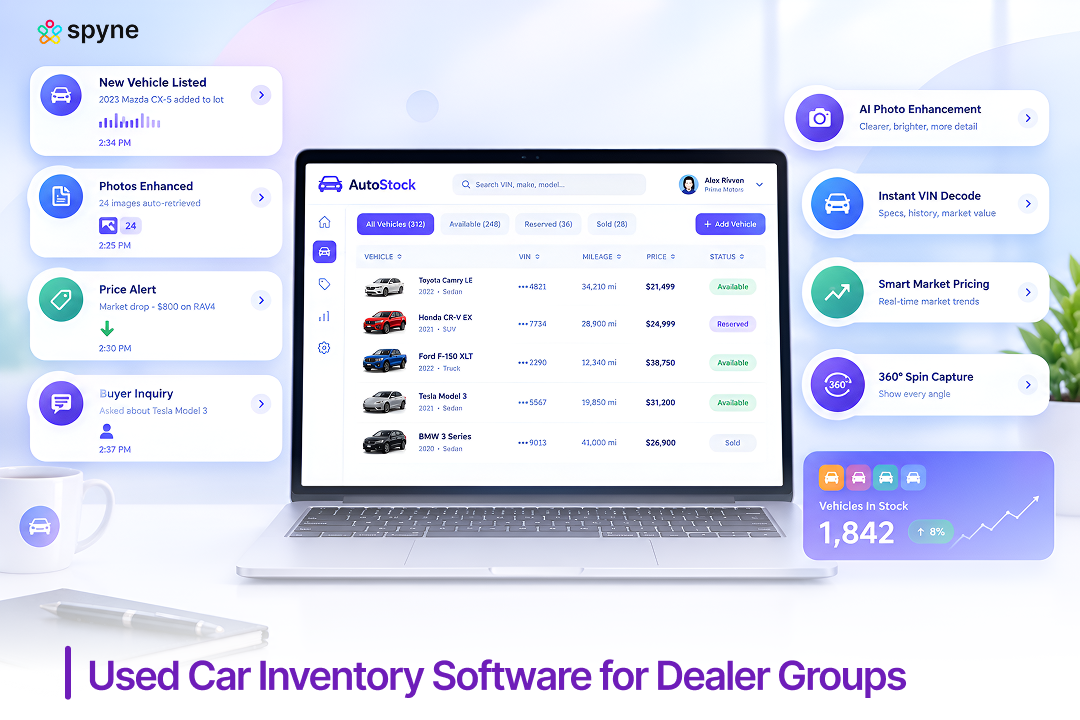
Spyne Inventory Management is used car inventory management software, not a photo or imaging add-on. It gives dealer groups one connected system for tracking, pricing, and transferring used car inventory across every rooftop, instead of a separate spreadsheet or DMS module per store. It sits on top of the acquisition-to-sale workflow already in place and adds the group-wide layer most single-store tools skip: shared visibility, consistent pricing, and merchandising that looks the same whether a listing comes from the flagship store or the newest acquisition.
1. Group-Wide Inventory Dashboard
A single dashboard shows every rooftop’s used car inventory side by side, including age, price, recon status, and days on lot. A GM overseeing four stores can see which location is sitting on the oldest units without logging into four separate systems.
2. Cross-Store VIN Tracking
Every vehicle is logged with a VIN the moment it is acquired at any store, so any other rooftop in the group can search and locate it instantly. A sales rep at Store C can confirm in seconds whether Store A has the trim a customer wants, instead of making a call and waiting for a callback.
3. Consistent Merchandising Across Rooftops
Photos, descriptions, and listing quality are standardized and automated group-wide through Spyne’s AI car merchandising tools, so a car acquired at a smaller satellite store gets the same merchandising treatment as one acquired at the flagship location. That consistency matters when shoppers cross-shop a group’s own rooftops online.
4. Live Market Pricing Applied Group-Wide
Pricing benchmarks pull from live market data and apply the same rules across every store, which keeps two rooftops in the same group from pricing an identical unit differently and undercutting each other.
5. Reconditioning Status by Store and by Group
Recon stage, cost, and time-to-line are tracked per vehicle and rolled up by rooftop, so a group can see whether one store’s recon process is consistently slower and adding days to that location’s used car inventory turn.
6. Group-Level Days’ Supply and Aging Reports
Daily reporting on days’ supply, aging, and profit-per-day is available by rooftop and by group, not just at month-end, so slow-moving inventory gets flagged while there is still time to reprice or transfer it.
7. Automated Syndication to Every Channel, Per Rooftop
Listings sync to the group’s website, marketplaces, and classified networks automatically, with each rooftop’s inventory tagged correctly so a shopper searching by location sees the right store’s used car inventory, not the whole group’s.
8. Transfer-Ready Vehicle Data
Because every vehicle’s condition, pricing, and photos already live in one system, moving a unit from one rooftop to another does not mean re-entering data or re-shooting photos. The listing simply updates to reflect the new location.

Conclusion
Used car inventory stops being a single-store problem the moment a group adds a second rooftop, and most groups are still running that expanded problem through single-store tools and spreadsheets. Cox Automotive’s 47-day national used-vehicle supply figure and NADA’s finding that the top 150 groups now hold roughly a third of industry revenue both point the same direction: group-wide used car inventory visibility is worth more every year, not less. Software built specifically for that cross-store view, rather than adapted from a single-lot tool, is what actually closes the gap.