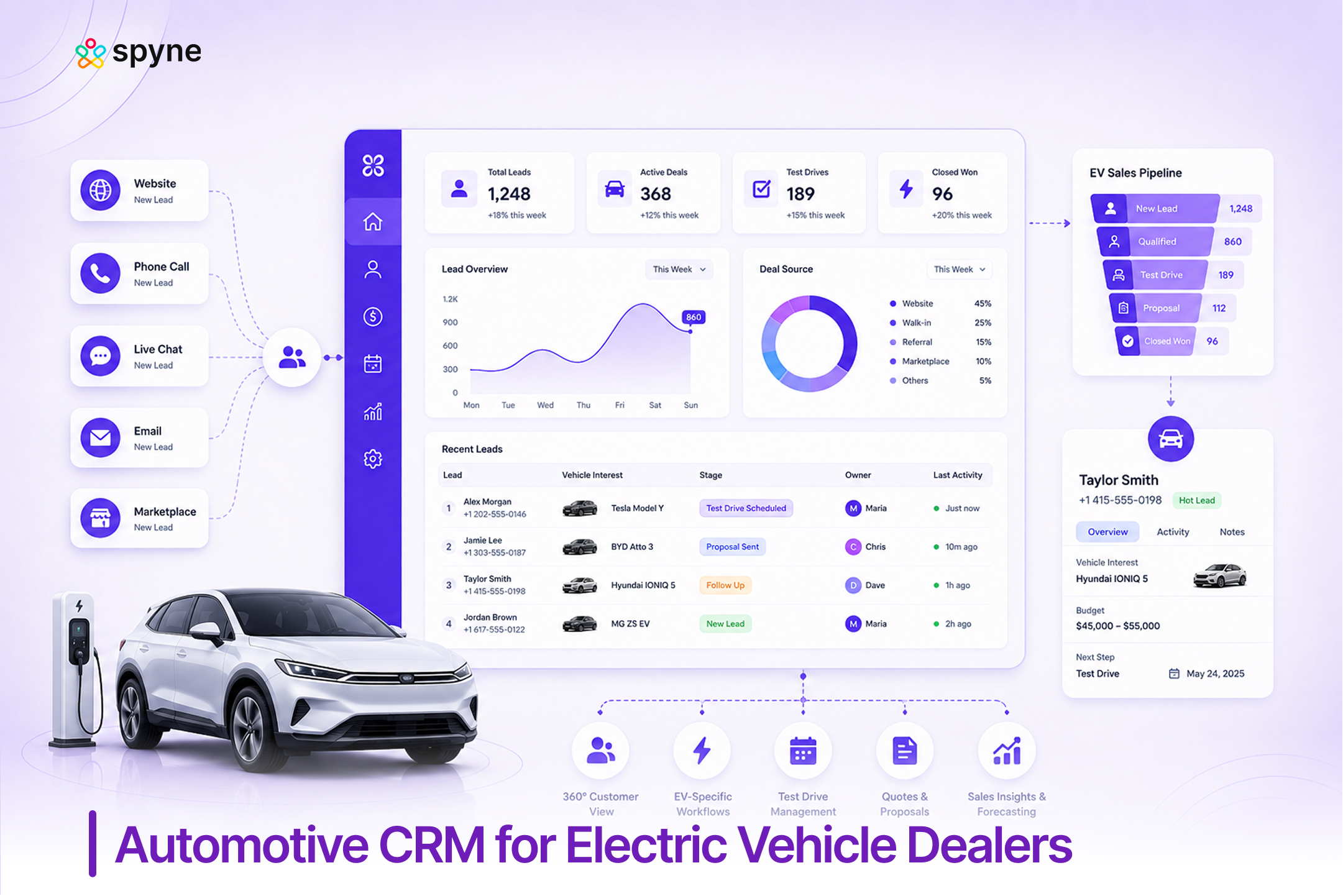

Executive SummaryAutomotive CRM for electric vehicle dealers works only when it tracks signals a standard sales CRM ignores: trade-in equity on two different depreciation curves, incentive eligibility, and lease-return timing. Cox Automotive’s Q1 2026 Dealer Sentiment Index found EV sentiment among franchised dealers fell to 25, down from 51 a year earlier, even as Cox Automotive reported used EV sales rose 12 percent year over year in the same quarter. That gap between dealer confidence and actual transaction volume is exactly what an EV-ready CRM is built to close. |
A shopper trades in a three-year-old gas sedan for a new EV. Your CRM logs it like any other trade-in: mileage, condition, offer. What it does not log is that EV trade-ins depreciate on a different curve, that this buyer might qualify for a rebate nobody mentioned, or that the lease on their current EV matures in four months, one of roughly 50,000 EV leases maturing monthly by late 2026, according to Cox Automotive. Automotive CRM for electric vehicle dealers has to catch what generic sales CRMs are built to miss. Here is what that looks like, and where Spyne fits.
What Is Automotive CRM for Electric Vehicle Dealers?
Automotive CRM for electric vehicle dealers is customer relationship management software configured to handle the data points unique to EV sales: trade-in equity on non-standard depreciation curves, federal and state incentive eligibility, charging questions, and lease-return timing on EVs leased through the 2023 to 2025 wave. It is not a separate product category from a standard automotive CRM software. It is the same CRM dealerships already use for lead management, sales pipelines, and follow-up, configured with the fields an EV sales process needs.
Most dealership CRM platforms were built around one transaction: a gas vehicle with a known depreciation schedule, a straightforward trade-in appraisal, and financing that does not depend on a federal tax credit’s eligibility window. EV sales break each assumption. A three-year-old EV trade-in can be worth more or less than a CRM’s default depreciation model predicts, and incentive eligibility can change between the showroom visit and the signature.
For dealerships selling both EVs and gas vehicles, the answer is not a separate EV CRM. It is a configurable automotive CRM for EV dealerships that adds these data points without disrupting the workflow reps already use.
Where an EV CRM Layer Fits in the Dealership Stack
Most answers to this question default to naming a bigger platform: an enterprise CRM, a DMS with more modules, an automotive cloud. That misses the architecture question. The useful frame is a chain: lead sources feed an EV-specific CRM layer, which feeds the dealership’s core automotive CRM, which feeds the DMS, which feeds digital retail and F&I.
None of VinSolutions, DealerSocket, CDK, DriveCentric, Tekion, or AutoRaptor were built as that EV-specific layer. They are the core automotive CRM further down the chain, already running desking, inventory, and general lead management. The gap sits earlier: qualifying a lead by battery range and home-charging readiness, tracking Section 30D and state incentive eligibility, and running EV education sequences before a general-purpose CRM record even opens.
A dealership does not need to replace its core CRM to close that gap. It needs a layer, built on configurable fields, automated sequences, and lead scoring, that sits in front of the existing CRM and DMS rather than competing with them. That is the role automotive CRM for electric vehicle dealers should play, and it is the specific role Spyne Automotive CRM’s configuration fits.
Why Generic Dealership CRMs Fall Short for EV Sales
Generic dealership CRMs fall short of what automotive CRM for electric vehicle dealers actually needs because their default fields do not match how EV transactions move.
Consumer sentiment on EVs has shifted in ways most CRM setups are not built to track. McKinsey’s Mobility Consumer Pulse 2026 survey found range anxiety dropped from the second-highest EV concern in 2023 to eighth place in 2026, with only about 20 percent of skeptical consumers now citing range as a holdout reason, down from 45 percent three years earlier. Charging concerns remain elevated. Today’s EV sales conversation is less about range and more about financing, incentives, and charging logistics, none of which a standard lead form captures.
Dealer sentiment and market reality have also diverged. Cox Automotive’s Q1 2026 Dealer Sentiment Index found EV sentiment among franchised dealers fell to 25, the steepest decline of any segment, down from 51 a year earlier. Yet in the same quarter, Cox Automotive reported used EV sales rose 12 percent year over year to 93,500 units, with average used EV pricing landing within roughly $1,300 of comparable gas vehicles. A CRM that only tracks pipeline stage will not surface that gap; one configured to flag trade-in equity, incentive status, and lease-maturity timing will.
This is also why CRM with DMS integration matters more for EV dealerships, since incentive eligibility and lease data often live outside the CRM itself.
How CRM Supports EV Sales: The Data Points a Standard Setup Misses
How CRM supports EV sales comes down to five data points most dealership CRM configurations were never asked to track.
1. Trade-In Equity on a Different Depreciation Curve
EVs and gas vehicles do not depreciate the same way, and a CRM’s default trade-in logic usually assumes one curve for everything. Used EV values have converged with gas-vehicle values faster than most CRM defaults account for, with Cox Automotive reporting average used EV listing prices landed within about $1,300 of average used gas vehicles in Q1 2026. EV-specific trade-in fields catch equity swings a generic model would misread, which matters directly for used car dealer CRM software handling mixed inventory.
2. Incentive and Rebate Eligibility
Federal incentive eligibility under Section 30D, plus state and OEM rebate rules, changes often, and eligibility can shift between a shopper’s first visit and their financing conversation. A standard CRM has no field for tracking incentive status against income, price caps, or delivery timelines. Without it, reps quote incentives that no longer apply or miss ones a buyer qualifies for, and financing gets renegotiated late in the deal. Flagging incentive eligibility as a custom field, tied to a follow-up task, removes that risk.
3. Service Retention: OTA Updates and Battery Health
EV service retention runs on different triggers than oil-change reminders: over-the-air software updates, battery health checks, and tire wear from added vehicle weight. A CRM that only fires standard mileage-based service reminders misses all three, and misses the tie-back to the original sale that would let a service visit surface a lease-maturity or trade-in conversation. Routing EV service triggers through the same CRM record as the sale keeps that connection intact instead of splitting it across sales and service systems.
4. Lease-Return Timing as a Sales Trigger
The 2023 to 2025 wave of EV leases is starting to mature, and Cox Automotive projects monthly lease returns climbing toward roughly 240,000 vehicles over the coming year, with about 20 percent expected to be EVs. That is a scheduled opportunity most CRMs never surface, since lease-maturity dates typically sit in a DMS or a lender’s system, not the CRM’s follow-up queue. Automotive CRM for electric vehicle dealers should treat an approaching lease maturity like a hot inbound lead: a task, a deadline, an assigned rep.
5. Charging and Range Questions During the Sales Cycle
EV shoppers ask about charging and range earlier than gas buyers ask about fuel economy, and those questions often surface before a lead reaches a rep, through chat, web forms, or service conversations. A CRM that logs them as structured data, rather than a free-text note, lets a rep walk in already knowing whether the objection is charging access, installation cost, or range for a specific commute.
6. Hybrid Buyer Bleed-Over
A meaningful share of EV-curious shoppers end up buying a hybrid, and a CRM that treats “EV interest” as one lead type loses that nuance. McKinsey’s research on the EV transition found buyer preferences moving toward more mainstream shoppers, just as likely to land on a hybrid as a full EV once range, price, and charging tradeoffs get weighed. Tagging leads by underlying concern, not vehicle type alone, keeps a hybrid sale from looking like a lost EV lead.

Best Automotive CRM That Supports Electric Vehicle Dealership Sales
The best automotive CRM that supports electric vehicle dealership sales is not necessarily the platform with the most EV-specific marketing copy. VinSolutions is usually the default answer for its ecosystem depth, and DriveCentric usually gets named for rep-facing UX. Both are strong at running the core dealership CRM. Neither was built to track incentive eligibility or lease-maturity timing as first-class data. Below is how six platforms compare on the capabilities that matter most for EV-heavy sales pipelines.
| CRM | Best For | Lead & Follow-Up Handling | Pricing |
| Spyne Automotive CRM | Dealers who want an EV-specific layer: incentive windows, trade-in equity, and lease timing, on top of their existing stack | AI-assisted lead scoring, automated follow-up sequences, custom fields for non-standard data points | Customized |
| VinSolutions CRM | Franchise dealers already inside the Cox Automotive ecosystem | GenAI-assisted messaging, equity mining across the trade-in database | Connect with Sales Team |
| DealerSocket CRM | Large, multi-rooftop dealer groups | Equity mining through RevenueRadar, OEM program certification tracking | Connect with Sales Team |
| CDK ELEAD | CDK-native dealer groups | Structured call tracking, BDC follow-up workflows, CDK ecosystem integration | Connect with Sales Team |
| DriveCentric | Dealers prioritizing rep-facing UX and digital engagement | Modern interface, video and digital communication tools, sales workflow automation | Connect with Sales Team |
| AutoRaptor | Independent and smaller dealerships | Straightforward lead tracking, customizable sales pipelines | Connect with Sales Team |
Every platform on this list, including Spyne, was built primarily around general dealership CRM needs, not EV-specific ones. The difference is configurability: whether custom fields and lead scoring can be pointed at EV-specific triggers, or whether the platform locks dealers into fields designed for gas-vehicle sales. Tekion, Salesforce Automotive Cloud, and Reynolds and Reynolds cover the same enterprise and DMS-tight end of the market; they sit outside the table above because their strongest fit is broad dealership operations, not this EV-specific layer. Dealerships evaluating automotive CRM for EV dealerships should ask each vendor directly whether trade-in equity, lease data, and incentive status can be added without custom development work.
Best Automotive CRM for Electric Vehicle Dealers
The best automotive CRM for electric vehicle dealers depends on what a dealership already runs, how much EV volume it carries, and whether it is a single store or a large group. Franchise dealers inside the Cox Automotive ecosystem often default to VinSolutions CRM for its native equity mining and GenAI-assisted messaging, applied to EV trade-ins the same way as gas ones. Large multi-rooftop groups running DealerSocket CRM can extend its equity-mining tool, RevenueRadar, to flag EV-specific equity swings. CDK-native groups on CDK ELEAD can route EV leads through structured BDC follow-up workflows without switching platforms.
Enterprise and OEM-adjacent operations sometimes evaluate Salesforce Automotive Cloud for its scale, though that comes with heavier implementation overhead than a dealership CRM. Dealerships with compliance-heavy paperwork, common where EV tax credits and lease incentives apply to the same deal, may already run Reynolds and Reynolds for its DMS-tight accounting and sales lock. Smaller dealerships running AutoRaptor may hit a ceiling once incentive tracking needs custom fields the platform was not built to hold. Dealerships comparing automotive CRM pricing across these platforms should ask each vendor whether EV-specific configuration is included or billed as custom development.
For dealerships that want incentive tracking, trade-in equity fields, and lease-maturity alerts in the same workflow reps already use for every deal, Spyne Automotive CRM’s configurable fields and automated follow-up sequences apply directly to EV-specific triggers without a separate system, for a US franchise stack or a generic automotive CRM setup elsewhere.
EV Dealer CRM Strategies for 2026
EV dealer CRM strategies for 2026 should start with the lease-return wave, not the showroom floor. Build a standing CRM segment for EV leases maturing in the next six months and route it to a follow-up sequence well before the maturity date, since Cox Automotive’s projections point to a growing, predictable source of trade-in opportunities through 2027.
Second, separate incentive tracking from general deal notes. A custom field for Section 30D and state-incentive eligibility, tied to a task reminder, keeps financing conversations accurate instead of relying on a rep’s memory.
Third, tag leads by underlying concern rather than only vehicle type. A shopper flagged charging-access-uncertain needs different follow-up than one flagged budget-constrained, even if both started as EV leads.
Finally, review dealership lead management software workflows for EV leads at least once a quarter, since incentive rules and lease-return volume are moving targets through 2027.
EV Dealer CRM Tips to Get More From Your Current System
EV dealer CRM tips do not require replacing a platform a dealership already knows. Start by auditing which EV-relevant data points are already captured somewhere, in the DMS, a lender portal, or a rep’s notes, and simply are not visible inside the CRM.
Add a small number of custom fields rather than a large one. Incentive eligibility, lease-maturity date, and charging-related objection are usually enough to start; a CRM cluttered with EV fields nobody updates is worse than one with none.
Set up automated follow-up sequences tied to lease-maturity dates the same way a dealership automates service reminders. Train reps to log charging and range objections as structured tags, not free-text notes, so the data is usable in reporting later.
For independent dealerships without a dedicated EV specialist, reviewing which automotive CRM features already exist but sit unused is often faster than buying new software.
Common Mistakes When Choosing a CRM for EV Sales
The most common mistake is treating EV sales as a marketing problem rather than a data problem. Dealerships add an “EV lead” tag and call it done, without building the incentive, equity, and lease-timing fields that would change how those leads get worked.
A second mistake is assuming a CRM’s built-in valuation tool applies equally to EV trade-ins, when used EV pricing has moved differently than gas-vehicle pricing and a stale default model can misprice a trade-in in either direction.
A third mistake is ignoring lease-return data because it lives outside the CRM. With EV lease maturities climbing through 2026 and 2027, a dealership that cannot see upcoming maturities inside its CRM leaves a predictable trade-in source to whoever contacts the customer first, often not the original selling dealer.
A fourth mistake, common at smaller independent auto dealer CRM setups, is over-customizing with EV fields nobody has time to maintain.
The fix for all four is the same: treat automotive CRM for electric vehicle dealers as a configuration project, not a purchase decision.
Spyne Automotive CRM: Automotive CRM for Electric Vehicle Dealers
Spyne Automotive CRM is built for dealership lead management, sales pipelines, and follow-up automation, the same foundation an automotive CRM for electric vehicle dealers needs before any EV-specific configuration happens. Its custom fields, automated workflows, and AI-assisted lead scoring can be pointed at EV-specific triggers, incentive windows, lease-maturity dates, and trade-in equity flags, without moving a dealership onto a separate system for EV deals. That makes it fit the EV-specific layer role described above, in front of whatever core CRM or DMS a dealership already runs.
1. Configurable Custom Fields for EV-Specific Data
Spyne Automotive CRM supports custom fields that can track incentive eligibility, lease-maturity dates, and EV-specific trade-in notes alongside standard lead data. A sales manager can add these fields without a development request, then report on them the same way they report on any other pipeline stage. For a dealership selling a growing share of EVs, this turns scattered EV details into structured, reportable data.
2. AI-Assisted Lead Scoring Applied to EV Triggers
Spyne’s AI-assisted lead scoring ranks leads by conversion likelihood using behavior and engagement signals already flowing into the CRM. Applied to EV-specific fields, that same scoring logic can prioritize a lead with an approaching lease-maturity date or a confirmed incentive match ahead of a colder inbound inquiry. Reps get a ranked list that reflects EV-specific urgency, not just generic lead age.
3. Automated Follow-Up Sequences for Lease-Maturity Timing
Spyne automates follow-up messaging by email, SMS, and WhatsApp based on triggers a dealership sets, the same mechanic already used for service reminders. Pointed at a custom lease-maturity field, that automation can start a re-engagement sequence months before an EV lease actually matures. That gives a dealership a head start on a trade-in opportunity competitors may not be tracking at all.
4. CRM and DMS Data Sync for Incentive and Trade-In Accuracy
Spyne Automotive CRM connects directly with a dealership’s DMS, so incentive status, trade-in appraisals, and inventory data stay current without duplicate entry between systems. For EV deals, where incentive rules and trade-in values shift more often than for gas vehicles, that sync reduces the chance a rep works from outdated information. Sales and service both see the same customer record.
5. Structured Objection Tagging for Charging and Range Questions
Instead of logging charging and range questions as free-text notes, reps can tag them as structured objection types inside the customer record. That makes it possible to report on how often charging access, home installation cost, or range comes up as the deciding factor in an EV deal. Over time, that data can inform training and inventory decisions, not just individual follow-ups.
6. Centralized Lead Capture Across EV-Specific Channels
Spyne pulls leads from a dealership’s website, marketplace listings, and social channels into one dashboard, which matters for EV shoppers who often start their research on manufacturer sites or EV-specific forums before ever visiting a dealership website. Centralizing that capture means an EV lead from a less common source gets the same follow-up discipline as one from a standard marketplace.
7. Reporting Built Around Custom EV Fields
Because Spyne’s custom fields feed into the same reporting dashboard as standard CRM data, a sales manager can pull a report on EV-specific metrics, incentive-matched leads, upcoming lease maturities, trade-in equity flags, without exporting data to a separate spreadsheet. That keeps EV performance visible in the same place as every other sales metric a dealership already tracks.

Conclusion
Automotive CRM for electric vehicle dealers is not a different product from the CRM a dealership already runs. It is the same lead management, pipeline, and follow-up system, configured to catch what generic setups miss: trade-in equity on a different curve, incentive eligibility that shifts mid-deal, and lease-return timing about to climb through 2026 and 2027. Cox Automotive’s own data shows the gap: dealer sentiment on EVs at a record low even as used EV sales grow. A CRM that only tracks pipeline stage will not close that gap. One configured with EV-specific fields, automated follow-up, and structured objection tracking will. The decision comes down to configurability, not brand.