
Executive SummaryUsed car reconditioning software gives a dealership one live record for every vehicle moving through intake, mechanical work, body and paint, detail, and photography, replacing whiteboards and phone calls that let cars sit unnoticed. Cox Automotive’s 2026 Fixed Operations and Ownership Study found 86% of high-performing dealers already treat reconditioning risk as a measurable acquisition factor, and Cox Automotive’s Q1 2026 Dealer Sentiment Index put used-vehicle inventory at a tight 45 reading. The right used car reconditioning software shortens time-to-frontline before depreciation and floorplan interest erode the gross. |
A used vehicle sits in your shop six extra days. No one flags it. The service bay is backed up, the detail tech is waiting on the body shop, and nobody owns the handoff. Multiply that across the lot and the lost gross adds up fast, especially with used-vehicle inventory already tight in 2026. Used car reconditioning software closes that exact gap: a visible clock on every vehicle, a clear owner at each stage, and an alert before a delay turns into a write-off. Here is how the right platform works and which tools actually move cars faster.
What Is Used Car Reconditioning Software?
Used car reconditioning software is a dedicated system that tracks a used vehicle through every reconditioning stage, from intake inspection through mechanical work, body and paint, detailing, and photography, until it is frontline-ready and priced for sale. It differs from a full dealer management system or a broader inventory management platform, both of which also handle accounting, sales, and pricing strategy; reconditioning software focuses specifically on workflow, vendor coordination, and status visibility inside the recon process itself.
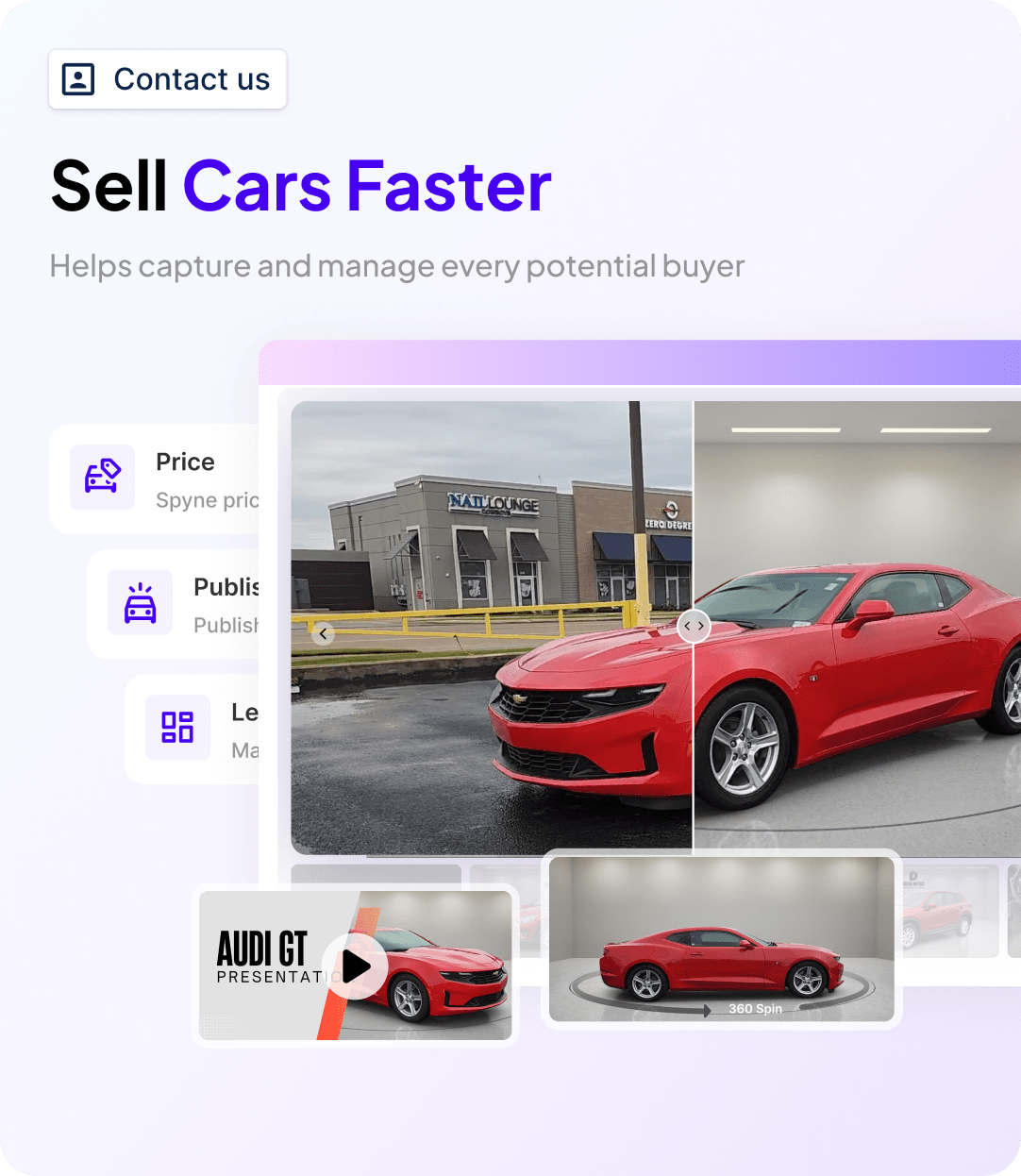
Most platforms assign each vehicle a stage, a task owner, and a target completion time, then flag anything that falls behind. Some platforms, including Spyne Inventory Management, extend that visibility into pricing and merchandising the moment a unit clears recon, instead of stopping at a status board that still requires someone to manually start the next step.
Why Reconditioning Speed Determines Used-Car Profit
Every extra day in reconditioning is a day of floorplan interest, depreciation, and lost showroom exposure, with zero chance to sell. Cox Automotive’s Q1 2026 Dealer Sentiment Index put the used-vehicle inventory reading at 45 out of 100, a sign that tight supply is already pushing dealers to make every acquired unit count instead of overbuying and waiting out a slow recon cycle.
The same pressure shows up earlier, at acquisition: Cox Automotive’s 2026 Fixed Operations and Ownership Study found that 86% of high-performing dealers have a formal process for weighing reconditioning risk before they acquire a vehicle, compared with 72% of other dealers, and they cite faster time-to-lot as one of the top reasons for doing it. A vehicle that reaches the frontline three days sooner captures three more days of shopper traffic before a competitor’s fresher listing pulls the same buyer away, and it does so without the dealership spending an extra dollar on marketing.
How to Speed Up Reconditioning With Software
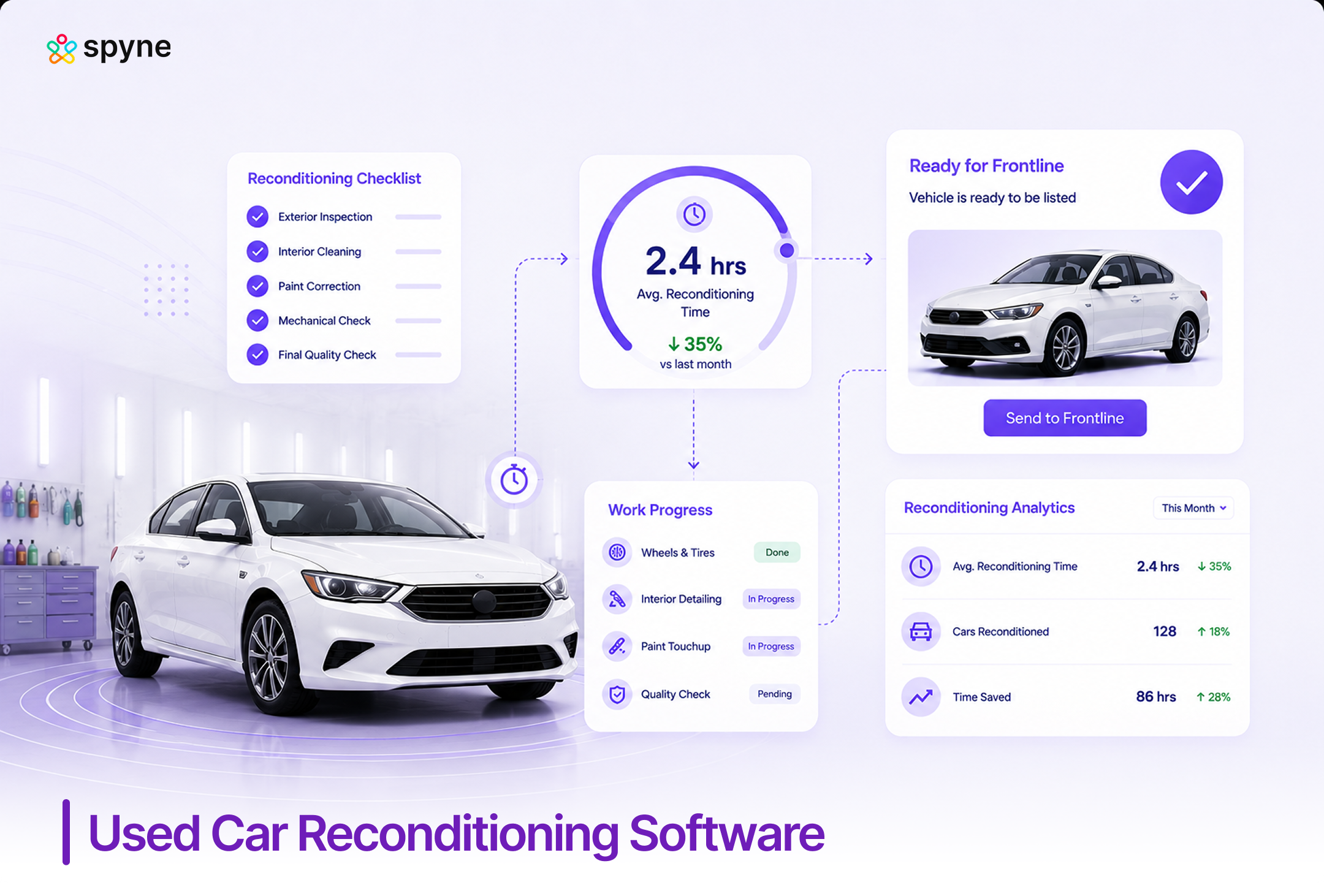
Speeding up reconditioning with software comes down to replacing manual handoffs with automatic ones, so a car never sits waiting for a person to notice it. The typical workflow looks like this:
- VIN Scan at Intake: The system creates a digital record the moment a vehicle arrives, capturing mileage, trim, and condition notes without a manual entry step that delays the clock from starting.
- Stage Assignment and Target Time: Each vehicle gets a recon stage, an owner, and a target completion window, whether that is mechanical, body, or detail work.
- Automated Status Updates: As a technician or outside vendor finishes a task, the record updates on its own instead of relying on a phone call or a sticky note on a windshield.
- Delay Alerts: When a vehicle exceeds its target time in a stage, the system flags it to a manager before the delay compounds into a full extra week.
- Frontline-Ready Handoff: Once every task clears, the vehicle’s status changes automatically, and on platforms connected to inventory and merchandising, photos and pricing can move the same day.
That handoff in step five is where many dealerships still lose the days they worked hard to save in steps one through four, because getting a car mechanically ready and getting it listed for sale are still treated as two separate jobs instead of one continuous process.
Best Used Car Reconditioning Software for Dealers
| Software | Best For | Key Capabilities |
| Spyne Inventory Management | Dealers who want recon connected to pricing, merchandising, and listings in one system | Recon stage tracking on the same VIN record as pricing, AI-assisted photo and listing generation once a unit clears recon, automatic multi-marketplace syndication |
| Rapid Recon | Larger stores and dealer groups wanting a structured, step-by-step process | 4.8/5 from 479 Software Advice reviews, QR-based vehicle movement, vendor management, holding-cost and time-to-line reporting, multi-store support |
| vAuto iRecon | Dealers already running vAuto Provision or ProfitTime GPS | Task and vendor communication, approval time tracking, GPS vehicle location, built inside the Cox Automotive ecosystem, not affiliated with DealerSocket |
| ReconRelay | Dealers who want recon paired with new-car inventory and sales tools in one platform | Real-time recon status, financial calendar and sales leaderboard modules bundled in |
| Cartuul | High-volume lots aiming to cut turnaround days through vendor accountability | Vendor invited directly into the platform, per-vehicle AI tips, VIN scanning, 30-plus DMS and IMS integrations |
| Repair360 | Independent, BHPH, and franchise dealers wanting recon tied to DMS repair orders | Workflow, technician, and vendor management modules, in-app chat, automated repair order write-back to Dealertrack and Autosoft |
None of these platforms publish full pricing publicly except Rapid Recon’s Software Advice listing, so a demo and a rooftop-specific quote are standard before committing to any of the rest. Other names dealers evaluate in this category include Carketa, which bundles recon with appraisal and market pricing, vinRECON and Simple Recon for smaller lots wanting a lighter mobile-first tool, ReconSmart for a straightforward, lower-cost option, and ReconCloud, Dealerslink’s own recon app for dealers already on that platform.
The more useful comparison point across all of them is workflow fit, not price: a bucket-based tool like Rapid Recon suits a store that wants one clear path per vehicle, while a connected platform like Spyne suits a store trying to eliminate the handoff between recon finishing and a listing going live.

How Does Reconditioning Software Reduce Time-to-Frontline?
Reconditioning software reduces time-to-frontline by cutting the administrative and waiting time between stages, not by making any single repair faster. The metric that matters is the full path from intake to inspection to repair work to quality check to frontline-ready, and software attacks the gaps inside that path in five ways. It standardizes inspections so issues surface immediately instead of getting discovered mid-process. This automates work orders and routes tasks straight to the right technician or vendor instead of relying on a phone call. It tracks parts and approvals so a job never sits idle waiting on a signature nobody noticed.
It gives every department, not just one manager, real-time visibility into exactly where a vehicle sits, replacing the texts and memory that let cars disappear into what some call the recon black hole between the auction block, the shop, and the photo bay. And it flags a vehicle automatically once it lingers past its target time in any single stage, so a bottleneck gets caught the day it happens instead of a week later.
Platforms built for this, including Rapid Recon, Cartuul, Carketa, ReconRelay, and Spyne Inventory Management, all compete on how well they close those specific gaps. Spyne’s version of that same mechanism ties recon status to the same VIN record used for pricing and listings, so the handoff from frontline-ready to actually online happens the same day instead of waiting on a separate merchandising cycle, which is where a lot of the gains from faster recon otherwise leak back out.
What to Look for in Used Car Reconditioning Software
Look for software that gives every department the same live view of a vehicle’s status, sets accountability at each stage, and connects to what happens after recon instead of stopping at a status board. Specific criteria worth checking in a demo:
- VIN-based vehicle tracking with mobile scanning, so a record starts the moment a car arrives instead of after someone finds time to type it in
- A digital inspection and reconditioning checklist, not a paper form that gets misplaced between departments
- Repair estimate and approval workflow, so a manager can sign off from a phone instead of a job sitting until someone walks over in person
- Parts and labor tracking, plus recon cost per vehicle, so true landed cost is visible before a salesperson quotes a number
- Internal technician and service-bay assignment, alongside outside-vendor and sublet management for glass, PDR, and upholstery work
- Automatic notifications when a vehicle is stuck, sent to a manager rather than requiring someone to check a dashboard on their own schedule
- Time-in-stage and time-to-line reporting, with GPS lot tracking to find a physical vehicle without walking the row
- DMS and inventory integration, so recon status updates automatically instead of requiring a second manual entry
- Multi-location support, for any dealer group running more than one store
- A direct path to merchandising, so a car that clears recon does not sit another day waiting on photos and a listing
Used Car Reconditioning Software Tips for Faster Turn
A handful of used car reconditioning software tips consistently separate dealerships with a fast recon cycle from the rest, regardless of which platform they run.
- Set a target time per stage, not just an overall goal, so a manager can see exactly where a vehicle is losing days
- Start the VIN scan at intake, not after the mechanical inspection, so the clock reflects true time-to-frontline
- Give vendors direct access to their assigned tasks instead of routing every update through a service advisor
- Review the delay report weekly, not only when a customer asks about a specific car
- Photograph and price a vehicle the same day it clears recon, instead of batching listings once a week
Used Car Recon Software Strategies That Cut Days to Frontline
Beyond day-to-day tips, a few structural used car recon software strategies make the biggest difference over a full month of inventory.
- Separate recon capacity from customer-pay service work, so retail repair orders do not bump recon vehicles down the queue
- Set a hard cap on reconditioning spend by vehicle tier, with manager sign-off required above it, so a technician cannot quietly extend the timeline chasing a marginal repair
- Route high-demand, low-days-supply vehicles to the front of the recon queue instead of processing strictly first-in-first-out
- Tie technician and vendor performance reviews to average stage time, not just total volume completed
- Audit the gap between recon completion and the vehicle actually appearing online, since that handoff is where dealerships lose back the days software was supposed to save
Common Mistakes Dealers Make With Reconditioning Software
The most common mistake is buying reconditioning software and treating it as a monitoring tool instead of an accountability tool. Specific mistakes to avoid:
- Letting the software run passively without a manager actually reviewing the delay report
- Failing to give outside vendors real access, so updates still happen by phone call instead of inside the system
- Treating recon and merchandising as two separate systems, which recreates the same handoff delay the software was meant to fix
- Setting stage targets too loosely, so the software confirms a slow process instead of challenging it
- Skipping the VIN scan at intake, which undercounts true time-to-frontline by however many days a car sat before anyone logged it
Spyne Inventory Management: Used Car Reconditioning Software Connected to Pricing and Listings
Spyne Inventory Management is a vehicle inventory management platform built for dealerships that need reconditioning status, pricing, and listing syndication working off the same live record instead of three separate systems. Alongside named platforms like Rapid Recon, vAuto iRecon, ReconRelay, and Cartuul, Spyne sits in the one spot none of those tools occupy on their own: the handoff from recon finishing to a vehicle actually going live for sale. Used car reconditioning software works best when the finish line connects directly to a sellable listing, and that is where Spyne is built to sit.
1. Recon Stage Tracking Tied to the VIN Record
Every vehicle’s recon stage lives on the same VIN record used for pricing and merchandising, so a used car manager sees exactly where a unit is stuck without opening a second system. A stalled detail step or a vendor waiting on parts shows up in the same dashboard as pricing and days-in-stock. That single view removes the daily status calls that eat a manager’s morning.
2. Delay Alerts Before a Vehicle Ages Past Target
When a unit exceeds its target time in a recon stage, the system flags it automatically instead of waiting for someone to notice on a walk of the lot. A used car manager can set different targets for a quick detail-only unit versus one needing body work, so the alert reflects real expectations instead of one blanket rule for every vehicle.
3. Same-Day Listing the Moment Recon Clears
Once a vehicle’s recon status changes to complete, Spyne’s AI-assisted photo and listing tools can move that unit toward a live listing the same day instead of waiting for a separate merchandising cycle. That closes the gap between a car being mechanically ready and a car actually being visible to shoppers online.
4. AI-Powered Photo and Listing Generation
Raw photos taken on the lot right after recon get converted into consistent, studio-style images without a separate photography setup, so a freshly reconditioned vehicle looks the part the moment it goes live. A used car manager does not need to schedule a photographer separately from the recon handoff.
5. Multi-Rooftop Recon Visibility
Dealer groups running more than one location see reconditioning status across every rooftop in one view, instead of checking each store separately. A group used car director can compare average recon time store to store and see which location is losing the most days to delays.
6. Automatic Listing Syndication Once Frontline-Ready
When a vehicle’s status changes to frontline-ready, its listing pushes automatically to the dealership website and connected marketplaces instead of requiring a manual repost. That keeps a sold vehicle from lingering visible online and a newly reconditioned vehicle from sitting invisible after the work is actually done.
7. Reconditioning Cost Tracked Against True Vehicle Cost
Parts, labor, and vendor charges tied to reconditioning post against the vehicle’s true cost basis, not just the acquisition price, so a manager sees actual margin before a salesperson quotes a number. That visibility keeps a car that looked profitable on paper from quietly losing money once recon costs land.

Conclusion
Used car reconditioning software will not fix a broken process by itself, but it makes a broken process visible, which is the first step to fixing it. The dealerships winning on time-to-frontline in 2026 are not necessarily reconditioning faster inside the shop; they are losing fewer days to handoffs nobody owns, whether that is a stalled approval, an invisible vendor, or a finished car that sits another week waiting on photos. Whether the right fit is a structured, bucket-based system like Rapid Recon, an AI-directed tool like ReconCloud, or a platform like Spyne Inventory Management that carries a vehicle straight from recon into a live listing, the goal is the same: a shorter, more visible path from acquisition to frontline-ready. Used car reconditioning software earns its cost back in the days it takes off every vehicle’s clock, not in the dashboard itself.