
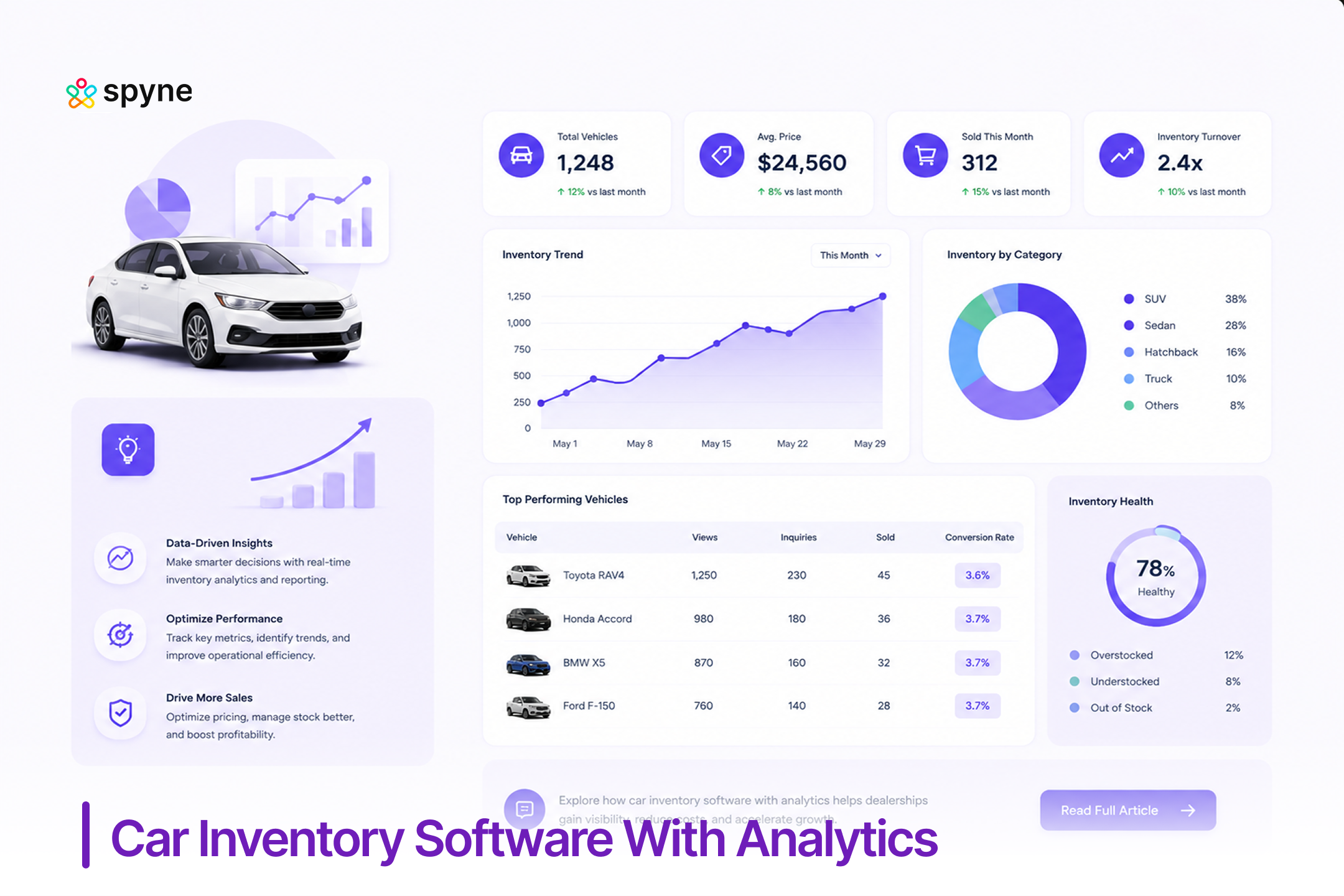

Executive SummaryCar inventory software with analytics gives dealerships a real-time view of turn rate, aging, and pricing so they can act before a vehicle becomes a loss. Cox Automotive (2026) reports used-vehicle days’ supply climbed to 47 days in June, with sub-$15,000 units moving in just 33 days, proof that speed varies sharply by segment. The best platforms turn that variance into a daily dashboard rather than a monthly spreadsheet, connecting analytics directly to pricing, merchandising, and reconditioning decisions. |
A vehicle sitting past day 45 is not just aging, it is bleeding floor-plan interest every day it sits. Cox Automotive (2026) puts average used-vehicle days’ supply at 47, up from 45 the month before, while the cheapest units turn in half that time. Dealers who catch that slide early keep more gross; dealers who find out at month-end do not. This article covers what car inventory software with analytics tracks, which platforms do it well, and how to turn dashboards into action.
What Is Car Inventory Software With Analytics?
Car inventory software with analytics is a system that tracks a dealership’s vehicle inventory and layers reporting on top of it, turning raw stock data into turn rate, aging, and pricing insights a manager can act on daily. Unlike a basic dealer management system (DMS) module that just logs vehicles in and out, this category answers operational questions in real time: which units are aging past their profit window, and where pricing has drifted from the local market.
Names that regularly come up in this category, in the US and elsewhere, include vAuto, DealerCenter, CDK Global, AutoRaptor, Lotlinx, and Spyne Inventory Management. Most fall into one of two buckets: pricing-and-market-data specialists, or broader DMS platforms with reporting built in. Few combine turn rate analytics with the merchandising and listing side of the business, the specific gap Spyne Inventory Management addresses.
Most platforms in this space build their analytics on four data layers:
- Inventory data: VIN, age, cost, and location per unit.
- Market data: comparable listings and price movement by model and trim.
- Merchandising data: photo quality and listing completeness per vehicle.
- Sales data: time to sale and gross profit tied back to the stocking decision.
Car inventory software with analytics pulls these layers into one dashboard, the real difference between software that just stores inventory and software built for performance tracking.
Why Inventory Analytics Matters for Dealership Profit
Inventory analytics matters because every extra day a vehicle sits costs real money, and most dealerships cannot see that cost building until it already has. Cox Automotive (2026) data shows new-vehicle days’ supply rose to 80 days in June, up from a revised 78 in May, with supply spread unevenly across brands, some near 30 days, others well past 100. A lot-wide average hides that spread; only segment-level analytics show where the real problem sits.
On the used side, Cox Automotive (2026) reported 2.14 million used vehicles in national supply at a 47-day average, while vehicles under $15,000 held just 33 days’ supply, two weeks faster than the broader market. End-of-month reports would miss that pricing tier’s velocity advantage until it was too late to restock against it.
Real dealers echo this on forums like DealerRefresh, asking for “a real-time view of what’s happening in a dealer’s specific market,” not a static report pulled once a week. That is the practical case for car inventory software with analytics: it turns a lagging indicator into a leading one, early enough for a fix to still matter.
What to Look For in Car Inventory Software With Analytics
The strongest car inventory software with analytics covers a specific set of features, not just a dashboard with charts on it. Prioritize platforms that include:
- Market-based valuation, pulling live comparables the way tools built on data like Kelley Blue Book or Edmunds do, rather than a fixed pricing formula.
- Days-on-lot tracking, flagging slow-moving vehicles before depreciation and floor-plan cost erode the margin.
- Acquisition insights, using sales history and demand trends to show which makes, models, and trims turn fastest right now.
- Reconditioning cost tracking, breaking down repair and parts expense per vehicle so true net profit is visible at sale, not just gross.
- VIN-level tracking, since trim, options, and service history all affect how a unit should be priced and merchandised.
- Mobile access, so a sales team can pull pricing and history from a tablet on the showroom floor.
Platforms including vAuto, DealerCenter, and Spyne Inventory Management each cover most of this checklist, though they differ in how closely analytics connect to merchandising.
Car Inventory Software With Analytics
When dealers search for the best car inventory software with analytics, the results split into a few clear categories, and picking the right one depends on which decision a dealership is trying to speed up.
1. Best overall for serious dealerships
vAuto shows up most often for pricing recommendations, acquisition guidance, and inventory-wide market data, and is a reasonable default if pricing accuracy is the top priority.
2. Best for SMB dealers wanting inventory plus CRM
AutoRaptor connects VIN details, pricing, and days-on-lot to lead and sales data, fitting a smaller store that does not want inventory analytics and CRM as two separate purchases.
3. Best for larger dealer groups needing a full ecosystem
DealerSocket and CDK Global fit multi-rooftop groups that want inventory analytics folded into a broader DMS and CRM stack rather than a standalone tool.
4. Best for connected analytics and merchandising in one workflow
This is the category vAuto, AutoRaptor, DealerSocket, and CDK Global do not fully cover. Spyne Inventory Management sits here, tying inventory health and turn rate reporting directly to the merchandising and publishing steps that influence how fast a vehicle sells.
Every one of these categories answers the same question a dealer is really asking when they search for the best car inventory software analytics options: which vehicles need attention today, and what should change about them.

Best Car Inventory Software With Analytics Compared
Before comparing tools by name, it helps to know what to compare them on: how each platform sources its data, what it reports on, and who it fits best. The table lists Spyne Inventory Management alongside the platforms that come up most consistently in SERP research and direct ChatGPT and Gemini queries for this category.
| Software | Best For | Key Analytics Capabilities | Pricing |
| Spyne Inventory Management | Connected turn rate and merchandising analytics | Inventory health dashboard, aging alerts, segment and model performance reporting, merchandising quality tied to listing performance | Customized |
| vAuto (Provision / ProfitTime GPS) | Live market pricing analytics | Investment-value scoring, market-day-supply pricing, sourcing and acquisition analytics | Connect with Sales Team |
| DealerCenter | Independent dealers wanting an all-in-one DMS | Real-time inventory tracking, financial reporting, valuation tools | Connect with Sales Team |
| CDK Global | Large dealership networks | Predictive analytics, cross-departmental reporting, DMS-integrated inventory insights | Connect with Sales Team |
| AutoRaptor | Inventory tied to CRM and sales | VIN details, pricing, reconditioning cost, and days-on-lot connected to lead and rep performance | Connect with Sales Team |
| Lotlinx | VIN-level performance and aged-inventory turn | At-risk VIN identification, ad spend efficiency, aging-triggered alerts | Connect with Sales Team |
No two rows solve the same problem. A dealer chasing pricing precision leans toward vAuto; one chasing VIN-level aging intervention leans toward Lotlinx; a dealer wanting turn rate, aging, and merchandising quality in one view is the use case Spyne Inventory Management is built around. Niche options for specific jobs include VINCUE (acquisition and appraisal analytics), Carketa (reconditioning-time tracking), and Tekion (cloud-native DMS).
Best Car Inventory Software With Performance and Turn Rate Analytics
The best car inventory software with performance and turn rate analytics ties turn rate directly to the decisions that move it, not just a tool that reports the number. Turn rate alone, a unit count divided by average inventory, tells a manager almost nothing about why a vehicle is slow. For pure inventory optimization, vAuto is the most consistently recommended option, with its ProfitTime GPS product built around profitability and turn car by car. Lotlinx is the next most-named option for VIN-level intervention, identifying at-risk vehicles before they become aged inventory. DealerCenter and CDK Global cover this need inside a broader all-in-one DMS rather than as a standalone specialty.
A platform genuinely built for this job should surface, at minimum: days in inventory by segment, expected turn versus actual turn, vehicle velocity and aging triggers tied to an automatic price review, price-to-market against current comparables, performance by make and model, and reconditioning-to-listing time, since a vehicle can look “aged” when the real delay happened in the shop, not on the lot.
Cox Automotive (2026) figures on days’ supply confirm why this matters at the segment level: national averages hide brand-level and price-tier swings wide enough to make one blended turn rate number close to useless for daily decisions. vAuto, Lotlinx, and Spyne Inventory Management are among the best car inventory software analytics options built around that same principle, report the segment, not just the lot, though Spyne is the one of the three that ties that turn rate view directly to merchandising quality rather than treating pricing and listing performance as separate problems.
How to Use Analytics in Car Inventory Software
Knowing how to use analytics in car inventory software matters more than which platform a dealership buys, since even the strongest dashboard does nothing without a routine built around it. Here is a practical framework:
- Set an age threshold per segment: A 60-day threshold fits a full-size truck; it is far too loose for a $12,000 sedan turning in 33 days on average, per Cox Automotive (2026).
- Review the dashboard on a fixed schedule: Weekly reviews catch pricing drift early; monthly reviews mostly confirm damage that already happened.
- Tie each alert to one owner: An aging alert with no assigned action item just becomes another unread notification.
- Cross-check pricing against market data, not gut instinct: Analytics only add value if the pricing decision changes based on what the dashboard shows.
- Track merchandising quality alongside turn rate: A well-priced vehicle with weak photos can still sit; separating pricing problems from merchandising problems keeps a manager fixing the right thing.
Knowing how to use analytics in car inventory software also means assigning an owner: without one, the best dashboard in the industry turns into a report nobody opens.
Car Inventory Analytics Strategies
Strong car inventory analytics strategies focus on a small number of numbers checked often, rather than a large dashboard checked rarely. Four strategies consistently show up across well-run stores:
- Segment before you average: Split turn rate and aging by body style and price tier before making any lot-wide pricing call.
- Price to velocity, not just margin: A vehicle priced for maximum margin that sits 70 days often nets less than one priced for a 30-day turn once floor-plan cost is factored in.
- Connect analytics to merchandising, not just pricing: A strong price on a weak listing still underperforms.
- Benchmark across rooftops, not just last month: A single store’s own history is a weak baseline compared with sister-store or market data.
These car inventory analytics strategies work because they turn a single lagging number, turn rate, into a set of leading indicators a manager can act on before the vehicle becomes a write-down.
Car Inventory Analytics Tips
A handful of practical car inventory analytics tips make the difference between a dashboard that gets used and one that gets ignored. Most of these car inventory analytics tips take less than a week to put into practice.
- Start with three metrics, not thirty: Days’ supply, aging count past threshold, and gross profit trend are enough for a weekly review.
- Automate the alert, not the decision: Let the system flag aging units; keep the pricing call with a person who knows the local market.
- Pull comparisons at the model level: A lot-wide turn rate hides which specific models drag the average down.
- Review analytics before ordering, not just after stocking: The same data flagging a slow unit today should shape what gets bought next.
Common Mistakes Dealers Make With Inventory Analytics
Even dealerships running the best car inventory software analytics options make a few repeatable mistakes that blunt its value.
- Treating the dashboard as a report instead of a routine: A dashboard checked once a month is barely better than none, since most aging problems show signal well before the 30-day mark.
- Using one blended turn rate for the whole lot: Cox Automotive’s (2026) brand-level days’ supply spread, from roughly 30 days to well over 100, shows why one average number hides more than it reveals.
- Splitting analytics across too many disconnected tools: Dealers tracking pricing in one system and merchandising in another, a gap flagged in the automotive inventory with marketplace sync research, end up reconciling numbers manually instead of acting on them.
- Not assigning ownership of the alert: An aging trigger nobody is responsible for acting on has the same effect as not having analytics at all.
Spyne Inventory Management: Car Inventory Software With Analytics Built for Dealership Profit
Spyne Inventory Management is car inventory software with analytics built into the core workflow, not bolted on as a separate report. It tracks inventory health, turn rate, and merchandising quality in one connected view, so a manager does not move between a pricing tool, a listing platform, and a spreadsheet to understand why a vehicle is slow. Where vAuto, DealerCenter, CDK Global, AutoRaptor, and Lotlinx each specialize in one side of this problem (pricing, DMS operations, CRM, or VIN-level marketing), Spyne is built for dealers who want turn rate and merchandising in one connected system.
1. Inventory Health Dashboard
Gives a manager a single view of every vehicle’s age, cost, and status against the lot’s target turn rate. A dealer running a 45-day turn target can filter straight to every unit past day 30 and act before it crosses the line.
2. Turn Rate and Days-to-Sell Analytics
Tracks how fast vehicles move by segment, model, and trim rather than as one lot-wide average. A dealer can see one segment turning in 25 days while another sits at 55, and adjust stocking and pricing separately.
3. Aging Alerts Tied to Action
Fires automatically once a vehicle crosses a set day threshold, prompting a specific next step such as a price review or merchandising refresh rather than a generic notification. A sedan crossing day 35 can trigger an automatic price-check task.
4. Segment and Model-Level Performance Reporting
Breaks turn rate and gross profit down by body style, price tier, and model instead of one aggregate number for the whole lot. A dealer group can see midsize SUVs outperforming sedans by two weeks of turn time, reshaping the next acquisition order.
5. Merchandising Quality Tied to Listing Performance
Connects photo and listing quality to how a vehicle performs online, so a manager can tell whether a slow vehicle has a pricing problem or a merchandising problem, and act on the right one.
6. Cross-Rooftop Benchmarking
For dealer groups running more than one store, compares turn rate, aging, and merchandising performance across locations. A group with five rooftops can see which store turns inventory faster and apply that approach elsewhere.
7. Publishing and Syndication Status Visibility
Shows exactly where a vehicle’s listing stands across every connected marketplace and the dealership’s own site, tied to the same performance view as pricing and merchandising, instead of finding out days later that one channel never updated.

Conclusion
Car inventory software with analytics is what separates dealerships reacting to aging inventory from dealerships catching it early. With Cox Automotive (2026) reporting used-vehicle days’ supply at 47 and new-vehicle supply at 80, a lot-wide number is no longer good enough to run a store on. Whether the choice lands on vAuto, DealerCenter, AutoRaptor, or a connected platform like Spyne Inventory Management, the dealers getting ahead are the ones pairing car inventory software with analytics to a real routine: segment-level reporting, automated aging alerts, and merchandising data checked in the same view as pricing.