
Executive SummaryThe right automotive CRM software fits how your dealership actually sells, not how clean the demo looks. Buyers now spend roughly 13 hours across the shopping journey, and Cox Automotive’s 2025 Car Buyer Journey Study found dealerships running mostly digital processes saved buyers 41 minutes and posted 78% satisfaction. Choosing the right platform comes down to five factors: lead routing speed, DMS integration, mobile usability, reporting depth, and total cost of ownership, weighed against your dealership’s actual sales process rather than a features checklist. |
Monday morning, three CRM demo calls booked, and still no closer to knowing which platform a sales team that already ignores half of what it’s handed will actually use. That’s the real problem with buying automotive CRM software: the demo always looks clean, and six months later reps are back to sticky notes and side text threads. Salesforce’s 2026 State of Sales Report found reps lose 60% of their time to non-selling tasks, manually logging customer notes among them. Here’s how to evaluate it against your dealership’s real workflow, not the pitch.
What Automotive CRM Software Actually Does for a Dealership
Automotive CRM software centralizes every lead, from website form fills to marketplace inquiries to walk-ins, into one system that tracks the sales pipeline from first contact to close. Unlike a generic CRM built for B2B sales cycles, this kind of software is built around the specific rhythm of vehicle sales: inventory-linked lead matching, trade-in tracking, F&I handoffs, and follow-up cadences built for a three-to-ten-day buying window instead of a multi-month enterprise sales cycle.
At a working level, automotive CRM software typically handles four jobs: routing new leads to the right rep or BDC agent, automating follow-up so leads don’t go cold after the first contact, giving managers visibility into which lead sources actually convert, and connecting to the dealership’s DMS and inventory systems so data doesn’t need to be entered twice. A platform that does all four well looks very different in daily use than one that only does the first two, even if both show up in the same search results.
For a franchise dealership, that might mean a rep can see a lead’s trade-in value estimate, current inventory match, and F&I pre-qualification status without leaving the lead record. For an independent dealer running a smaller team, it might simply mean every lead lands in one queue instead of a mix of email, texts, and a spreadsheet someone updates at the end of the day. Both are legitimate uses of the same category of software, which is exactly why a single ranked list rarely fits every dealership equally well.
The Real Cost of Choosing the Wrong Automotive CRM Software
The cost of the wrong platform rarely shows up on the invoice. It shows up in the gap between what a rep is supposed to do and what a rep actually does once the new-system enthusiasm wears off. Salesforce’s 2026 State of Sales Report found sales reps spend 60% of their time on non-selling tasks, including manually re-entering customer notes into a CRM that doesn’t sync cleanly with the tools they already use. In a dealership, that translates directly into slower lead response and leads that quietly stall in a pipeline nobody is watching.
A CRM that reps avoid isn’t a lighter-weight problem than a CRM that lacks features. It’s often worse, because a dealership ends up paying for software while the sales team keeps coordinating over text and sticky notes anyway. Cox Automotive’s 2025 Car Buyer Journey Study found buyers at dealerships with mostly digital, well-connected processes reported 78% satisfaction and saved 41 minutes compared to less digital dealerships, a gap that traces back to whether the tools behind the scenes are actually being used, not just purchased.
Five Criteria for Evaluating Automotive CRM Software
Ranking vendors by star rating skips the part that actually determines whether the software works at your dealership: fit with your existing process. These five criteria matter more than a feature list.
- Lead routing speed: How fast does a new lead reach a specific rep, and does the system auto-assign based on source, or does someone have to manually distribute leads every morning?
- DMS and inventory integration: Does the platform pull live inventory and DMS data automatically, or does someone re-key vehicle and customer information between systems?
- Mobile usability: Can a rep update a lead record and log a note from the sales floor on a phone, or does it require sitting down at a desktop between test drives?
- Reporting depth: Can a GM see conversion rate by lead source and by rep, not just total lead volume, without exporting to a spreadsheet first?
- Total cost of ownership: Beyond the license fee, what do onboarding, training, and any per-integration cost add to the real first-year price?
When dealerships researching the best CRM systems for automotive industry use skip straight to a demo, these five criteria are usually where the demo and the day-to-day reality diverge. A vendor can score well on all five and still be the wrong fit if the underlying sales process it assumes doesn’t match how your team actually works the floor.

How the Top Automotive CRM Systems Compare
Prefer a ranked shortlist instead of a full evaluation framework? See our 10 Best Automotive CRM Software Solutions roundup for a straight ranking. This section instead lays out how the top automotive CRM systems actually differ, so the comparison stays useful regardless of which platform a dealership eventually picks.
| CRM | Best For | Notable Strength | Pricing |
| Spyne Automotive CRM | Dealerships that want lead management tied directly to inventory and merchandising | Lead and inventory data live in one system, so a rep sees vehicle interest and pipeline status on the same screen | Customized |
| VinSolutions | Large franchise dealerships and dealer groups | Draws on Cox Automotive’s first-party data, including Kelley Blue Book and Autotrader signals, for lead scoring | Connect with Sales Team |
| DriveCentric | Sales teams where rep adoption is the main risk | Built around a simpler, more visual interface aimed at getting daily use out of the sales team | Connect with Sales Team |
| DealerSocket | Multi-rooftop and independent dealer groups | Combines CRM with inventory, desking, and marketing tools inside one platform | Connect with Sales Team |
| AutoRaptor | Independent and buy-here-pay-here dealers | Lower setup complexity for smaller teams without a dedicated CRM administrator | Connect with Sales Team |
| Tekion CRM | Cloud-native dealer groups already on Tekion’s DMS | Shares Tekion’s cloud architecture, which reduces integration overhead for existing Tekion customers | Connect with Sales Team |
No platform in this table is the universal answer. A franchise dealer group weighing Cox Automotive’s data depth will land somewhere different than an independent dealer prioritizing setup simplicity, which is exactly why the five criteria above matter more than any single ranking or star rating.
Automotive CRM Software and AI: Where the Real Differences Show Up in 2026
AI is the feature every vendor now claims, which makes it one of the hardest parts of automotive CRM software to evaluate honestly. Gartner found in 2024 that sellers who partner with AI sales tools are 3.7 times more likely to meet quota, and Cox Automotive’s 2025 study found 84% of shoppers who used AI-powered tools during the buying process reported high satisfaction. Those numbers explain why nearly every CRM vendor in this category now advertises some form of AI lead scoring or automated follow-up.
The practical question for a dealership isn’t whether a platform has AI, it’s what the AI actually does with your data. Some automotive CRM software uses AI mainly to draft follow-up messages, a modest but genuinely useful time-saver. Other platforms use it to score leads based on likely close probability, prioritizing a rep’s day automatically. The best CRM software for automotive dealers evaluating this feature should ask vendors for a specific, concrete example of what the AI changes in a rep’s actual workflow, not a general description of “AI-powered” capability, since that phrase alone doesn’t tell you much.
Among the best CRM systems for automotive industry use in 2026, the dividing line isn’t whether AI exists on the feature list, it’s whether it’s built into the core lead and inventory data or bolted on as a separate module that still requires manual review before a rep can trust it.
Common Mistakes Dealerships Make Choosing Automotive Dealer Management and CRM Systems
Most CRM buying mistakes happen before the contract is signed, during the research phase itself.
1. Defaulting to whatever the DMS provider bundles in
Dealerships researching automotive dealer management and CRM systems often accept a bundled CRM because it’s the path of least resistance, not because it was actually evaluated against the five criteria above. A bundled tool can be the right choice, but only if it’s compared against alternatives first.
2. Letting the demo, not the sales team, make the decision
The person running the demo is rarely the person entering leads at 7 p.m. on a Friday. Involve BDC staff and floor sales reps in at least one evaluation session before committing, and ask them directly whether they’d actually use the tool as shown.
3. Ignoring mobile usability until after signing
A CRM that looks complete on a desktop screen but is clumsy on a phone will get skipped on the sales floor, which is where a large share of lead updates actually happen during a typical shift.
4. Underestimating switching costs
Dealerships evaluating the best CRM software for automotive dealers sometimes focus entirely on a new platform’s features and skip data migration, historical lead history, and retraining time, all of which show up as hidden costs in month one.
5. Treating every automotive CRM software option as interchangeable
A platform built for high-volume franchise groups and a platform built for independent dealers solve different problems, even when both are marketed under the same automotive dealer management and CRM systems category.
Switching or Upgrading Your Automotive CRM Software: What Changes
Switching platforms is a different decision than choosing one for the first time, because there’s existing lead history, rep habits, and DMS integrations already in place. Three things change the calculus.
1. Data migration
Historical lead records, notes, and pipeline stages need to move cleanly, not just get exported into a spreadsheet and re-imported by hand. Ask any vendor being considered exactly how migration from the current system works before signing anything.
2. Retraining time
A sales team that has used one CRM for years will resist a switch regardless of how much better the new automotive CRM software is on paper. Build a retraining timeline into the decision, not just a go-live date, and expect a temporary dip in speed while the team adjusts.
3. Parallel-running risk
Most dealerships run both systems briefly during a transition. That period is where leads are most likely to fall through, so a short, clearly bounded overlap window matters more than a long “just in case” one that drags on for months.
Quick Decision Checklist Before You Sign
Use this checklist to narrow the field before the final vendor conversation:
- Does the platform auto-route leads by source, or require manual distribution?
- Does it sync with your DMS and inventory in real time, or require manual re-entry?
- Can a rep use it fully from a phone on the sales floor?
- Does reporting break down conversion by lead source and by rep, not just total volume?
- Have you calculated total first-year cost, including onboarding and training, not just the license fee?
- Has at least one BDC or sales team member tested it directly, not just watched a demo?
Any vendor that can’t answer these questions specifically, rather than in marketing language, is worth a second look before signing. Running your shortlist through this checklist is a faster way to spot the best CRM systems for automotive industry use than reading another ranked list, since it tests fit against your own process rather than a generic scoring rubric.
Spyne Automotive CRM Software Built For Dealerships
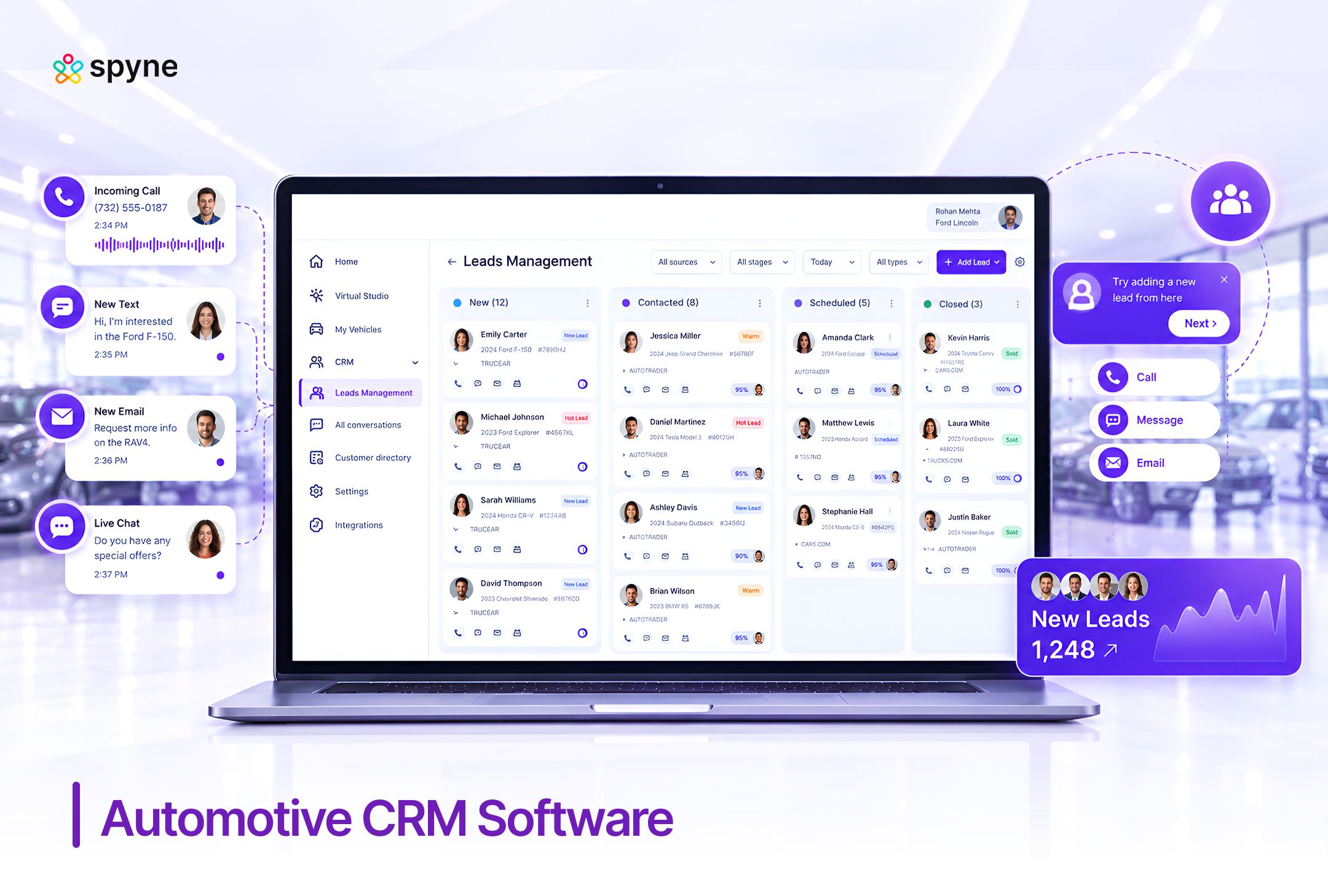
Spyne Automotive CRM is built for the evaluation criteria above rather than a features list designed to look complete in a demo. It centralizes leads from every channel, connects directly to inventory and merchandising data already inside Spyne’s platform, and gives BDC and sales teams one queue instead of several disconnected tools. For dealerships weighing this category of software against an existing DMS-bundled option, Spyne is built to plug into that stack rather than replace it wholesale.
1. Unified lead inbox across channels
Leads from the website, marketplace listings, walk-ins, and phone calls land in one queue instead of four separate tools. A BDC rep starts the day in one place, not four inboxes.
2. Automated follow-up sequences
Follow-up texts, emails, and reminders trigger based on lead source and days since last contact, so a lead doesn’t go cold simply because a rep got busy with a walk-in.
3. Inventory-linked lead matching
Because Spyne’s CRM sits alongside its inventory and merchandising tools, a rep can see which specific vehicles a lead has already viewed on the same screen as the lead record.
4. Pipeline and rep performance reporting
Dashboards break down response time, conversion rate by lead source, and rep activity, so a GM can see which lead sources actually close deals rather than just which generate the most volume.
5. Mobile access for the sales floor
Reps can update a lead record or log a note from a phone on the lot, without walking back to a desktop between test drives.
6. DMS and third-party integration
Spyne connects with existing DMS and listing platforms so lead and inventory data doesn’t require manual double entry, directly addressing the non-selling admin time Salesforce’s 2026 report flags as a productivity drain.
7. Role-based workflow views
BDC managers see the lead queue, GMs see performance rollups, and floor sales reps see their own pipeline, without extra reporting-only licenses.

Conclusion
There’s no single best automotive CRM software, only the one that matches how a specific dealership actually sells. A franchise group weighing Cox Automotive’s data depth through VinSolutions will land somewhere different than an independent dealer prioritizing AutoRaptor’s simplicity, and a dealership already on Tekion’s DMS has a different calculation than one evaluating Spyne’s inventory-linked approach. Score any platform against the five criteria in this guide, lead routing speed, DMS integration, mobile usability, reporting depth, and total cost of ownership, before signing anything, and involve the team that will actually use it every day in that evaluation.