
Every dealer knows what a BDC is supposed to do, answer leads fast, set appointments consistently, and keep the sales floor focused on buyers who are ready to move. The harder question is how to structure that function without it becoming your most expensive underperformer.
Right now, dealerships with effective BDC operations see 15–25% improvements in lead-to-sale conversion and 23–37% higher appointment show rates (NADA, 2024). But those results don’t come from having a BDC, they come from running the right model for your volume and cost structure. Build in-house at the wrong scale, and you’re absorbing $180,000–$350,000 in Year 1 costs before a single appointment is set. Outsource without the right benchmarks, and you’re paying a monthly retainer for response times that lose leads to the dealer down the street.
In 2026, there’s a third option that changes the math entirely.
In this blog, we cover:
- The hidden costs of in-house BDC that most dealers undercount.
- What outsourced BDC companies actually charge in 2026.
- A full cost and performance comparison across all three models.
- The benchmarks you should be tracking weekly.
- When each model wins, and when it doesn’t.
- How to transition to AI BDC without disrupting current operations.
The Real Cost of Running an In-House BDC (That Most Dealers Undercount)
Ask a dealer what their BDC costs and they’ll quote you a salary number. Ask them what it actually costs, including the two months of lost productivity when a rep quits, the recruitment fees to replace them, and the CRM data gaps from inconsistent logging, and the number changes significantly.
When dealerships calculate in-house BDC costs, they typically underestimate by 40–60%. The salary line is obvious. Everything else is invisible until it hits.
The average BDC representative stays under 12 months (Dealer Marketing Magazine, 2024). That’s not a management failure, it’s a structural reality of a high-repetition, relatively low-compensation role with limited career progression. For a three-agent team running at industry-average turnover, the annual cost of recruiting, rehiring, and ramping replacement reps runs $24,000–$36,000. That number never appears on the income statement, but it is entirely real and entirely predictable.
The costs that don’t show up on the salary line:
- Turnover cost per departure: $8,000–$12,000 per agent when you include time-to-fill vacancy, recruiter fees at 15–20% of annual salary, and the productivity deficit during the first 60–90 days of ramp-up
- Technology overhead: CRM customization, call tracking software, and power dialing tools add $5,500–$13,000 in Year 1 alone
- Management overhead: A functioning BDC requires a dedicated BDC manager at $55,000–$75,000/year, this is not a role you can absorb into a GSM’s schedule without cost
- Coverage gaps: Without overtime or weekend staffing, in-house BDC provides zero after-hours coverage, which is precisely when a significant share of digital leads arrive
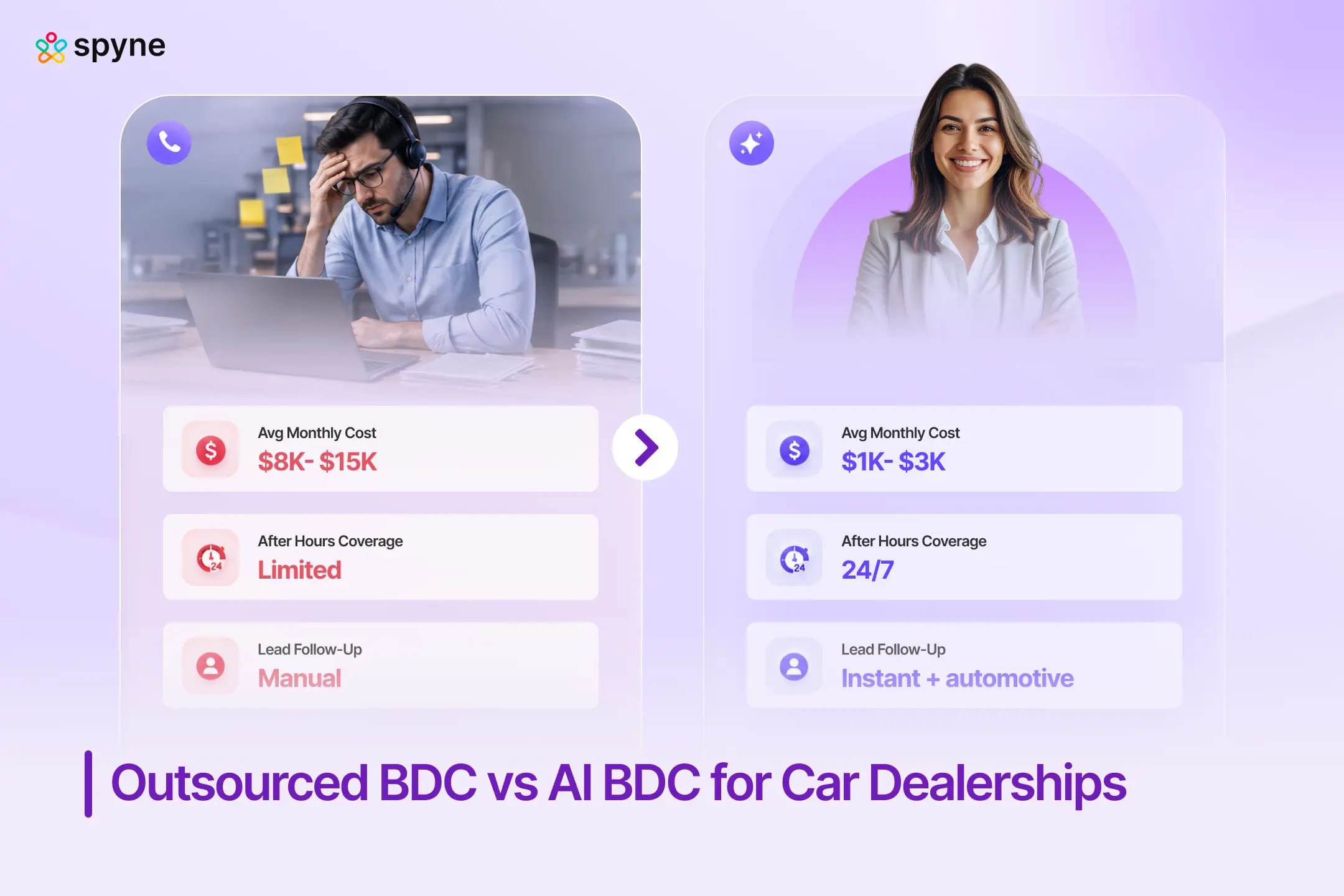
Total first-year investment for a three-person in-house BDC lands between $180,000 and $350,000 (Automotive Management Network, 2024). That same coverage level from an outsourced provider costs $36,000–$120,000 annually. The gap is not marginal.
What Outsourced BDC Companies Actually Charge in 2026
Outsourced BDC pricing is less standardized than most dealers expect. The structure of your contract, retainer, per-lead, or hybrid, changes the total cost more than the headline monthly fee does.
- Retainer model: $2,500–$8,000/month for a defined scope of lead handling and channels covered. Predictable cost, but you pay the same rate in slow months. Works best for dealerships with consistent lead volume above 200 leads/month.
- Per-lead model: $15–$45 per qualified appointment set. Variable cost that scales with performance, but can spike significantly during promotional pushes or seasonal peaks. Works best when lead volume fluctuates month to month.
- Hybrid model: A base monthly fee covering a set lead volume, with per-lead overage rates above threshold. Most common structure from established outsourced BDC companies. Provides cost predictability without penalizing low-volume months.
What outsourced automotive BDC solves well: the hiring burden disappears, automotive-specific scripts are deployed from day one, and extended-hours coverage is typically included in the base fee. What it doesn’t solve: individual agent consistency still varies, brand alignment requires active oversight from your team, and response times still average 5–30 minutes on first contact, not the sub-5-minute window that maximizes lead conversion.
76% of dealers who evaluate both models ultimately choose outsourced over in-house (Strolid, 2025), primarily because the economics are clearer and the staffing risk transfers to the provider.
Cost Breakdown: In-House vs Outsourced BDC vs Spyne Vini AI
| Cost Factor | In-House BDC (3 agents) | Outsourced BDC | Spyne Vini AI |
| Monthly base cost | $15,000–$25,000+ | $2,500–$8,000 | Contact Spyne |
| Year-1 total investment | $180,000–$350,000 | $36,000–$120,000 | Significantly lower |
| Lead response time | Variable, hours possible | 5–30 minutes typical | Under 60 seconds |
| After-hours coverage | None without overtime | Included (varies) | Full 24/7 |
| Annual turnover cost | $24,000–$36,000 | Managed by provider | None |
| Consistency | Variable by agent | Variable by agent | Identical every time |
| Surge capacity | Requires hiring | Request from vendor | Instant |
| CRM logging | Manual, inconsistent | Provider-dependent | Automatic |
| Appointment conversion lift | Baseline | +10–20% vs in-house | +20–25% vs baseline |
Performance Benchmarks: The Four Numbers That Actually Matter
Before switching BDC models, or doubling down on the current one, you need a clear-eyed view of where you stand. Most dealers don’t track these weekly. Most dealers also can’t tell you with confidence whether their BDC is performing or just existing.
| Metric | Strong | Average | Concerning |
| Lead response time | Under 5 min | 5–30 min | Over 30 min |
| Appointment set rate | 20–30% | 12–20% | Under 12% |
| Appointment show rate | 70–80% | 60–70% | Under 60% |
| Cost per appointment | Under $50 | $50–$100 | Over $100 |
Response speed is the single highest-leverage variable in the entire funnel. Responding to a digital lead within 5 minutes makes you 21–100x more likely to qualify and convert that prospect (Lead Response Management Study). Not 21% more likely, 21 to 100 times more likely. Despite that, 19% of dealerships still take over an hour to respond to inbound leads, and 4% don’t respond at all (Demand Local, 2025).
An AI BDC eliminates response time as a variable entirely. A human BDC, in-house or outsourced, never will.

4 Signs Your BDC Model Is Broken
Dealers don’t restructure their BDC operations on principle. They do it when a specific pain point becomes impossible to ignore. The most common triggers fall into four categories, and they usually arrive together:
#1- Chronic turnover creating a perpetual retraining cycle.
When your BDC manager spends more time recruiting than coaching, the team never reaches full productivity. The CRM shows it: inconsistent notes, missed follow-up tasks, gaps in lead attribution that make it impossible to evaluate your ad spend accurately.
#2- A documented after-hours lead gap.
Pull your lead timestamps from the last 90 days and sort by submission time. For most dealers, 25–35% of digital leads arrive outside business hours. Without a coverage solution, those leads sit until the morning shift, by which point the buyer has already heard from two other stores.
#3- Appointment set rate below 15%.
Anything under 15% on a consistent basis points to one of three problems: scripts that don’t match the buyer’s stage in the funnel, agents who aren’t trained well enough to handle objections, or response times so slow the lead has already gone cold on first contact. All three are fixable. None of them fix themselves.
#4- Cost-per-appointment above $100.
At that level, the BDC economics don’t support the function. You’re subsidizing a coverage operation that isn’t converting, and the sales team is doing it without clean data to show them why.
Outsourced BDC vs AI BDC: Where Each Model Has a Structural Advantage
This is not a binary decision. Most dealerships that get this right end up running a layered model: AI for car dealerships delivers speed, scale, and consistent follow-up, while human teams handle complexity, negotiation, and long-term relationship management. Understanding where each has a genuine structural edge helps dealers build the right operating model instead of committing entirely to one approach and constantly managing the gaps.
1. Where Outsourced BDC Has the Edge
Outsourced providers give you trained agents, established automotive scripts, and a management structure you don’t have to build from scratch. For dealers whose primary pain point is eliminating the internal hiring burden, not maximizing response speed, outsourcing is a defensible, operational choice.
It’s also the right answer for high-complexity interactions that require real judgment: a customer in a long-standing service dispute, a commercial fleet account that needs negotiation, a loyal repeat buyer who wants to be recognized by name. These conversations require context-sensitivity that human agents handle better than any current AI system.
2. Where AI BDC Has a Structural Advantage
Spyne’s conversational AI, Vini answers 100% of inbound calls, chats, and digital inquiries in under 60 seconds. It doesn’t vary by agent, shift, or day of the week. It handles 70% of routine sales and service interactions automatically, qualification, appointment scheduling, inventory checks against live DMS data, and full CRM logging with source attribution on every single interaction.
The performance difference shows up most starkly in two scenarios: after-hours lead recovery, where AI captures appointments that would otherwise sit uncontacted until the morning shift, and first-touch response speed, where the gap between sub-60-second AI response and 20-minute human response is the difference between a live prospect and a cold lead.
Dealerships using Vini AI see a 20–25% increase in lead-to-appointment conversion, not from better conversations, but from the simple operational reality that every lead gets an immediate, qualified response, at any hour, without exception.
Why After-Hours Leads Are Your Biggest Missed Opportunity?
Here’s a number worth running at your own store: what percentage of your inbound digital leads arrive between 7 PM and 9 AM?
For most dealerships, it’s between 25% and 35% of total monthly lead volume. Every one of those leads submitted after closing time sits uncontacted until the morning shift. By the time your BDC opens, the buyer has been waiting 8–12 hours. Some have already submitted the same lead form to two other dealers who have after-hours coverage.
The most common first deployment for Vini AI is exactly this gap: after-hours and overflow coverage, running in parallel with your existing in-house or outsourced team during business hours. Your daytime workflow doesn’t change. Vini handles the hours your team isn’t staffed, qualifies the lead, books the appointment if the buyer is ready, and delivers a complete conversation summary and CRM entry before your first rep clocks in.
Dealers who pilot Vini AI in this configuration and see the volume of recovered after-hours appointments typically expand to full-day coverage within 90 days. The data makes the case for them.
How to Actually Measure Whether Your Outsourced BDC Is Performing?
Most outsourced BDC providers send a monthly performance summary. That’s not enough. You need four BDC metrics weekly, and if your provider won’t give them to you on that cadence, that’s information about how seriously they’re managing your account.
#1- Lead response time. Average time from lead submission to first meaningful contact, not an automated acknowledgment email, but an actual qualifying conversation. Should be under 5 minutes. Over 30 minutes means you’re losing a significant portion of those leads before the first call connects.
#2- Appointment set rate. Appointments booked as a percentage of leads contacted. Industry strong performance is 20–30%. Under 12% consistently means something is broken, scripts, training, or agent quality. Push the provider on which one.
#3- Show rate. Percentage of booked appointments that actually arrive at the dealership. Strong is 70–80%. Under 60% usually signals that appointments are being set without genuine buyer intent, the agent is booking to hit a metric, not to bring a qualified buyer to your floor. This is one of the most common failure modes in outsourced BDC.
#4- Cost per appointment. Total monthly BDC spend divided by appointments that showed. Under $50 is strong. Over $100 is a structural problem that won’t resolve without a model change.
If your current outsourced BDC is consistently hitting all 4 benchmarks, the relationship is working. If two or more sit in the concerning range month after month, you’re paying for coverage that isn’t converting, and the cost of staying is higher than the cost of switching.
Is In-House BDC Worth Building for a Single-Location Dealer?
For most single-rooftop dealers under 150 units per month, the answer is no, and the math is clear.
The minimum viable in-house BDC requires three agents and a dedicated manager. Combined compensation, benefits, and overhead puts you at $19,500–$31,000 per month before technology costs. At 150 units per month, that’s $130–$207 per unit sold just for the BDC function, before you measure a single conversion outcome.
Outsourced BDC or AI BDC provides equivalent or better coverage at a fraction of that cost for single-rooftop operations. The fixed-overhead model of in-house BDC only makes economic sense when volume is high enough to dilute the cost, typically 200+ units per month, where the per-unit cost drops into a range the revenue math can support.
For franchise groups running multiple rooftops, the calculation changes: a centralized in-house BDC operation serving three or four locations can achieve favorable cost-per-appointment metrics. But even at that scale, AI-assisted coverage for after-hours and overflow improves outcomes compared to human-only operations.
How Vini AI Fits Into Your Dealership From Day 1?
Most dealers assume switching to AI BDC means a hard cutover, cancel the outsourced contract, flip the switch, and hope the appointments keep coming. That’s not how it works, and it’s not how Spyne recommends approaching it.
Spyne Vini AI is an AI-powered communication platform built specifically for automotive dealerships. It answers 100% of inbound calls, chats, and web inquiries instantly, 24/7, qualifies leads, books appointments, and logs every interaction directly into your CRM. Here’s how the typical onboarding sequence looks:
Week 1–2: Integration and configuration. Vini connects to your existing CRM, DMS, and scheduling tools, CDK, Reynolds, Xtime, and others. Inventory data feeds in live so Vini can answer accurate vehicle questions from day one. Your dealership’s call handling preferences, escalation rules, and appointment confirmation workflows are configured before a single lead is touched.
Week 2–4: Parallel deployment on a defined lead scope. Rather than handing Vini the entire lead queue on day one, start with a contained set: after-hours inbound calls and web chat leads. These are high-volume, lower-complexity interactions, exactly where response speed matters most and where the gap between AI and human BDC is easiest to measure cleanly.
Your outsourced or in-house team continues handling everything else. Nothing in their workflow changes.
Day 30: Compare the numbers. Pull four metrics for the Vini-handled leads and the human-handled leads over the same period, response time, appointment set rate, show rate, and cost per appointment. In most deployments, Vini’s performance on first-touch response and appointment scheduling meets or exceeds the outsourced team within the first 30 days.
Day 30–90: Expand based on data, not assumption. Once the parallel data is in hand, the decision to expand Vini’s scope, business-hours overflow, service lane inbound, full primary coverage, is driven by what the numbers show, not by a sales pitch. Dealers who see meaningful appointment recovery from after-hours coverage in the first 30 days typically expand to full-day deployment within 90 days.
The transition doesn’t require a contract termination or an overnight change to how your team operates. It requires a defined starting scope, 30 days of clean comparative data, and the willingness to let the results drive the next decision.

Closing Thoughts
The BDC question in 2026 is not whether to have one. It’s how much of it should be human, and at what cost.
In-house BDC works at scale, but the fixed cost structure and turnover math punish single-rooftop dealers who can’t spread overhead across volume. Outsourced BDC solves the hiring problem and provides coverage flexibility, but response times, brand consistency, and script quality introduce variables you can’t fully control from a distance.
AI BDC, specifically Spyne Vini AI, addresses the structural weaknesses of both: guaranteed sub-60-second response on every lead, 24/7 coverage without overtime, zero turnover cost, and automatic CRM logging that produces clean attribution data. It doesn’t replace the relationship-driven conversations your best salespeople handle. It ensures those conversations happen more often, because no lead slips through on a Saturday night or during a busy Monday lunch break.
Most dealerships find the right answer is a combination: Vini AI for first-touch contact, qualification, and after-hours coverage; human agents for escalations that require judgment. The math on that configuration is straightforward, and the first 90 days of data typically make the case.
If you want to see exactly what that would look like for your rooftop, response time comparisons, appointment recovery projections, and cost-per-appointment modeling against your current setup, book a demo with Spyne.