
Executive SummaryAn omnichannel CRM for dealerships combines calls, texts, emails, and web chat into a single customer record instead of scattering them across separate tools. Cox Automotive’s 16th annual Car Buyer Journey Study (January 2026) found that 63% of car buyers said an omnichannel experience would be ideal, while only 28% wanted a fully online process. Dealerships using a unified CRM avoid the repeated questions and dropped context that come from siloed channel tools, and salespeople see one conversation history instead of four. |
A shopper texts your BDC about a truck, emails a question two days later, then calls about financing, and each time reaches a rep with no idea the earlier conversations happened. That disconnect is exactly what an omnichannel CRM for dealerships closes. Cox Automotive’s 2026 Car Buyer Journey Study found 53% of buyers still complete every step at the dealership, so the channel mix shifts constantly mid-deal. Here’s what an omnichannel CRM for dealerships covers, what to look for, and how to set one up without disrupting your current pipeline.
What Is an Omnichannel CRM for Dealerships?
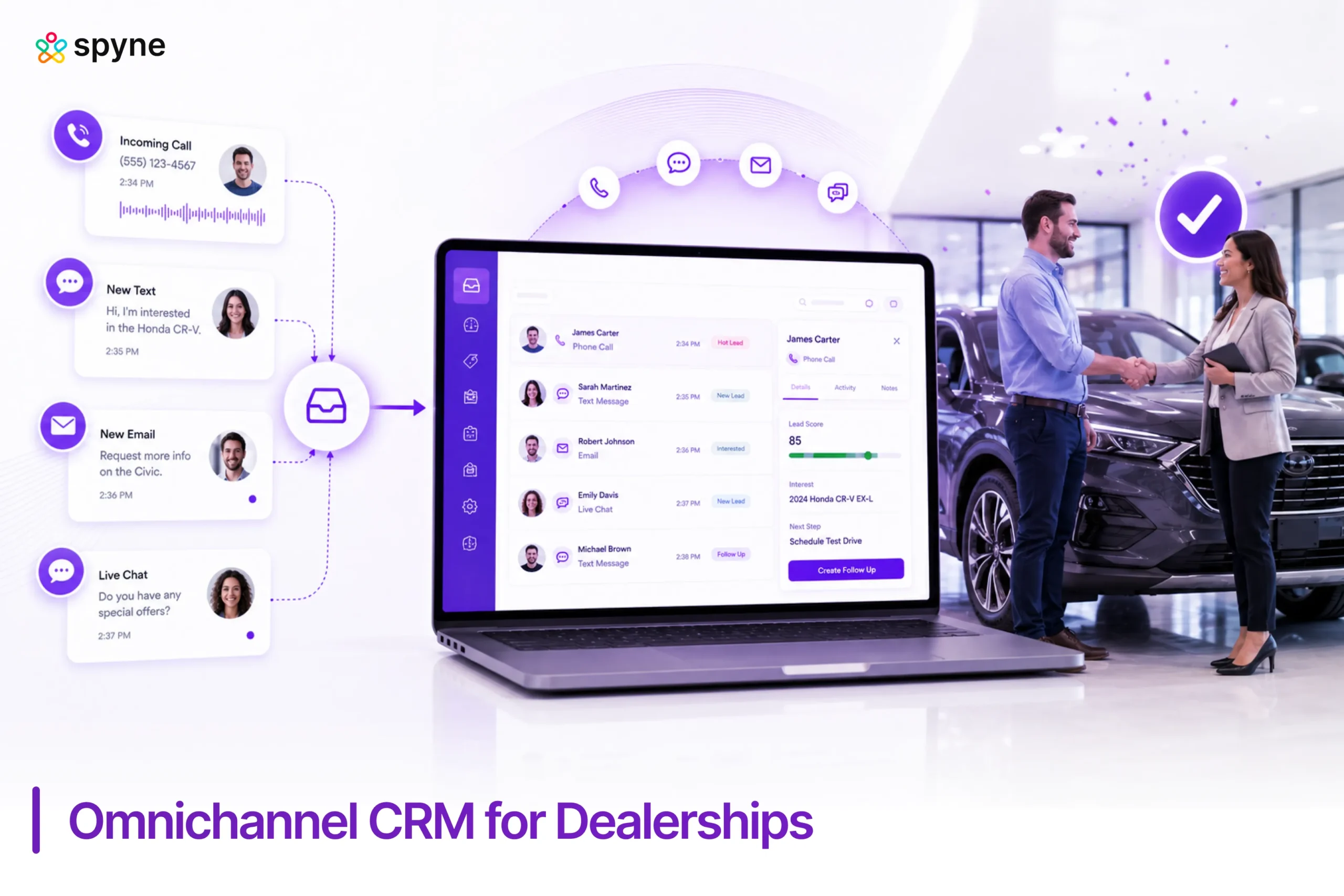
An omnichannel CRM for dealerships is customer relationship management software that logs every call, text, email, and web chat into one profile, so any rep who opens a lead sees the full history regardless of channel. That’s different from a multichannel setup, where a dealership runs several tools that never share data.
The difference shows up the moment a customer switches channels. In a multichannel shop, a customer who called yesterday and texts today looks like a new lead. In a true omnichannel CRM for dealerships, that text opens directly into yesterday’s call notes and the vehicle they asked about. The customer never repeats themselves, and the rep never has to guess.
How an Omnichannel CRM Workflow Actually Runs
A typical omnichannel CRM for dealerships follows the same sequence: a customer submits an inquiry through the website, a marketplace, or a call; the CRM creates one lead and routes it to a rep; every reply across channels logs to that record; reminders prompt the next follow-up; and after the deal closes, the CRM hands off to service reminders instead of losing the customer at delivery. This only holds together if the CRM writes to one record instead of several, regardless of DMS.
Why Omnichannel Engagement Strategies Matter for Dealers
Omnichannel engagement strategies for dealers matter because the buying journey rarely stays on one channel. A shopper might chat at 9 p.m., text the next morning, then call to confirm an appointment by lunch. If those touches live in three systems, nobody has the full picture, and the customer feels like they’re starting over each time.
Cox Automotive’s research found real gaps between what buyers want online and what dealers deliver: 48% want to apply for credit online, but only 33% do, and just 19% finalize price online despite 37% wanting that option. Coordinated omnichannel engagement strategies for dealers close part of that gap by keeping every channel on the same deal status.
Dealerships running an omnichannel CRM for dealerships also cut duplicate follow-up. Without a shared view, a BDC rep and a salesperson often message the same lead the same day about the same vehicle, which reads as disorganized rather than attentive.

Best Omnichannel Automotive CRM Covering Call, Text, Email, and Webchat
The best omnichannel automotive CRM covering call, text, email, and webchat is one where all four channels write to the same customer record automatically, not one where staff manually forward messages between tools. Look for native call logging, two-way texting, email tracking, and web chat that timestamp into one activity feed, the core test of any dealer CRM with call, text, email, and chat claims.
VinSolutions CRM and DealerSocket CRM tie channel coverage closely to their own DMS ecosystems, suiting franchise groups already standardized on those platforms. Elead CRM leans on call-tracking heritage, while AutoRaptor suits smaller lots wanting simpler texting and email. Spyne Automotive CRM, built as an omnichannel CRM for dealerships from the ground up, consolidates call, text, email, and chat per lead in one inbox, with conversational AI that handles routine inbound questions across channels without adding a separate chatbot tool.
Broader platforms sometimes named in this comparison, DriveCentric, Fullpath, Salesforce Automotive Cloud, HubSpot, Tekion, also cover these channels at varying depth, but most extend a general-purpose or newer platform into automotive rather than starting from dealership call and text volume as the core design problem.
| Platform | Call Tracking | Two-Way Texting | Email Automation | Web Chat | Pricing |
| Spyne Automotive CRM | Yes, unified inbox |  |
|
Yes, AI-assisted | Customized |
| VinSolutions CRM | Yes | |
|
Limited native chat | Connect with Sales Team |
| DealerSocket CRM | Yes | |
|
Limited native chat | Connect with Sales Team |
| Elead CRM | Yes, strong call focus | |
|
Add-on required | Connect with Sales Team |
| AutoRaptor | Basic | |
|
Not native | Connect with Sales Team |
Best Omnichannel CRM for Car Dealerships
The best omnichannel CRM for car dealerships depends less on feature lists and more on whether the platform matches how your team works. A high-volume franchise store juggling OEM lead feeds needs different channel routing than a two-person independent lot answering its own texts.
Three questions narrow the field fast. Does the CRM merge duplicate records automatically when the same person contacts you through two channels? Can a rep see the full cross-channel history without clicking into three tabs? Does the platform keep the same rep on a channel-switching customer, or does ownership reset? Onboarding time matters too. A platform that unifies channels on paper but takes six weeks to configure delays the payoff, so ask for a realistic timeline before signing.
Omnichannel CRM for Automotive Sales: Common Mistakes to Avoid
Rolling out an omnichannel CRM for automotive sales without changing team habits is the most common mistake. The software can unify the channels, but if reps default to personal phones for texting or answer webchat from a separate app, the CRM never gets the full picture.
- Letting reps text from personal numbers instead of the CRM’s tracked line, which breaks the shared history that’s the entire point of an omnichannel CRM for automotive sales
- Leaving web chat staffed by a third-party vendor whose transcripts never sync into the CRM
- No clear ownership rule for channel-switching leads, so two reps unknowingly work the same customer- skipping team training on the unified inbox, so reps keep checking separate tabs out of habit
- Not auditing duplicate records for the first few months after go-live, letting old habits quietly undo the unification
Omnichannel Dealer CRM Tips for Getting Started
Start with a channel audit before touching any settings. List every tool handling calls, texts, emails, and chat, and note which already share data. These omnichannel dealer CRM tips assume you know your gaps before closing them.
Migrate one channel at a time rather than flipping everything at once. Most dealerships start with texting and email, since those generate the clearest paper trail, then fold in call tracking and chat once reps are comfortable. Set a firm cutover date, because running the CRM alongside legacy texting apps “just in case” recreates the fragmentation you’re fixing.
Review cross-channel activity weekly for the first month. Conversation gaps between channels usually mean a rep is working around the system, which is exactly what these omnichannel dealer CRM tips are meant to catch early.
Dealer CRM with Call, Text, Email, and Chat: What to Look For
Automotive lead management with call, text, email, and chat should show every interaction on one timeline, with no separate login needed to see the full picture. If a manager has to pull three reports to reconstruct one customer’s journey, the channels aren’t actually unified.
Compliance matters as much as coverage. Confirm the platform supports TCPA-compliant opt-in tracking for texting and call recording disclosures where required. Also check whether the mobile app gives reps the same view on the lot as at a desk.
Some general CRM comparisons list WhatsApp as a core channel too. That matters for dealer groups with international buyers, but for most US dealerships, SMS, email, phone, and web chat cover the large majority of contact. Confirm which channels your buyers actually use before treating WhatsApp as a requirement.
Spyne Automotive CRM: Omnichannel CRM for Dealerships Built for Call, Text, Email, and Chat
Spyne Automotive CRM addresses the exact problem this article describes. Dealership conversations happening across call, text, email, and chat with no shared record connecting them. Spyne centralizes those channels into one customer profile any rep can pick up mid-conversation. As an omnichannel CRM for dealerships, the features below are grounded in how BDC and sales teams work through a lead day to day.
1. Unified Cross-Channel Inbox
Every call, text, email, and chat message for a lead lands in one inbox instead of four apps. A rep opening a lead sees the full sequence in order, so a text following up on yesterday’s call reads in context, not as a fresh message.
2. Conversational AI Across Channels
Spyne’s conversational AI fields routine inbound questions, whether by text, chat, or a missed-call callback, without handing off to a separate chatbot. It logs every exchange into the same profile, so a human rep who takes over later has full context.
3. Automated Multi-Channel Follow-Up Sequences
Automated follow-up for car dealers cadences span channels automatically, such as a same-day text after a missed call followed by an email with vehicle details the next morning. A customer who replies on any channel pauses the automation instead of getting a redundant message on a channel they’ve already answered.
4. Channel-Aware Lead Routing
When a lead switches from web chat to a phone call, the CRM routes the call to the same rep whenever they’re available, instead of resetting ownership. This keeps continuity intact at the exact moment a customer expects the dealership to already know who they are.
5. Duplicate Profile Merging
If the same customer contacts the dealership through two channels using different contact details, Spyne flags likely matches for a quick manual confirm rather than silently creating two records. This keeps the unified view accurate instead of quietly fragmenting after go-live.
6. Cross-Channel Activity Reporting
Managers see response times and conversion rates by channel and by rep, instead of pulling separate reports from a texting tool, an email platform, and a call tracker. This makes it possible to spot a rep who’s fast on calls but slow on text replies.
7. Mobile Access to the Full Conversation History
The mobile app shows the same call, text, email, and chat history a rep would see at a desktop, so a salesperson on the lot can check what a customer already asked before walking over, rather than starting blind.
8. DMS-Aware Context on Every Channel
Spyne automotive CRM connects to the dealership’s DMS or another system, a rep on any channel can see if the customer already has a vehicle in service, an open deal, or a prior purchase. This prevents pitching a new vehicle to someone already mid-deal on another one.

Conclusion
An omnichannel CRM for dealerships isn’t about adding more channels. It’s about making the channels you already use share one record instead of four disconnected ones. Cox Automotive’s data shows most buyers want that connected experience, not a fully online or fully in-person process. Closing that gap is what an omnichannel CRM for dealerships does. Start with a channel audit, migrate deliberately, and hold your team to the unified inbox instead of old habits. Ready to bring call, text, email, and chat into one view? Book a demo.