
Executive SummaryDealer inventory pricing software pulls live market data, competitor listings, and demand signals into one view so every vehicle gets priced to sell, not priced by gut feel. Cox Automotive reported new-vehicle days’ supply at 80.3 days in June 2026, up from 78 days in May, and every extra day on the lot chips away at gross before the car ever sells. The right dealer inventory pricing software turns that market noise into a repeatable pricing strategy that protects margin and moves metal faster. |
A used car sits on the lot an extra ten days because it was priced $800 too high, and nobody catches it until the aging report lands on the manager’s desk. Cox Automotive put new-vehicle days’ supply at 80.3 days in June 2026, and every extra day of holding cost eats into gross before the sale even happens. Dealer inventory pricing software exists to catch that mistake before it costs you a deal, not after the desk asks why gross is down. Here is how live market data, real pricing strategy, and the right software stop the bleeding.
What Is Dealer Inventory Pricing Software?
Dealer inventory pricing software is a technology platform that analyzes real-time market data, competitor listings, and vehicle-specific factors to recommend the right retail price for each unit in inventory. Instead of a static book value or last month’s gut check, it pulls in what similar vehicles are actually selling for in a dealer’s local market right now.
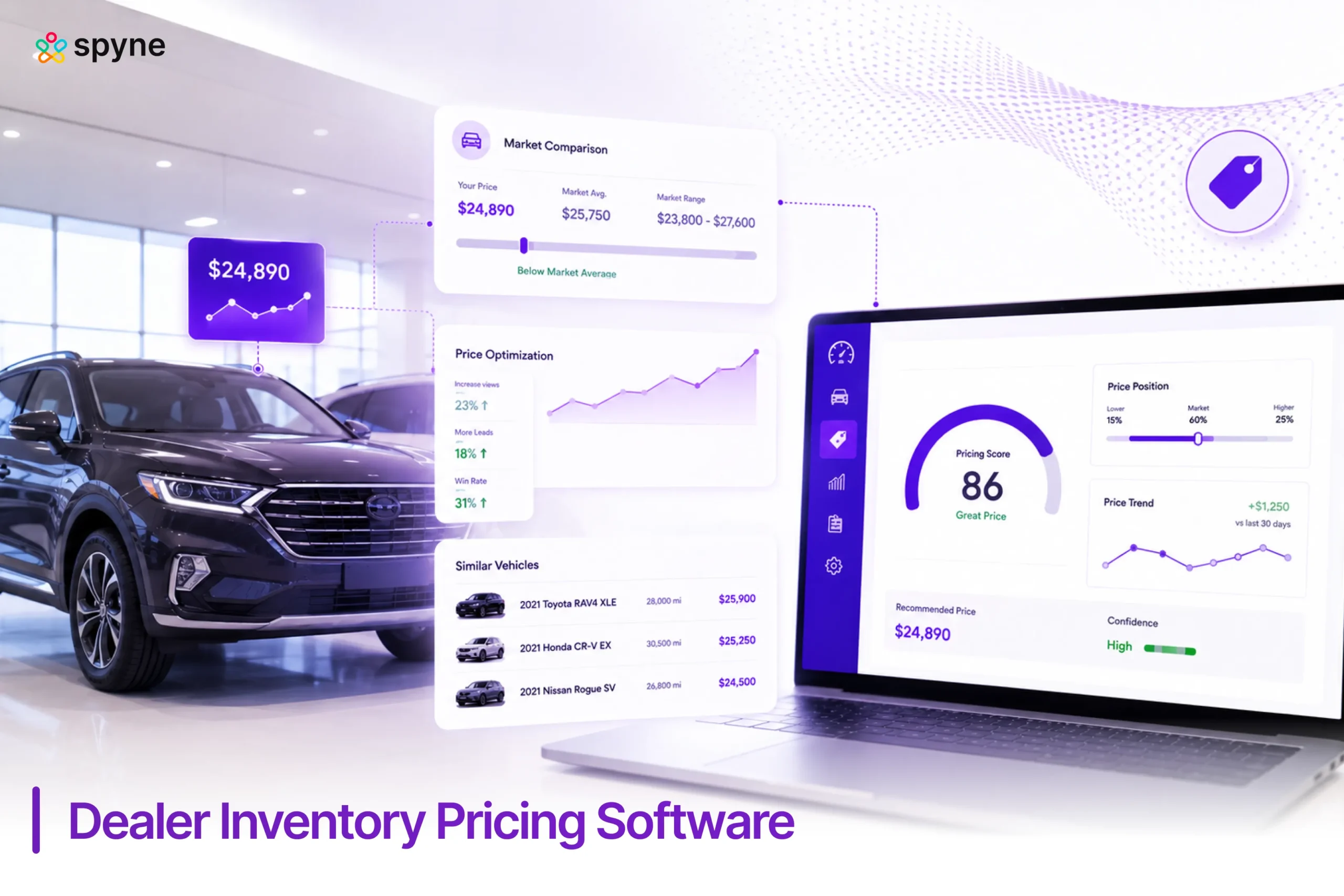
Most platforms combine competitive set pricing, demand signals, condition and mileage adjustments, and days’ supply by segment, then output a price recommendation, a market position, and a drift alert.
Pricing is the single biggest lever on gross profit and days on the lot. Price too high and the car sits, racking up holding cost. Price too low and gross is left on the table. Dealer inventory pricing software exists to find the number in between, backed by data instead of instinct.
Which Dealer Inventory Software Helps Price Vehicles Competitively?
The direct answer: platforms such as vAuto, DealerSocket, VinSolutions, CDK Global, and Spyne Inventory Management help price vehicles competitively by combining live market comps, competitor monitoring, and automatic repricing rules, so a manager gets a data-backed number instead of a guess. The strongest tools share five traits: real-time pricing recommendations, competitor monitoring, days-on-lot tracking, repricing rules, and DMS or CRM integration.
Software alone will not fix a bad process. Here is what these tools do, and what managers should do without one:
- Pull the competitive set. Identify similar vehicles within a 50 to 100 mile radius.
- Adjust for vehicle-specific factors. Mileage, trim, color, accident history, and reconditioning move the number.
- Check demand velocity. High demand and low days’ supply support a firmer price; a slow segment needs a sharper one.
- Set a market position. Decide whether the unit needs to win the sale or protect margin.
- Reprice on a schedule. A price competitive on day one can be $500 off by day fourteen.
- Track the outcome. Watch days to sell against target and adjust rules going forward.
That is how to price vehicles with inventory software in practice: a repeatable loop, not a guess.
Dealer Inventory Pricing Strategies That Actually Move Metal
The direct answer: dealerships winning on both gross and turn rate combine a market-based pricing baseline with a segment-specific approach, rather than one flat markup across the lot. Effective pricing strategies treat every vehicle segment differently based on how fast it moves and how much margin it can hold.
A few approaches dealer groups use well right now:
- Velocity pricing by segment: Fast-moving segments like sub-$20,000 trucks and SUVs get priced closer to market average; slower segments hold a firmer price.
- Aging-based price steps: Vehicles get an automatic adjustment at day 15, 30, and 45 if unsold.
- Channel-specific pricing: A marketplace price need not match the dealer’s own site price, since shopper behavior differs by channel.
- Reconditioning cost transparency: Building true reconditioning cost into the price floor keeps a vehicle from looking profitable while losing money in reality.
McKinsey reported in 2023 that more than 95 percent of used-car searches start online, and more than 70 percent of shoppers compare prices on third-party sites first. Sound pricing strategies compete against a shopper who already has five tabs open with competitors’ listings.

Live Market Pricing for Dealer Inventory: Why Static Pricing Fails
Live market pricing for dealer inventory means the price recommendation updates as the market moves, not just when someone manually revisits the vehicle. Static pricing sets a number once at intake and leaves it untouched until someone notices the car has sat too long.
Cox Automotive’s June 2026 data showed the average new-vehicle listing price at $49,336, up 1.4 percent year over year, while days’ supply climbed from 78 to 80.3 days in a single month. A price competitive in May can be stale by the third week of June, and spreadsheet pricing has no reliable way to catch that shift.
Real-time repricing solves this by comparing every vehicle against fresh listings and flagging units that have drifted out of position before the car becomes aged inventory, and it surfaces regional differences too, since a trim selling fast in one metro can sit for weeks two states over.
Best Dealer Inventory Pricing Software with Live Market Data
The direct answer: the best software combines a comp set large enough to be statistically reliable, frequent refresh (daily or near real time), and clear alerts when a vehicle needs a price change, rather than a static report a manager has to remember to check.
Look for:
- Comp set size and radius control: Thousands of live listings in your selling radius beat national averages.
- Refresh frequency: Daily updates catch drift a monthly refresh will miss.
- Actionable alerts: The best platforms flag which units are out of position, instead of an unread report.
Established players include vAuto, DealerSocket, VinSolutions, CDK Global, and Dealerslink. Spyne Inventory Management fits this category too, pairing pricing signals with reconditioning and merchandising data.
Dealer Inventory Pricing Software Tips for Faster Turn
The direct answer: the fastest wins come from repricing on a fixed schedule, trusting the data over gut instinct on aged units, and keeping reconditioning cost in the price floor from day one. These dealer inventory pricing software tips apply whether you run one rooftop or twenty.
- Set a repricing cadence and stick to it: Weekly is the minimum; daily is better for high-value units.
- Trust the data past day 30: Emotional attachment to acquisition price is the biggest reason aged inventory stays aged.
- Segment pricing rules by vehicle type: Trucks, SUVs, and economy cars behave differently.
- Use alerts, not memory: A manager covering 150 units cannot mentally track which ten need a change this week.
- Pair pricing with photo quality: A correctly priced vehicle with weak photos still underperforms.
Common Mistakes to Avoid in Vehicle Pricing
The direct answer: the costliest mistake is pricing off acquisition cost or gut feel instead of live market data, followed by letting aged units sit without a scheduled review. A few other mistakes show up across dealer groups of every size:
- Ignoring reconditioning cost until after the price is set. This creates a price floor that looks fine on paper and loses money in practice.
- Pricing every vehicle the same way regardless of segment. A slow-moving sedan and a fast-turning SUV need different logic.
- Treating price as a one-time decision. A price that made sense at intake can be stale within days.
Spyne Inventory Management: Dealer Inventory Pricing Software for Dealership Merchandising
Spyne Inventory Management is a dealership software solution built to price, merchandise, and track inventory health from acquisition through sale. It sits in the same operational lane as vAuto and DealerSocket, but ties live market pricing directly to reconditioning and listing quality. For dealer principals running multiple rooftops, that link often decides whether a deal closes.
1. Live Market Pricing Signals
Spyne pulls live market listings by year, make, model, and trim, then compares each vehicle against what is actually selling nearby right now. A unit that drifts out of competitive range gets flagged before it turns into an aging problem. A manager covering forty or more units gets a prioritized list, not a spreadsheet built from memory.
2. Inventory Health Monitoring
Dashboards track days’ supply, aging thresholds, and price-to-market position by segment, not just unit by unit. A general manager sees at a glance which segment, trucks, SUVs, or sedans, carries the most pricing risk, weeks before it shows up in a monthly report.
3. Reconditioning-Aware Price Floors
Spyne tracks reconditioning workflows alongside pricing, so a manager sees true landed cost, not just acquisition cost, before setting a price. This closes a common gap where a vehicle looks profitable on paper but loses money once paint, tires, and detail work are added in.
4. Real-Time Syndication
When a price changes, the update pushes across every listing channel automatically, including the dealer’s own site and third-party marketplaces. A vehicle never shows one price on a marketplace and a different number at home. That consistency protects trust with shoppers already cross-referencing multiple sources.
5. Segment-Level Pricing Rules
Managers set a different repricing cadence and market position for trucks, SUVs, and economy vehicles instead of one blanket rule. A fast-turning economy segment stays priced tight to market, while a slower segment holds a firmer number. This is what separates a real pricing strategy from a single markup applied to everything.
6. Aging Alerts Tied to Action
Instead of a static report a manager has to remember to open, Spyne flags units approaching day 15, 30, or 45 with a recommended price adjustment already attached. The alert states what to do next, not just that a problem exists, which is what keeps aged inventory from quietly piling up.
7. AI-Powered Merchandising and Fast Listing Turn
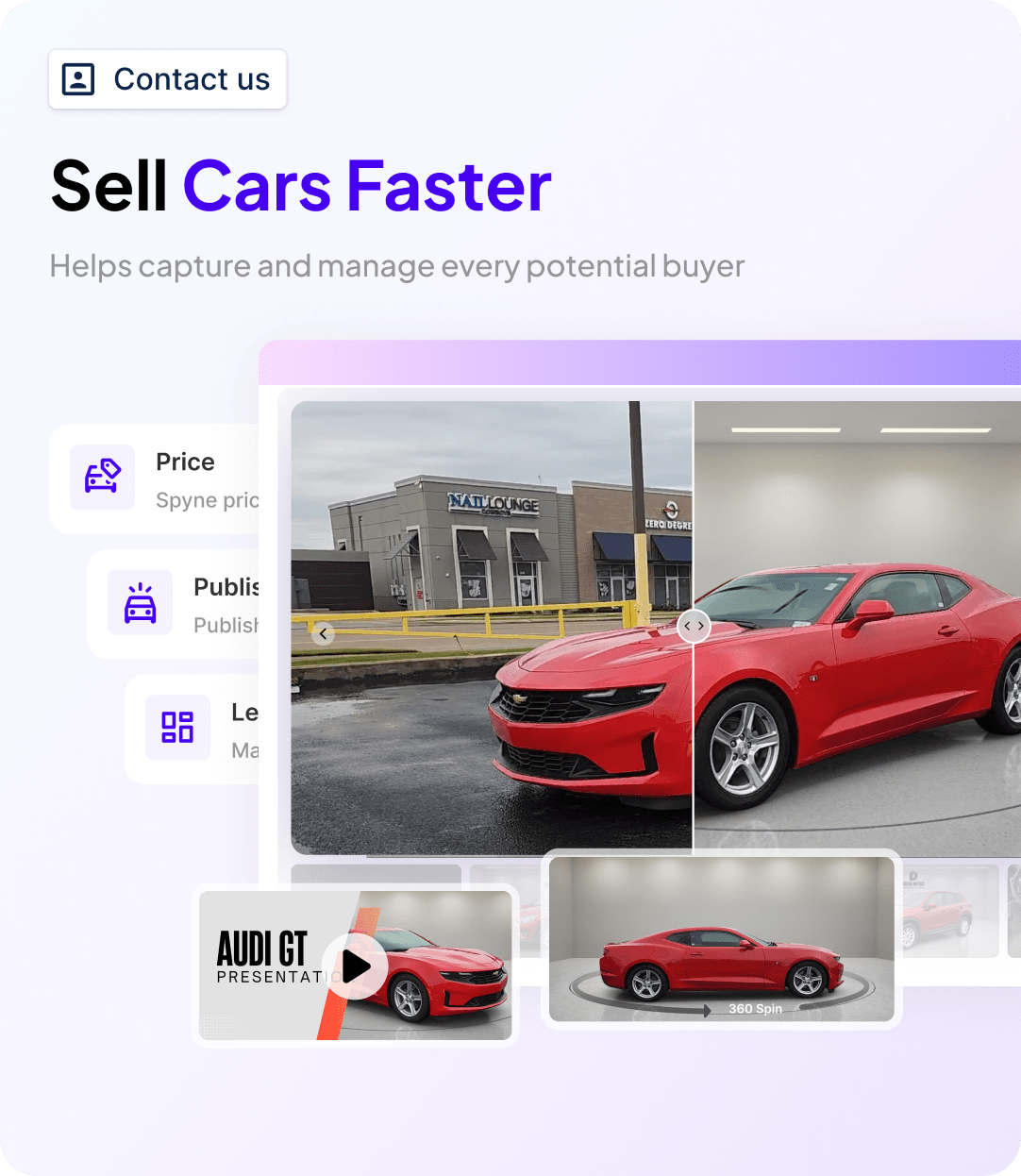
Spyne pairs its pricing signals with AI photo enhancement and listing generation, so a repriced vehicle gets back onto every channel with accurate images the same day. A manager does not have to choose between pricing a car correctly and getting it listed quickly. Both happen inside the same workflow.

Conclusion
Pricing a vehicle correctly is not guesswork anymore, and dealerships still treating it that way are losing gross to competitors who are not. Dealer inventory pricing software replaces the guesswork by combining live market data, demand signals, and vehicle-specific factors into a price that reflects what the market will pay today, not what a spreadsheet said last month. The strategies that work best segment pricing by vehicle type, revisit aged units on a schedule, and treat reconditioning cost as part of the price floor. With days’ supply and listing prices climbing through 2026 per Cox Automotive, dealerships protecting gross are pricing to the market in real time, not by instinct.