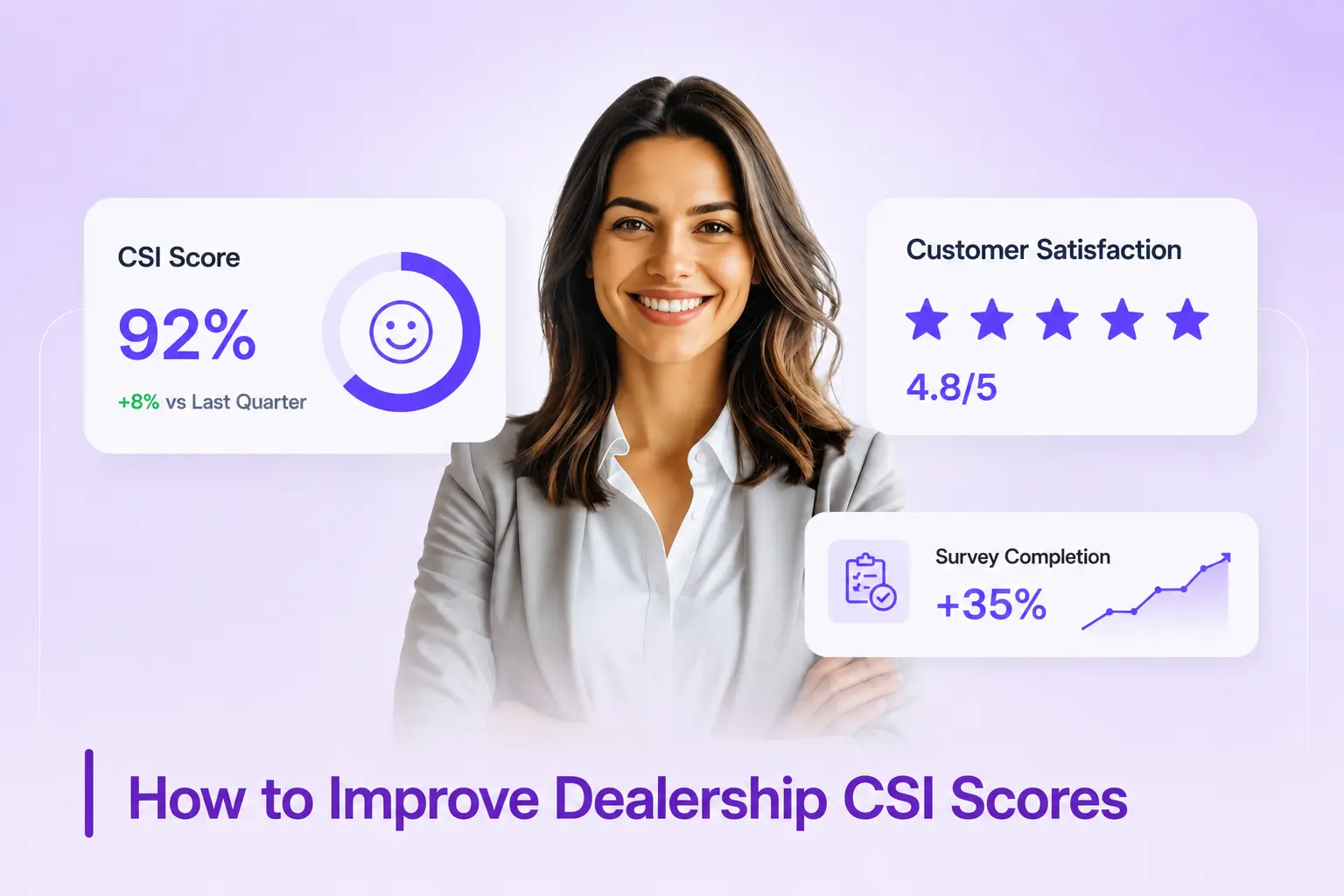

| Dealership CSI scores fail at the communication layer before they ever reach the repair bay. According to the J.D. Power 2025 U.S. Customer Service Index (CSI) Study, four of the ten most influential CSI KPIs are communication-related. Vini AI by Spyne handles service scheduling, automated status updates, declined-service follow-up, and post-visit outreach across voice, SMS, and email, eliminating the three process failures that cost dealers their scores. Paragon Honda recovered $310K in service revenue in one week after deployment. |
Most franchise dealerships losing OEM incentive thresholds are not losing them in the repair bay. The J.D. Power 2026 U.S. CSI Study puts the number plainly: when all 10 top KPIs are completed in a single service visit, average customer satisfaction scores 979. When only three are met, it collapses to 632. The delta between those two numbers is not technician skill or repair quality. It is whether the customer heard from you — at booking, during the visit, and after pickup.
That gap is where most stores are quietly bleeding. Not on the lift. On the phone queue at 8am, the status update that never came at 2pm, and the declined brake job nobody followed up on. Fixed Ops Directors who have been chasing CSI for years know this already. The problem is that knowing it and having a system that closes it are two different things.
What Do CSI Scores Actually Measure, and Where Do Dealers Keep Losing Points?
CSI (Customer Satisfaction Index) scores are OEM-issued metrics that measure the customer experience across the full service visit: initiation, advisor interaction, service quality, vehicle pickup, and facility experience. OEMs use these scores to determine holdback incentives, co-op marketing eligibility, and priority vehicle allocations. A mid-volume franchise dealership can risk hundreds of thousands of dollars in annual OEM incentives if CSI drops below threshold.
Most dealers assume repair quality drives the score. It does not drive the swings. The J.D. Power 2025 CSI Study identified that four of the ten most influential KPIs are communication-related: focusing on customer needs, keeping customers informed on status, meeting them immediately on arrival, and following up after the visit. Only 26% of customers say they experienced nine or ten of those top KPIs in a single visit.
The two failure points that appear on every service manager’s dashboard, month after month:
- Response time: Customers can’t get through, get placed on hold, or reach voicemail when calling to book or check status.
- Communication gaps during the visit: No one proactively updates the customer after drop-off. The customer calls in to ask. The advisor stops what they’re doing. The RO slows. And the customer still leaves frustrated.
How Slow Service Communication Destroys CSI: The Three Failure Points
Most CSI damage is baked in before the survey ever arrives. Here is where it happens operationally:
# Failure Point 1: The Booking Call That Doesn’t Get Answered
According to CDK Global research, dealerships miss an average of 19% of all incoming calls, a figure CDK describes as unacceptable to every dealer who sees it. Around 50% of dealers in CDK’s own survey identified missed and mishandled calls as an active operational problem. A service department fielding 200 calls per day is dropping 38 every morning before the first repair order is written.
When a customer hits a wall at booking, their CSI score is already set, mentally, before they arrive.
# Failure Point 2: The Status Update Gap
Numa’s internal dealer data quotes one dealer principal directly: “Half of the phone calls we get in here is because they haven’t had a status update.” That is not a staffing problem. An advisor managing 12 to 15 open ROs simultaneously cannot be expected to manually call every customer with a mid-day update. The volume makes it structurally impossible. So customers call in, advisors get interrupted, and the RO falls behind, which makes the next status call more necessary, not less.
The J.D. Power 2025 CSI Study found customers are four times more likely to prefer status updates via text (68%) over phone call (16%). Most dealerships are still calling.
# Failure Point 3: Declined Service Goes Silent
A customer declines a recommended repair, brake pads, cabin filter, coolant flush. The RO closes. No one follows up. The customer forgets. They return six months later with a more expensive problem. The dealership lost the repair revenue, the return visit, and the CSI point for follow-through.
The survey arrives 3 to 10 days after the visit. By that point, the friction from one of these three failure points has already calcified into a 2-star response.
What Does a Good CSI Improvement Process Look Like With AI?
The operational sequence for AI-assisted CSI improvement runs across five touchpoints: pre-booking response, status updates during the visit, declined-service re-engagement, post-visit follow-up, and proactive recovery before the survey window.
Each one maps to a CSI KPI. Each one is automatable. Here is what the workflow looks like in practice:
- Service booking (inbound call or text): AI answers in under 5 seconds, captures intent, confirms appointment, syncs to DMS. No hold time. No missed call. Customer expectation set correctly at the first touchpoint.
- Mid-visit status update: Automated text sent when the vehicle enters inspection and again when work is authorized, without the advisor stopping to dial. Customer does not need to call in.
- Declined service follow-up: AI sends a structured follow-up within 24 to 72 hours referencing the specific item declined. The message is not generic, it names the repair, explains the risk, and offers a booking link. Re-engagement rate for declined services is materially higher via text than via outbound advisor calls.
- Post-visit check-in: An automated message sent within 24 hours of vehicle pickup asks if everything was resolved. If the customer indicates a problem, it routes to the service manager before the OEM survey fires. This is the proactive recovery window.
- Pre-survey alert: If a customer has had zero status contact during their visit and has not received a post-pickup message, the system flags that RO for manual outreach before the survey is issued.
How Vini AI Specifically Lifts CSI Scores?
Vini AI is Spyne’s conversational AI agent built for automotive dealerships, handling inbound and outbound voice, SMS, and email for both sales and fixed ops. For service departments, Vini targets the three communication failure points directly.
1. Service Scheduling at Scale
Vini answers every inbound service call in under 5 seconds, around the clock. It captures appointment intent, handles rescheduling, and syncs confirmed appointments directly into your DMS. Advisors enter the lane with a prepared desk, not a backlog of missed calls and voicemails.
Pied Piper’s 2025 Service Telephone Effectiveness Study found that AI-handled service calls scored an average of 72 on the STE benchmark, 8 points higher than the national dealer average for human staff. The study covered 2,105 dealerships. AI is not aspirational for fixed ops anymore. It is performing above the human baseline.
2. Automated Status Updates
Vini pushes status updates to customers at pre-defined points in the repair process: inspection start, authorization decision, work completion, ready-for-pickup. Each message is sent via the customer’s preferred channel, text or email, without advisor intervention. The inbound “where’s my car” call volume drops. Advisors stay in the lane.
3. Declined Service Re-Engagement
When an advisor marks a service item as declined in the DMS, Vini automatically schedules a follow-up outreach at 48 hours, 7 days, and 30 days, each referencing the specific line item. Spyne data shows a +35% RO rate lift when Vini manages service scheduling and declined-service follow-up on the same RO cycle.
4. After-Visit Follow-Up and Pre-Survey Recovery
Within 24 hours of vehicle pickup, Vini sends an automated check-in. Responses indicating unresolved issues are flagged immediately and routed to the service manager, before the OEM survey window opens. This is the narrowest, highest-leverage window for CSI recovery, and most dealerships leave it entirely unmanaged.
What Dealerships That Improved CSI With AI Actually Changed
The Paragon Honda case is the most cited example in this category for good reason: it is specific, auditable, and operationally instructive.
Paragon Honda deployed Vini AI for service department call coverage and outbound follow-up. The result: $310K recovered in service revenue in one week, driven by a combination of inbound call capture and declined-service re-engagement that had previously gone unworked. The +35% RO rate lift is a function of both channels working simultaneously.
What changed operationally at stores that have moved CSI scores materially inside a single survey cycle:
- Inbound call answer rate went from ~81% to near-complete coverage with AI handling overflow and after-hours
- Status update calls dropped from advisor workload because automated texts replaced manual calls
- Declined service follow-up moved from “whenever the advisor has time” to a structured 3-touch automated sequence
- Post-visit recovery window was created where previously none existed
None of these changes required retraining advisors on soft skills. They required process infrastructure.
AI Tools for Dealership CSI Improvement: Quick Comparison
The following table is sourced exclusively from official platform websites and public press releases.
| Platform | Primary Focus | CSI-Relevant Capabilities | Voice AI | DMS Integration | Human QA on Calls |
| Vini AI (Spyne) | Full-lifecycle dealership AI: sales + service | Service scheduling, automated status updates, declined service follow-up, post-visit check-in, omnichannel (voice/SMS/email) | Yes | Yes | Yes, daily human QA on every call |
| Numa | Service communication and CSI management | Appointment booking, real-time status updates, unified inbox, team escalation, Voice AI + Smart Inbox | Yes | Yes | Not publicly specified |
| Podium | Reputation management and customer messaging | Review collection, SMS, online engagement; pairs with other systems for responsiveness | No (messaging-focused) | Partial | Not publicly specified |
| Kenect | Business texting and service engagement | Two-way texting, appointment reminders, service updates, review requests, payment via text, proactive CSI surveys | Via Service AI (Voice AI add-on) | Yes | Not publicly specified |
Best AI Platforms for Dealership CSI Improvement: In-Depth Breakdown
Not every AI communication platform approaches CSI the same way. Some handle scheduling. Some handle reputation. Some handle the full lifecycle. Here is how each platform actually works for fixed ops, and what to expect from each.
1. Vini AI by Spyne
Vini AI is Spyne’s conversational AI agent built specifically for automotive dealerships. For fixed ops, it functions as a full-service communication layer, handling inbound scheduling, mid-visit status updates, declined service re-engagement, and post-visit check-in across voice, SMS, and email from a single platform.
CSI-Relevant Capabilities:
- Answers every inbound service call in under 5 seconds, around the clock, no hold time, no voicemail, no missed booking
- Sends automated status updates at each stage of the repair process (inspection start, authorization, ready-for-pickup) via the customer’s preferred channel, eliminating inbound “where’s my car” calls
- Executes a structured 3-touch declined service follow-up sequence (48 hours, 7 days, 30 days) referencing the specific line item declined, not a generic reminder
- Sends an automated post-visit check-in within 24 hours; negative responses are flagged to the service manager before the OEM survey fires
- Flags ROs with zero status contact during the visit as high-risk, enabling pre-survey manual recovery
What Sets It Apart:
- Covers sales, service, parts, and financing from one platform, no separate tools for each department
- Human QA reviews every AI call daily, giving service managers visibility into conversation quality and compliance
- Full CRM and DMS sync: every call, text, and appointment logged automatically with source attribution and next steps
- SOC2, TCPA, GDPR, and DNC compliant for all outbound service communication
- Spyne data shows a +35% RO rate lift when Vini manages both service scheduling and declined service follow-up on the same RO cycle
Measured Outcomes (Spyne data):
- 100% inbound call coverage across all hours
- +35% RO rate lift on managed service lanes
- $310K recovered in service revenue at Paragon Honda in one week
- 5,000+ dealership customers on the Spyne platform
Pricing: Custom (demos available at spyne.ai)
Best for: Dealerships that want a single AI platform managing the full service communication lifecycle, from the booking call through post-visit recovery, fully synced with their CRM and DMS, with human QA oversight on every interaction.
2. Numa
Numa is an AI platform focused on dealership service communication and CSI management. Its Voice AI and Smart Inbox handle inbound calls, real-time status updates, and team escalation within the service lane.
CSI-Relevant Capabilities:
- AI-powered appointment booking with 24/7 availability
- Unified inbox combining calls, texts, and emails for service advisors
- Real-time status updates and team escalation alerts
- Voice AI with context-aware Smart Inbox for customer history
Best for: Service departments that want to reduce advisor communication load and improve real-time CSI visibility within the service lane. Strong fit for stores focused specifically on the service communication layer rather than full dealership-wide AI coverage.
3. Podium
Podium is a customer messaging and reputation management platform. It focuses on review collection, SMS-based customer communication, and online engagement rather than inbound call handling or service scheduling automation.
CSI-Relevant Capabilities:
- Two-way texting for appointment reminders and service updates
- Review collection and reputation management
- Online engagement and webchat
- Pairs with other systems for broader responsiveness coverage
Best for: Dealerships looking to improve their online review presence and add text-based customer communication. Not a standalone solution for service scheduling or inbound call coverage.
4. Kenect
Kenect is a business texting platform built for dealerships with an add-on Service AI that includes Voice AI and a proactive engagement module. Its strength is in SMS-based communication and automated outreach campaigns.
CSI-Relevant Capabilities:
- Two-way business texting from the dealership’s main number
- Appointment reminders, service updates, and review requests via text
- Proactive CSI surveys and retention campaigns
- Voice AI add-on for call handling (Service AI)
- Payment collection via text
Best for: Dealerships prioritizing text-based customer engagement, proactive CSI survey outreach, and retention campaigns. The Voice AI is an add-on rather than a core capability, making it a partial solution for stores with significant inbound call volume.

Closing Thoughts
The uncomfortable reality in fixed ops is this: most CSI scores are not lost in the repair bay. They are lost in the 20-minute hold queue on Monday morning, the status update that never came at 2pm, and the declined brake job that no one followed up on for the next four weeks.
These are not advisor failures. They are process failures. And process failures are fixable with the right infrastructure, not with another all-hands training session on customer empathy.
The dealerships gaining ground on CSI right now are not the ones with the most talented advisors. They are the ones with the tightest communication loops: every call answered, every customer updated before they have to ask, every declined service worked before it goes cold.
If your store is losing OEM incentive dollars over preventable communication gaps, the math is straightforward: Vini AI recovers that ground in the first cycle. Book a demo with Spyne and see the operational impact on your service department within 30 days.