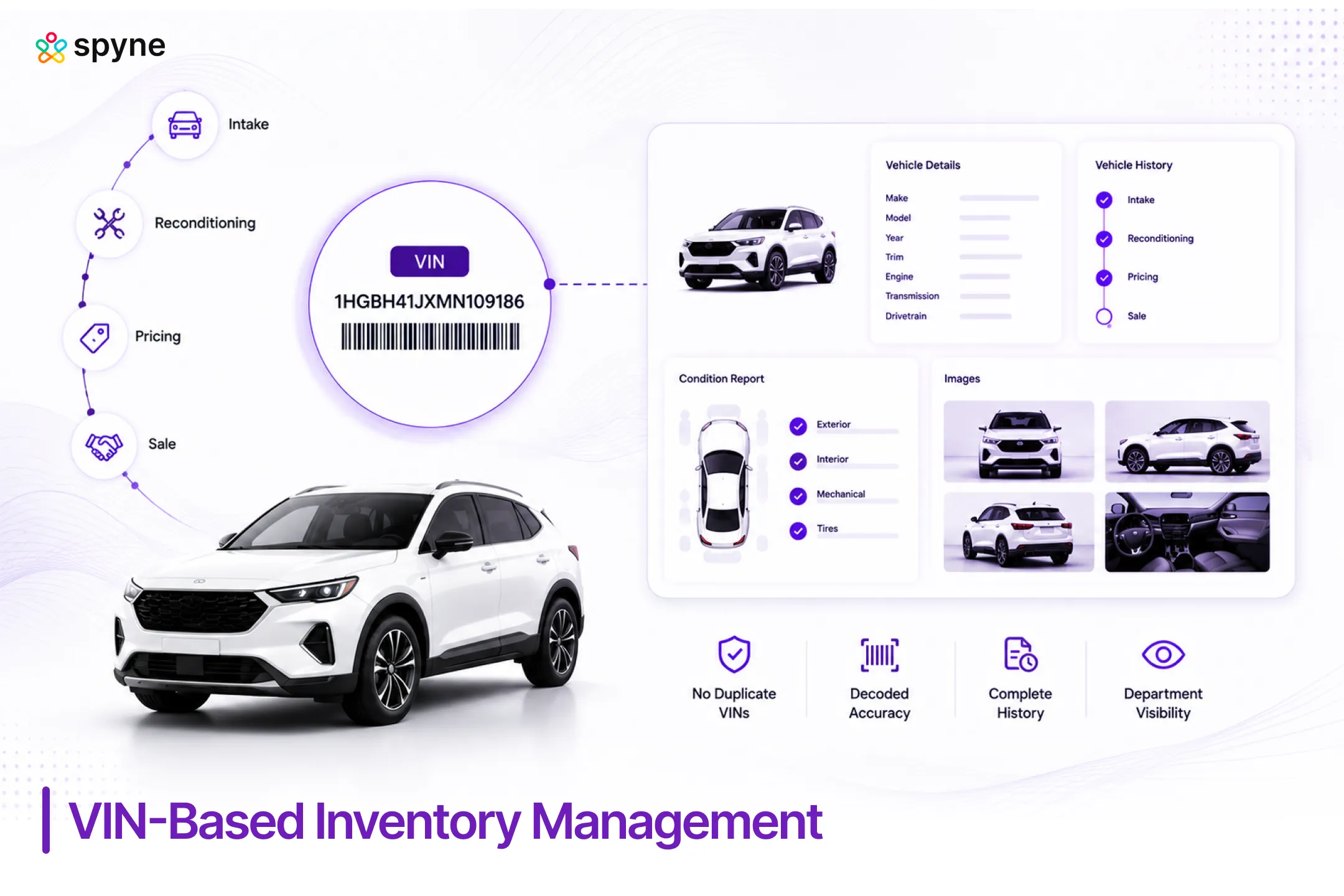

Executive SummaryVIN based inventory management uses each vehicle’s 17-character Vehicle Identification Number as the single record key that links intake, reconditioning, pricing, and sale data to one specific unit. Cox Automotive reported used-vehicle days’ supply at 47 in June 2026, meaning slow-turning VINs carry real floorplan cost. A decoder-driven system removes manual entry, flags duplicate VINs, and gives every department the same vehicle history at a glance. |
A missed VIN scan does not just create a blank field. It creates a car nobody can find in the system, a duplicate stock number, or a reconditioning invoice that never gets matched to a sale. Multiply that across a 150-unit lot and the gaps add up fast. VIN based inventory management fixes this by making the VIN, not a stock tag or spreadsheet row, the permanent record key for every vehicle. Here is how it works, what to track, and which software actually does the decoding correctly.
What Is VIN-Based Inventory Management?
VIN-based inventory management is a system where every vehicle record is built around its 17-character Vehicle Identification Number instead of a stock number, make, or model description. The VIN is decoded once at intake and every downstream record, purchase price, reconditioning cost, photos, inspection reports, and final sale, stays linked to that same identifier for the life of the vehicle.
This matters because stock numbers reset, get duplicated, or get reassigned across rooftops. A VIN cannot. Fleet operators, auctions, rental companies, and dealerships all rely on VIN based inventory management for the same reason: it is the only identifier guaranteed to be unique to one physical vehicle, which makes it the natural key for inventory, financing, and title systems to share.
How VIN-Based Inventory Management Works
Understanding how VIN-based inventory management works starts with intake, not reporting. The sequence generally runs in four stages.
1. VIN capture: A team member scans a barcode, QR code, or windshield VIN using a phone or handheld scanner, or enters the 17 characters manually.
2. Automated decoding: The system pulls year, make, model, trim, engine, transmission, body style, and factory options directly from the VIN, eliminating manual spec entry.
3. Record creation: A unique inventory record is generated and tied permanently to that VIN, holding purchase price, acquisition source, location, and status (available, reserved, in recon, sold).
4. Lifecycle tracking: Every subsequent event, a reconditioning line item, a test drive, a price change, a listing sync, gets appended to the same VIN record instead of living in a separate spreadsheet or department system.
The result is one continuous file per vehicle rather than four disconnected ones across sales, service, accounting, and marketing.
VIN Inventory Tracking Strategies That Actually Reduce Days on the Lot
Decoding a VIN correctly is only half the job. These VIN inventory tracking strategies are what turn accurate data into faster turns.
- Tie aging alerts to the VIN, not the stock number. Flag any VIN sitting past 45 days so pricing or merchandising action happens before floorplan interest erodes margin.
- Reconcile VIN records against physical lot checks weekly. A VIN marked “available” that is actually in a service bay is a lost sale waiting to happen.
- Attach every recon and detail cost to the VIN as it occurs, not at month-end, so true landed cost per unit stays accurate for pricing decisions.
- Use VIN-level duplicate detection during intake to identify vehicles that already exist under a different stock number. This helps dealerships prevent duplicate records, especially when vehicles move between locations during multi-rooftop transfers.
- Sync VIN records to listing platforms automatically so a status change (sold, reserved) updates everywhere within minutes instead of overnight.
Cox Automotive’s June 2026 data put new-vehicle days’ supply at 80 and used-vehicle days’ supply at 47, underscoring why VIN-level aging visibility, not lot-wide averages, is what actually protects margin on individual units.

VIN Decoder Inventory Management: What the Decoder Actually Automates
VIN decoder inventory management refers to the software layer that reads the 17-character VIN and returns structured vehicle data automatically, instead of a staff member typing specs from a window sticker. Most decoders draw on the check-digit and manufacturer-plant structure built into every VIN, then cross-reference it against a manufacturer specification database.
In the US, many platforms use the NHTSA’s free vPIC decoder for baseline specs, then layer a commercial decoding service on top for factory-installed options, trim-level detail, and international VINs, since community feedback from dealer forums consistently notes that free decoders return thinner option and trim data than commercial services. A dealership does not need to know which decoder sits underneath. What matters is that the inventory platform returns clean, structured data on the first scan, flags anything it cannot decode for manual review, and never silently guesses at a trim level.
Best Automotive Inventory Software With VIN Decoder Integration
The best automotive inventory software with VIN decoder integration shares three traits: decoding accuracy on the first scan, automatic duplicate-VIN detection, and a direct sync from the decoded record to listing sites and CRM without a second data entry step.
Established platforms in this space include vAuto, built around market pricing layered on top of decoded VIN data, and DMS-anchored systems like VinSolutions and DealerSocket, which route decoded VIN specs into broader dealer management workflows. CDK Global also ties VIN decoding into its wider DMS suite for franchise groups running high vehicle volume.
For dealerships that want VIN decoding built directly into a modern inventory workflow rather than bolted onto a legacy DMS, the criteria worth weighing are decode speed on mobile, how cleanly the platform flags incomplete or unrecognized VINs, and whether reconditioning and photo data attach to the VIN automatically or require a separate upload step. This is ultimately what separates genuine VIN based inventory management software from a DMS that simply displays a decoded VIN without acting on it.
VIN Inventory Management Tips for Dealership Teams
A few VIN inventory management tips that reduce errors without adding process:
- Scan the VIN at every physical handoff (intake, recon, lot placement), not just once at acquisition.
- Require a decoder match confirmation before a vehicle is marked ready for listing, catching mis-scans early.
- Keep one VIN-indexed photo folder per vehicle instead of a shared drive sorted by date.
- Review VIN-level aging reports during the same meeting where you make pricing decisions, not in a separate process.
- Train new hires on VIN scanning first, before DMS navigation, since most inventory errors trace back to intake, not reporting.
These VIN inventory management tips work because they attack the moment data enters the system, not the moment a report goes wrong weeks later.
Why VIN Inventory Tracking Strategies Depend on Decoder Accuracy
VIN inventory tracking strategies only hold up if the underlying decode is correct. A wrong trim or engine code at intake can spread inaccurate data across pricing, window stickers, and third-party listings. By the time dealerships identify the error, they may already have marketed the vehicle with incorrect specifications. This is the practical link between VIN decoder inventory management and everything discussed above: decoding is not a back-office detail, it is the foundation the rest of VIN-based inventory management sits on.
For teams still asking how VIN based inventory management works in day-to-day terms, the honest answer is that it works exactly as well as the decode at intake and the discipline to keep every later event tied to that same VIN. Skip either half, and the system reverts to a glorified spreadsheet with a fancier scanner attached.
Spyne Inventory Management: VIN-Based Inventory Tracking Built for Dealerships
Spyne Inventory Management is built around the VIN as the anchor for every vehicle record, so decoding, reconditioning, merchandising, and listing all reference the same unit from intake through sale. It fits into the workflow at the point a vehicle arrives on the lot, replacing manual spec entry with automated decoding and giving every department, sales, service, and marketing, one shared source of truth for that VIN.
1. Instant VIN Decoding at Vehicle Intake
Automatically decode VINs to capture essential vehicle details, including year, make, model, trim, engine specifications, and more. Spyne eliminates manual data entry during intake, reducing errors and helping dealerships add vehicles to inventory faster.
2. Smart Duplicate VIN Detection
Prevent duplicate inventory records with automatic VIN matching and alerts. Spyne identifies vehicles that already exist in your system, helping dealer groups avoid duplicate listings and maintain clean, accurate inventory data across locations.
3. VIN-Based Reconditioning Management
Track every repair, detail, inspection, and reconditioning expense directly under the vehicle’s VIN record. Dealerships get a complete view of each unit’s investment, helping managers understand true vehicle costs and make better pricing decisions.
4. Automated VIN-Level Aging Alerts
Monitor vehicle age and identify units that are approaching critical aging thresholds. Spyne highlights inventory that needs pricing adjustments, additional marketing, or faster action before holding costs reduce profitability.
5. Seamless Listing Creation and Syndication
Use decoded VIN data to automatically create accurate vehicle listings across dealership websites and third-party marketplaces. Spyne eliminates repetitive data entry while ensuring every listing includes consistent specifications, pricing, and vehicle details.
6. Multi-Location VIN Tracking
Manage inventory across multiple dealership rooftops with complete VIN-level visibility. Spyne helps dealer groups quickly locate vehicles, simplify transfers, and improve coordination between different locations.
7. Centralized VIN-Based Document Management
Store inspection reports, vehicle photos, titles, and reconditioning records within each VIN profile. Spyne keeps critical vehicle information organized in one accessible location instead of scattered across spreadsheets, folders, and systems.

Conclusion
VIN-based inventory management works because it uses the vehicle’s unique identifier to maintain accurate records. Unlike stock numbers, a VIN cannot be duplicated, reassigned, or reset, ensuring every vehicle maintains a single, reliable record throughout its lifecycle. Getting the decoding right at intake, tracking every recon dollar against that same VIN, and syncing status changes automatically are what separate a system that saves time from one that just adds another spreadsheet. With used-vehicle days’ supply sitting at 47 in mid-2026 per Cox Automotive, the dealerships protecting margin are the ones tracking cost and aging at the individual VIN level, not the lot average.