
| Executive Summary: An AI implementation rollout at a dealership runs through four phases: integration and configuration, testing and sign-off, go-live, and post-live handover to ongoing support. Vini AI typically reaches go-live in one to two weeks when the dealership is already on a supported CRM. At Paragon Honda, this phased approach recovered $310,000 in one week once rollout was fully live. This roadmap covers the execution sequence itself, not the buying decision. |
Introduction
An AI implementation rollout at a dealership isn’t one event, it’s a sequence with a fixed order and a variable clock. Most stores that stall after signing a contract stall for the same reason: nobody mapped which phase they’re actually in, or who’s responsible for moving it forward. Car Wars’ 2026 tracking data puts the cost of that kind of drift in real terms, roughly 19 million of the 53 million inbound service calls dealerships received in 2025 never converted into a booked appointment. If you haven’t yet made the decision to move forward, how AI improves dealership efficiency covers that case. This roadmap picks up from there and breaks a Vini AI rollout into its actual phases, from integration through go-live to the first ninety days of live performance.
What happens before an AI implementation rollout begins?
Before any phase starts, the dealership does one thing: name the workflow that’s actually costing money and put a number on it.
- Pick the highest-friction workflow, usually after-hours calls or missed peak-hour volume
- Set 2-3 measurable targets, a GSM typically targets appointment set rate or response time
- Assign named owners for the CRM data, staff communication, and the vendor relationship, not departments, people
- Skipping this is the single most common reason a rollout drifts unnoticed through its first month
For the full framework on building that internal case, see Building a Business Case for AI.
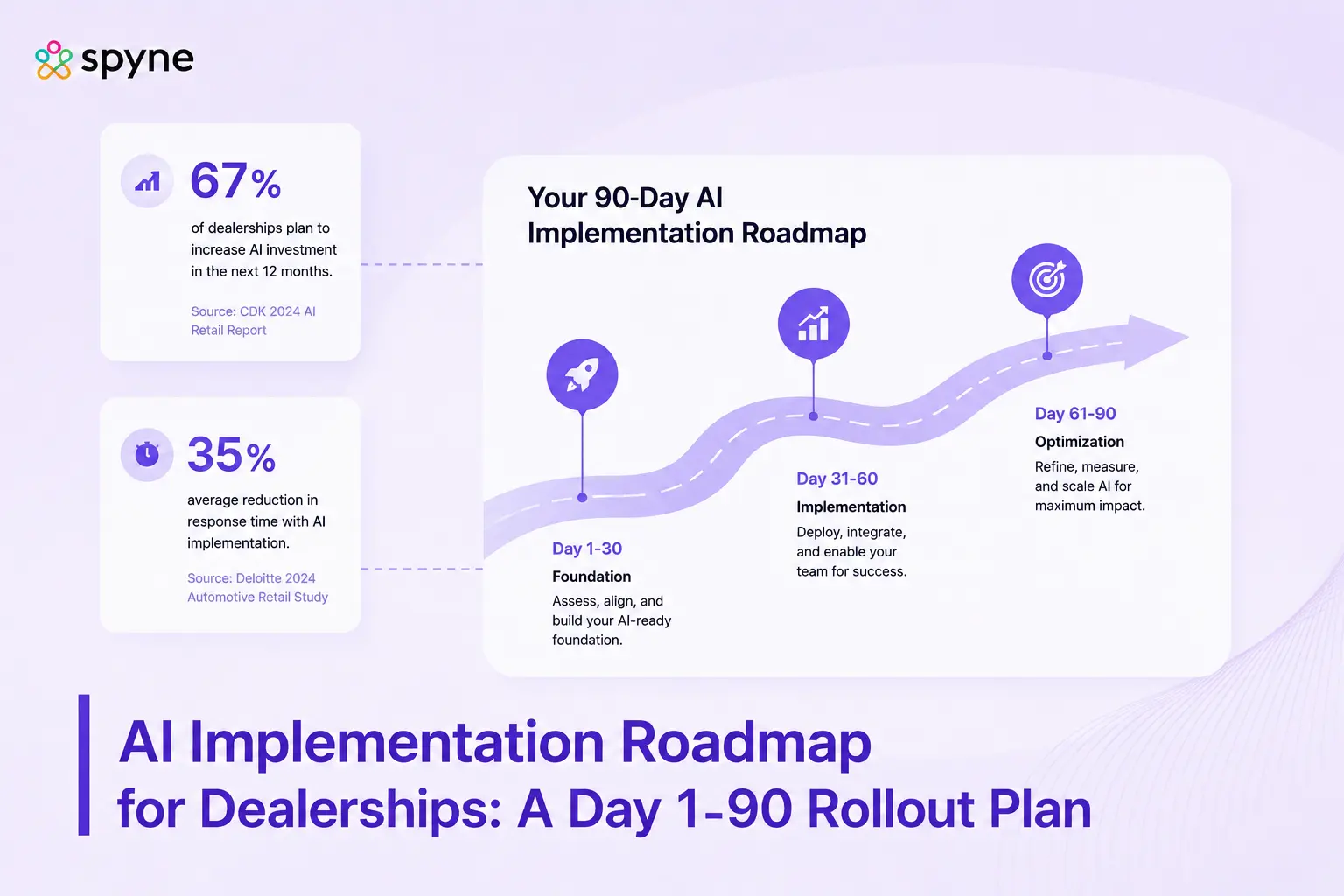
The four phases, at a glance:
| Phase | What happens | Duration, CRM already integrated | Duration, new integration needed |
| 1. Integration & Configuration | Connect CRM/scheduler, configure agent voice and conversation flows | 5 days – 1 week | 2-3 months |
| 2. Testing & Feedback | Internal and dealer testing, feedback, sign-off | 1-2 weeks | 1-2 weeks |
| 3. Go-Live & Setup | Assign phone numbers, configure routing, activate campaigns | 1-3 days | 1-3 days |
| 4. Post-Live & Handover | Week-1 performance review, ongoing support handover | Ongoing from week 1 | Ongoing from week 1 |
The rest of this roadmap walks through each phase in order, plus what determines whether a given dealership lands on the fast end of that range or the slow end.
Phase 1: What happens during integration and configuration?
This phase is where the technical groundwork gets laid, and it’s also where the timeline forks hardest depending on one factor: whether the dealership’s systems are already supported.
- If already on VinSolutions, DealerSocket, or CDK: integration typically takes 5 days to 1 week
- If a new integration is required: this stretches to 2-3 months, since it involves a structured build rather than connecting to an existing certified link
- What gets configured: agent personality, voice, and accent to match the dealership’s brand; custom conversation flows per agent type; escalation and transfer rules for when a call needs to hand off to a person
- Dealer’s role: complete a handful of steps inside their own CRM/scheduler portal, then review and approve the configuration before testing starts
- If integration isn’t ready yet: a dedicated team can manage leads manually as an accelerated start, so outreach doesn’t sit idle while the technical integration finishes in parallel
Phase 2: What happens during testing and feedback?
Once configuration is built, nothing goes live to a real customer until it’s been tested and signed off internally and by the dealership.
- Duration: 1-2 weeks, regardless of whether integration was fast or slow
- What happens: internal testing first, then the dealership reviews sample interactions and flags anything off, tone, accuracy, handoff timing
- What ends this phase: formal sign-off from the dealer. Nothing moves to go-live without it
- Why this phase is worth protecting: slow dealer feedback is one of the most common causes of rollout delay. Agreeing a 3-5 business day feedback turnaround at kickoff, before testing starts, keeps this phase from quietly stretching
Phase 3: What does go-live day actually involve?
Go-live is short and mechanical, not a long transition. Most of the actual work happens in the one to three days this phase takes.
- Dedicated phone numbers get assigned per agent
- Phone routing gets configured by the dealership’s own phone administrator, following exact instructions provided ahead of time, this is the one piece of go-live day that depends on someone outside Spyne being available
- Two routing options to choose between: the office rings first and transfers to Vini after three rings, or every call routes to Vini first, which then directs it appropriately
- Go-live itself is scheduled after hours, specifically so the switch doesn’t disrupt a live call queue mid-shift
- Campaigns activate using the dealership’s own customer list, no list ready means no campaign at go-live, so this needs to exist before this phase starts
- The morning after, the dealership confirms everything is routing and behaving as expected
Sign-off for this phase requires all of the above confirmed working, plus the dealer’s next-morning check.
Phase 4: What happens in the first week after go-live?
The relationship shifts here, from implementation to ongoing performance management, and it happens fast.
- A performance review runs within 4 days to 1 week, covering calls handled, appointments booked, escalation accuracy, and results against the pre-rollout baseline captured before Phase 1 started
- The dealership is introduced to a dedicated Customer Success contact, who becomes the long-term point person going forward
- A check-in cadence gets agreed, typically biweekly for the first 90 days, then monthly after that
- Anything worth flagging from week one, a routing issue, a tone mismatch, a scenario the agent didn’t handle well, gets raised here while it’s still fresh, not weeks later
What determines how long a dealership’s AI implementation actually takes?
The four-phase sequence is fixed. What varies is the calendar, and it comes down to a short list of dependencies rather than dealership size alone.
| Dependency | Impact on timeline |
| CRM / integration status | Already integrated: ~1 week. New integration: 2-3 months |
| Number of agents contracted | Each additional agent adds configuration and testing time in Phases 1-2 |
| Number of rooftops | Each rooftop needs its own configuration and phone setup, one location is fastest |
| Customer list availability | No list ready means no campaign activation at go-live |
| Dealer feedback speed in testing | Slow feedback is one of the most common causes of delay, agree a turnaround window upfront |
| VoIP / phone provider readiness | The dealership’s phone administrator must be available on the agreed go-live day |
A single-rooftop dealership already on a supported CRM can realistically clear all four phases in two to four weeks. A multi-rooftop group adding a new integration is a multi-month project, and that difference is almost entirely explained by this table, not by how “big” the rollout is in a general sense.
What should a dealership check in the first 90 days after AI implementation?
Ninety days in, the numbers should be read against the baseline captured before Phase 1, not in isolation.
- Response and answer rate, compared to the pre-rollout call log baseline
- Repair order rate lift, Vini AI’s service-scheduling automation has driven a 35% RO rate lift in comparable deployments
- Escalation accuracy, how often calls that needed a human handoff actually got one
For the fuller KPI picture beyond these headline numbers, see KPIs Every Dealership Should Track After AI Deployment. Automotive News’ July 2026 Intelligence Report put AI usage among dealership personnel at 57%, with fixed operations leading adoption, the 90-day mark is where a dealership finds out whether it’s tracking toward that kind of return.

Closing Thoughts
A rollout that should take two to four weeks often takes two to four months for one reason: nobody confirmed CRM integration status before quoting a timeline. That single dependency, more than dealership size, decides which end of the range a store lands on. Every week spent figuring that out after signing is a week of after-hours calls still going to voicemail instead of Vini AI. Book a 20-minute call and get a day-by-day rollout timeline for your dealership, integration status, go-live date, and 90-day checkpoints mapped out.