
Most stores do not have a lead generation problem. They have a lead response problem. Foureyes analyzed more than 1.1 billion dealer website visits across 22,500 rooftops and found that 43.2% of sales leads were mishandled in 2024, with 14.1% never logged to a CRM at all. You are paying for those leads twice: once in ad spend, again in the gross they would have produced.
The fix is not more BDC headcount. It is removing the human from the first touch entirely. Vini AI by Spyne is conversational automotive AI that engages every inbound lead in under five seconds across every channel, then hands a qualified, context-rich buyer to your team. This post covers why response times stay slow, what the delay costs in real dollars, and how AI lead response closes the gap.
Why Lead Response Time Decides Who Sells the Car?
Lead response time is the elapsed time between a customer submitting an inquiry, form, call, text, or chat, and your store making its first meaningful contact. Not the auto-reply. The first real conversation. It matters because buying intent is perishable: the dealer who responds first usually wins, and every minute of delay measurably lowers the odds of ever connecting.
The research is old enough to be settled. Harvard Business Review’s study The Short Life of Online Sales Leads found that contacting a lead within five minutes makes you 21 times more likely to qualify it than waiting 30 minutes. Velocify’s call-center data put the sub-one-minute conversion lift at 391% versus a delayed response. Treat 391% as directional, not gospel; the principle underneath it is not in dispute. Here is why speed to lead is crucial for businesses:
- Lead response time = inquiry submitted to first real contact, not auto-reply.
- 5-minute response vs. 30-minute = 21x more likely to qualify.
- First responder wins the majority of deals; intent decays by the minute.
What is the average lead response time at a dealership in 2026?
The commonly cited business-hours average is about 47 minutes, and the top 10% of stores answer in under 60 seconds. The more useful number comes from independent mystery shopping: Pied Piper’s 2026 Internet Lead Effectiveness study scored the industry an average of 71 out of 100, with only 51% of dealers delivering a ‘perfect response’, a real answer across multiple channels within 15 minutes, and 14% scoring below 40.
Read those two figures together. Half the market is genuinely responsive. The other half is leaking leads, and most of them do not know which half they are in, because their CRM dashboard counts auto-texts as “responses.” When you strip out automation and measure time to a live human voice, the real number is worse than the report card.
| Response time bucket | What it signals | Likelihood of qualifying the lead |
| Under 60 seconds | Top-decile store / AI-driven | Highest; buyer still engaged |
| Under 5 minutes | Strong, disciplined BDC | 21x vs. 30-minute response (HBR) |
| 30+ minutes | Industry middle | Sharp drop; buyer contacting others |
| Hours / next day | Mishandled bucket | Functionally cold |
5 Structural Reasons Your Dealership Responds Too Slowly
The cause is structural, not motivational. Leads arrive 24/7 and at unpredictable volume; human capacity is fixed to staffed hours. Five specific failure points create almost every slow response, and a well-staffed, well-intentioned store hits all five.
- After-hours arrivals. A large share of dealership leads land outside business hours, when no one is on the floor. Those leads wait until morning, by which point competitors have already called.
- Concurrent volume. When ten leads hit during a weekend sales event, a BDC rep can only work one at a time. The other nine queue.
- Shift transitions. Leads submitted in the last two hours of business sit until the next shift picks them up.
- Human delay before action. Reading the lead, finding the contact info, deciding on an approach, and dialing takes a motivated rep several minutes even on a good day.
- CRM notification lag. Some systems delay rep notification by minutes after submission, burning the most valuable window before anyone has touched the lead
How does AI respond to leads faster than a human BDC?
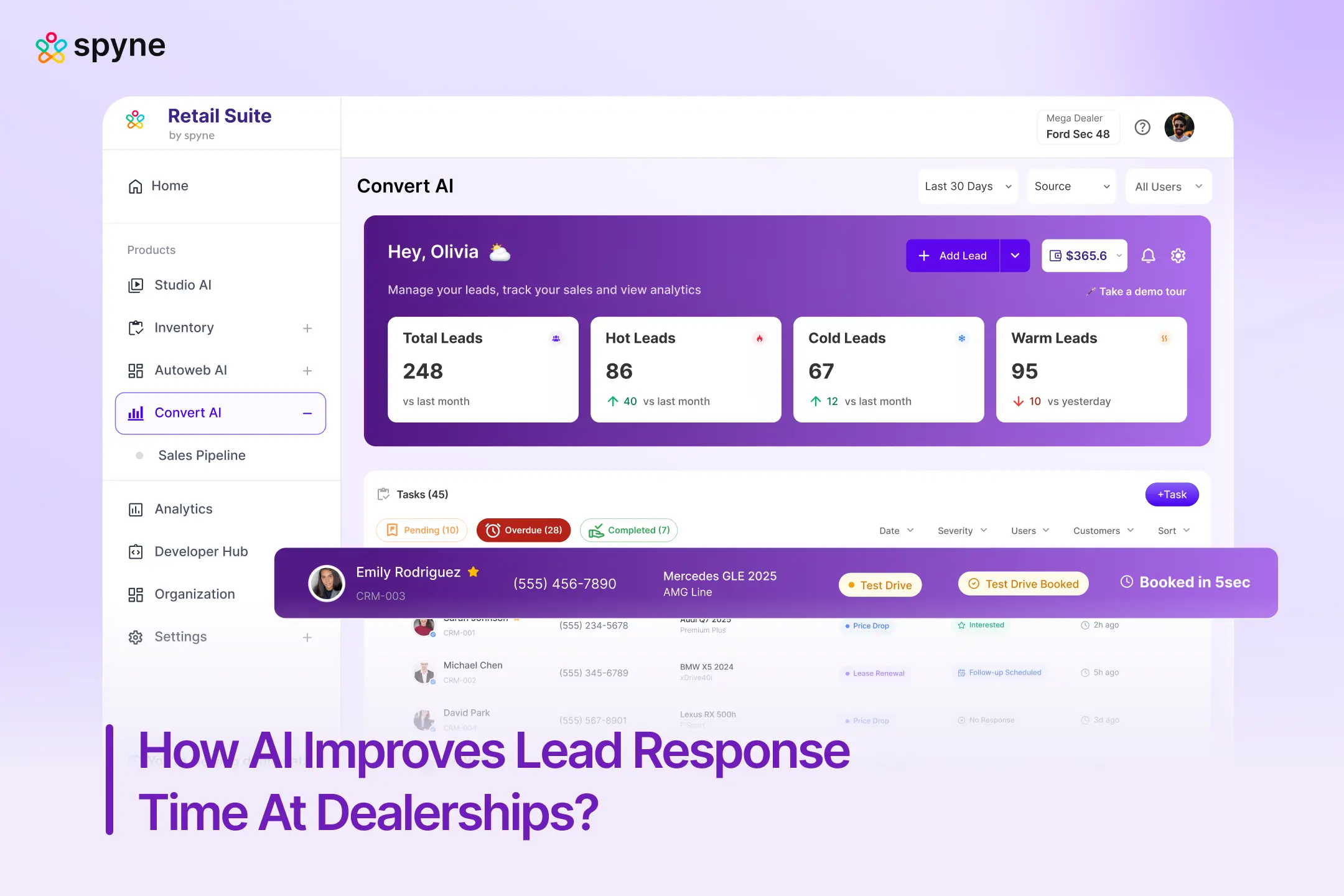
AI wins on speed because it skips every step that slows a human down. It does not read the lead first, decide what to say, find a phone, or open a CRM tab. The moment a lead is submitted, Vini AI fires a personalized first response referencing the specific vehicle and asking one qualifying question.
For a web form on a specific unit, Vini AI sends a text that names the vehicle and asks a natural follow-up. For an inbound call after hours, it answers within two rings using natural conversation. For a Marketplace or chat message, it replies in seconds. Vini AI responds in under five seconds and handles 70% of routine sales and service conversations without human intervention, at any volume, at any hour. The BDC stops doing intake and starts working buyers who are already engaged and qualified.
- AI removes the read-decide-dial delay that costs humans 3 to 7 minutes per lead.
- Vini AI responds in under 5 seconds across every channel.
- It absorbs concurrent volume that overwhelms a human team at peak hours.
Multi-Channel Lead Response for Car Dealerships: How Vini AI Works?
Comprehensive AI lead response has to cover every channel a lead can arrive through. A system that handles web forms but drops phone calls leaves a hole. A system that answers calls but ignores Marketplace messages leaves another. Vini AI provides unified response across inbound calls, web forms, SMS, website chat, email, and Facebook Marketplace from a single system.
| Channel | Typical human response | Vini AI response |
| Web form | ~47 min, business hours only | Under 60 seconds, 24/7 |
| Inbound phone | Answered or placed on hold | Answered within 2 rings, 24/7 |
| After-hours call | Voicemail, hours later | Answered immediately |
| Facebook Marketplace | Hours to days | Under 30 seconds |
| SMS text | Variable | Under 60 seconds |
| Email lead | 24 to 48 hours | Qualifying text in minutes |
This is the difference between AI lead response as a feature and as coverage infrastructure. Vini AI is the second category: every lead engaged, qualified, and logged, before the buyer reaches the next dealership’s website.
After-Hours Lead Response for Dealerships: How AI Covers the Gap
This is the highest-intent, lowest-coverage window in the entire funnel, and most lead-response tools quietly skip it. A large share of dealership inquiries arrive evenings and weekends. Car Wars’ 2025 call data found the average hold time before reaching a person was over three minutes, and nearly a third of callers who were not connected hung up. Voicemail after 7 p.m. is operationally identical to being closed.
Vini AI does not have an after-hours. It answers the 11 p.m. Marketplace message and the Sunday-morning call with the same five-second response as a Tuesday at noon. 41% of dealership calls go unanswered after hours; Vini AI is the layer that captures them. For used-car inquiries in particular, where each unit is one of one, after-hours coverage is the difference between booking the appointment and watching the buyer call the next store.

Vini AI vs. a Human-Only BDC: What Changes Operationally
Vini AI is not a BDC replacement. It is coverage that lets the BDC do higher-value work. Most stores start with after-hours and overflow only, see the recovered appointments, then expand.
| Dimension | Human-only BDC | BDC + Vini AI |
| First-response time | ~47 min avg, business hours | Under 5 seconds, 24/7 |
| After-hours / weekend | Voicemail | Fully covered |
| Concurrent leads | One at a time | Unlimited simultaneous |
| What the BDC works | Cold intake | Qualified, engaged buyers |
| Compliance | Manual, variable | SOC 2, TCPA, DNC compliant; human QA on calls daily |
At Paragon Honda, deploying Vini AI recovered $310,000 in its first week by catching opportunities that previously went unanswered (Spyne case study). The mechanism is not magic. It is coverage applied to a structural gap.
How to Know If You Have a Lead Response Problem?
Pull your CRM export and measure time from lead-submission timestamp to first outbound human or AI contact, excluding auto-replies and system notifications. Segment by time of day, day of week, lead source, and rep. The largest gaps almost always sit in after-hours, weekends, and concurrent-volume spikes. Most GSMs who run this for the first time are surprised by how wide the weekend hole is.

What a 60-Second Response Process Looks Like End to End
A lead submits a form on a specific VIN. The source fires a webhook to Vini AI in milliseconds. Vini AI identifies the buyer name, the inquiry vehicle, and the source, generates a personalized text naming the vehicle and asking one qualifying question, and dispatches it by SMS. Total time from submission to the buyer’s phone: under 60 seconds, at any hour, at any volume. For inbound calls, Vini AI answers within two rings, greets returning CRM contacts by name, resolves or routes the call, and logs full context for the human follow-up.
Conclusion
Lead response is one of the few things in retail automotive you fully control. You cannot control floor traffic, OEM allocation, or rate. You can control whether a buyer who raised their hand at 9 p.m. hears from you in five seconds or the next morning. Right now, half the market still answers slowly enough that the buyer has already texted three other stores. That is not a disadvantage to absorb. It is a market share opening to take.
If your store is responding to internet leads in minutes instead of seconds, you are funding your competitors’ appointments. See exactly which leads Vini AI by Spyne recovers in the first week on your own inventory and lead volume
Book a demo today and experience real-time automotive lead engagement in action.