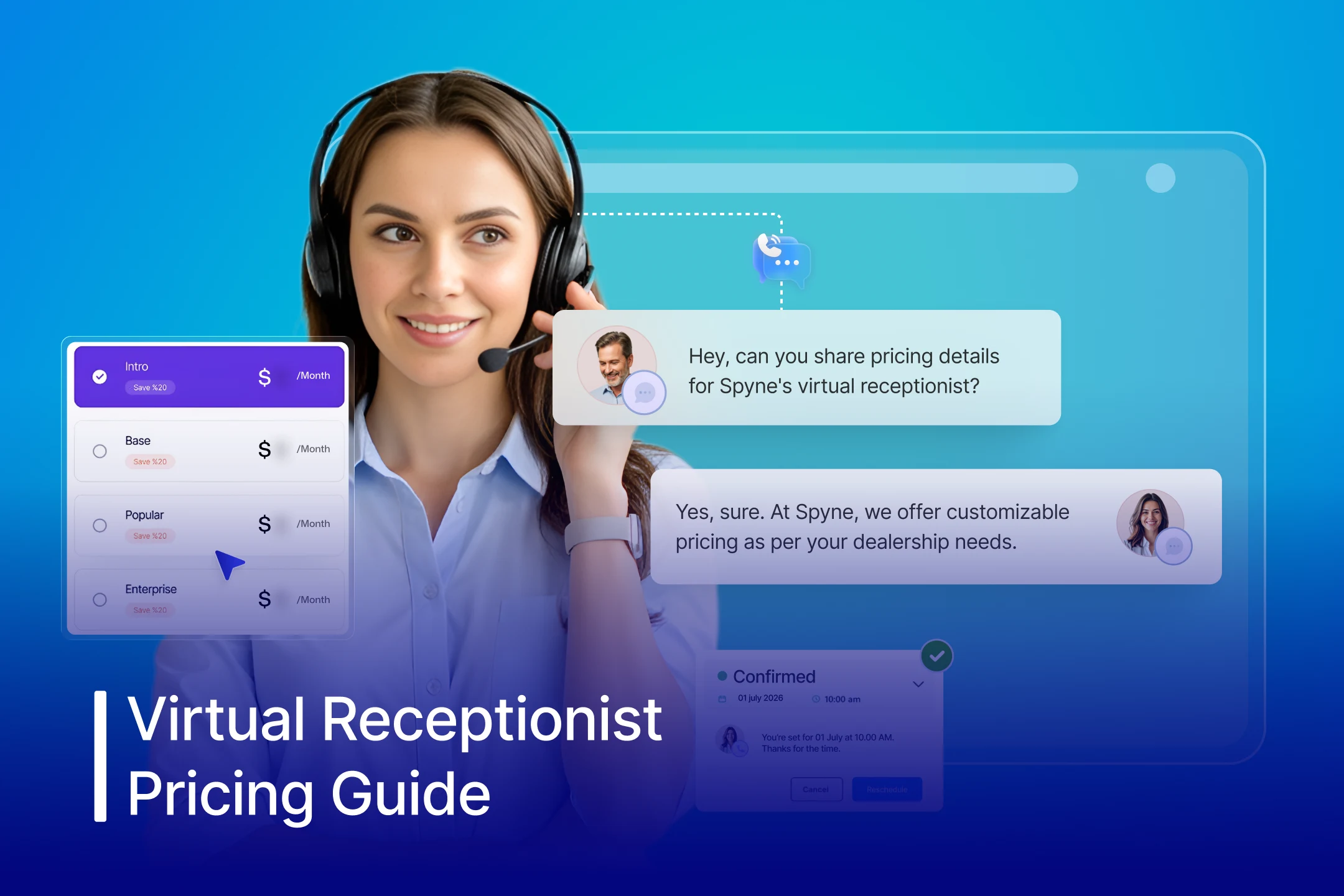

Understanding virtual receptionist pricing is one of the first steps businesses take when evaluating whether an answering service is worth the investment. For many companies, every missed call represents a missed opportunity, whether it’s a potential customer inquiry, a service appointment request, or a new sales lead.
That’s why more businesses are turning to virtual receptionist services to handle incoming calls, schedule appointments, and manage customer communication more efficiently. However, the cost of these services can vary widely depending on factors such as call volume, service features, and whether the solution uses AI automation, live agents, or a hybrid approach.
In this guide, we break down virtual receptionist pricing in 2026, including typical costs, pricing models, hidden fees, and how leading providers compare. We’ll also explore how pricing differs across industries, especially in high-call environments like automotive, and what features are typically included in modern receptionist plans so you can choose the right solution for your business.
What is a Virtual Receptionist and How Does it Work?
A virtual receptionist is a remote service, powered by either trained professionals or AI, that manages a business’s incoming communications without requiring someone physically present at the front desk. These services typically handle tasks such as answering calls, screening inquiries, scheduling appointments, routing calls, and taking messages, ensuring businesses never miss important customer interactions.
Unlike a traditional in-house receptionist, a virtual receptionist works off-site through a specialized answering service or AI platform, allowing businesses to maintain a professional call experience while reducing staffing costs. Many providers offer 24/7 coverage, multilingual support, and flexible virtual receptionist services pricing, making them a practical solution for companies that receive high call volumes.
Businesses across industries, from healthcare and legal firms to small businesses, often rely on virtual receptionists to reduce missed calls, improve response times, and streamline customer communication.
How Much Does a Virtual Receptionist Cost?
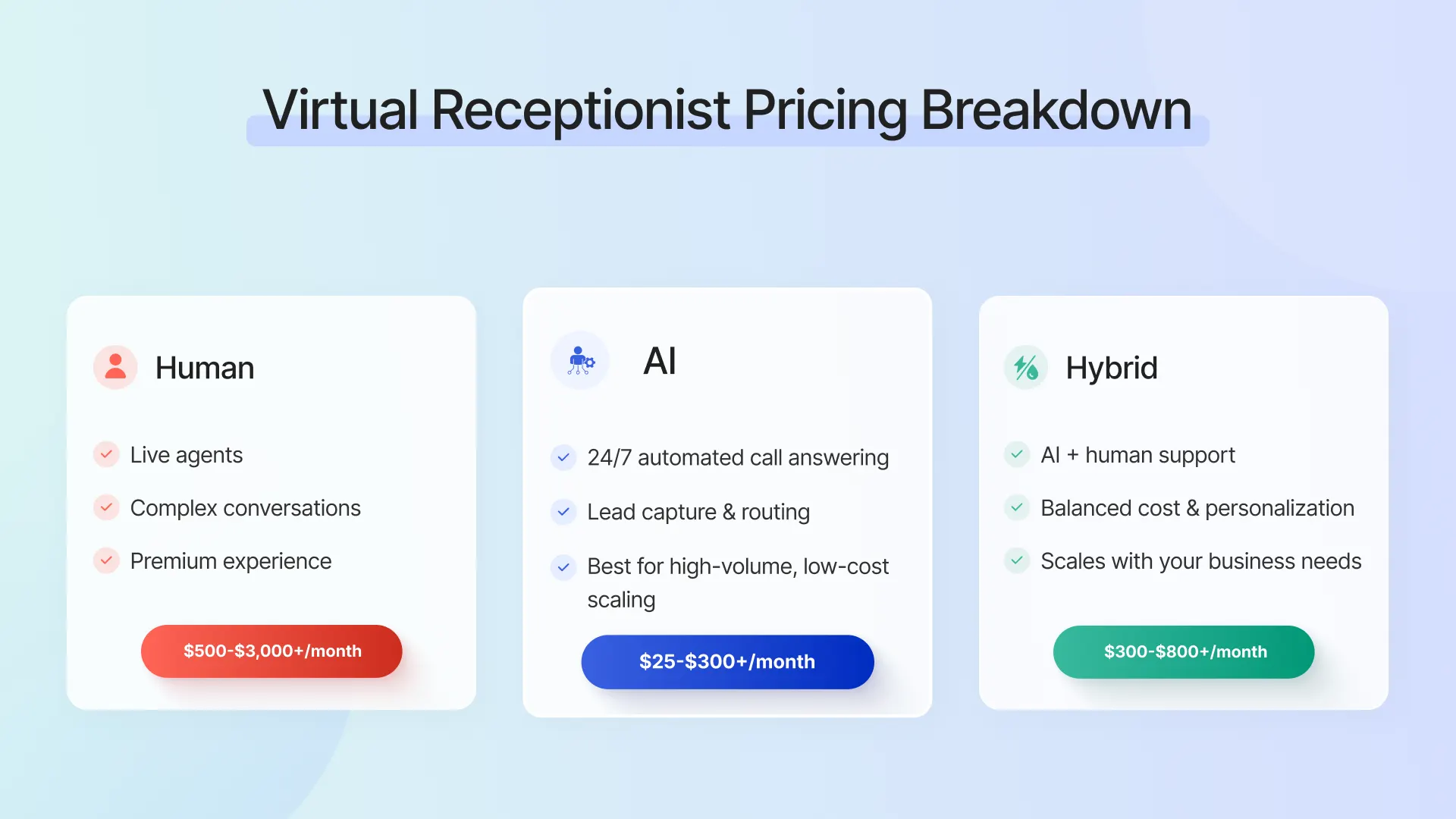
Virtual receptionist pricing can vary widely depending on the type of service you choose: AI-powered, human-led, or a hybrid model. In most cases, businesses pay anywhere from $25 to over $3,000 per month based on call volume, service hours, and the level of support required.
AI virtual receptionist pricing typically starts at $25-$100 per month for basic call answering, routing, and FAQs. More advanced AI plans with CRM integrations, lead capture, and workflow automation range from $100 to $500, while enterprise-grade platforms can go up to $1,500+ per month.
On the other hand, human virtual receptionist services are more expensive, starting around $250-$500 per month for limited minutes. Mid-tier plans range from $500-$1,200, while premium 24/7 live answering services with high call volumes and multilingual support can exceed $2,400 per month.
Ultimately, the exact virtual receptionist services pricing depends on how complex your requirements are, the number of calls or minutes included, and whether you prioritize automation, personalization, or a mix of both.
Multilingual Virtual Receptionist Pricing
Businesses serving diverse customer bases often require multilingual support, which can increase costs. AI-powered multilingual receptionists typically start at $50-$300 per month, depending on the number of languages and conversation complexity.
Advanced solutions with features like lead qualification, intelligent routing, and CRM integrations may range from $200 to $800+ per month. Human multilingual support, however, is significantly more expensive due to staffing requirements and limited scalability.
What Actually Affects Virtual Receptionist Pricing?
Several factors influence how much you’ll pay for a virtual receptionist:
- Call volume: Higher call traffic requires larger plans or additional usage charges
- Service type: AI is more cost-effective, while human agents increase pricing
- Coverage hours: 24/7 or after-hours support adds to the overall cost
- Features: Appointment scheduling, lead capture, and routing can increase pricing
- Integrations: CRM and calendar integrations may add setup or monthly fees
- Multilingual support: Handling multiple languages often requires higher-tier plans
Understanding these factors helps businesses choose a plan that balances cost, scalability, and performance.
Virtual Receptionist Cost Comparison by Service Type
| Service Type | Typical Monthly Cost | Best For |
| AI Virtual Receptionist | $25 – $500+ | 24/7 automation, lead capture, cost efficiency |
| Human Receptionist | $300 – $2,400+ | Personalized conversations, complex queries |
| Hybrid (AI + Human) | $300 – $800+ | Balance of automation and human support |
| Outsourced Receptionist | $100 – $1,200 | Flexible, scalable call handling |
| Add-on: Scheduling | +$50 – $300 | Appointment-heavy businesses |
AI receptionists are best suited for businesses prioritizing cost, speed, and 24/7 availability, while human receptionists are ideal for handling complex or high-touch interactions. For most growing businesses, a hybrid approach offers the best balance between efficiency and customer experience.
Is a Virtual Receptionist Worth the Cost, or Are You Losing More Without One?
Yes, a virtual receptionist is generally worth the cost, especially for businesses that regularly miss customer calls or inquiries. Compared to hiring an in-house employee, virtual receptionist services can reduce staffing expenses by 40-80% while providing 24/7 call coverage, lead capture, and professional customer interactions. Most virtual receptionist pricing plans range from $25-$300 per month for AI-powered services and $300-$3,000+ per month for live human agents, making them a scalable and cost-efficient alternative to traditional front-desk staffing.
The bigger consideration, however, is the true cost of missed calls. When potential customers cannot reach your business, they often contact a competitor instead. For industries that rely on inbound calls, such as legal, healthcare, home services, and automotive, even a few missed inquiries can result in lost appointments, missed sales opportunities, and reduced customer trust.
Virtual receptionist solutions address this problem by ensuring that every call is answered, routed, or scheduled properly. With options ranging from AI receptionist pricing plans for automated 24/7 responses to live virtual receptionist support for complex conversations, businesses can choose a solution that fits both their budget and call handling needs.
Ultimately, when you compare the monthly answering service cost to the potential revenue lost from missed leads, investing in a virtual receptionist often delivers a high return on investment while improving customer experience and responsiveness.
Virtual Receptionist Pricing Models Explained (With Examples)
In 2026, virtual receptionist pricing models are typically structured as tiered plans, usage-based pricing, or unlimited AI subscriptions, tailored to different business sizes and call volumes. Providers commonly charge through per-minute ($0.25-$3.50), per-call ($1-$10), or monthly subscription packages ($25-$3,000+), depending on whether services uses a live agent or an AI receptionist, as well as the number of calls handled.
Per-Minute Pricing (Best for variable call volumes)
With per-minute virtual receptionist pricing, businesses pay for the total time spent handling calls. Rates typically range between $1.20 and $2.50 per minute, with overage charges sometimes reaching $3 or more per minute. This model works best for companies with unpredictable call volumes.
Per-Call Pricing (Predictable costs for short interactions)
Under a per-call pricing model, businesses pay a fixed fee for each call answered, usually $7-$9.75 per call for live services. This structure is ideal for short, consistent interactions, such as message taking or quick lead capture.
Monthly Subscription Packages (Bundled pricing for growing teams)
Many providers offer tiered virtual receptionist pricing per month, bundling a set number of calls or minutes into plans. Typical packages range from $130-$400 for standard plans, while premium tiers with extended hours or higher call volumes can reach $1,000-$3,000+ per month.
Flat-Rate AI Plans (Scalable and cost-efficient)
Modern AI virtual receptionist pricing plans often use a flat monthly subscription for automated call handling. These plans can start as low as $25-$100 per month, while advanced platforms with integrations and analytics typically range from $199-$299 per month for high-volume or unlimited usage.
Hybrid Pricing Models (Flexible for scaling businesses)
Some providers combine multiple structures, such as a base monthly fee plus lower per-minute charges for additional usage. These hybrid virtual receptionist pricing models offer flexibility for growing businesses with fluctuating call volumes.
Hidden Costs in Virtual Receptionist Pricing You Shouldn’t Ignore
While many providers advertise competitive virtual receptionist pricing, the final cost can increase due to additional charges that aren’t always highlighted upfront. These hidden fees can significantly impact your virtual receptionist pricing per month if not reviewed carefully.
Setup and Onboarding Fees
Many services charge a one-time setup or onboarding fee, typically ranging from $50 to $500, to configure call scripts, workflows, and account settings.
Overage Charges That Increase Monthly Costs
Most plans include a fixed number of minutes or calls. If usage exceeds that limit, providers may charge $0.50 to $11 per additional call or minute, with common overage rates around $1.50-$3 per minute.
Billing Rounding Practices That Impact Your Final Cost
Some answering services round calls up to the nearest minute, meaning even a short 30-second call could be billed as a full minute.
After-Hours and Holiday Surcharges
Live receptionist services often charge 15-25% higher rates for nights, weekends, or holidays, especially in live virtual receptionist pricing models.
Add-On Features and Integration Fees
Advanced features like CRM integrations, calendar syncing, call recording, or appointment scheduling may add $50-$200 per month to your virtual receptionist services pricing.
Additional Service Charges and Contract Limitations
Some providers charge extra for bilingual support, outbound calls, call transfers, or message delivery, and certain contracts may include early termination penalties if services are canceled before the agreed term.
Before committing to a provider, request a detailed pricing breakdown to ensure the answering service cost per month aligns with your expected usage and features.
Virtual Receptionist Pricing Comparison: Top Providers in 2026
The virtual receptionist pricing offered by leading providers in 2026 varies widely depending on whether the service uses AI automation, live human agents, or a hybrid model. Basic AI plans start around $25-$65 per month, while premium live receptionist services with 24/7 support can exceed $1,000 per month. Human answering services often charge around $2.95-$3.50 per minute, making call volume a major cost factor.
Below is a comparison of pricing among the top 10 virtual receptionist providers:
| Provider | Starting Price | Key Feature |
| Spyne | Custom pricing | 24/7 AI and human-assisted reception with multilingual support and CRM integration |
| Ruby | $245-$385/mo | Premium 24/7 live U.S.-based receptionists |
| Smith.ai | $285-$292/mo | AI + human hybrid with high CRM integrations |
| PATLive | $198-$235/mo | 24/7 live agents with call routing |
| Nexa | $180-$200/mo | Focused on legal and home services |
| Abby Connect | $299/mo | Dedicated 24/7 agents for personalized service |
| AnswerConnect | $325-$350/mo | Per-minute billing with 24/7 coverage |
| ReceptionHQ | $70/mo | Basic human answering for small businesses |
| VoiceNation | $59/mo | Budget-friendly live receptionist service |
| My AI Front Desk | $55/mo | Affordable AI-focused 24/7 call handling |
What Drives Pricing Differences Across Providers?
The variation in virtual receptionist services pricing usually depends on a few key factors:
- Live vs AI support: Human receptionists typically cost significantly more than AI virtual receptionist pricing plans.
- Pricing structure: Some providers charge per minute, while others use per-call or monthly subscription plans.
- Overage charges: Exceeding plan limits may cost $3-$11 per additional call or minute.
- Additional features: Services like CRM integrations, bilingual support, or appointment scheduling can increase the overall answering service cost per month.
When comparing providers, businesses should evaluate both base pricing and overage costs to determine the most cost-effective solution for their call volume and support needs.
How to Choose the Right Virtual Receptionist Pricing Plan for Your Business?
Choosing the right virtual receptionist pricing plan depends on balancing cost, call volume, and the level of service your business needs. Today, pricing typically ranges from $25-$150 per month for AI-powered services to $500-$1,600+ per month for premium human-led or 24/7 live support.
For many businesses, the decision comes down to the type of receptionist model:
- AI receptionists ($29-$300/month): Best for startups and small businesses that need 24/7 automated call answering, message taking, and basic appointment scheduling at a low cost.
- Hybrid AI + human services ($300-$800+/month): Combine automation with live agents, offering a balance between efficiency and personalized support.
- Human virtual receptionists ($500-$1,600+/month): Ideal for industries like legal, healthcare, or home services where conversations are a bit complex for an AI call bot to handle and a personal touch is important.
Key Factors to Consider Before Choosing a Plan
When comparing virtual receptionist services pricing, consider these factors:
- Call volume and average call length
- 24/7 or after-hours coverage requirements
- Features like bilingual support, lead qualification, or appointment scheduling
- CRM and calendar integrations
For startups or budget-conscious teams, AI receptionist pricing plans between $29-$120 per month often provide the best value. Businesses that rely heavily on customer calls, however, may benefit from hybrid or human receptionists that deliver more personalized service while ensuring every call is handled professionally.

What’s Included in Most Virtual Receptionist Plans?
Most virtual receptionist plans include a core set of features designed to handle customer calls professionally and ensure businesses never miss important inquiries. Whether powered by AI or live agents, these services function as an extension of your front desk by managing calls, capturing leads, and routing requests efficiently.
Below are the core features you can expect in any virtual receptionist plan:
1. 24/7 Call Answering
Nearly all virtual receptionist services offer 24/7 or extended-hours call answering, ensuring customer calls are handled even after business hours, on weekends, or during holidays.
2. Customizable Greetings
Businesses can configure personalized call greetings that reflect their brand voice, ensuring callers receive a consistent and professional first impression.
3. Intelligent Call Routing and Transfers
Receptionists can screen incoming calls and route them to the appropriate team member or department, helping teams respond quickly while reducing interruptions.
4. Message Taking and Instant Notifications
Detailed messages from callers are captured and delivered instantly through SMS, email, or a mobile app, ensuring teams stay informed even when away from their desks.
5. Lead Capture and Client Intake
Most plans include lead capture tools that collect essential information such as the caller’s name, contact details, and reason for calling, helping businesses convert more inquiries into opportunities.
6. Appointment Scheduling
Many providers offer integrated scheduling tools that sync with calendars like Google Calendar or Outlook, allowing receptionists to book, reschedule, or cancel appointments directly.
7. Multilingual Support
Some virtual receptionist pricing plans include multilingual support, commonly in English and Spanish, helping businesses serve a broader customer base.
8. CRM Integrations and Business Tools
Advanced plans often include CRM integrations, allowing call details, messages, and customer interactions to be automatically logged into systems such as Salesforce or HubSpot.
9. Additional Operational Features
Depending on the provider, plans may also include call recording, analytics, overflow call support, and security compliance options (such as HIPAA or PCI) for businesses that handle sensitive customer information.
Together, these features ensure that virtual receptionist services operate much like an in-house front desk, delivering consistent communication, improved lead management, and a better customer experience.
What You Can Expect to Pay for a Virtual Receptionist (Quick Recap)
The cost of a virtual receptionist service isn’t tied to a single fixed price, and it depends on how your business uses the service. In practice, companies may spend anywhere from a few dozen dollars per month for basic AI answering to several thousand dollars for full-service live receptionist support.
Providers structure virtual receptionist pricing in different ways. Some offer monthly subscription plans with bundled call minutes, while others charge per minute or per call based on usage. AI-powered solutions typically offer flat-rate plans for automated call handling, while live receptionist services scale with the complexity and volume of interactions.
This flexibility allows businesses to start small and upgrade as their needs grow. Many companies begin with AI answering services and later adopt hybrid or live receptionist support as call volume and customer interaction requirements increase.
Key Factors That Influence Your Final Pricing
Several factors determine the final virtual receptionist services pricing you’ll pay:
- Call volume: Higher call traffic usually requires larger plans or additional minutes.
- Service type: AI receptionists are more affordable, while live agents cost more due to personalized interaction.
- Operating hours: 24/7 or after-hours coverage increases pricing compared to standard business-hour support.
- Feature requirements: Services like appointment scheduling, lead capture, and call routing can raise plan costs.
- Integrations: Connecting with CRM systems, calendars, or business tools may add setup or monthly fees.
- Multilingual support: Handling calls in multiple languages often requires higher-tier plans.
Understanding these factors helps businesses choose a virtual receptionist plan that balances cost, scalability, and service quality.
Virtual Receptionist Pricing for Automotive Businesses
In the automotive industry, missed calls often translate directly into lost revenue, no matter whether it’s a missed service appointment, test drive inquiry, or parts request. As automotive businesses handle high call volumes daily, a generic receptionist answering phone calls often falls short. That’s why many dealerships, repair shops, and auto service centers rely on virtual receptionist services to manage high call volumes and after-hours inquiries.
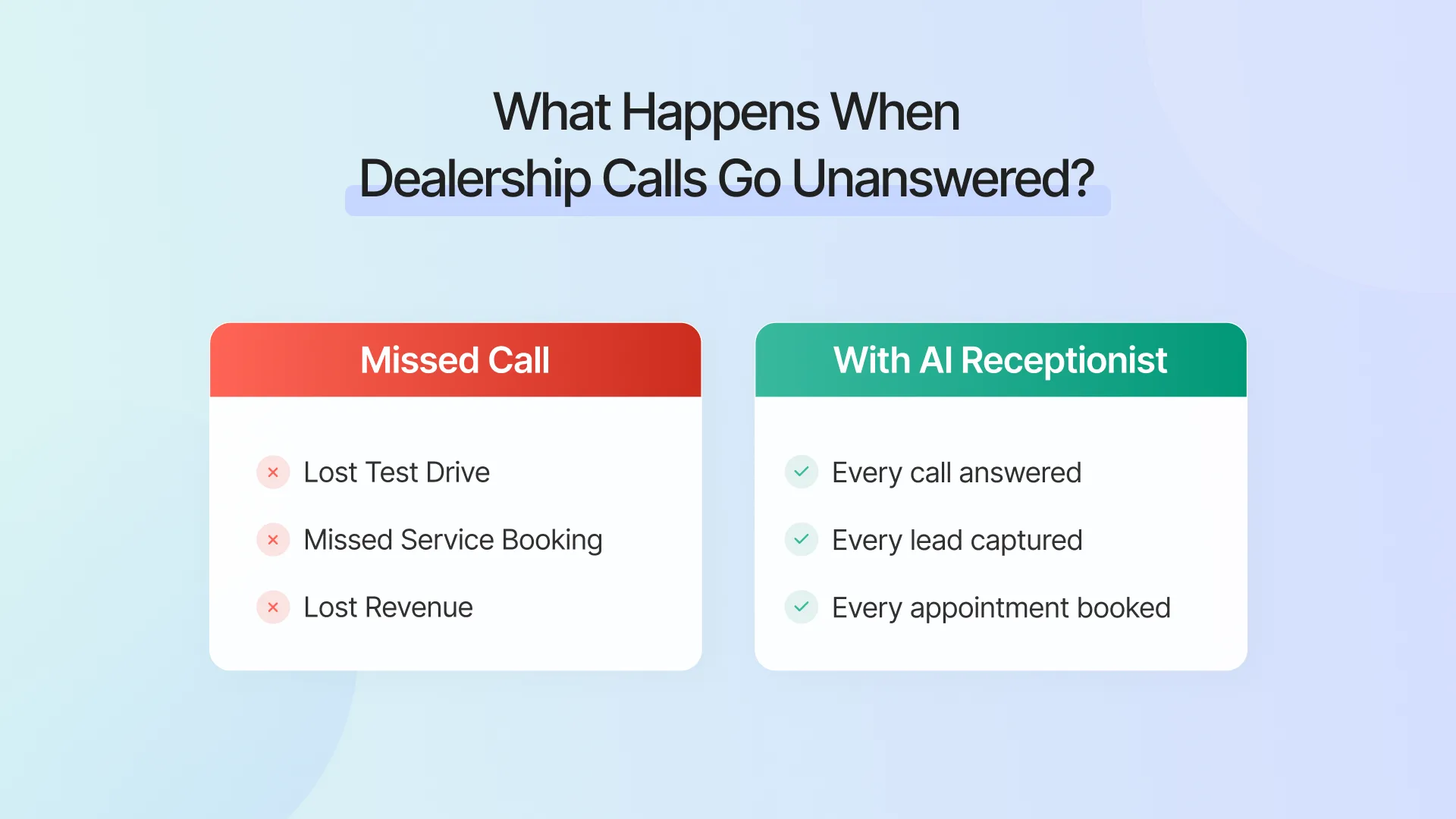
Pricing for automotive virtual receptionist solutions typically ranges from $25 to $1,000+ per month, depending on whether the service uses AI automation or live agents. AI-powered receptionists usually start between $25 and $199 per month, offering 24/7 call answering, appointment scheduling, and basic lead capture. Live or hybrid receptionist services are more expensive, often $150 to $1,000+ monthly, because they include trained agents who can handle complex customer interactions and service inquiries.
Automotive-specific solutions may also include features tailored to dealership workflows, such as service appointment booking, vehicle intake details, emergency breakdown triage, and integration with dealership management software, capabilities commonly built into modern automotive answering service solutions.
For dealerships and auto service businesses that receive dozens (or even hundreds) of calls daily, the best virtual receptionist service can reduce missed leads, improve customer response times, and maintain consistent communication without expanding front-desk staffing.
Spyne’s Virtual Receptionist: Built for Automotive Teams
Spyne is an AI-native platform built to solve everyday challenges in automotive retail. Vini, its conversational AI agent, is designed for dealerships, marketplaces, and service centers, and functions as an intelligent receptionist that handles customer interactions end-to-end.
What Makes Spyne Different from Standard Receptionist Services?
Unlike traditional services that only answer calls or take messages, Spyne’s AI receptionist focuses on capturing leads, managing appointments, and engaging customers in real time. This helps teams reduce missed opportunities and stay consistently responsive across the customer journey.
Built exclusively for automotive businesses, Spyne’s virtual receptionist is customized to each dealership’s needs. Spyne provides flexible pricing based on call volume, workflows, and feature requirements. To find the best setup for your business, you can connect with the team for a personalized walkthrough and pricing details.
What’s Included in Spyne’s Virtual Receptionist?
- 24/7 AI Call Answering: Vini handles inbound customer calls at any time, ensuring no leads or service inquiries are missed.
- Appointment Scheduling: Books or reschedules service visits, test drives, or consultations directly into dealership calendars.
- Lead Capture & Qualification: Collects caller information such as vehicle interest, service requirements, and contact details for follow-up.
- Intelligent Call Routing: Whenever human intervention is required, it directs complex queries to the right team, including sales, service, or parts.
- Multilingual Support: Engages customers in multiple languages to serve diverse customer bases.
- CRM & Workflow Integration: Automatically logs conversations and customer details into dealership systems for seamless follow-up.
- After-Hours Customer Support: Ensures inquiries outside business hours are captured and scheduled for the next available slot.
By combining automotive-specific intelligence with scalable AI technology, Spyne’s virtual receptionist enables dealerships and service centers to manage communication more efficiently while delivering a faster, more consistent customer experience.

Choosing the Right Virtual Receptionist for Your Business
Understanding virtual receptionist pricing helps businesses choose a solution that balances cost, scalability, and customer experience. Depending on the provider and service model, pricing can range from $25 per month for basic AI answering to $3,000+ for premium live receptionist services. These cost differences are influenced by call volume, features, and coverage hours.
For businesses that rely heavily on inbound calls, investing in the right receptionist solution can significantly reduce missed opportunities while improving response times and customer satisfaction. As AI-powered communication tools continue to evolve, many companies are adopting solutions that combine automation, lead capture, and intelligent call routing to handle growing customer demand more efficiently.
For automotive businesses in particular, Spyne’s virtual receptionist offers industry-specific capabilities designed to manage dealership inquiries, schedule appointments, and capture leads around the clock, helping teams stay responsive without expanding front-desk staffing.
To explore how Vini can help your dealership manage sales and service inquiries 24/7 while improving lead capture, book a demo today.