
Executive SummaryCar dealership follow up software automates lead and customer outreach across text, email, phone, and video so no inquiry goes cold. McKinsey (2025) found that 56% of new dealership leads arrive after hours and go unanswered in time, with only 37% of dealers responding within an hour. CBT News (2026) reports top dealers reply in about a minute across every channel. The right software closes that gap with scheduled cadences, lead scoring, and automated reminders built for the sales and service lifecycle. |
A customer fills out a form for a Certified Pre-Owned SUV at 9:40 p.m. By the time your BDC opens the lead the next morning, three other dealers have already texted her. This is not a rare miss. It is the default outcome without car dealership follow up software running in the background. This guide covers what the software does, the follow-up tips and strategies that convert cold leads into appointments, and the lead follow up best practices your team can put to work this week.
What Is Car Dealership Follow Up Software?
Car dealership follow up software is a system that automates and schedules outreach to sales leads, unsold prospects, and existing customers across text, email, phone, and video, so every contact happens on a set cadence instead of relying on a rep’s memory. It typically sits inside or alongside a dealership’s CRM and pulls in lead source, vehicle interest, and purchase history to personalize each touch.
Unlike a generic lead management tool that focuses on capturing and routing new inquiries, follow up software is built around what happens after the first contact: the second text, the day-four email, the thirty-day nurture, and the six-month service reminder. Dealerships already running an automotive CRM software platform typically layer follow-up automation on top of it rather than replacing it, since the CRM holds the customer record and the follow-up engine drives the cadence.
Why Follow-Up Automation Is the Biggest Lever in Dealership Sales Right Now
The direct answer: dealerships are not losing deals because of weak leads, they are losing them because of slow and inconsistent follow-up, and the data backs this up.
McKinsey (2025) reports that 56% of new dealership leads come in after hours and do not get a timely response, and just 37% of dealerships respond to after-hours leads within an hour. McKinsey also estimates that every 1% gain in sales productivity is worth roughly $500,000 in revenue for the average US dealership, a figure closely tied to how fast and how consistently reps follow up.
CBT News (2026) cited mystery-shop data from over 50,000 dealership visits showing the average US dealership takes 3 hours and 11 minutes to return a phone call, 1 hour and 5 minutes to answer an email, and 2 hours and 12 minutes to reply to a text. Top-performing dealers, by contrast, respond to calls, emails, and texts in about a minute. The same research found the top 10% of dealers contact a lead multiple times across five days, while the bottom performers often reach out once and stop.
A separate 2025 Lead Response Study covering 1,700 dealerships found 61% responded to a lead within 15 minutes, up from 55% the year before, but 19% still took over an hour and 4% never responded at all. The same study found 74% of dealer replies skipped the price the customer asked for. This is where dealership lead management software and follow-up automation solve different halves of the same problem: management software gets the lead to the right person, follow-up software makes sure that person keeps showing up in the customer’s inbox and phone until there is an answer.
Car Dealership Follow Up Tips That Actually Move Deals
The direct answer: speed, personalization, and a defined cadence outperform generic reminders every time. These car dealership follow up tips apply whether you run a single lot or a multi-rooftop group.
- Respond inside five minutes, not five hours: Every hour of delay compounds the odds a buyer has already talked to a competitor. Automated first-touch texts and emails buy your rep time to make a real call.
- Reference the exact vehicle, not a generic template: “Thanks for your interest” gets ignored. “Hi Priya, the Hyundai Creta SX you asked about is still available, want to see updated photos?” gets a reply.
- Always include a price or a clear next step: Vague replies push shoppers to the dealer who answers the pricing question first.
- Mix channels instead of repeating the same one: A text on day one, a call on day two, and an email with financing details on day four covers more ground than five emails in a row.
- Set a hard stop and a re-engagement trigger: Long-term nurture (30, 60, 90 days) should shift to inventory alerts and service reminders once the active sales window closes.
- Log every touch in one place: Reps waste time re-contacting customers who already replied to someone else on the team.
How Automated Follow Up for Car Dealers Works, Step by Step
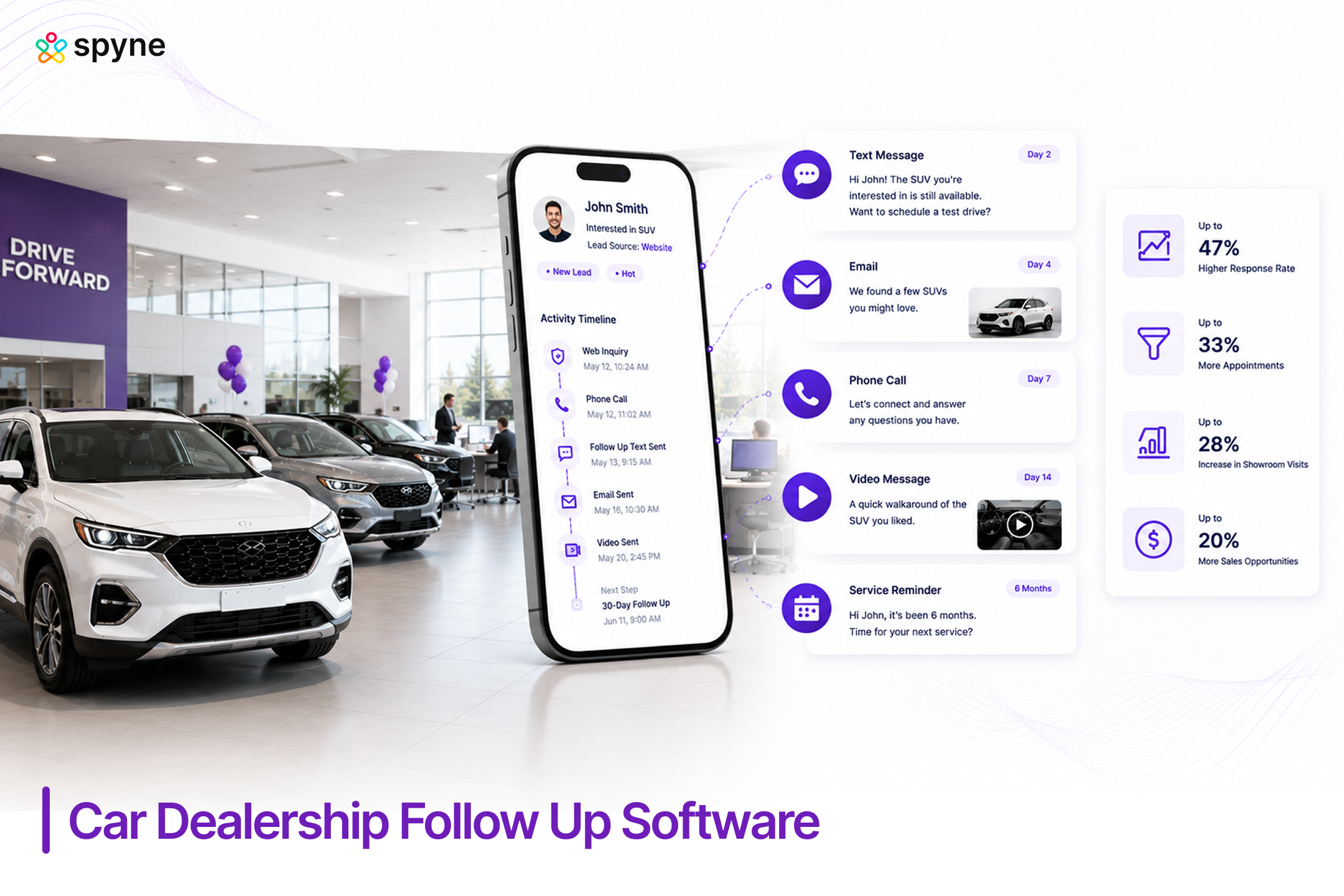
The direct answer: automated follow up for car dealers works by triggering a pre-built sequence of texts, emails, and tasks the moment a lead or customer event happens, then handing off to a human the moment the customer engages.
- Capture the trigger: A new web lead, a missed call, a completed test drive, or a service due-date all count as triggers that start a sequence.
- Score and segment: The system flags high-intent leads (financing pre-qualified, trade-in submitted) so reps see who to call first. Dealers using AI lead scoring for car dealerships can route those leads automatically.
- Fire the first response: An SMS or email goes out within minutes, confirming the inquiry and setting expectations for a callback.
- Run the cadence: Scheduled touches continue on a fixed calendar, day one, day two, day four, day seven, day fourteen, day thirty, mixing channels and content.
- Hand off on reply: The moment a customer responds, the sequence pauses and a human takes over. This single rule keeps automation from feeling robotic.
- Loop into service and retention: After a sale, the same engine shifts to delivery follow-up, satisfaction checks, and maintenance reminders tied to mileage or time.
Car Dealership Follow Up Strategies by Customer Type
The direct answer: effective car dealership follow up strategies treat new leads, cold leads, buyers, and service customers as four separate playbooks, not one generic drip.
- New inbound leads: Fast, multi-channel response within minutes, followed by a structured five-to-fourteen day sequence. This is where most dealerships lose the most winnable deals to slow reaction time.
- Unsold or cold leads: Equity-mining and inventory-match triggers work better here than repeated “are you still interested” messages. A cold lead that gets a text about newly arrived inventory matching their original search re-engages far more often than one that gets a generic check-in.
- Recent buyers: Day-one thank-you and setup help, day-seven satisfaction check and review request. This window strongly influences review volume and referral rate.
- Service and ownership customers: Mileage and time-based reminders, recall alerts, and trade-in equity notifications keep the relationship active between sales. Dealerships already running automotive sales automation for the sales side typically extend the same logic into the service lane.
Car Dealer Lead Follow Up Best Practices
The direct answer: car dealer lead follow up best practices come down to consistency, documentation, and knowing when to stop automating and start calling.
Do:
- Text first when possible. SMS gets read fast and answered often, which is why texting has become a default channel in dealership follow-up sequences alongside email and calls.
- Keep automated messages short, specific, and written like a person typed them.
- Review response-time and follow-up-completion reports weekly, not just at month end.
- Get proper opt-in consent before any automated texting to stay compliant with TCPA rules.
Don’t:
- Send five identical emails in a row. It reads as spam and increases opt-outs.
- Let automation run past the point a customer replies. Hand off immediately.
- Treat every lead the same way regardless of source or intent.
- Ignore the data. If a sequence has a low reply rate, change the message before adding more volume.
Common mistakes: the biggest one is treating follow-up software as a replacement for a documented process instead of an enforcer of one. A platform can send the reminders, but a dealership still needs an owner accountable for whether reps act on them.

Spyne Automotive CRM: Car Dealership Follow Up Software Built for Every Stage of the Deal
Spyne Automotive CRM is dealership software built to centralize lead management, automate follow-up, and track customer communication from first inquiry through service retention. It gives sales and BDC teams one system to see every open lead, every scheduled touch, and every reply, instead of juggling separate texting apps, email inboxes, and spreadsheets. For dealerships evaluating car dealership follow up software, Spyne Automotive CRM is built to handle the full cadence rather than just the first response.
1. Automated multi-channel sequences
Pre-built cadences trigger texts, emails, and tasks based on lead source, vehicle interest, and time since last contact, so unsold leads keep receiving relevant outreach without manual scheduling.
2. AI-assisted lead scoring
Incoming leads are ranked by intent signals like financing activity and repeat visits, so reps prioritize the contacts most likely to close first.
3. Two-way texting with automatic logging
Every text sent and received is logged against the customer record, so any team member can pick up a conversation with full context.
4. Instant reply hand-off
The moment a customer responds to an automated message, the sequence pauses and the assigned rep gets an alert, keeping the conversation human at the moment it matters most.
5. Service and retention reminders
Mileage and time-based triggers automate maintenance reminders and trade-in equity alerts, extending follow-up beyond the sale.
6. DMS and inventory sync
Follow-up messages can reference live pricing and availability, so a cold-lead re-engagement text about matching inventory reflects what is actually on the lot.
7. Response-time and completion reporting
Managers can see average response time, sequence completion rate, and rep-level follow-up performance in one dashboard instead of pulling reports from multiple systems.

Conclusion
Every hour a lead sits unanswered is an hour a competitor has to close it first. Car dealership follow up software will not fix a broken process on its own, but paired with the tips, strategies, and best practices in this guide, it gives your team the speed and consistency that turns more inquiries into sales and more sold customers into repeat buyers. If your current process still relies on memory and manual reminders, the gap between you and dealerships already running structured, automated follow-up is only getting wider. Here is a simple next step to close that gap. Book a demo today and Automate Your Follow-Up Today