
Every customer who walks into the F&I office has already made the hardest decision, they’re buying the car. What happens next determines whether your store captures $400 in accessory gross or watches that margin walk out the door. Most dealerships still present accessories verbally, asking buyers to imagine tint levels, PPF coverage, and wheel upgrades they’ve never seen on their actual vehicle. The result is a chronic under-attachment problem no training budget fixes.
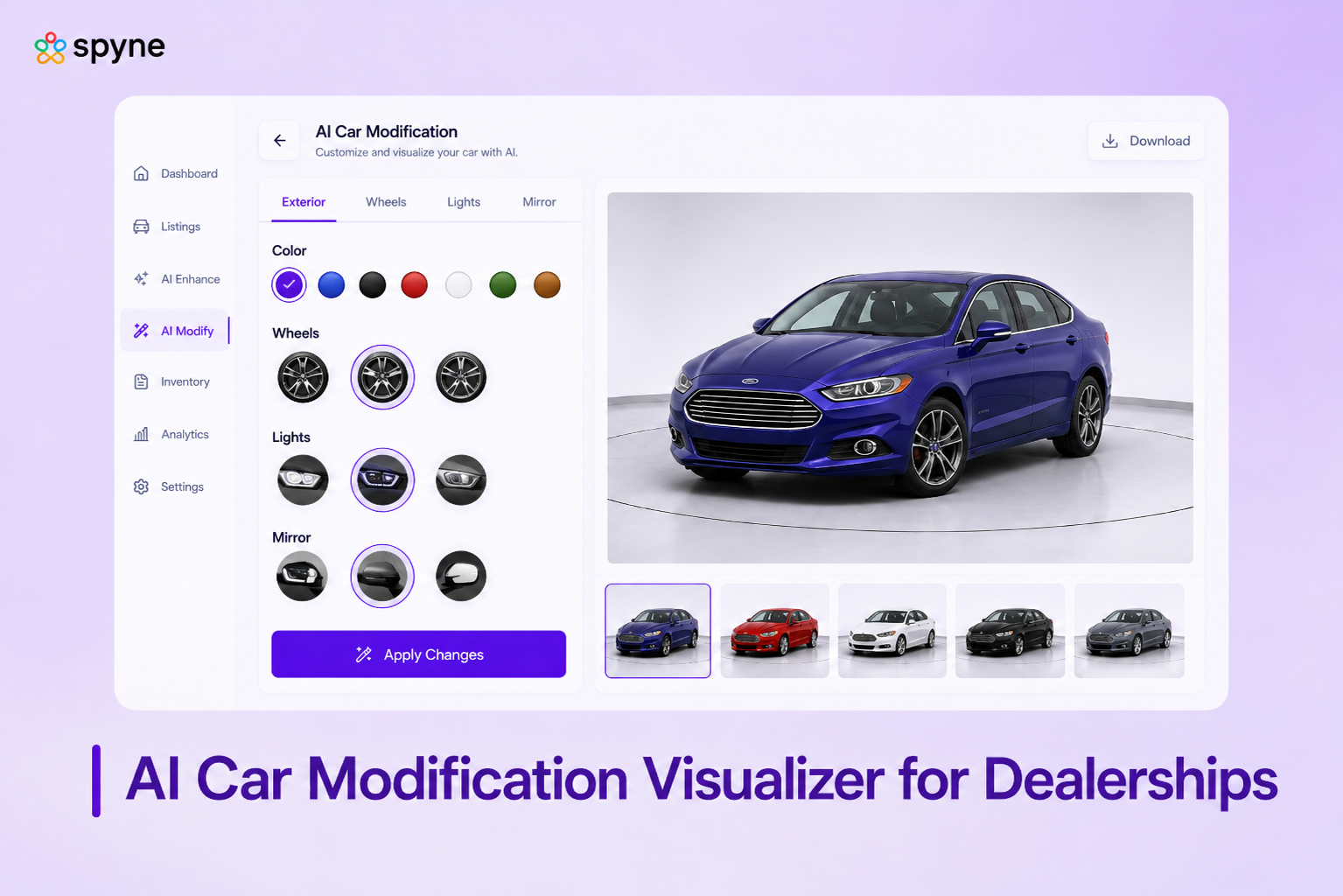
This is exactly where AI car modification visualizers are changing dealership economics. Spyne’s platform renders any vehicle from existing inventory photos, in any color, tint, or accessory configuration, in seconds, directly inside the F&I conversation.
In this guide, we break down how AI modification visualizers work, which accessories close highest visually, and what dealerships using Spyne’s Studio AI are seeing in gross per unit and attachment rates.
What Is a Car Modification Visualizer for Dealerships?
A car modification visualizer is an AI-powered tool that applies customer-selected modifications, paint colors, window tint percentages, PPF coverage zones, aftermarket wheels, or body accessories, to a photorealistic rendering of the customer’s actual vehicle in real time.
This is distinct from generic product photography or OEM configurators. A car modification visualizer at the dealership level operates on the specific VIN the customer is considering. The output is not a representative model in a similar color. It is that customer’s exact car, rendered with their exact configuration, in seconds.
Why this matters operationally:
- Customers who see their vehicle with a modification applied make decisions faster.
- Visual confirmation eliminates the ‘I’ll think about it’ deferral on appearance accessories.
- Finance managers shift from persuasion-driven selling to preference-driven selection.
- The rendered output can be saved and emailed as a configuration record, creating commitment before the customer leaves the dealership.
The Math Behind the Accessory Opportunity Most Dealers Are Ignoring
Front-end gross is structurally compressed. Accessories are not.
Front-end margins fell to their lowest level since January 2022 at $279 per deal, while publicly traded auto retail groups generated an average of $2,534 in F&I gross profit per vehicle retailed in Q3 2025, according to the Haig Report.
Appearance accessories, tint, PPF, wheels, body additions, occupy a structurally different profit profile from vehicle gross:
| Revenue Source | Avg Gross per Unit | Variable Cost | Margin Profile |
| New vehicle front-end | ~$279 | High (holdback, pack, transport) | Compressed |
| F&I products (service contracts, GAP) | ~$2,025–$2,534 | Low | Strong |
| Appearance accessories (tint, PPF, wheels) | $300–$2,500+ | Very low | High |
| Color/appearance upsell via visualizer | $400–$600 | Near-zero (digital) | Near-pure gross |
The accessory opportunity is not theoretical. A nine-month study of 120+ dealerships by izmocars found that buyers presented with an interactive visual configurator at point of purchase generated $400–$600 in accessory revenue per vehicle sold, up from $80–$120 before the tool was introduced. That is a 5x increase in accessory revenue per unit, from the same customers, on the same lot.
One in two buyers experiencing that process purchased accessories, up from one in ten before.
For a store doing 100 units per month, moving from a 10% to a 50% accessory attachment rate at $400 average gross per transaction = $16,000 in additional monthly gross from the same traffic and the same team.
Why Verbal Accessory Selling Fails, and Always Will
The finance manager who describes window tint as “it makes the car look sleeker and provides UV protection” is not selling. They are narrating. The customer, who has already made the largest purchase of their month, is mentally exhausted and cognitively resistant to new variables they cannot evaluate.
The failure mode is structural, not a training problem:
- Imagination is unreliable. A buyer cannot accurately picture how 20% tint versus 35% tint will look on their specific exterior color.
- Brochures are abstract. Showing a generic stock image of a similarly tinted vehicle does not answer the buyer’s actual question: “Will I like how my car looks?”
- Verbal objections are unanswerable. “I’m not sure if I’ll like it” has no verbal response that converts. It has one visual response: show them.
- Decision fatigue is real. By the time the F&I conversation happens, buyers are ready to sign and leave, not evaluate new options they cannot see.
Visual selling short-circuits all four failure modes simultaneously. It replaces the imagination variable with a concrete rendered output. It replaces the brochure with the customer’s actual car. It answers “will I like it” before the objection forms.
The Most Profitable Accessories to Visualize, and Why Visualization Matters More for Each
#1- Window Tint
Window tint is the gateway accessory for most F&I offices, relatively low ticket, fast installation, high gross margin (up to 200–300% per job according to industry benchmarks), and immediately visible to the customer after delivery.
The visualization challenge: tint percentage differences are subtle to the untrained eye, especially across different paint colors. A buyer with a white vehicle imagining ‘35% tint’ has no reliable mental picture. The same buyer looking at a rendered preview of their white car with 35% tint selected makes a confident, immediate decision.
What visualization does for tint sales:
- Eliminates the ‘I’ll see how it looks first’ objection.
- Allows side-by-side comparison of tint levels on their specific car.
- Converts indecision into preference, customers choose a level rather than declining the category.
#2- Paint Protection Film (PPF)
PPF is the highest-gross appearance accessory available to most dealerships, full-vehicle installations can run $2,500–$6,000+ depending on coverage and product tier. It is also the hardest to sell verbally, because its primary value is invisible: the protection it provides cannot be seen on the finished car.
The visualization approach for PPF is not about showing the film itself. It is about showing coverage zones, a rendered diagram of the vehicle with highlighted protection areas overlaid, combined with a comparison view showing paint damage scenarios PPF prevents.
This reframes the F&I conversation from “do you want to buy something you can’t see?” to “do you want this specific coverage on the hood, fenders, and door edges?” That is a concrete choice, not an abstract insurance decision.
#3- Wheel Upgrades
For trucks, SUVs, and crossovers, the volume categories at most franchise and independent stores, wheel upgrades represent significant per-unit gross with strong visual impact.
A buyer considering a wheel upgrade for their F-150 who cannot picture how a specific aftermarket wheel looks on their exact trim level and color will hesitate. The hesitation is not about price. It is about visual uncertainty. A rendered preview with the actual truck in the customer’s color wearing the options they are evaluating removes that hesitation and moves the conversation to preference selection rather than risk avoidance.
#4- Color Options for Non-Stocked Inventory
This is one of the highest-value applications of modification visualization, and it addresses a problem that costs dealerships sales every day.
The scenario: A buyer wants a specific model in Carbonized Gray. The lot has it in Oxford White and Velocity Blue. Traditionally, the sales associate apologizes, mentions they can do a dealer trade, and the buyer says they’ll think about it, then shops the next dealer.
With Spyne’s AI color visualizer, the sales associate renders the exact model and trim the buyer is evaluating in carbonized gray in under a minute. The buyer sees their car. The conversation shifts from “we don’t have it” to “here’s exactly what it looks like, want to place a deposit?”
Dealers using this capability for non-stock color presentations consistently report significantly higher deposit rates from buyers who would otherwise have continued shopping.
How Spyne’s AI Modification Visualizer Works in the Dealership Workflow
Spyne’s modification visualizer is not a standalone product requiring additional photography workflows. It operates directly on the vehicle’s existing inventory photos, the same images already captured and processed through Spyne’s standard automotive merchandising platform.
The operational workflow:
- Photo capture: Same smartphone-based process used for listing photos. No additional equipment or setup.
- AI processing: Spyne’s computer vision automatically produces studio-grade inventory images ready for modification rendering.
- Modification session: Finance manager or sales associate opens the visualizer during the F&I or delivery conversation. Customer selects modifications from a configured menu.
- Rendered preview: AI applies selected modifications to the vehicle’s actual inventory photo. Output generates in seconds.
- Configuration record: The rendered image is saved and can be emailed to the customer as a record of their selected configuration.
What this means for dealer operations:
- No separate photo shoot for visualization
- No design expertise required from staff
- No additional vendor relationship for accessory visualization
- Full integration with existing Spyne inventory photo workflow
- Works on tablet, desktop, or any screen during the F&I conversation
Dealers already using Spyne’s car visualizer for inventory photography have the modification visualizer available immediately, zero additional capture work required.
How Visual Selling Changes the F&I Conversation Structurally
The traditional F&I product presentation follows a menu sequence: the finance manager walks through each product category, describes benefits, and handles objections. Conversion depends heavily on the finance manager’s individual persuasion skill. The same product, presented by different managers, produces wildly different attachment rates.
Visual selling with a modification tool changes the conversion variable from manager skill to customer preference, which is more scalable, more consistent, and higher-converting across the entire team.
| Variable | Verbal Selling | Visual Selling |
| Primary conversion driver | Finance manager persuasion skill | Quality of visual + customer preference |
| Customer decision basis | Imagination | Rendered evidence |
| Objection type | “I’m not sure I’ll like it” | Disappears, they already saw it |
| Scalability | Limited to top performers | Consistent across all managers |
| Documentation | None | Rendered configuration saved |
| Time per accessory decision | 5–8 minutes average | 60–90 seconds with visual |
The shift from persuasion-dependent to preference-dependent selling is not just a gross improvement. It reduces manager-to-manager variance, reduces training time for new F&I staff, and produces a more buyer-friendly experience that improves CSI scores alongside accessory attachment rates.
Does Showing Customers a Visual of Accessories Actually Increase Attachment Rate?
Yes, consistently, and by a significant margin.
The most rigorous documented data comes from the izmocars nine-month study across 120+ dealerships. When buyers were presented with an interactive visual configurator at point of purchase, the accessory attachment rate moved from 1-in-10 to 1-in-2. That is a 5x improvement in the same dealerships, with the same buyers, using the same sales staff, the only variable was the presence of a visual tool.
Industry-level context:
- AI-driven F&I recommendations are projected to boost sales 20% by 2025, and menu selling digitalization is expected to reach 75% adoption by 2026.
- Visual accessories tools specifically targeting appearance modifications consistently report 20–35% improvement in attachment rates across documented implementations.
- The improvement is largest for accessories where evaluation requires seeing the finished product: tint, wheels, and body additions consistently outperform verbal-only closing rates by the widest margins.
The underlying mechanism is not psychological manipulation. It is decision quality. Customers who can evaluate a concrete visual make faster, more confident decisions than customers asked to evaluate an abstract description. Faster decisions and reduced hesitation produce higher attachment rates, it is that straightforward.
Can a Dealership Show a Customer a Different Car Color When That Vehicle Isn’t in Stock?
Yes, and this is one of the most commercially valuable applications of the technology.
When a buyer wants a color not currently on the lot, the standard response (“we can do a dealer trade or order it”) introduces delay, uncertainty, and a reason to shop competitors. Many sales are lost at exactly this moment.
Spyne’s AI color visualizer renders the customer’s exact model, trim, and configuration in their preferred color in under a minute. The buyer sees their car, not a stock photo of a similar model, but their specific selection rendered accurately. This transforms the “we don’t have it” moment into a visual confirmation that keeps the buyer engaged and provides a compelling reason to commit.
What this does operationally:
- Converts a lost sale scenario into a deposit opportunity.
- Reduces dealer trade costs by capturing buyers who would otherwise shop elsewhere.
- Creates a documented visual configuration the customer agreed to, reducing post-sale disputes about color expectations.
- Works for any color, any trim, any model in the Spyne inventory database.
What Is the Average F&I Gross Profit Per Vehicle at Dealerships in 2026?
Based on the most current industry data:
- F&I gross profit per vehicle sold topped $2,501 at publicly owned dealership groups in 2025, the highest level in five years, according to the Haig Partners Q3 2025 Report. F&I PVR at publicly traded groups rose 5.2% year over year.
- F&I offices set an all-time monthly record for profit per vehicle retailed in November 2025 at $2,025, with average F&I income per dealer rising more than 8% year-over-year.
- F&I gross profit per vehicle reached $2,515 in Q2 2025, the highest since 2020. Meanwhile, front-end profits continue to shrink as vehicle affordability remains the top concern for dealers nationwide.
Accessories add on top of these figures. For dealerships with mature visual selling programs, total back-of-deal gross (F&I + accessories) consistently exceeds vehicle front-end gross, often by 8–10x in compressed market conditions.
For a store doing 100 units per month, a 10-point improvement in accessory attachment rate at $400 average gross per accessory transaction adds $4,000 in monthly net profit, from the same unit count, the same floor traffic, the same ad spend.

Closing Thoughts
The dealerships consistently outperforming their peers on back-of-deal gross in 2026 are not doing something complicated. They are showing customers what they are buying before they buy it.
The principle applies to every category in the F&I office, but it applies with particular force to appearance accessories, where the customer’s decision is fundamentally visual and the traditional presentation method is fundamentally verbal. That mismatch is the accessory attachment gap at most dealerships. It is not a training problem. It is a tool problem.
Spyne’s Studio AI closes that gap by turning your existing inventory photos into real-time modification previews, for every vehicle, every customer, every F&I conversation, without adding a single step to your photo workflow.
If you are selling 100 units a month and your accessory attachment rate is under 30%, you are leaving $6,000–$10,000 in monthly gross on the table. That math does not require a market study. It requires a demo.
Book a demo with Spyne and see what your inventory looks like when every customer can see exactly what they are buying.