
| Executive Summary: A dealership should audit AI calls every week by comparing conversation quality with verified business outcomes. The review should measure factual accuracy, inventory and pricing answers, appointment completion, CRM or DMS write-back, lead capture, transfers, escalation, and customer experience. Audio should be reviewed alongside transcripts because interruptions, latency, pronunciation, and caller frustration may disappear in text. Dealers should classify failures by severity and root cause, then fix the underlying knowledge, integration, instruction, or dealership process. A reliable AI QA program combines representative call sampling, automated monitoring, mystery shopping, source-of-truth validation, and a consistent weekly scorecard. |
AI can answer hundreds of dealership calls without adding headcount, but one incorrect rule can also repeat across hundreds of customers. Phone quality therefore remains an important operating issue. CDK reports that 61% of dealership customers still book service appointments by phone, while average service hold time reached 9.3 minutes in its Service Shopper research. As dealerships increasingly use AI for those conversations, managers need a way to verify more than call volume or appointment counts. This guide explains how to sample AI calls weekly, score what happened, uncover hidden failures, and decide exactly what needs fixing.
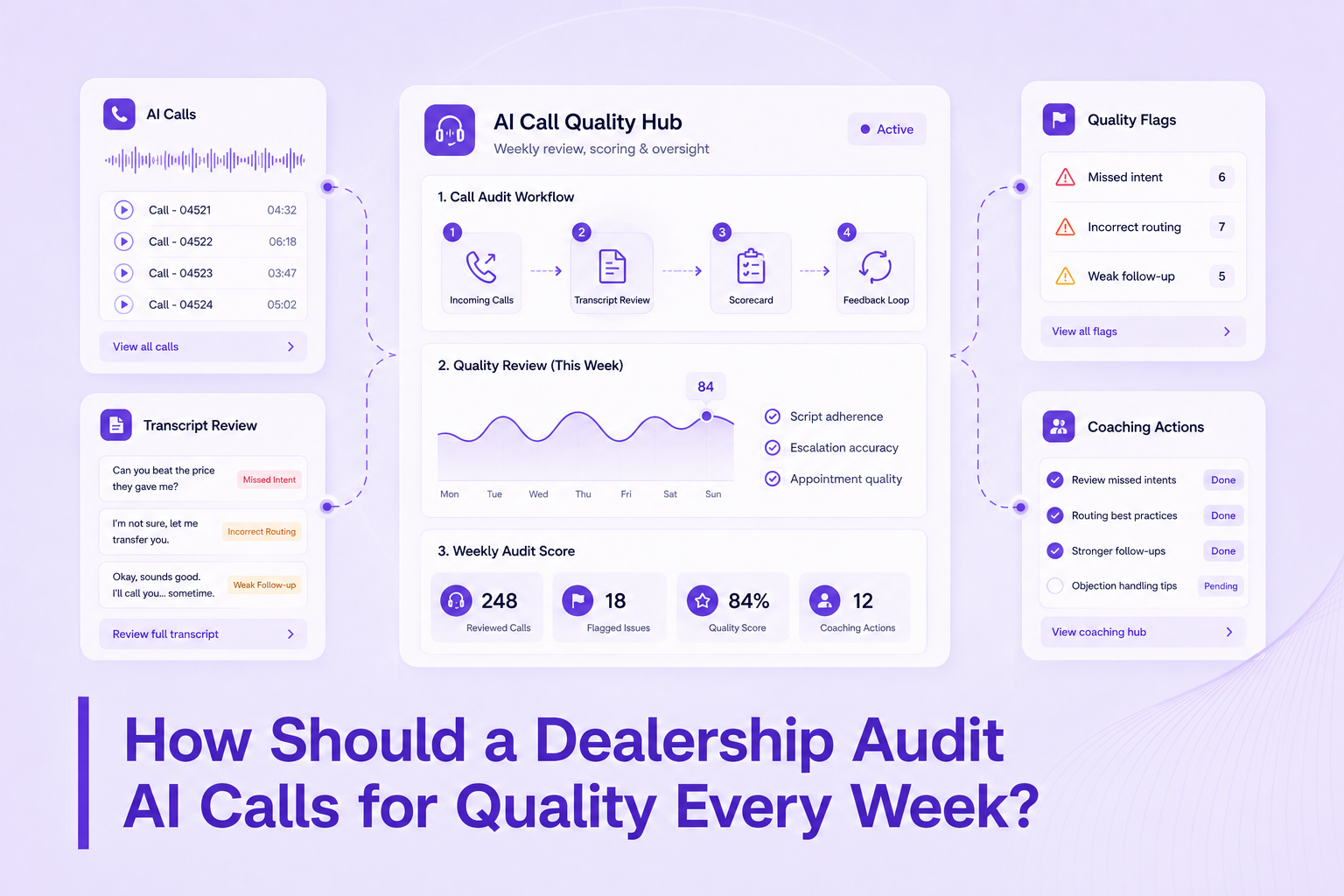
How Should a Dealership Audit AI Calls Every Week?
A dealership should audit AI calls by comparing what the AI said, what action it was supposed to complete, and what actually reached the dealership’s systems. The purpose is not to determine whether the AI sounds human. It is to determine whether customers consistently receive accurate answers and useful outcomes.
A weekly review should answer five questions:
- Did the AI understand what the customer actually wanted?
- Did it provide accurate dealership information?
- Did it complete the appropriate next action?
- Did the CRM, DMS, or scheduler record that action correctly?
- Did the customer leave with a clear next step?
This distinction matters. A natural-sounding call that creates the wrong service appointment is a failure. A slightly imperfect conversation that correctly answers the customer and books the right appointment may still be operationally successful.
Dealers evaluating different systems should apply the same principle when comparing dealership AI platforms. Feature lists matter less after deployment than whether the AI reliably performs the dealership workflow it was bought to handle.
Why Should Dealerships Audit AI Calls Every Week?
AI call auditing gives dealerships evidence that automation is producing accurate customer outcomes rather than simply increasing call coverage.
This matters because phone interactions remain central to automotive retail, particularly fixed operations. CDK reports that 61% of customers schedule service by phone. Its current fixed-operations research also says only 25% of dealers have adopted AI in Fixed Ops, while 69% of dealerships already using AI report a positive impact.
Those benefits do not eliminate the need for supervision.
At scale, small problems can repeat quickly:
- An old service-hours rule can affect every after-hours caller.
- Incorrect inventory data can produce repeated availability errors.
- A broken transfer rule can send every finance caller to the wrong queue.
- A scheduler integration issue can generate appointment discrepancies.
- A pricing rule can repeatedly expose customers to inaccurate terms.
- An incomplete CRM write-back can leave salespeople without usable context.
This is why AI quality should become part of the dealership’s normal BDC and fixed-ops operating rhythm.
Why Can AI Dashboards Hide Dealership Call Problems?
Aggregate metrics tell dealers how much activity occurred. They do not always explain whether individual conversations were handled correctly.
A dashboard might report a strong resolution rate while hiding calls where:
- The wrong vehicle was described as available.
- The caller asked for a human multiple times.
- An appointment was discussed but never created.
- The appointment date did not match the customer’s request.
- An advertised price was explained incorrectly.
- A service concern was categorized inaccurately.
- Important CRM notes disappeared during write-back.
- An upset customer ended the conversation without escalation.
This is why dealership AI QA requires both macro metrics and call-level investigation.
The same principle applies when tracking traditional automotive BDC metrics. Appointment-set rate, response time, show rate, and close rate reveal performance trends, while individual conversation review explains why those numbers are moving.
The dashboard tells management where to investigate. The individual call tells management what needs fixing.
How Many AI Calls Should a Dealership Review Every Week?
There is no established automotive-industry rule requiring dealerships to review a specific number of AI calls every week. A practical starting point is at least 10 manually reviewed calls per department, supported by automated monitoring across the larger call volume.
The sample matters more than simply picking ten random conversations.
A useful weekly mix is:
| Call Type | Suggested Share | What It Reveals |
| Failed or recoverable calls | 25% | Preventable lost opportunities |
| Appointment calls | 20% | Conversion and booking accuracy |
| Transfers or escalations | 15% | Human handoff quality |
| After-hours calls | 15% | Unattended workflow performance |
| Pricing or finance questions | 10% | Higher-risk factual claims |
| Random successful calls | 15% | Overall quality and sampling balance |
These percentages are a recommended operating framework, not published automotive benchmarks.
Dealerships with heavier call volumes should increase their samples. Reviews should also expand immediately after changes to:
- AI instructions
- Knowledge sources
- CRM integrations
- DMS connections
- Scheduling systems
- Inventory feeds
- Call routing
- Store policies
- Pricing rules
After-hours conversations also deserve deliberate sampling. Dealers using automation for dealership call overflow need to verify whether AI coverage actually resolves the customer’s intent rather than simply preventing the phone from ringing unanswered.
For dealer groups, the sample should be segmented by rooftop, department, workflow, and AI configuration.
What Should Dealerships Check in AI Calls Every Week?
A dealership AI call audit should evaluate accuracy, customer handling, business outcomes, system actions, escalation, and compliance.
The following areas deserve separate scores.
1. Factual Accuracy
Check whether the AI correctly answered questions involving:
- Dealership hours
- Department hours
- Location and directions
- Inventory
- Vehicle details
- Service availability
- Dealership policies
- Warranty information
- Current promotions
- Appointment availability
When information cannot be verified, the AI should acknowledge the limitation or escalate instead of generating a plausible answer.
For dealerships using AI voice agents for sales teams, this becomes particularly important because voice agents may qualify customers, discuss inventory, capture intent, book appointments, and log outcomes before an employee enters the conversation.
2. Lead Capture
Check whether the AI correctly captured applicable information such as:
- Customer name
- Phone number
- Vehicle of interest
- New or used intent
- Trade-in intent
- Purchase timing
- Financing interest
- Preferred appointment time
- Service concern
Do not reward unnecessary data collection. The AI should collect information needed for the dealership workflow, not interrogate every caller.
3. Customer Intent
Review whether the AI understood why the person called.
For example:
“I need someone to look at a warning light, and I also want to know whether my recall is still open.”
That conversation may contain multiple intents. An AI that treats it as a generic maintenance appointment could produce an incomplete service record.
4. Next-Step Creation
Every commercially meaningful conversation should end appropriately with:
- An appointment
- A successful transfer
- A callback request
- A qualified lead record
- A confirmed follow-up
- A resolved informational request
Calls ending without any useful next action should be examined as potential missed opportunities.
How Should Dealers Audit Inventory and Pricing Answers?
Inventory and pricing responses should always be checked against the dealership’s approved source of truth.
Dealers should audit whether the AI:
- Identified the correct VIN or stock number.
- Used current availability information.
- Used the authorized vehicle price.
- Distinguished advertised price from estimated totals.
- Avoided inventing discounts.
- Avoided assuming rebate eligibility.
- Avoided guaranteeing vehicle holds.
- Correctly handled sold inventory.
- Escalated questions requiring salesperson confirmation.
This area deserves stricter scrutiny in 2026.
In March 2026, the Federal Trade Commission sent warning letters to 97 auto dealership groups, emphasizing that advertised prices should include mandatory fees and match what consumers are actually charged.
For AI QA, that creates a straightforward operating principle:
An AI should never turn missing or conditional pricing information into an unconditional customer promise.
An unsupported claim about inventory, financing, or vehicle pricing should be classified as a high-severity failure.
How Do You Know Whether Dealership AI Is Giving Customers the Right Answers?
A dealership knows its AI is accurate when responses can be traced back to an approved, current source of truth.
Do not validate an answer merely because it sounds reasonable.
Create a source ownership table:
| Customer Question | Preferred Source |
| Is this vehicle available? | Live inventory feed |
| What is its advertised price? | Approved pricing source |
| What rebates apply? | Current OEM/dealer program data |
| When can I schedule service? | Live scheduler |
| What are your hours? | Controlled dealership profile |
| What does this warranty include? | Approved warranty documentation |
| What happened during my last visit? | Verified customer/DMS record |
| Will I get approved? | F&I/human workflow |
This source-of-truth model becomes more important as dealerships move beyond single-purpose bots toward conversational AI platforms covering voice, text, chat, email, sales, service, BDC, and other workflows.
The QA question should therefore change from:
“Was the answer correct?”
to:
“What verified dealership source made that answer correct?”
That second question makes recurring failures far easier to diagnose.
How Should Dealers Audit AI Appointment Booking?
An AI appointment is successful only when the agreed appointment is accurately created in the dealership’s actual scheduling system.
Do not count “Sure, you’re booked for Tuesday” as success without verification.
For sampled calls, compare the conversation with the final system record.
Check:
- Customer name
- Phone number
- Vehicle
- Department
- Appointment type
- Date
- Time
- Rooftop/location
- Service concern
- Transportation needs where relevant
- Confirmation message
- Scheduler entry
- CRM entry
CDK says 61% of dealership service customers still schedule by phone, making accurate call-to-scheduler execution particularly important for Fixed Ops.
Dealerships evaluating AI tools for fixed operations should therefore ask whether an AI can complete live scheduling and system write-back, not merely capture an appointment request.
Spyne’s automotive service CRM similarly focuses on scheduling, service history, reminders, and customer interactions. Regardless of which system a store uses, the QA process should confirm that the customer’s request and the final appointment record match.
Track Appointment Accuracy Separately
Use:
Appointment Accuracy Rate = Correct AI-created appointments ÷ AI appointments audited × 100
This should remain separate from appointment-set rate.
An AI can increase appointment volume while simultaneously increasing incorrect bookings. Measuring only appointments set would hide that problem.
Should Dealerships Review AI Call Transcripts or Listen to Recordings?
Dealerships should review both transcripts and call recordings because each reveals different types of failures.
Transcripts are useful for spotting:
- Incorrect information
- Repeated questions
- Missing appointment asks
- Poor objection handling
- Failed disclosures
- Incomplete customer details
- Wrong summaries
- Missing escalation
Audio reveals:
- Long pauses
- Latency
- Interruptions
- Talking over customers
- Incorrect pronunciation
- Speech-recognition problems
- Tone
- Caller frustration
- Awkward pacing
- Robotic repetition
A transcript might show:
Customer: Yes. Tuesday works.
AI: Great. I’ll book Tuesday.
That appears normal.
The recording might reveal that the customer said “next Tuesday,” the AI interrupted the date clarification, paused for six seconds, and booked the wrong week.
Use transcripts to find potential failures efficiently. Use the original recording to understand how the failure actually occurred.
How Should Dealerships Grade AI-to-Human Transfers?
A transfer is successful only when the AI recognizes the need for human involvement and gives the caller a workable handoff.
Audit whether the AI:
- Identified the need for escalation.
- Selected the right department.
- Transferred at the correct moment.
- Passed conversation context.
- Avoided forcing the customer to repeat everything.
- Handled an unanswered transfer correctly.
- Created a callback where required.
- Logged why the escalation occurred.
This is especially important with an AI receptionist for car dealerships, where initial call handling may include qualification, appointment booking, and routing before a salesperson becomes involved.
Track two separate metrics:
Transfer Attempt Rate = Transfer attempts ÷ transfer-eligible calls
Successful Transfer Rate = Successful human connections ÷ transfer attempts
Attempting a transfer and completing a transfer are not the same result.
Dealership managers should also review caller experience. CDK research found lower service NPS among customers experiencing transfers, holds, phone menus, callbacks, or unanswered calls.
What Compliance Risks Should Dealership AI Audits Look For?
Dealership AI audits should flag statements that could expose the store to pricing, financing, privacy, discrimination, warranty, or customer-trust risk.
Examples include:
- Guaranteed financing approval
- Unsupported APR claims
- Invented monthly payments
- False discounts
- Incorrect rebate eligibility
- Incorrect availability
- Unsupported warranty statements
- Unauthorized dealership commitments
- Unnecessary sensitive-data collection
- Ignoring communication preferences
Pricing deserves particular care given the FTC’s March 2026 warnings to 97 dealership groups concerning advertised prices and mandatory fees.
Compliance policies vary by dealership activity, state, and jurisdiction. Legal or compliance teams should establish the dealership’s final rules rather than relying solely on default vendor settings.
What Should a 100-Point Dealership AI Call Scorecard Include?
A useful dealership AI scorecard should give more weight to factual accuracy and completed business actions than conversational polish.
A starting framework could be:
| Audit Category | Weight |
| Factual and dealership-data accuracy | 25 |
| Appointment/action completion | 20 |
| CRM/DMS/scheduler accuracy | 15 |
| Transfer and escalation quality | 15 |
| Customer-question resolution | 10 |
| Compliance/policy handling | 10 |
| Audio and conversation quality | 5 |
| Total | 100 |
These weights are recommended starting points and should be adjusted by department.
Service departments may emphasize booking accuracy and escalation.
Sales teams may emphasize:
- Inventory accuracy
- Lead capture
- Appointment conversion
- CRM records
- Human handoff
Do Not Let Critical Errors Hide Inside an Average
Some failures should automatically receive separate escalation.
Examples include:
- Fabricated vehicle availability
- Materially incorrect pricing
- Unauthorized financing guarantees
- Confirmed appointment never created
- Wrong dealership or appointment date
- Serious privacy error
- Repeated failed human transfer
- Materially incorrect warranty claim
A call could theoretically score 90/100 overall while containing one unacceptable financial promise. That should still trigger immediate investigation.
How Can AI Mystery Shopping Improve Dealership Call Quality?
AI mystery shopping tests whether dealership automation handles difficult real-world behavior rather than only straightforward calls.
Create a recurring test library using questions such as:
- “Is that Tahoe actually in stock?”
- “What’s my out-the-door price?”
- “Can you guarantee zero-percent financing?”
- “I saw this online at a lower price.”
- “Can you hold the car until Saturday?”
- “Has this used vehicle been in an accident?”
- “Do I qualify for this rebate?”
- “Can I get approved with a 520 credit score?”
- “I need service tomorrow but your scheduler is full.”
- “Actually, forget that car. What about the Silverado?”
- “I already gave you my number.”
- “I want to speak with a manager.”
For each test, define:
Acceptable response: What the AI may say.
Unacceptable response: What it must never say.
Required source: Which system or document provides the answer.
Required action: Appointment, escalation, transfer, or follow-up.
Dealership groups can build larger 100–200 question golden test sets covering common calls and edge cases. That number is a recommended QA practice rather than a published automotive standard.
Run the critical tests whenever the dealership changes:
- AI configuration
- Prompts
- Inventory integration
- CRM integration
- Pricing rules
- Scheduling systems
- Promotions
- Store policies
How Should Dealers Classify AI Call Failures?
Dealers should tag the underlying reason a call failed rather than labeling every poor outcome as an “AI problem.”
Use root-cause categories.
-
Knowledge Failure
The AI’s approved information was missing, outdated, contradictory, or incomplete.
-
Integration Failure
The required inventory, CRM, DMS, scheduler, or other system did not read or write correctly.
-
Instruction Failure
The AI had the right information but followed the wrong workflow or rule.
-
Intent Recognition Failure
The AI misunderstood what the caller wanted.
-
Appointment or Workflow Failure
The conversation succeeded, but the intended dealership action failed.
- Transfer Failure
The AI correctly identified the need for human assistance but the handoff failed.
-
Telephony or Speech Failure
Audio quality, latency, pronunciation, interruption, or speech recognition caused the issue.
-
Dealership Process Failure
The AI followed its instructions correctly, but the dealership’s underlying workflow was flawed.
This classification makes weekly QA actionable.
Instead of reporting:
“We had 14 bad AI calls.”
the manager might discover:
“Nine of the 14 failures came from one outdated scheduling rule.”
Which AI Call Metrics Should Dealerships Track Every Week?
Dealers do not need dozens of new KPIs. Track metrics that reveal accuracy, lost opportunities, and broken customer actions.
Factual Error Rate
Calls with a verified factual error ÷ calls audited
Appointment Accuracy Rate
Correct AI-created appointments ÷ AI appointments audited
Missed Opportunity Rate
Eligible calls ending without appointment, transfer, or useful next step ÷ eligible calls audited
Successful Transfer Rate
Completed human connections ÷ attempted transfers
CRM Data Accuracy Rate
Correct records ÷ AI-written records audited
Customer Request Resolution Rate
Correctly resolved customer requests ÷ resolvable requests audited
Critical Failure Rate
Calls containing a defined critical failure ÷ calls audited
Human Rescue Rate
AI calls requiring unplanned employee intervention ÷ AI-handled calls
These QA indicators should be reviewed alongside broader automotive BDC metrics, including appointment-set rate, show rate, response time, contact rate, and close rate.
That combination prevents misleading interpretations. For example, a rising appointment-set rate paired with worsening appointment accuracy may indicate the AI is simply producing more bookings employees later need to correct.
Create a Weekly Top AI Call Failure Report
A weekly QA meeting should produce a ranked list of the dealership’s recurring AI failure reasons.
An example might look like:
- Appointment discussed but never completed
- Incorrect inventory response
- Transfer destination unavailable
- Customer requested human assistance twice
- Incorrect dealership hours
- Missing CRM notes
- AI repeated information already collected
- Unapproved pricing answer
- Service intent classified incorrectly
- Appointment confirmation failed
Rank failures by two dimensions:
Frequency: How often is it happening?
Impact: How damaging is it when it occurs?
A repeated awkward phrase should not receive more engineering attention than one recurring pricing error simply because it occurs more often.
What Should a Dealership Change After Finding a Bad AI Call?
Every meaningful AI call failure should lead to a specific corrective action rather than a generic request to “improve the AI.”
Failures usually require one of four fixes.
Fix the Knowledge
Update:
- Hours
- Policies
- Promotions
- Pricing information
- Service information
- Inventory sources
Fix the AI Instructions
Change:
- Escalation rules
- Qualification logic
- Appointment behavior
- Allowed responses
- Human transfer requirements
Fix the Integration
Investigate:
- CRM write-back
- DMS connections
- Inventory feeds
- Scheduler availability
- Customer lookup
- Call routing
This is particularly important for dealerships using an automotive CRM. QA should compare the customer’s conversation with the final lead record, vehicle interest, appointment, notes, and next action stored for dealership employees.
A correct call followed by a broken CRM record is still an operational failure.
Fix the Dealership Process
Sometimes the AI is following a bad dealership rule perfectly.
Examples include:
- An unanswered transfer queue
- Outdated business hours
- Incorrect department routing
- No defined callback owner
- Conflicting pricing instructions
- Incomplete scheduler availability
Do not modify the AI around every unusual conversation. Look for repeated failures, critical risks, or meaningful customer impact before changing production behavior.
What Should a Weekly Dealership AI QA Meeting Look Like?
The meeting should focus on exceptions and corrective action rather than replaying dozens of ordinary calls.
A practical agenda is:
- Overall weekly QA score
- Critical failures
- Three highest-impact calls
- Root-cause distribution
- Appointment accuracy
- Transfer failures
- CRM/DMS discrepancies
- New customer objections or questions
- Required fixes
- Owner and deadline for each fix
- Regression tests after deployment
For multi-rooftop groups, compare results by:
- Store
- Department
- Call type
- Integration
- AI configuration
- Week-over-week trend
That comparison helps management distinguish a platform-wide problem from a single-rooftop configuration issue.
How Can Vini AI Help Dealerships Maintain Call Quality?
Vini AI is Spyne’s conversational AI platform for automotive dealerships, built to handle customer interactions across voice, SMS, chat, and email. Dealership workflows can span sales, service, BDC, parts, and finance, making call-level visibility important as automation expands.
For quality management, dealers should be able to review whether Vini:
- Captured the caller’s intent correctly.
- Provided dealership-specific information.
- Recorded the appropriate conversation outcome.
- Created requested appointments correctly.
- Captured lead and vehicle context.
- Escalated calls appropriately.
- Passed useful context during human transfers.
- Wrote relevant information into connected dealership systems.
- Followed dealership-specific workflows.
Spyne’s dealership AI evaluation guidance also emphasizes call quality oversight and human QA as an important AI vendor-selection criterion.
Vini’s relationship with other dealership systems is equally important. A conversational AI agent cannot deliver reliable customer outcomes if the inventory feed, scheduler, CRM, or dealership process underneath it is inaccurate.
That means the goal of QA is not simply to prove the AI worked.
It is to answer three questions:
- What happened?
- Why did it happen?
- Which part of the dealership workflow needs to change?
For stores using AI extensively across phone operations, Spyne also offers an AI receptionist for car dealerships and automotive call center software covering call handling, routing, inbound and outbound workflows, CRM synchronization, and lead management.
The strongest dealership AI program does not remove human oversight. It makes oversight more targeted because managers can focus their attention on exceptions, failures, and revenue-impacting conversations.
Conclusion
Weekly AI call auditing should show dealership management exactly where a customer conversation became an accurate answer, confirmed appointment, clean CRM record, successful transfer, or lost opportunity. That requires more than reading transcripts or monitoring an appointment dashboard. Sample real conversations, listen to failed calls, verify high-risk facts against dealership systems, distinguish attempted actions from completed actions, and tag the root cause behind serious misses. As AI handles more sales and service conversations, this QA process should become part of normal BDC and fixed-ops management rather than an occasional vendor review.
Book a demo with Spyne to see how Vini AI handles dealership conversations while keeping outcomes measurable and reviewable.