
| Executive Summary
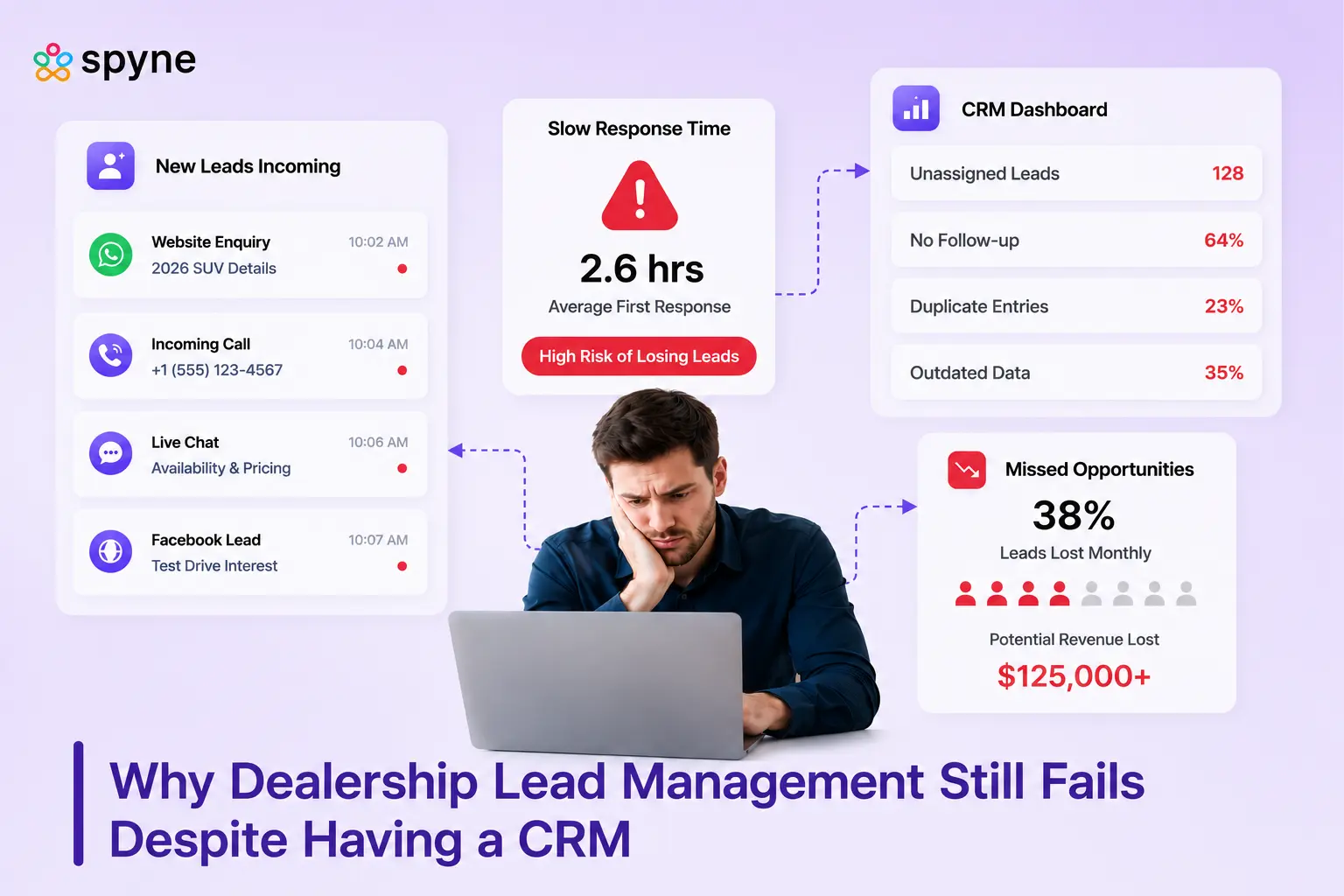
Dealership lead management and CRM record-keeping are not the same function, and treating them as interchangeable is why 30 to 40% of dealership leads get no meaningful follow-up even inside a fully staffed CRM (industry benchmark, 2025-2026). A CRM logs leads. It doesn’t route them, escalate them, or decide who should respond within what window. Spyne’s Vini AI closes that routing gap directly, responding to inbound leads in under 5 seconds. One franchise store recovered $310,000 in its first week running it. |
Introduction
Dealership lead management is not the same job as CRM record-keeping, and confusing the two is costing you deals. Industry data puts the no-meaningful-follow-up rate at 30 to 40% of inbound leads across CRM-equipped dealerships, according to lead-handling research cited by Numa and Foureyes. Spyne’s Vini AI responds to inbound leads in under 5 seconds and helped recover $310,000 in one week for one franchise store. This piece breaks down why the CRM isn’t the fix, where the gap actually lives, and what closes it.
What Is Lead Response Time and Why Does a CRM Alone Rarely Fix It?
Lead response time is the interval between a customer’s first inquiry and a human or AI reply that moves the conversation forward. A CRM records that interval. It doesn’t shorten it. VinSolutions, DealerSocket, and Elead will show you exactly how late a response was after the fact, but none of them decide, in real time, who should answer, through which channel, within what window. That decision logic is the actual job of dealership lead management, and it sits above the CRM, not inside it.
This distinction matters because most BDC Managers treat a slow response as a staffing or training problem. Often it’s neither. It’s a routing problem the CRM was never architected to solve.
Why Doesn’t a CRM Fix Slow Lead Response on Its Own?
A CRM is a system of record. It was built to store, assign, and report, not to make time-sensitive decisions across channels. It can put a lead in a queue and assign a rep. It cannot determine whether that lead should be called instead of texted, escalated after 20 minutes of silence, or pulled automatically from an OEM portal that a human hasn’t checked since Friday.
That last point matters more than most BDC Managers realize. Numa’s own audit of dealership lead flow found that leads sitting in an OEM portal, waiting on a single agent’s login, routinely age two to three days past the point of conversion. The CRM shows the lead as “received.” It never shows the lead as “abandoned by the customer while waiting.”
Three structural gaps sit underneath almost every “our CRM isn’t helping” complaint:
- Channel fragmentation — a customer’s call, web form, and text sit in three disconnected records, so no rep sees the full picture before responding.
- No escalation trigger — the CRM doesn’t flag a lead automatically if 30, 60, or 120 minutes pass with no reply. It just sits.
- Context loss at handoff — when a bot or after-hours system does respond, 68% of AI-to-human handoffs fail to carry forward key details, according to ETS Labs research cited in recent dealership AI handoff studies, forcing the customer to repeat themselves before the rep even understands the ask.
Quick summary: Your CRM tells you a lead came in. It does not tell you, in real time, whether anyone is about to miss it.
What Does Slow Lead Response Actually Cost a BDC?
The math is direct enough that most BDC Managers underestimate it until they run their own numbers. Foureyes’ 2024 mishandled-leads report found that 43.2% of all sales leads received no adequate follow-up across the dealerships it studied. Car Wars data from nearly 3,000 rooftops found that 31.8% of unconnected inbound calls are customers hanging up while on hold, not calls that simply failed to connect.
Run that against a mid-size store. At 200 inbound calls a week, a 30% miss rate is 60 missed conversations weekly, or roughly 3,100 a year. Internet lead conversion averages 8 to 12% industry-wide. Even a conservative slice of those missed calls representing real buying intent, converted at that average rate, is dozens of deals a year walking to a competitor who answered first.
Cost table: response speed vs. deal outcome
| Response window | Typical conversion impact | What the CRM shows |
|---|---|---|
| Under 5 minutes | 3 to 4x higher conversion than 30+ minute response (industry benchmark) | Lead marked “contacted,” timestamp accurate |
| 5 to 30 minutes | Moderate drop-off, still competitive | Same, timestamp still accurate |
| 30 minutes to 2 hours | Sharp drop-off, customer often already contacted a competitor | CRM shows no error, lead simply looks “open” |
| After hours, no coverage | Lead frequently lost before the store reopens | CRM shows lead received, not lead lost |
That last row is the one BDC Managers should sit with. The CRM’s dashboard looks clean in every scenario above. The revenue outcome is not.

Why Does the CRM Look Fine on Paper While Leads Still Go Cold at Night?
The gap concentrates almost entirely outside business hours and during call spikes your floor staff can’t absorb. Roughly 41% of dealership calls go unanswered after hours, based on Car Wars call-handling data referenced across Spyne’s own benchmarking. During peak showroom hours, another 30 to 40% of inbound calls go missed simply because advisors are with walk-in customers.
A BDC Manager staffing for average volume will always be short-staffed at the two moments that matter most: the 7 PM to 9 AM window when a third of your leads arrive, and the Saturday midday rush when your best reps are already on the floor. Hiring around this doesn’t scale cleanly either. NADA’s 2025 Dealership Workforce Study found total dealership employee turnover reached 42% in 2024, with sales consultant turnover closer to 60%. Every training cycle you run to plug the coverage gap gets partially erased by attrition before it pays off.
Quick summary: The lead response gap isn’t evenly distributed across the week. It clusters at exactly the hours a human-only BDC structurally can’t cover.
How Vini AI Closes the Routing Gap a CRM Can’t
Vini AI doesn’t replace the CRM. It sits above it as the decision layer that answers, qualifies, and routes before a lead ever has time to go cold.
What it does on every inbound lead, regardless of channel:
- Answers calls, texts, and web form submissions in under 5 seconds, including nights, weekends, and peak-hour overflow
- Qualifies the buyer’s intent (vehicle, budget, trade-in, financing preference) before any human touches the conversation
- Checks live inventory before booking, so a rep never opens a call to find the customer was qualified on a vehicle that already sold
- Logs the full interaction, transcript, and intent score back to the CRM automatically, not just a name and a callback time
- Escalates to a human immediately when a conversation needs judgment a script can’t provide, such as financing objections, trade disputes, or high-emotion calls
What this changes for a BDC Manager specifically:
- Reps stop opening their morning with a backlog of unworked overnight leads
- Handoff records arrive complete, so a rep isn’t re-asking questions the customer already answered
- Roughly 70% of routine inbound volume gets handled without a human touching it, freeing the team to work engaged, qualified buyers instead of spending hours on intake
- One franchise store recovered $310,000 in previously missed opportunity in its first week running Vini AI, without adding headcount or changing ad spend
The mechanism is coverage, not replacement. Vini doesn’t take leads away from the BDC. It stops leads from aging out before the BDC ever sees them.
Why Do CRM-Plus-Chatbot Setups Still Lose the Customer at Handoff?
Most dealerships that bolt a chatbot onto their website or CRM solve first response and then drop the ball at the exact moment a human needs to take over. The bot gathers trade-in details, financing preference, and a vehicle of interest, then hands the rep a generic summary or nothing at all. The rep re-asks every question. The customer, who already gave that information once, notices.
Vini AI is built to avoid this specific failure by carrying full conversation context, intent signals, and a structured handoff record into the CRM before a rep picks up the thread, so the second conversation starts where the first one left off, not from zero.
CRM-Only Workflow vs. CRM Plus Vini AI
| Workflow stage | CRM alone | CRM + Vini AI |
|---|---|---|
| First response, business hours | Depends on rep availability | Under 5 seconds, every time |
| First response, after hours | Voicemail or unanswered | Under 5 seconds, every time |
| Lead routing logic | Static assignment rules | Context-aware, channel-matched routing |
| Escalation if no reply | None built in | Automatic escalation on time window |
| Handoff context to rep | Often just name and callback time | Full qualification record, transcript, intent score |
| Weekend and peak-hour coverage | Gap by design | Covered continuously |

Closing Thoughts
The uncomfortable part isn’t that your CRM is bad. It’s that you’ve been measuring the wrong layer. Every hour a lead sits unrouted after hours or during a Saturday rush is an appointment your CRM will never show as lost, it’ll just show as late. That’s revenue quietly moving to whichever competitor answered first. See how Spyne Automotive CRM handles lead routing, follow-up, and reporting against your own volume. Book a demo now!