
Every inbound call to your dealership represents a potential sale, service appointment, trade-in opportunity, or long-term customer relationship. AI to reduce missed dealership calls helps dealerships capture these opportunities by ensuring more customer calls are answered promptly, yet many dealerships still lose valuable business because calls go unanswered during peak hours, after business hours, on weekends, or when staff are already tied up with customers.
The result is frustrated buyers, lost appointments, and revenue that quietly goes to competitors who answer first. If you’re exploring an AI solution, you’re likely looking for a practical way to improve answer rates without expanding your team.
This guide explains why dealerships miss calls, how AI call handling works in real-world operations, the features that matter most, and what to consider before evaluating and implementing an AI solution.
What Missed Calls Actually Cost a Dealership?
Phone calls remain one of the highest-intent lead channels in automotive retail because customers expect immediate answers. Yet industry call-tracking data shows the average dealership connects with only about 65% of inbound service callers, leaving nearly one in three calls unanswered.
The impact extends far beyond a missed conversation. Every unanswered call creates a ripple effect across the dealership, from lost revenue and wasted marketing spend to weaker customer retention and lifetime value.
Direct Revenue Loss
Every unanswered call is a missed opportunity to book a service appointment, sell a vehicle, value a trade-in, or answer a high-intent buyer’s question. With the average repair order worth several hundred dollars, missing 150-200 calls each month can translate into hundreds of thousands of dollars in lost annual service revenue, even before factoring in missed vehicle sales and F&I opportunities. That’s why improving automotive lead response remains one of the fastest ways to recover lost revenue opportunities.
Wasted Marketing Spend
Missed calls also undermine the marketing budget that generated them. Every dollar invested in paid advertising, SEO, third-party marketplaces, or dealership listings is meant to drive customer inquiries. When those calls go unanswered, the dealership not only loses the potential sale but also the return on its customer acquisition investment, making missed calls one of the most expensive yet preventable operational gaps.
The Hidden Retention Cost
The highest cost often shows up long after the phone stops ringing. Customers who can’t reach your dealership are less likely to call back, schedule future service, or return for their next vehicle purchase. Over time, unanswered calls erode trust, weaken loyalty, and reduce customer lifetime value, turning what seems like a single missed interaction into a long-term revenue loss.
Why Do Dealerships Miss So Many Calls?
Before evaluating AI solutions, it’s important to understand why dealerships miss so many calls in the first place. In most cases, the issue isn’t a lack of effort or staffing. It’s a capacity challenge driven by predictable patterns in dealership operations, making it difficult to answer every call consistently.
Peak-hour overload
Call volume isn’t evenly distributed throughout the day. Mornings, especially between 8:00 and 11:30 a.m., are often the busiest, with service advisors juggling walk-ins, technician coordination, appointment check-ins, and a surge of inbound calls. As demand outpaces available staff, unanswered calls become almost inevitable. This is where an AI call overflow solution can help maintain consistent answer rates without adding headcount.
After-hours gaps
Many customers shop for vehicles or think about scheduling service outside regular business hours. They call in the evenings, on weekends, or during holidays when the dealership is closed. Without reliable after-hours coverage, these callers are typically sent to voicemail, and most move on rather than waiting for a callback.
Revenue-draining calls
Not every inbound call requires the expertise of a sales or service advisor. Appointment rescheduling, vehicle status updates, parts availability, and pickup confirmations are routine requests that still demand staff attention. When these inquiries compete with high-intent sales and service opportunities, they reduce advisor availability and increase the likelihood of valuable calls going unanswered.

What to Look for in an AI Solution for Missed Calls?
Choosing the right AI solution to reduce missed dealership calls requires looking beyond basic call answering capabilities. The ideal solution should integrate with your dealership’s existing systems, handle conversations naturally, automate appointment scheduling, qualify leads accurately, and provide reporting that demonstrates measurable business impact.
As you evaluate vendors, here are five questions worth asking.
1. Does it hold a real conversation, or just follow a script?
Customers can tell within seconds whether they’re speaking to an intelligent assistant or a rigid automated system. The best AI understands context, responds naturally, and adapts to unexpected questions instead of relying on predefined scripts. Otherwise, it risks creating the same frustration as an unanswered call. That’s why many dealerships are turning to an AI receptionist to deliver more natural, responsive customer conversations.
2. Does it integrate with your CRM and DMS?
An AI solution should work within your existing dealership systems, not alongside them. Look for native CRM and DMS integrations that automatically log conversations, update customer records, and schedule appointments, eliminating duplicate work and ensuring every interaction is captured accurately.
3. Does it support multiple customer channels?
Today’s customers rarely rely on a single communication channel. They may call first, follow up with a text, and later use live chat on your website. A unified AI platform that manages conversations across calls, SMS, and web chat delivers a more consistent customer experience while preventing leads from slipping through the cracks. For many dealerships, AI outbound calling further extends this omnichannel experience by proactively following up with customers beyond inbound conversations.
4. Does it complete the task, or just take a message?
Capturing a message is only the first step. The real value comes from resolving the customer’s request, whether that’s booking a service appointment, scheduling a test drive, answering common questions, or routing the conversation to the right team when human assistance is needed.
5. Can your team monitor and improve performance?
Visibility matters just as much as automation. Look for reporting features such as call summaries, transcripts, conversation analytics, and escalation insights. These help managers understand how the AI is performing, identify missed opportunities, and continuously improve the customer experience.
How AI Call Handling Works in Practice
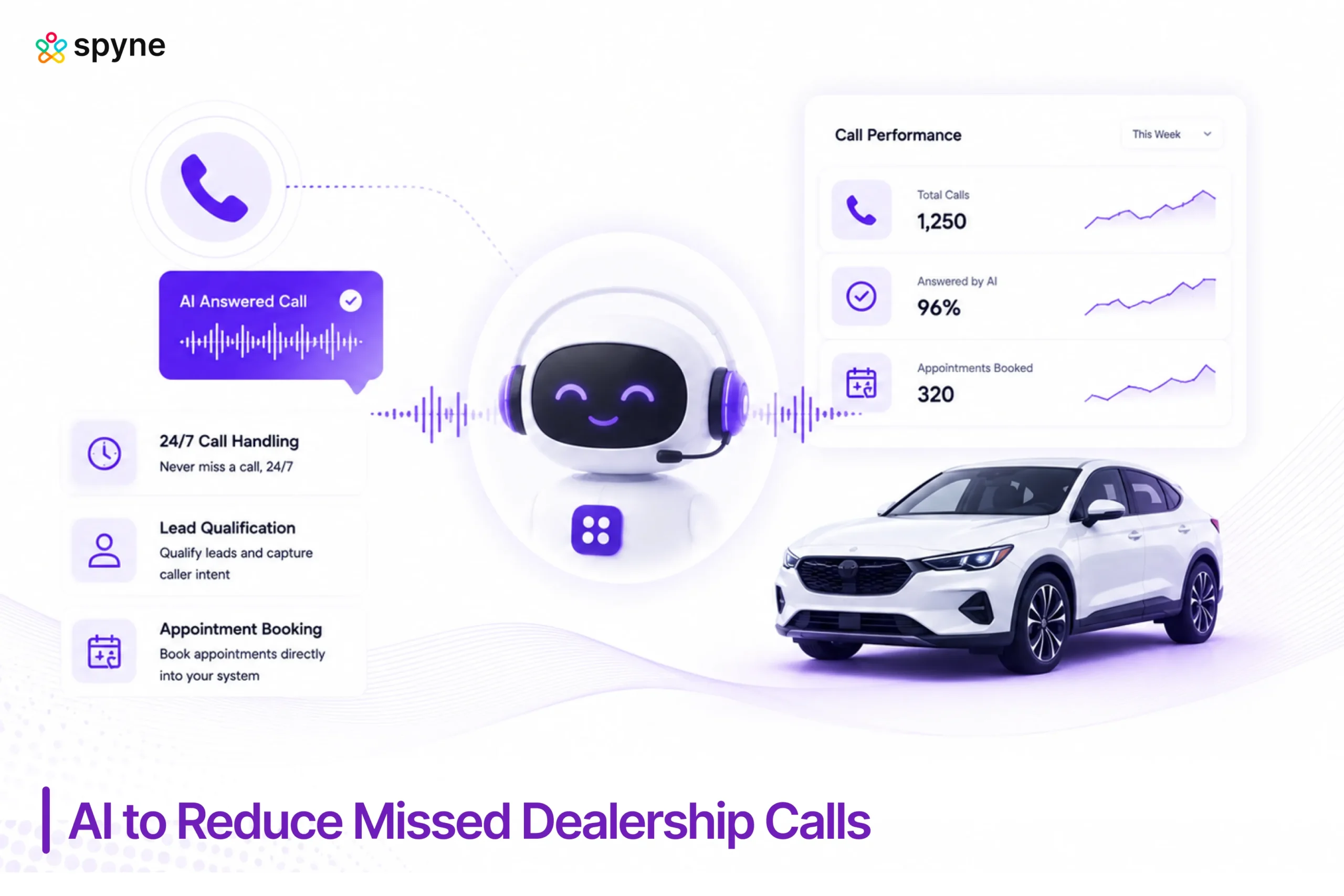
A modern AI call handling solution does much more than answer the phone. Powered by conversational AI, it understands customer intent, responds with dealership-specific information, and completes the appropriate next step. AI call handling serves as the dealership’s first line of customer engagement, resolving routine inquiries or routing more complex conversations to the right team. If human assistance is needed, the conversation is seamlessly handed off with the right context. 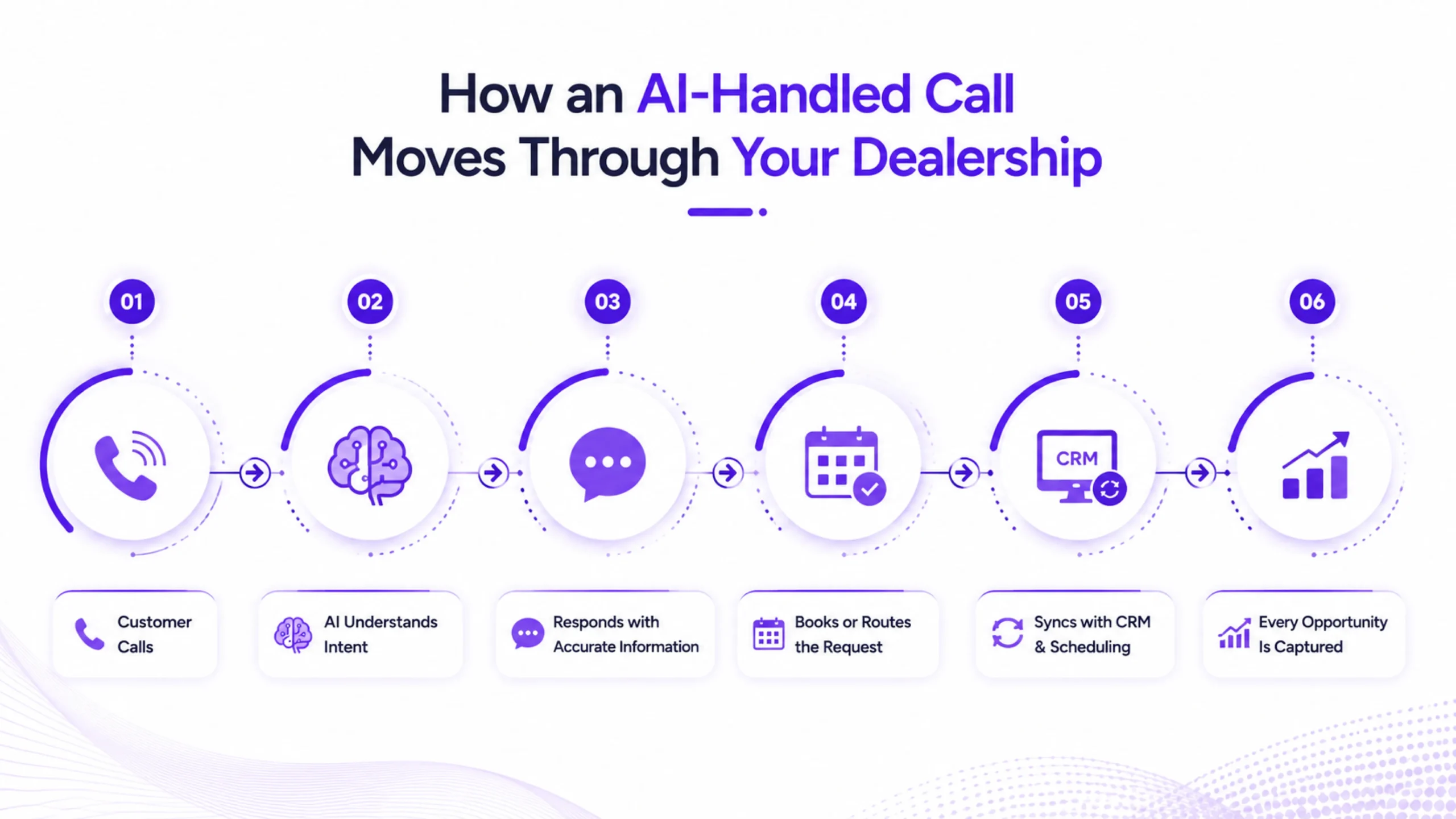
Here’s what typically happens when a customer calls:
- The AI answers instantly
Every inbound call is answered within seconds, whether it arrives during business hours, after hours, weekends, holidays, or periods of peak call volume. - It identifies the customer’s intent
The AI understands why the customer is calling and determines whether the inquiry relates to sales, service, parts, financing, or general dealership support. - It provides dealership-specific answers
Using your dealership’s inventory, scheduling rules, business information, and knowledge base, the AI answers common questions about vehicle availability, pricing, service appointments, parts, operating hours, and more. - It completes the next action
Instead of simply taking a message, the AI can book appointments, qualify leads, capture customer information, answer routine requests, or intelligently route more complex conversations to the appropriate team member. Many dealerships now use an AI sales assistant to automate these repetitive tasks while allowing advisors to focus on closing deals. - It syncs every interaction automatically
Conversations, appointments, customer details, and lead information are automatically recorded in your CRM or scheduling system, giving staff complete context before they follow up.
Whether the call comes in at 10 A.M. during the morning rush or 10 P.M. after the dealership has closed, the outcome remains the same. Every customer reaches a responsive first point of contact, every inquiry is captured, and every opportunity moves to the right team without relying on voicemail or manual callbacks. This allows dealerships to move closer to a future where they never miss a call, regardless of when customers reach out.
Which AI Call-Handling Approach Fits Your Dealership?
Not every AI call-handling solution is designed to solve the same problem. Some focus on preventing missed opportunities in a single channel, while others manage customer conversations across the entire dealership.
Understanding what each approach can and can’t do makes it easier to choose a solution that aligns with your operational needs, staffing model, and long-term goals. Use the comparison below to evaluate which approach best matches your dealership’s operational needs and customer engagement goals.
| Approach | What it covers | Where it stops | Best for |
| Missed-call-text-back tools | Sends an automatic text after an unanswered call | No live conversation or booking, just an acknowledgment | Dealers wanting a fast, low-list first step |
| Traditional after-hours answering services | Human agents answer after business hours | Limited automotive context, no CRM/DMS integration, added per-call cost | Stores not ready for an AI-based system |
| AI texting-only platforms | Handles inbound/outbound text conversations well | No voice-call coverage at all | Dealers whose bottleneck is text volume specifically |
| Full conversational AI platforms | Voice, text, and chat in one system, with real booking and CRM/DMS sync | Requires more setup than a single-purpose setup | Dealers who want to close the gap across every channel, not patch one at a time |
Each approach addresses a different operational challenge, and the right choice depends on your dealership’s goals. A standalone solution may be sufficient if you’re solving a specific problem, such as after-hours coverage or missed-call follow-ups. However, dealerships looking to improve response rates across every customer touchpoint often benefit from a unified conversational AI platform that brings voice, text, and chat into a single workflow.
How Better Vehicle Listings Complement AI Call Handling?
AI call handling, powered by conversational AI, ensures every customer inquiry receives an immediate response, but it’s only one part of improving the dealership experience. Another opportunity lies in reducing routine inquiries before customers even pick up the phone. Many inbound calls stem from incomplete vehicle listings. When buyers can’t clearly see a vehicle or verify key details online through a virtual car photography studio, they often call the dealership to fill in the gaps.
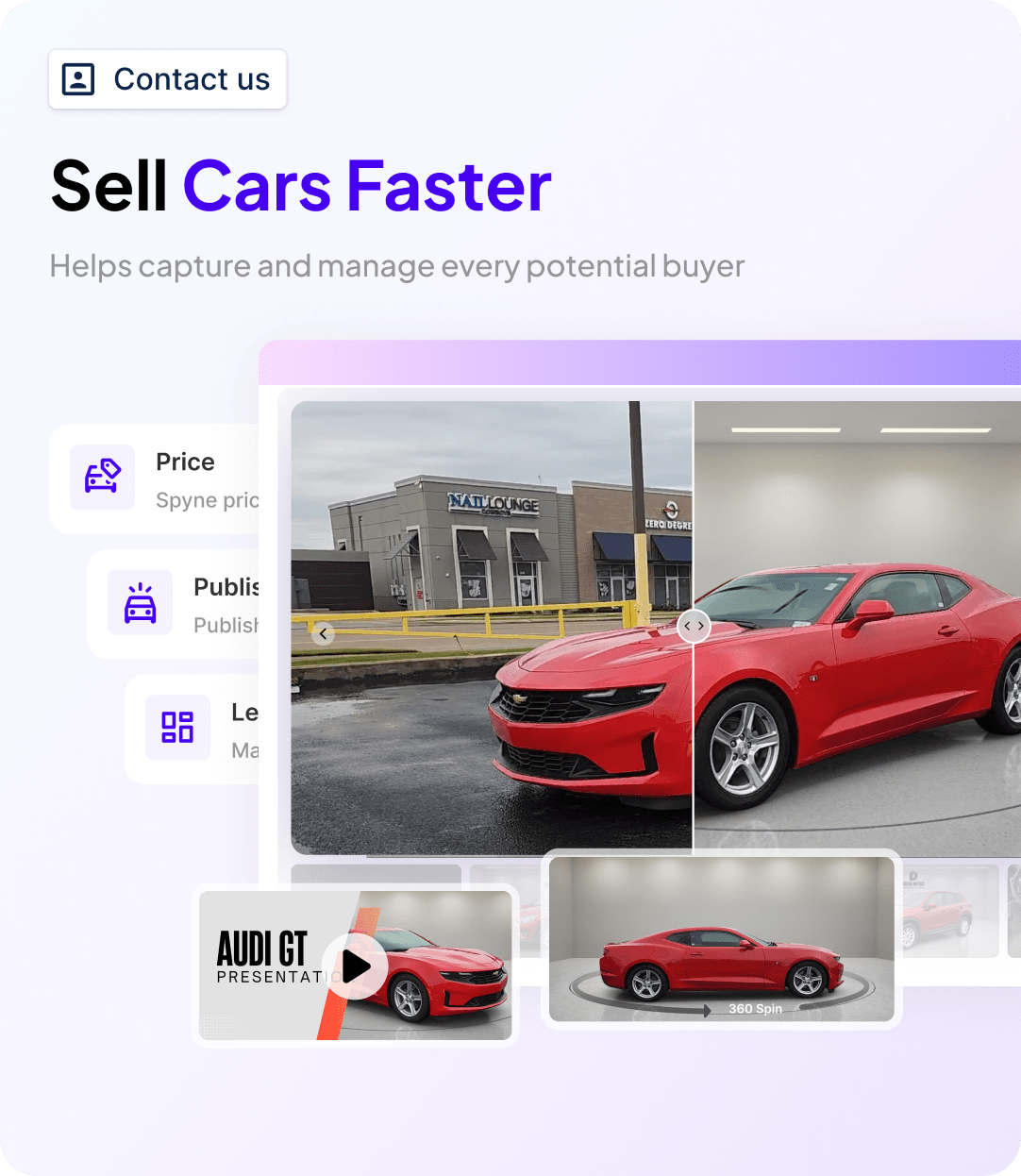
Enhanced visual merchandising goes beyond static images. A rotating car tour gives buyers a complete view of the vehicle, while a car video tour highlights its key features and condition. Together, they answer common buyer questions upfront, reducing routine clarification calls and allowing dealership teams to focus on higher-intent conversations.
Together, conversational AI and richer vehicle merchandising create a more efficient customer journey by reducing low-value call volume, improving responsiveness, and giving dealership teams more time for conversations that drive revenue.
What to Expect When You Implement an AI Call Solution?
Implementing an AI call solution doesn’t have to be disruptive. The rollout timeline depends on the type of platform you choose and how deeply it integrates with your dealership’s existing systems. While more comprehensive solutions require additional setup, they often deliver greater long-term operational value by replacing multiple disconnected tools with a single, unified workflow.
What Does Implementation Typically Look Like?
Implementation timelines vary based on the complexity of the solution:
- Point solutions can often be deployed within a few days, as they typically address a single use case with minimal integration.
- Integrated conversational AI platforms generally take a few weeks to implement because they connect with your phone system, CRM, DMS, scheduling tools, and other dealership workflows.
Although a unified platform requires more upfront configuration, it streamlines operations over time by eliminating disconnected workflows and reducing manual effort. As AI for car dealerships continues to evolve, more retailers are choosing unified platforms over standalone point solutions.
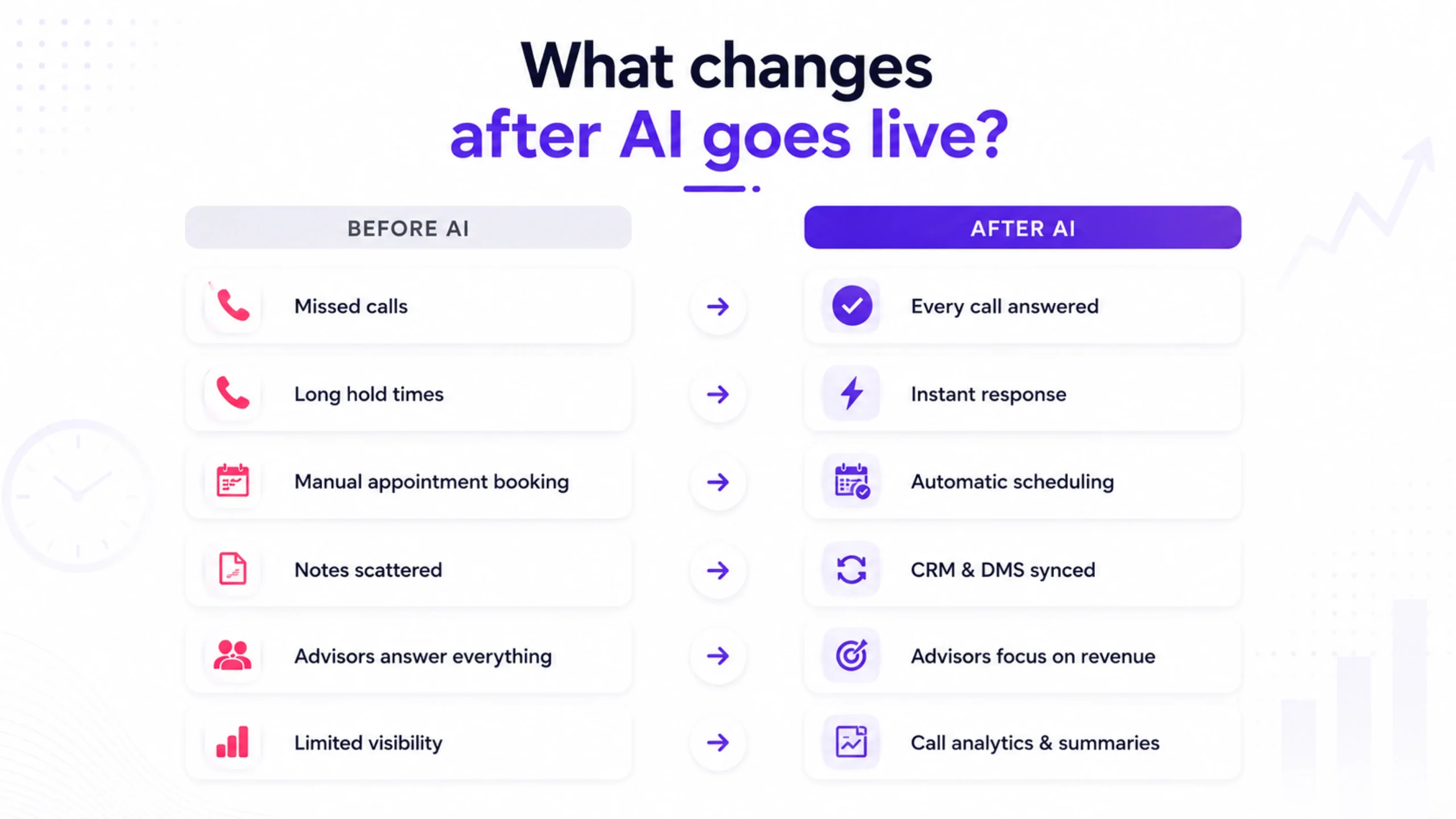
2. How Should You Measure Success?
Reducing missed calls is only one indicator of success. To understand the full business impact, dealerships should monitor metrics such as:
- More appointments booked from calls that would have otherwise gone unanswered.
- Higher inbound call answer rates.
- Fewer no-shows through automated confirmations and reminders.
- Increased advisor and BDC capacity for high-value customer interactions.
- Better operational visibility through call analytics, conversation summaries, and performance dashboards.
Within the first few months, these metrics reveal how AI improves customer responsiveness, operational efficiency, and revenue capture.
They also help dealerships measure the return on their investment.
How does Spyne Bring These Capabilities Together?
Throughout this guide, we’ve explored what dealerships should look for in an AI call solution. This includes conversational AI, appointment booking, CRM/DMS integration, and omnichannel communication. Spyne’s Vini AI brings these capabilities together in a single platform built specifically for automotive dealerships, helping teams manage every customer interaction through one unified workflow.
How Vini AI Helps Eliminate Missed Call Gaps?
| Challenge | How Vini AI Responds |
| After-hours and peak-hour coverage | Answers customer inquiries 24/7 across calls, text, and web chat |
| Routine inquiries | Resolves common questions automatically, allowing advisors to focus on high-value conversations |
| Appointment booking | Schedules sales and service appointments and syncs them with your CRM/DMS. |
| Complex conversations | Transfers customers to the right team with the full conversation context. |
| Performance visibility | Provides call summaries, transcripts, analytics, and booking insights. |
Beyond Call Handling
Answering every call is only part of improving the customer experience. Better vehicle merchandising also reduces routine clarification calls by helping buyers find the information they need before reaching out. Together, Vini AI and Spyne’s Studio AI Suite help dealerships create higher-intent conversations while improving response coverage.
Bringing It All Together
The goal is to ensure every customer receives a timely response while dealership teams spend more time on conversations that require human expertise. By combining conversational AI with digital merchandising, Spyne helps dealerships improve responsiveness, operate more efficiently, and capture more revenue opportunities.

Conclusion
Missed dealership calls are more than an operational inconvenience. They represent lost sales opportunities, missed service appointments, wasted marketing spend, and frustrated customers who may never return. As call volumes continue to grow and customer expectations for instant responses rise, relying solely on dealership staff to handle every inquiry becomes increasingly difficult.
A conversational AI platform helps close that gap by answering every customer and automating routine inquiries. It books appointments and ensures no opportunity slips through the cracks. Combined with stronger digital merchandising, it reduces unnecessary clarification calls. This creates a faster, more consistent customer experience, also allowing dealership teams to focus on high-value conversations.
See how Spyne helps dealerships answer every customer inquiry, automate appointment booking, and convert more conversations into booked appointments. Book a personalized demo to see it in action.