
Customer expectations are evolving rapidly, and businesses today need faster, smarter, and more personalized communication solutions to stay competitive. Traditional phone systems are no longer enough, which is why modern call center software has become essential for managing customer interactions, improving agent productivity, and delivering seamless support experiences across multiple channels.
From AI-powered automation and conversational AI agents to omnichannel communication and real-time analytics, call center software is transforming how businesses handle customer engagement. In this blog, you will explore what call center software is, its key features and benefits, the best call center software solutions for 2026, and how to choose the right platform for your business needs.
What is Call Center Software?
Call center software is a digital platform that allows businesses to manage, route, and track customer calls efficiently. It is specifically designed to optimize and enhance your call center operations. Modern call center software supports both inbound call handling and outbound customer outreach for sales, promotions, feedback, follow-ups, and more.
A call center software automates workflows and provides a unified view of customer data across multiple communication channels by integrating with your CRM software.
Types of Call Center Software
Call center software comes in different types based on deployment models, infrastructure, and accessibility needs. Each solution offers unique advantages depending on a business’s size, operational requirements, budget, and customer communication strategy. Understanding these types helps businesses choose the right platform for improving customer support, agent productivity, and scalability.
1. Cloud-Based or CCaaS
Cloud-based call center software is hosted by third-party providers and accessed through the internet. It eliminates the need for physical servers, making deployment faster, more scalable, and cost-effective for growing businesses and remote teams.
2. On-Premise Call Centers
On-premise systems are installed and managed within a company’s physical infrastructure. Businesses maintain full control over servers, security, and customization, but these solutions often require higher upfront investment and dedicated IT resources.
3. Browser-Based (Softphone)
Browser-based or softphone solutions allow agents to manage calls directly from their computers using a web browser or application instead of traditional desk phones. These systems improve flexibility, remote accessibility, and operational efficiency.
Benefits of Using Call Center Software
Modern call center software helps businesses streamline customer communication, automate repetitive workflows, and improve overall service efficiency. From enhancing customer support to reducing operational costs, these solutions enable businesses to deliver faster, smarter, and more personalized customer experiences at scale.
1. Enhances Customer Support
Advanced AI call center solution software like Spyne’s offers businesses features such as conversational AI that handle customer calls like a real human. These AI agents deliver instant responses, enabling 24/7 connectivity for customers. It helps reduce wait times and boosts the FCR (first call resolution) rate through personalized responses and intelligent call routing.
2. Increases Agent Productivity
With centralized data, an AI-powered call center solution software allows agents to instantly access past purchases, preferences, and account history, eliminating the need to ask customers to repeat themselves. Together, the automated workflow reduces agents’ workload, allowing them to focus on closing deals effectively.
3. Scalability & Flexibility
AI-powered call center solution software helps businesses scale when call volume increases and helps handle seasonal spikes or fluctuating demand without adding extra staff. Cloud-based inbound call center also allows remote teams to work seamlessly from anywhere while maintaining consistent customer support quality. This flexibility makes it easier for growing businesses to adapt quickly to changing customer expectations and operational needs.
4. Insightful Decision Making
Modern virtual call center software provides real-time analytics, call monitoring, and performance reports that help businesses make smarter decisions. Managers can track KPIs like call resolution rates, agent performance, customer satisfaction, and peak call hours to identify gaps and optimize workflows. AI-driven insights also help businesses improve customer experience strategies and forecasting accuracy.
5. Cost-Effective
Call center software reduces operational costs by automating repetitive tasks, minimizing manual workloads, and lowering infrastructure expenses. Cloud-based and AI-driven systems eliminate the need for expensive hardware and large support teams while improving overall efficiency. Businesses can deliver better customer service while keeping operational costs under control.

Call Center Software Essential Features
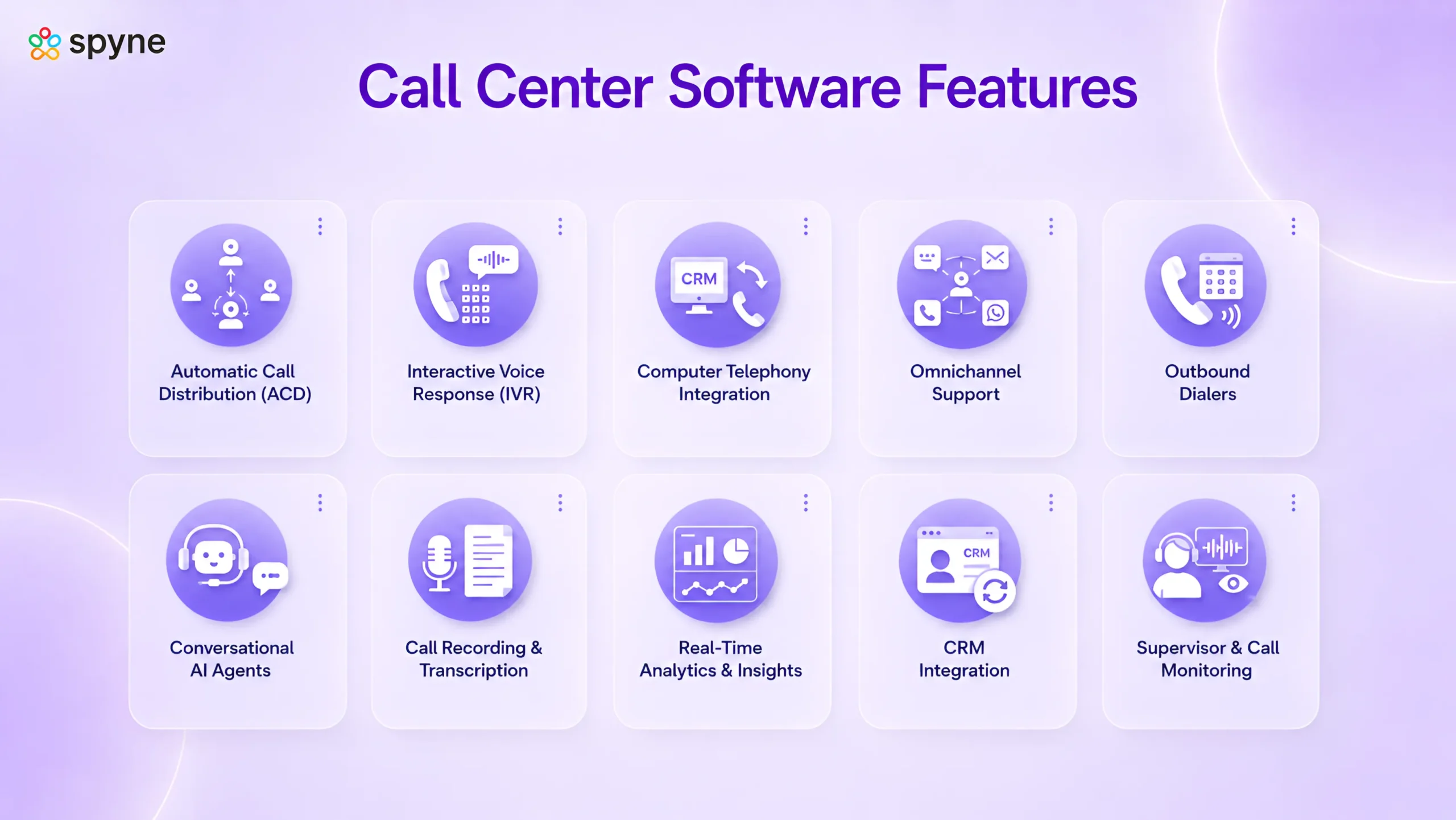
The best call center software comes equipped with advanced features that help businesses streamline customer communication, improve agent productivity, and enhance overall customer experience. From intelligent call routing and AI-powered automation to real-time analytics and omnichannel support, these features enable businesses to manage customer interactions more efficiently and at scale.
1. Automatic Call Distribution (ACD)
Modern call center solution software intelligently routes calls to the best-suited department and agent based on skills, availability, and customer needs. This reduces unnecessary transfers, lowers average handle time (AHT), and improves first call resolution (FCR) rates by connecting customers with the right agent from the beginning.
2. Interactive Voice Response (IVR)
IVR systems help businesses automate customer interactions using pre-recorded voice menus and speech recognition. It allows customers to instantly access their account information, make payments, and track orders. This reduces call queue time and enhances customer satisfaction.
3. Computer Telephony Integration
Computer telephony integration (CTI) connects the business phone system with CRM and desktop applications. It enables features for businesses like click-to-call, automatic screen pop-ups, caller identification, and unified customer data access. Employees can instantly access customer history and previous interactions whenever required to resolve issues faster and deliver personalized support experiences.
4. Omnichannel Support
Customers these days expect businesses to communicate across multiple channels, such as voice, email, SMS, live chat, and more. Omnichannel support unifies all conversations into a single interface, allowing agents to interact with customers seamlessly across channels. This creates a consistent customer experience while improving response times and reducing customer effort.
5. Outbound Dialers
Advanced call center software solutions not only handle incoming calls but also act as outbound call centers for sales, follow-ups, appointment reminders, and customer surveys. Further, advanced dialing modes like predictive, progressive, and preview dialers help agents maximize talk time while reducing manual dialing efforts. This improves agent productivity, increases connect rates, and boosts campaign efficiency by analyzing outbound call center KPIs.
6. Conversational AI Agents
AI-powered conversational agents use natural language processing (NLP), natural language understanding (NLU), and machine learning (ML) to handle customer interactions like a real human. These AI agents answer common customer inquiries, qualify leads, schedule appointments, and transfer complex cases to live agents with full context. Solutions like Spyne’s Vini AI help businesses provide 24/7 support while reducing operational costs and improving FCR rates.
7. Call Recording & Transcription
Automated call recording and transcriptions capture customer conversations, eroding manual effort. These recordings and transcriptions are used for quality assurance, compliance, and training purposes. These help evaluate agent performance, identify recurring customer issues, and improve service quality, together reducing after-call work (ACW) for agents.
8. Real-Time Analytics & Insights
Real-Time analytics and insights provide businesses with visibility into critical KPIs such as average handle time (AHT), first call resolution (FCR), call abandonment rate (CAR), queue times, and agent utilization. These insights help managers optimize staffing, improve workflows, monitor customer satisfaction, and make data-driven operational decisions.
9. CMR Integration
CRM integration connects call center software with customer databases to provide agents with a complete view of customer profiles, purchase history, and previous interactions. This eliminates repetitive questioning, speeds up issue resolution, and enables more personalized customer engagement across every interaction.
10. Supervisor & Call Monitoring Tools
Supervisor tools allow managers to monitor live calls, provide whisper coaching, barge into conversations when necessary, and track agent performance in real time. These features help maintain service quality, improve agent training, and ensure better customer handling during critical interactions.
12+ Best Call Center Software for 2026
Modern businesses need call center software that goes beyond basic calling capabilities and delivers AI-powered automation, omnichannel communication, advanced analytics, and seamless customer experiences. Here are some of the best call center software solutions for 2026 that help businesses improve customer engagement, streamline operations, and scale support efficiently.
1. Spyne AI
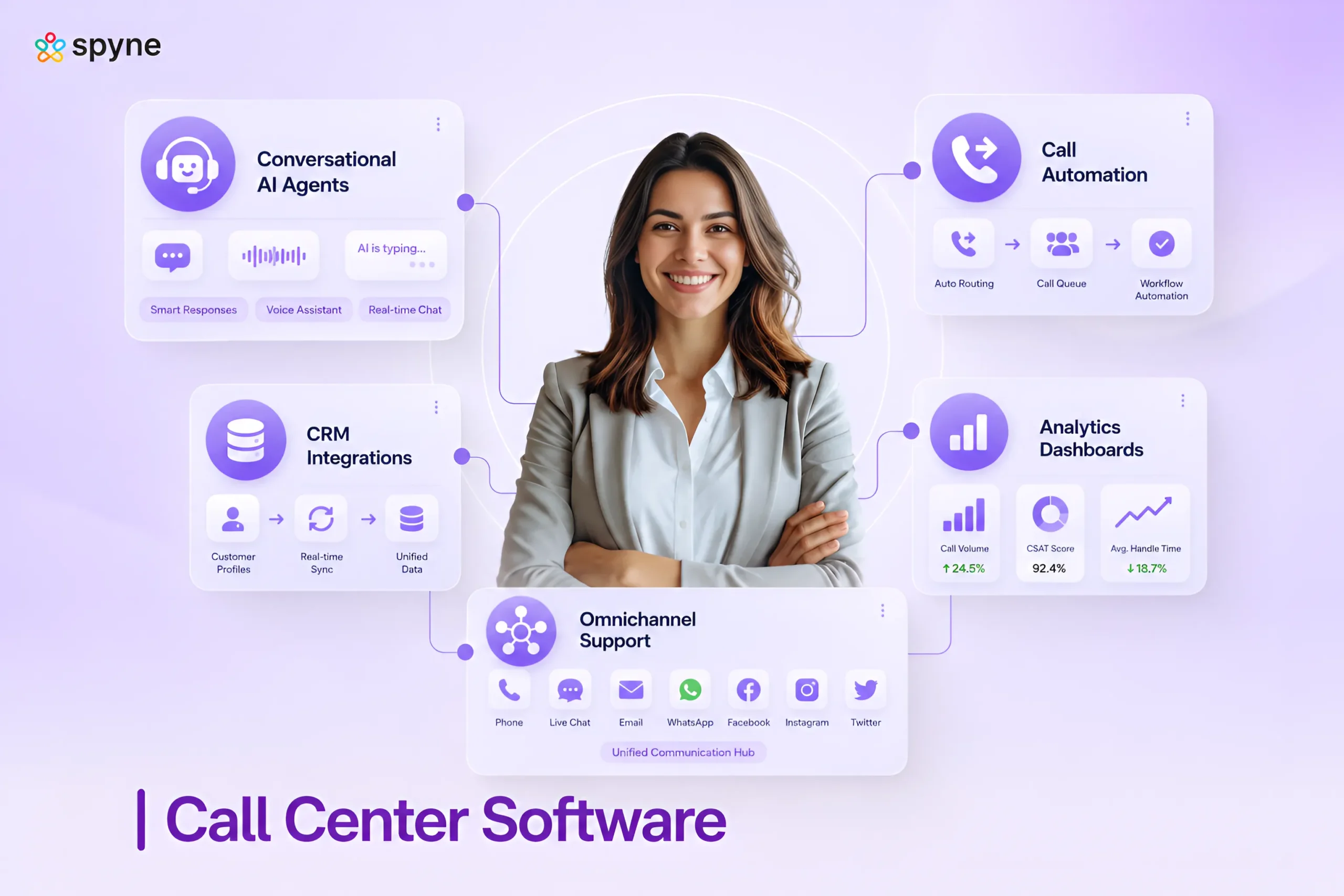
Spyne AI is an advanced conversational AI-powered call center solution software designed to help automotive businesses automate customer interactions, lead qualification, appointment booking, and follow-ups at scale. Its AI voice agents deliver human-like conversations across inbound and outbound calls, enabling dealerships and businesses to improve customer engagement while reducing operational workload.
The platform combines conversational AI, workflow automation, and real-time analytics to help businesses improve first call resolution (FCR), reduce average handle time (AHT), and streamline customer communication. Spyne AI is particularly useful for businesses looking to manage high call volumes while maintaining personalized customer experiences.
Best For: Automotive businesses, dealerships, and AI-driven customer engagement
Key Features
- Conversational AI agents
- Call automation
- CRM integrations
- Analytics dashboards
- Omnichannel support
Pricing: Spyne AI offers customized pricing based on business requirements, call volumes, and feature needs. Businesses can contact the Spyne Sales Team for a personalized demo and pricing details.
2. Genesys
Genesys Cloud CX is an enterprise-grade call center application software known for its advanced AI capabilities and omnichannel customer engagement tools. It offers intelligent routing, workforce optimization, and deep CRM integrations for large-scale support operations.
Best For: Large enterprises and global contact centers
Key Features
- AI routing
- Workforce engagement management
- Omnichannel support
- Analytics
- Compliance monitoring
Pricing: Custom enterprise pricing
3. Five9
Five9 is a cloud-based call center software widely used for outbound sales and customer support automation. Its predictive dialing, AI-powered workflows, and analytics tools help businesses improve agent productivity and campaign efficiency.
Best For: Outbound sales and enterprise support teams
Key Features
- Predictive dialing
- AI automation
- IVR
- Workforce optimization
- Analytics
Pricing: Quote-based pricing
4. Talkdesk
Talkdesk provides AI-driven customer experience solutions with fast deployment and flexible customization options. The platform helps businesses streamline support operations using automation, analytics, and omnichannel communication tools.
Best For: Enterprises needing fast deployment and customization
Key Features
- AI virtual agents
- Omnichannel routing
- Analytics
- CRM integrations
Pricing: Custom pricing
5. NICE CXone
NICE CXone is a cloud contact center platform focused on workforce optimization and customer experience management. It combines AI analytics, call monitoring, and automation features to improve operational performance and service quality.
Best For: Large-scale customer support operations
Key Features
- AI quality monitoring
- Workforce optimization
- Call recording
- Advanced analytics
Pricing: Enterprise pricing available on request
6. Dialpad AI Contact Center
Dialpad AI, one of the best Contact Center software, uses artificial intelligence to provide real-time call transcription, sentiment analysis, and agent coaching. It is popular among sales and support teams looking to improve conversation quality and reduce average handle time (AHT).
Best For: Startups and sales-focused teams
Key Features
- AI coaching
- Call transcription
- Sentiment analysis
- Voice intelligence
Pricing: Subscription-based pricing
7. CloudTalk
CloudTalk is a browser-based call center solution software built for small and medium-sized businesses. It offers features like click-to-call, CRM integrations, and smart analytics to simplify customer communication and remote team collaboration.
Best For: SMBs and remote sales teams
Key Features
- Click-to-call
- Analytics
- IVR
- CRM integrations
- International calling
Pricing: Tier-based monthly plans
8. Aircall
Aircall is a cloud call center platform designed for modern sales and support teams. It focuses on team collaboration, workflow automation, and seamless integration with popular CRM and helpdesk tools.
Best For: Mid-sized sales and support teams
Key Features
- Call monitoring
- Shared inbox
- CRM integrations
- Analytics dashboards
Pricing: Per-user monthly pricing
9. Zendesk
Zendesk is a popular omnichannel customer service platform that combines voice, email, chat, and social media support into a unified workspace. Its AI-powered automation and ticketing tools help businesses deliver faster and more personalized customer experiences.
Best For: Omnichannel customer support operations
Key Features
- AI bots
- Ticketing
- IVR
- Analytics & Insights
- Customer profiles
Pricing: Flexible subscription pricing
10. Nextiva
Nextiva is a unified communication and call center solution offering VoIP calling, CRM tools, and customer engagement features. It is widely used by businesses looking for an all-in-one communication platform for support and sales teams.
Best For: Businesses seeking unified communications
Key Features
- VoIP calling
- CRM integration
- Workflow automation
- AI Analytics
Pricing: Subscription-based pricing
11. HubSpot Service Hub
HubSpot Service Hub combines customer service tools with its CRM ecosystem to improve customer interactions and support workflows. Businesses can manage calls, tickets, automation, and customer data from a centralized dashboard.
Best For: Businesses already using the HubSpot ecosystem
Key Features
- CRM integration
- Ticketing
- Call tracking
- Automation workflows
Pricing: Free and premium plans available
12. Twilio Flex
Twilio Flex is a highly customizable and one of the best cloud contact center platforms designed for developers and growing SaaS businesses. It provides API-driven communication tools that allow businesses to build tailored customer support experiences.
Best For: Customizable enterprise communication systems
Key Features
- API-based customization
- Omnichannel communication
- AI integrations
Pricing: Usage-based pricing
13. RingCentral
RingCentral is a cloud communication platform offering voice, video conferencing, messaging, and contact center solutions. It is ideal for remote and hybrid teams needing reliable collaboration and customer communication tools.
Best For: Distributed and remote workforces
Key Features
- Video conferencing
- Cloud calling
- AI call center analytics software
- Team messaging
Pricing: Subscription pricing plans
14. 8×8 Contact Center
8×8 Contact Center provides cloud-based customer communication solutions with strong global calling capabilities and AI-powered analytics. The platform supports omnichannel engagement and workforce management for distributed teams.
Best For: International customer support teams
Key Features
- Omnichannel routing
- Workforce analytics
- Voice intelligence
- Call recording
Pricing: Quote-based pricing
15. Freshworks Contact Center
Freshworks virtual contact center software is an AI-powered customer communication platform designed for growing businesses and support teams. It offers automation, omnichannel support, and real-time reporting to improve customer service efficiency.
Best For: SMBs and growing customer support teams
Key Features
- AI chatbots
- Call routing
- Omnichannel support
- Reporting dashboards
Pricing: Freemium and premium plans available
How to Choose the Right Call Center Software
Choosing the best software contact center is not just about selecting the platform with the most features. Businesses need a solution that aligns with their communication channels, customer expectations, operational goals, and long-term scalability needs. The right platform can improve customer satisfaction, reduce average handle time (AHT), and boost first call resolution (FCR), while the wrong solution may increase operational complexity and costs. Here are the key factors to consider before choosing a virtual call center software solution:
1. Evaluate AI & Automation Capabilities
Best call center software should include AI-powered automation features such as conversational AI agents, intelligent call routing, sentiment analysis, automated quality assurance, and real-time agent assistance. AI helps businesses reduce manual workloads, improve response times, and deliver personalized customer experiences at scale.
Look for platforms that offer:
- AI voice agents and chatbots
- Automated call summaries and transcription
- Real-time coaching and sentiment analysis
- Workflow automation and ticket routing
2. Check Omnichannel Communication Support
Customers today interact across multiple channels, including voice calls, email, live chat, SMS, and social media. A good cloud call center platform should unify all conversations into a single dashboard to provide a seamless omnichannel experience.
Choose software that supports:
- Voice and video calling
- Live chat and chatbots
- SMS and email support
- Social media integrations
- Omnichannel routing and conversation history
3. Review Routing & Queue Management Features
Efficient call routing directly impacts customer experience and operational efficiency. Businesses handling high call volumes should prioritize advanced routing and queueing capabilities.
Important features include:
- Automatic Call Distribution (ACD)
- Skill-based routing
- Interactive Voice Response (IVR)
- Intelligent Virtual Agents (IVA)
- Callback queue management
These features help reduce queue times, improve FCR rates, and ensure customers reach the right agent quickly.
4. Prioritize Analytics & Reporting
AI call center analytics software helps businesses monitor call center performance and identify operational gaps. Strong reporting capabilities allow managers to optimize staffing, improve agent performance, and enhance customer satisfaction.
Your software should track key KPIs like:
- Average Handle Time (AHT)
- First Call Resolution (FCR)
- Call Abandonment Rate (CAR)
- Customer Satisfaction Score (CSAT)
- Agent utilization and idle time
AI-powered contact center analytics software can also provide customer sentiment insights and performance recommendations.
5. Ensure CRM & Third-Party Integrations
Cloud call center software should integrate smoothly with your existing CRM, helpdesk, and business applications. Seamless integrations eliminate manual data entry, improve workflow efficiency, and give agents complete customer visibility during conversations. Look for compatibility with platforms like:
- Salesforce
- HubSpot
- Zendesk
- ERP and marketing automation tools
6. Assess Security & Compliance Standards
Customer conversations often involve sensitive information, making security a critical factor. Enterprise-grade call center solutions software should include strong security protocols and compliance certifications. Look for:
- End-to-end encryption
- Multi-factor authentication (MFA)
- Role-based access controls
- GDPR, HIPAA, and PCI compliance
- SOC 2 and ISO-27001 certifications
Strong security measures help protect customer data and reduce compliance risks.
7. Consider Scalability & Flexibility
As your business grows, your cloud call center software should scale with your operations. Cloud-based and CCaaS inbound call center software make it easier to add users, expand communication channels, and support remote teams without major infrastructure investments. A scalable solution should offer:
- Flexible pricing plans
- Easy user expansion
- Cloud-based accessibility
- Remote and hybrid team support
8. Analyze Pricing & Total Cost of Ownership (TCO)
The cheapest software is not always the best long-term investment. Businesses should evaluate the total cost of ownership, including setup fees, integrations, maintenance costs, training expenses, and add-on features. Compare:
- Monthly or annual subscription costs
- Per-user pricing models
- Additional feature costs
- Setup and onboarding fees
- ROI and operational savings
9. Review Service Quality & SLA Commitments
Reliable uptime and support services are essential for uninterrupted customer communication. Before finalizing a provider, carefully review their Service Level Agreement (SLA). Check for:
- Guaranteed uptime percentage
- Customer support availability
- Response and resolution timelines
- Disaster recovery policies
- Penalties for SLA violations
10. Focus on User Experience & Ease of Use
A complex platform can slow down agent productivity and increase training time. The best call center software should offer an intuitive interface, fast onboarding, and easy customization options for both agents and supervisors. A user-friendly system helps teams:
- Learn faster
- Reduce operational errors
- Improve agent productivity
- Deliver better customer experiences
Ultimately, the best call center solutions software is one that balances AI capabilities, scalability, integrations, security, and ease of use while aligning with your business goals and customer expectations.
Why Spyne Is the Best Automotive Call Center Software?
The automotive industry handles thousands of customer interactions daily, from vehicle inquiries and service bookings to financing discussions and follow-ups. Managing these conversations manually often leads to missed leads, delayed responses, and inconsistent customer experiences. This is where Spyne AI stands out as one of the best automotive call center software solutions for dealerships and automotive businesses.
1. Built Specifically for Automotive Businesses
Unlike generic call center applications, Spyne AI is designed specifically for the automotive industry. It understands dealership workflows, customer journeys, lead qualification, inventory inquiries, and appointment scheduling. This industry-focused approach helps dealerships automate repetitive communication while delivering personalized customer interactions.
2. Conversational AI Agents That Interacts Like Human
Spyne AI uses conversational AI “Vini” capable of handling both inbound and outbound calls naturally. These AI agents can answer customer queries, qualify leads, schedule test drives, and confirm appointments. Together with Spyne’s outbound call center software can follow up with prospects, sending promotional messages and more without human intervention. This helps dealerships provide 24/7 customer support while reducing response delays.
3. Faster Lead Response & Higher Conversion Rates
Speed plays a major role in automotive sales. Spyne AI instantly responds to customer inquiries, ensuring leads are engaged before they lose interest or switch to competitors. Automated follow-ups and intelligent lead nurturing also help dealerships improve lead conversion rates and maximize sales opportunities.
4. Reduces Average Handle Time (AHT)
Spyne AI automates repetitive customer interactions such as appointment confirmations, service reminders, inventory checks, and FAQ responses. By reducing manual workloads, dealerships can lower average handle time (AHT) while allowing human agents to focus on high-value conversations and closing deals.
5. Improves First Call Resolution (FCR)
With intelligent routing, CRM integrations, and contextual customer understanding, Spyne AI helps resolve customer issues faster during the first interaction. Higher first call resolution (FCR) rates improve customer satisfaction and reduce unnecessary callbacks or transfers.
6. Seamless CRM & Dealership Integrations
Spyne AI integrates with CRM systems and dealership management platforms, giving agents and AI voice assistants access to customer history, preferences, and previous interactions. This centralized customer view enables more personalized communication and smoother workflow management.
7. Scalable Cloud-Based Infrastructure
Whether managing a single dealership or multiple locations, Spyne AI automotive call center service offers scalable cloud-based infrastructure that grows with business needs. Dealerships can handle increasing call volumes, seasonal demand spikes, and remote operations without investing heavily in additional infrastructure.
8. Real-Time Analytics & Performance Insights
Spyne AI contact center analytics software provides real-time analytics dashboards that help dealerships track KPIs like lead response time, call outcomes, agent productivity, AHT, FCR, and customer engagement trends. These insights help businesses optimize communication strategies and improve overall operational performance.
9. Cost-Effective Customer Communication
Hiring and managing large customer support teams can be expensive for dealerships. Spyne AI automates repetitive workflows and reduces dependency on manual calling processes, helping businesses lower operational costs while maintaining consistent customer engagement.
10. Omnichannel Customer Engagement
Modern automotive buyers interact through multiple channels, including calls, SMS, email, and online inquiries. Spyne AI acts as an automotive BPO and helps businesses manage customer communication across channels while maintaining conversation continuity and personalized engagement.
For automotive businesses looking to automate customer communication, improve lead conversion, and deliver faster support experiences, Spyne AI offers a scalable and AI-driven solution tailored specifically for the automotive industry.

Conclusion
Modern virtual call center software helps businesses streamline customer communication, automate workflows, and improve overall customer experience. Features like AI automation, omnichannel support, real-time analytics, and intelligent call routing enable businesses to improve efficiency, reduce operational costs, and boost customer satisfaction.
For automotive businesses, Spyne AI offers an AI-powered call center solutions software designed to automate customer interactions, improve lead conversions, and enhance dealership operations with conversational AI, workflow automation, and real-time insights. Book a demo now!