
Executive SummaryAutomotive CRM software for car dealerships centralizes lead capture, follow-up, and customer data so sales teams respond faster and track every deal from first contact to close. NADA’s 2025 Data report counted 16,990 franchised dealerships generating $1.3 trillion in sales, all competing for the same shoppers. Pied Piper PSI’s 2026 study found dealer response scores climbing to 71 out of 100 industry-wide. This guide covers core CRM capabilities, best practices, and how to compare platforms without sitting through five sales demos. |
A shopper submits three lead forms on a Friday night. Two dealerships call back by Monday. One never calls at all. Pied Piper PSI’s 2026 study found the industry average dealership response score still sits at 71 out of 100, meaning nearly three in ten interactions fall short before a salesperson says a word. Automotive CRM software for car dealerships exists to close that gap. This guide breaks down what these platforms do, the capabilities worth paying for, and how to run an automotive CRM software comparison without losing a week to vendor demos.
What Is Automotive CRM Software for Car Dealerships?
Automotive CRM software for car dealerships is a system that captures leads from a dealership’s website, third-party marketplaces, and OEM programs, then organizes follow-up, appointment scheduling, and customer history in one place. It replaces tracking leads across spreadsheets, sticky notes, and a salesperson’s memory. A dealership running this software can see every open lead, who owns it, and how long it has sat untouched.
Most platforms in this category connect to a dealership’s DMS, inventory feed, and communication channels, so a lead’s status updates automatically as a deal moves from first contact to delivery. That connectivity separates dedicated automotive CRM software for car dealerships from a general-purpose CRM retrofitted for a sales floor. It is built around dealership-specific workflows: desking, trade valuations, F&I handoffs, and service retention, none of which a generic CRM handles without heavy customization.
What Is the Best Automotive CRM Software for Dealerships?
There is no single best automotive CRM software for dealerships. The right choice depends on your dealership’s size, DMS, lead volume, and sales process. Franchise groups often prioritize OEM integrations and multi-rooftop support, while independent dealers typically value ease of use, faster onboarding, mobile access, and affordable pricing.
Instead of focusing on vendor names, compare platforms based on the capabilities that directly impact sales performance. Look for strong lead routing, DMS integration, automated follow-ups, reporting, mobile usability, and responsive customer support. The best CRM is the one that fits your dealership’s workflows and helps your team respond faster, stay organized, and close more deals.

Core 8 Features Automotive CRM Software Platform Should Have
A competitive automotive CRM software platform covers eight areas, regardless of vendor, and this is the checklist to hold any platform against before signing.
| Capability | What It Does | Why It Matters |
| Lead capture and routing | Pulls leads from the website, OEM programs, and third-party marketplaces into one queue and assigns them automatically | Unassigned leads in a shared inbox are the top reason dealerships lose deals to faster competitors |
| DMS integration | Syncs customer, inventory, and deal data with the dealership’s DMS in real time | Manual re-entry between systems is where customer data goes stale |
| Desking and F&I workflow | Lets reps structure deals, run payment scenarios, and hand off to F&I inside the same platform | Fewer systems in the deal path means fewer places for data to get lost |
| Equity mining | Scans owned and financed vehicles against current market values to flag trade-up opportunities | Converts service visits and past sales into new leads without new ad spend |
| Service retention | Tracks service history and triggers reminders for maintenance, recalls, and lease-end dates | Keeps customers inside the dealership’s ecosystem between purchases |
| Reporting and analytics | Surfaces response time, close rate, and rep-level performance in real time | Managers can’t fix a lead-response problem they can’t see |
| Mobile access | Gives sales reps full CRM functionality on a phone or tablet | Reps on the lot need the same data as reps at a desk |
| AI-assisted follow-up | Automates first-touch responses and multi-step follow-up sequences | Cuts the delay between a lead arriving and a quality response |
How Does Automotive CRM Software Improve Lead Conversion Rates?
Automotive CRM software improves lead conversion rates by cutting the time between a lead arriving and a human response, then keeping that lead visible until it closes or goes cold. Pied Piper PSI’s 2026 Internet Lead Effectiveness study found that 51% of dealers now deliver a “perfect” multichannel response within 15 minutes, more than double the rate from five years earlier (Pied Piper PSI, 2026). Dealerships automating first response inside their CRM are driving that shift, not dealerships adding headcount.
Several mechanisms push conversion higher: automated routing gets leads to reps in seconds instead of hours, lead scoring flags which shoppers are closest to buying based on signals as credit application starts, DMS-linked profiles mean reps never re-ask questions customers already answered online, and equity mining alerts turn a routine service visit into a sales opportunity the dealership would otherwise miss.
Automotive CRM Software for Small Dealers
Automotive CRM software for small dealers works best when it skips OEM-certification overhead and prices by user or by rooftop rather than by module. A single-rooftop independent dealer doesn’t need the DMS certifications a five-brand franchise group carries, so paying for that infrastructure is often wasted spend.
For a small dealer, prioritize simple onboarding, mobile-first usability, transparent pricing, and strong lead capture from marketplaces like Cars.com and Facebook Marketplace. Automotive CRM software for small dealers should be judged on time-to-value, and not by feature count.
What are the Automotive CRM Software Best Practices?
Automotive CRM software best practices matter more than which platform a dealership buys. A recurring theme across DealerRefresh’s dealer forums is that CRM outcomes track training, consistent data entry, and management follow-through more than platform choice. Dealers who log every call and outcome get accurate reporting; dealers who skip that step get a CRM that looks empty no matter how capable its automation is.
Automotive CRM software best practices worth building into daily operations:
- Log every customer interaction the same day it happens, not at the end of the week
- Assign clear lead ownership so nothing sits unclaimed in a shared queue
- Review response-time reports weekly, not quarterly, and act on what they show
- Retrain the sales team every time a new automation rule or workflow ships
- Treat the CRM as the single source of truth, not a backup to personal notes
Automotive CRM Software Tips and Common Mistakes to Avoid
A few automotive CRM software tips separate a platform that gets used from one that gets ignored by week three: migrate historical lead data before go-live instead of starting from zero, set up lead-routing rules before any marketing campaign goes live, turn on mobile notifications for every rep, not just managers, and audit the DMS sync weekly for the first quarter, since small errors compound fast.
Common Mistakes Dealerships Make With Automotive CRM Software
- Buying a platform for its feature list instead of its DMS fit
- Skipping rep training beyond a single onboarding call
- Letting leads sit in a shared queue with no individual owner
- Ignoring response-time reports until show rates have already dropped
- Running two systems in parallel indefinitely instead of committing to one
How to Compare Automotive CRM Software Before You Buy
An automotive CRM software comparison comes down to four questions, not a feature checklist: Does the platform integrate natively with your DMS? Can it handle your lead volume without added per-lead fees? How fast can your team realistically learn it? What does support look like after signing, not during the demo?
On G2, platforms such as VinSolutions Connect CRM list adoption in the thousands of dealerships, which signals staying power, but reviewer feedback there consistently ties satisfaction to implementation quality and training, not the software alone (G2, 2026). When running your own comparison, read reviews from dealerships close to your own size and rooftop count. A five-star review from a 12-rooftop group says little about how the platform runs at a single independent lot.
Why Choose Spyne’s Automotive CRM Software?
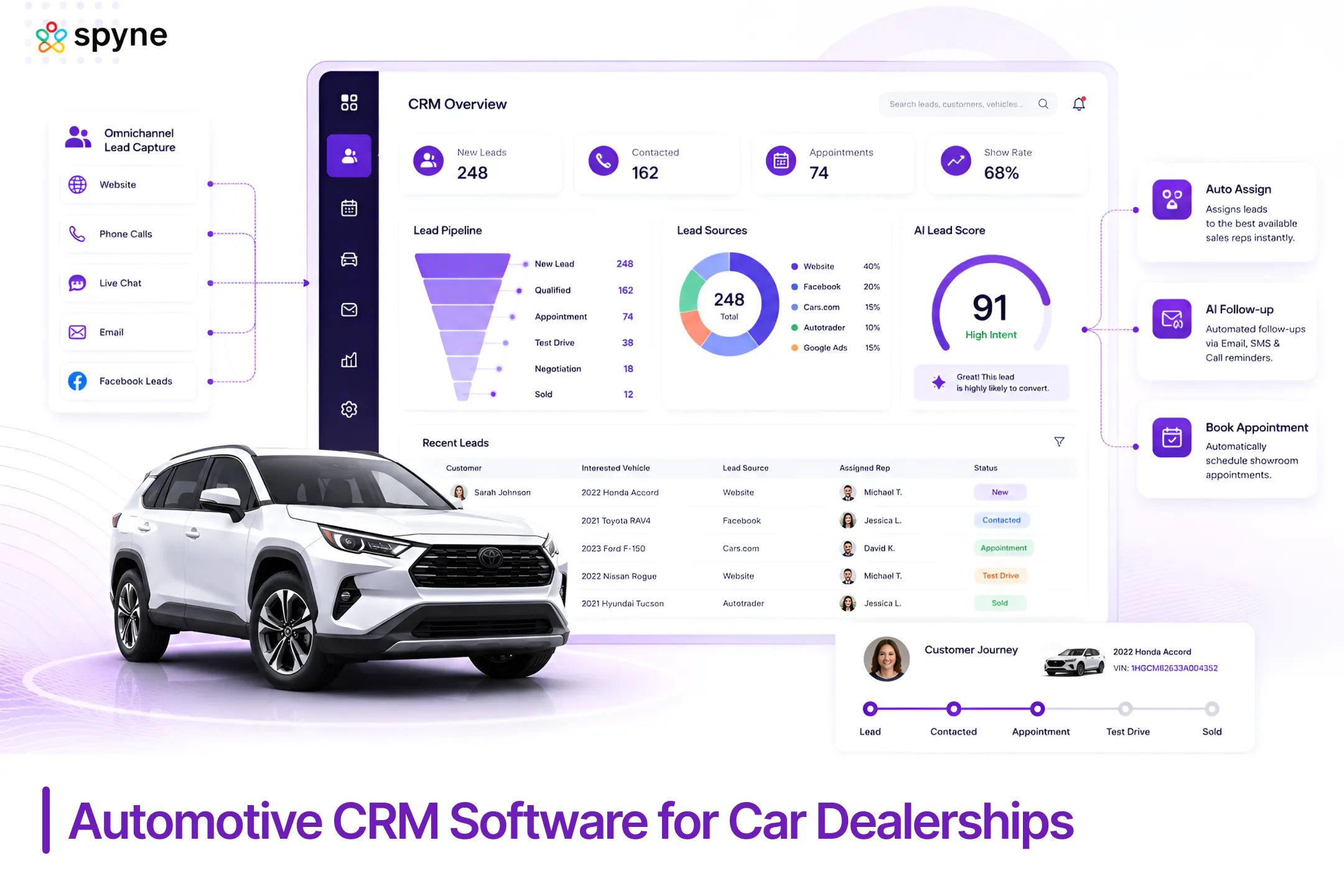
Spyne Automotive CRM addresses the gap dealerships hit most often: leads arriving from multiple sources need one consistent follow-up process without adding headcount. It fits into daily operations at the exact points where a lead becomes an appointment, a trade valuation gets logged, or a service customer turns into a sales opportunity. Rather than replacing a dealership’s existing DMS, it is built to slot into the sales process already in place.
1. Centralized lead capture and routing
Spyne’s dealership lead management software pulls leads from the website, OEM programs, and third-party marketplaces into a single queue and assigns them by rule, not by whoever checks the inbox first. A used-car manager running leads from three marketplaces sees all of them in one view.
2. Automated multi-touch follow-up
Together with BDC software for dealership capabilities, it sends the first response within minutes and continues a scheduled cadence of email, text, and call reminders until a rep engages the lead directly. Keeps a Friday-night lead warm through the weekend instead of going cold by Monday.
3. DMS-aware customer profiles
Our CRM pulls existing customer and vehicle history from the dealership’s DMS so reps see prior purchases, service visits, and open deals in one profile, without asking a repeat customer to repeat themselves.
4. Equity and trade-in alerts
It flags customers whose current vehicle value creates a trade-up opportunity, surfaced directly to the assigned rep. Turns a routine oil-change visit into a lead for a newer model with no added marketing spend.
5. Sales pipeline and reporting dashboard
Spyne’s automotive lead tracking software shows response time, lead source performance, and rep-level close rates in one live view, so a general manager spots a slow-responding rep without waiting for a month-end report.
6. Mobile access for sales teams
It gives reps full lead and customer visibility from a phone, on the lot or off-site, including trade appraisals logged without walking back to a desk.
7. Service-to-sales handoff
Spyne’s automotive CRM passes qualifying service visits to the sales team automatically when equity or lease-end triggers are met, so fixed ops and sales stop working from systems that don’t talk to each other.

Conclusion
Automotive CRM software for car dealerships only pays for itself if it fixes how leads actually move, not how a vendor’s demo says they should move. Start with the eight core capabilities above, match them to your DMS and rooftop count, and hold any platform to the best practices here before judging its results. With 16,990 franchised dealerships competing for the same buyers (NADA, 2025) and dealer response scores still averaging 71 out of 100 (Pied Piper PSI, 2026), the dealerships pulling ahead treat their CRM as a discipline, not a purchase. See how Spyne Automotive CRM handles lead routing, follow-up, and reporting against your own volume. Book a demo now!