
Executive SummaryBDC software for dealerships is the technology layer that routes inbound leads, automates follow-up, and books appointments before a competitor responds first. Most dealerships run their BDC inside a CRM layered with AI agents for after-hours and overflow coverage. Spyne’s 2026 U.S. Automotive Market Sentiment and Dealer Operations Report found 74% of dealership executives named AI voice agents their top investment priority for lead response and inbound call management (Spyne, 2026). This guide covers platform types, per-platform profiles, a six-criteria comparison table, and the BDC software tips that separate software that converts from software that collects dust. |
A buyer texts at 11 p.m. about a used F-150. By Monday morning, that lead has already gone to a competitor. That is the gap BDC software for dealerships is built to close. DAS Technology’s 2025 Automotive Lead Response Study found 19% of dealerships still take over an hour to respond to inbound leads, and 4% never respond at all (DAS Technology, 2025). With dealership sales consultant turnover running near 60% in 2024 (NADA, 2025), manual processes cannot hold the line. This guide covers platform types, a decision framework by dealership size, and the practices that determine whether BDC software actually converts leads or just tracks them.
What Is BDC Software for Dealerships?
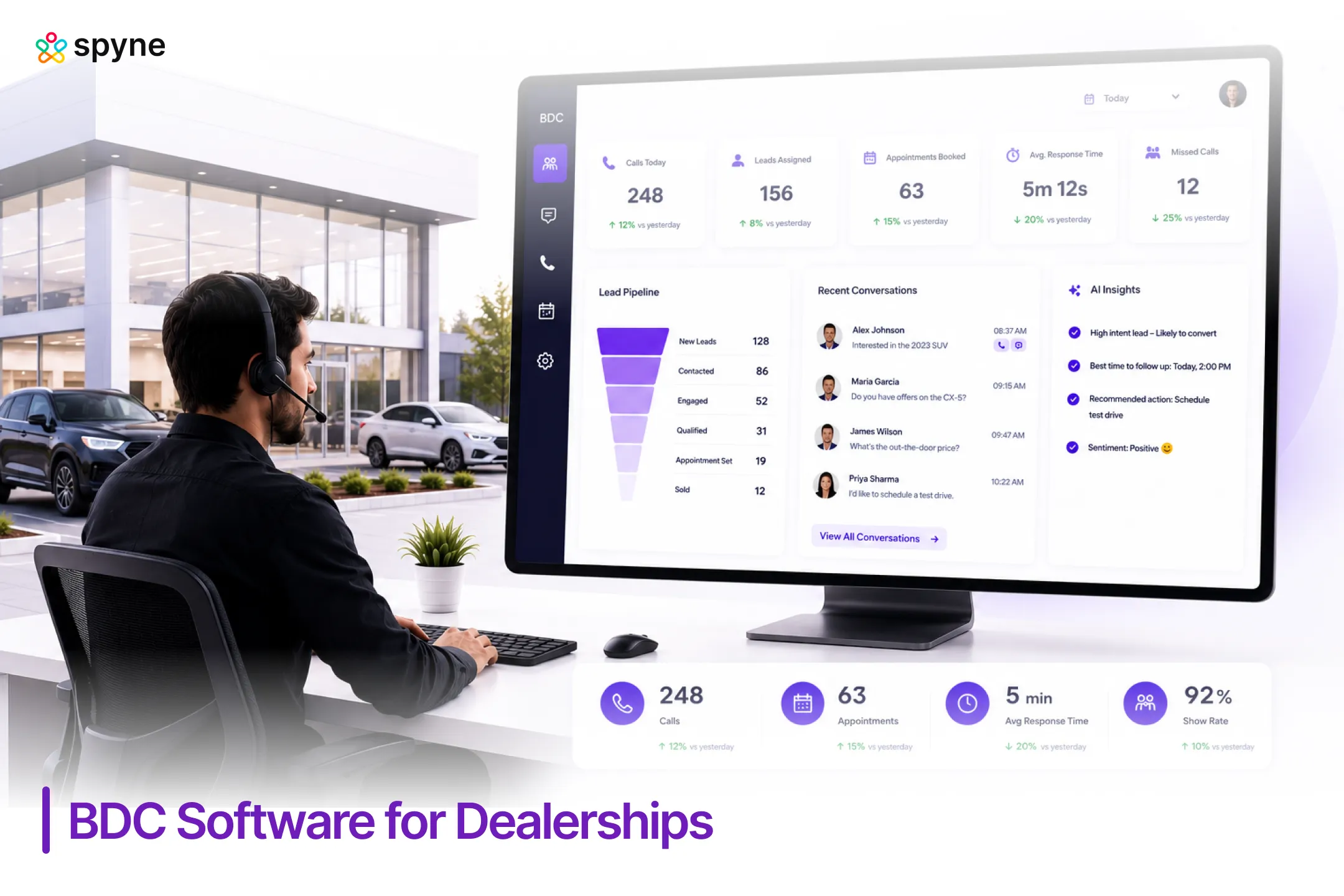
BDC software for dealerships is a category of tools, not a single product. It falls into three types: CRM platforms with built-in BDC workflows, dedicated communication tools that sit on top of an existing CRM, and AI-powered BDC agents that handle leads automatically.
Most dealerships run their BDC out of a core CRM where leads land, get assigned, and get tracked through to an appointment or a sale. Dedicated communication platforms add auto-dialers, call recording, and agent dashboards when outbound call volume outgrows the CRM alone. AI BDC agents handle first response across text, calls, and email within seconds, qualify the buyer, and log the outcome back to the CRM, especially during after-hours when no human is staffed.
Why BDC Software for Dealerships Matters More in 2026
BDC software for dealerships matters more in 2026 because two pressures are converging: staff turnover is eroding lead coverage and customer patience is shrinking.
Turnover is the bigger structural problem. NADA’s 2025 Dealership Workforce Study found total dealership employee turnover rose to 42% in 2024, with sales consultant turnover hitting nearly 60%, the sharpest single-year jump in recent years (NADA, 2025). Every rep who leaves takes active lead context. A replacement takes weeks to reach full productivity.
Customers are leaving over communication, not price. Cox Automotive’s 2025 research found dealerships are handling 12% fewer service visits than in 2018, with only 54% of owners returning to the selling dealership for service, down from 72% in 2023, tied largely to poor communication rather than cost (Cox Automotive, 2025).
Software alone cannot fix a turnover problem. But the right platform limits how much damage it does to lead follow-up while a team rebuilds.

What BDC Software Do Car Dealerships Use?
Car dealerships do not use a single standalone BDC platform. They run BDC software for dealerships out of an, layered with communication tools and, increasingly, AI agents for first response.
The stack has three layers. The first is the core CRM, where internet leads land, customer histories are logged, and daily follow-up tasks are assigned. VinSolutions, DealerSocket, Elead, and Spyne Automotive CRM are the most commonly deployed options across franchise and independent stores. The second layer adds dedicated BDC communication tools with auto-dialing, call recording, and agent performance dashboards. The third is AI BDC software, the fastest-growing category, which handles inbound leads and calls in real time, qualifies buyers, and books appointments without human input.
CDK Global’s January 2026 “AI at the Dealership” study found nearly 40% of U.S. dealerships are actively using AI, with 77% of those already integrating AI tools directly into their existing systems (CDK Global, 2026). For most dealerships, BDC software for dealerships is already an AI-assisted workflow, not a purely human one.
Dealership BDC Software Comparison: Spyne vs. VinSolutions vs. DealerSocket vs. Elead vs. AutoRaptor
A useful dealership BDC software comparison evaluates every platform on the same criteria, not whichever feature a vendor leads with in a demo. Spyne’s 2026 research found 49% of U.S. dealerships are prioritizing CRM modernization as a top investment area this year (Spyne, 2026), which is exactly the workflow layer the table below evaluates across six criteria: lead routing, follow-up automation, AI-assisted response, DMS/OEM integration, reporting depth, and ideal dealership fit.
| Platform | Best Fit | Lead Routing | Follow-Up Automation | AI-Assisted Response | DMS/OEM Integration | Reporting Depth | Notable Limitation |
| Spyne’s Automotive CRM | Independent dealers to multi-rooftop groups | Automated, rule-based routing by source and rep availability | Built-in email and SMS sequences | Native via Vini AI: first response across chat, text, and call | Syncs with major DMS platforms and OEM lead sources | Outcome-based: show rate, close rate | Newer entrant; some franchise groups still evaluating alongside legacy CRMs |
| VinSolutions CRM | Franchise dealers in the Cox ecosystem | Highly configurable routing rules | Mature, well-established automation | GenAI add-ons available; not native to base CRM | Deepest within Cox-affiliated systems | Enterprise-grade reporting | Heavy configuration for smaller stores |
| DealerSocket CRM | Groups wanting CRM, desking, and inventory together | Routing tied to desking workflows | Standard automation, less BDC-specific | Limited native AI; relies on third-party add-ons | Strong desking and inventory integration | General reporting; shallower BDC granularity | BDC-specific reporting weaker than dedicated tools |
| Elead CRM | Large franchise groups on the CDK ecosystem | Process-heavy routing built for accountability | Strong, OEM-compliant workflows | Limited native AI; CDK add-ons required | Deepest within the CDK ecosystem | Strong for OEM compliance | Heavier platform, longer training cycle |
| AutoRaptor | Independent and used-car dealers on tighter budgets | Basic routing for lower lead volumes | Core email/SMS; fewer advanced sequences | Minimal to none | Lighter integration footprint | Functional but basic | Fewer AI or automation features |
Platform Profiles: What Each Option Actually Delivers
The comparison table gives the cross-platform view. The profiles below give per-platform depth so a dealership can match a specific tool to its team size, existing stack, and BDC workflow before committing to a demo.
1. Spyne Automotive CRM
- Best for: Independent dealers to multi-rooftop franchise groups that want BDC workflows and CRM in a single system
- BDC strength: Native Vini AI handles after-hours first response across chat, text, and call without a third-party integration; lead routing, follow-up sequences, and outcome-based reporting run inside one platform
- Top differentiator: No separate AI login or integration required; CRM and AI-assisted BDC coverage are built into the same workflow
- Limitation: Newer to market than legacy CRMs; some franchise groups are still evaluating it alongside established platforms
- Pricing: Customized
2. VinSolutions CRM
- Best for: Franchise dealerships operating inside the Cox Automotive ecosystem that need deep OEM integration and enterprise analytics
- BDC strength: Industry-standard BDC process tracking and accountability tooling; GenAI-assisted communication add-ons and predictive lead scoring available through the Cox platform
- Top differentiator: Deepest native integration with Cox DMS platforms, OEM lead sources, and third-party data providers
- Limitation: Configuration overhead makes it a heavier lift for smaller, single-rooftop stores
- Pricing: Connect with Sales Team
3. DealerSocket CRM
- Best for: Dealer groups that want a single platform spanning CRM, desking, inventory management, and BDC operations
- BDC strength: Lead routing tied directly to desking and inventory visibility; BDC agents can check real-time vehicle availability and rough payment estimates during a live call without switching systems
- Top differentiator: End-to-end visibility from the first BDC contact through desking, F&I, and delivery in one platform
- Limitation: BDC-specific reporting is shallower than platforms built exclusively for BDC performance tracking
- Pricing: Connect with Sales Team
4. Elead CRM
- Best for: Large franchise dealer groups already running on the CDK ecosystem that need OEM-compliant workflows and built-in telephony
- BDC strength: Deep CDK DMS integration; built-in telephony tools and process workflows that enforce BDC follow-up accountability and OEM lead compliance standards
- Top differentiator: Best-in-class for OEM compliance reporting and CDK ecosystem alignment across large franchise groups
- Limitation: Heavier platform with a longer training and implementation cycle; less suited to independent dealers
- Pricing: Connect with Sales Team
5. AutoRaptor
- Best for: Independent and used-car dealers managing lower lead volumes who need a straightforward, budget-friendly CRM with BDC follow-up built in
- BDC strength: Core lead management, email, and SMS follow-up at an accessible monthly cost; faster to set up than enterprise platforms with lighter DMS requirements
- Top differentiator: Lowest implementation complexity among the five platforms compared; good entry point for stores not yet ready for enterprise tooling
- Limitation: Minimal AI or advanced automation features; not suited for high-volume, multi-rooftop, or franchise operations
- Pricing: Connect with Sales Team
For a wider vendor field, including dedicated BDC platforms and standalone AI tools, Spyne’s roundup of automotive BDC companies and software covers more ground than this comparison alone.
How to Choose BDC Software for Dealerships: A Decision Framework by Size
Effective BDC software strategies start with matching the platform and the vendor to your dealership’s size and call volume, not the other way around.
- Single-store independents: prioritize affordability and a CRM with BDC workflows built in. AutoRaptor and Spyne Automotive CRM system fit this profile without requiring an enterprise rollout.
- Small franchise groups (1 to 3 rooftops): prioritize OEM ecosystem compatibility. VinSolutions fits Cox Automotive stores; Elead fits CDK stores. Spyne Automotive CRM is the DMS-agnostic option worth evaluating if you are not locked into either.
- Mid-size groups (4 to 10 rooftops): prioritize standardized reporting across locations. DealerSocket and VinSolutions are common at this tier, with Spyne Automotive CRM increasingly layered on top for AI-assisted after-hours coverage.
- Enterprise groups (10+ rooftops): the CRM is usually already set by OEM agreement. The real BDC software strategies decision shifts to what you layer on top. Spyne’s 2026 research found dealerships in its “fast follower” cohort, those who deployed AI in specific functions, reported 10% to 20% performance gains in those areas (Spyne, 2026).
These BDC software strategies require one named owner, typically a BDC manager, accountable for adoption. Software without that owner tends to be abandoned within a quarter.
Best BDC Software for Managing Inbound Dealership Leads
The best BDC software for managing inbound dealership leads responds within five minutes, routes correctly on the first attempt, and logs every outcome automatically. For most dealerships, that means a CRM-based platform paired with AI for after-hours and overflow coverage.
When evaluating specifically for inbound automotive lead management, the BDC software tips below identify the features that move the needle:
- Lead routing and assignment tied to rep availability and lead source
- Automated SMS and email follow-up with a defined cadence
- Click-to-call with automatic call recording against the lead record
- Appointment scheduling synced to a live, real-time calendar
- AI-assisted first response for nights, weekends, and peak overflow
- Reporting built around show rate and close rate, not raw call counts
- Native DMS and OEM lead source integration
These automotive BDC software best practices apply regardless of platform. DAS Technology’s 2025 Lead Response Study found that even with tools in place, 89% of dealership responses still fail to include alternative vehicle options (DAS Technology, 2025). Follow-up discipline matters as much as which BDC software for dealerships a store selects.
Common Mistakes Dealerships Make When Buying BDC Software
The most common mistake dealerships make with BDC software for dealerships is buying on a feature list rather than an actual lead audit.
- Choosing before auditing: Skipping a call and lead volume review before purchase leads to over-buying enterprise software or under-buying a tool that cannot scale.
- Assuming AI replaces the BDC team: AI agents lower workload; they do not remove the need for a BDC manager. Cox Automotive’s 2025 research found 83% of dealers report customers having to repeat information in-store because data is inconsistent across systems (Cox Automotive, 2025). AI only closes that gap when humans manage the handoff correctly.
- Ignoring reporting setup at launch: Without a baseline captured at go-live, leadership has no number to measure ROI against six months later.
Spyne Automotive CRM: AI BDC Software for Car Dealerships
Spyne Automotive CRM is built for dealerships that want BDC workflows and customer relationship management running inside a single system, not stitched together across separate logins. It functions as the CRM itself, with BDC-specific lead routing, automated follow-up sequences, and outcome-based reporting built in from the start. Dealerships that have historically split lead response across a CRM, a communication tool, and manual follow-up use Spyne Automotive CRM to consolidate that into one accountable workflow.
1. Centralized lead routing
Inbound leads from the dealership website, OEM sources, and third-party listings are assigned automatically based on rep availability and lead source rules. A Saturday afternoon spike does not sit in a shared inbox waiting for Monday morning.
2. Automated follow-up sequences
Email and SMS touchpoints fire on a set cadence so no lead goes more than a day without contact. A buyer submitting a Friday night inquiry gets a confirmation text within minutes and a personalized follow-up by Saturday morning.
3. Conversational AI for first response (Vini AI)
Vini AI handles first reply across chat, text, and inbound calls after hours, qualifies buyer intent, and hands the conversation to a human rep with full context when needed. An after-hours trade-in inquiry gets answered immediately instead of going cold until Monday.
4. DMS and scheduler sync
Appointment data, inventory, and customer records stay aligned across systems so reps never quote a vehicle that sold two days earlier. Every booking writes back automatically.
5. Outcome-based reporting
Dashboards track appointment show rate, first-response time, and close rate rather than raw call counts. A general manager can see which lead source is actually converting, not just which rep was most active.
6. Click-to-call and automatic call logging
Every call logs against the lead record automatically, so shift handoffs do not lose context. A manager auditing a missed deal can see exactly when and how many times the lead was contacted.

Conclusion
AI BDC software for car dealerships only earns its cost if it matches how leads actually move at your store. Run the dealership BDC software comparison above, apply the decision framework to your rooftop count, and put the right automotive BDC software best practices in place before judging any platform on results.
The data makes the stakes plain: 60% sales consultant turnover, 4% of dealerships never responding to leads at all, and 83% of customers forced to repeat information they already shared (NADA, 2025; DAS Technology, 2025; Cox Automotive, 2025). BDC software for dealerships closes these gaps faster than any staffing fix alone.
Book a demo with Spyne to see how Spyne Automotive CRM handles routing, follow-up, and AI-assisted first response against your own lead volume.